Have you ever typed of course or ofcourse and stopped to wonder which one is correct? You are not alone. This is a very common spelling question because the two versions look almost identical. The small space between the words can be easy to miss, especially when typing quickly. ✍️
The correct form is of course. It is always written as two separate words in standard English. Ofcourse is not the standard spelling and should be avoided in formal and informal writing.
I often see this mistake in emails, messages, school assignments, and social media posts. The good news is that the rule is simple. Once you understand how the phrase works, you will rarely make this mistake again.
In this guide, I will explain the difference, show you real examples, cover common mistakes, and give you easy ways to remember the correct form. 😊 Foolproof or Fullproof | Leotard vs Tights | Fair vs Good
Quick Answer: Of Course or Ofcourse? ⚡
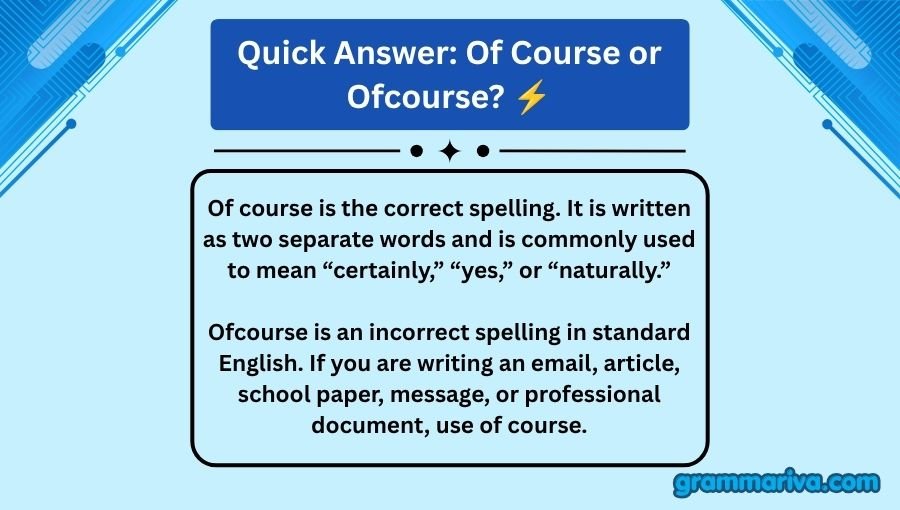
Of course is the correct spelling. It is written as two separate words and is commonly used to mean “certainly,” “yes,” or “naturally.”
Ofcourse is an incorrect spelling in standard English. If you are writing an email, article, school paper, message, or professional document, use of course.
| Form | Correct? | Example |
|---|---|---|
| of course | ✅ Yes | Of course, I can help you. |
| ofcourse | ❌ No | Ofcourse, I can help you. |
The simplest rule is this: Always write “of course” as two words.
Is Of Course the Same as Ofcourse? 🔎
No. Of course is the standard English expression, while ofcourse is a misspelling. The meaning people intend is usually clear, but the spelling still matters.
The phrase contains two separate words:
- of is a preposition.
- course is a noun.
Together, they form the familiar expression of course.
The space is not optional. Removing it creates a nonstandard form.
Correct and Incorrect Examples
✅ Of course, I remember your name.
❌ Ofcourse, I remember your name.
The first sentence follows standard English spelling. The second joins two words that should remain separate.
| Sentence | Status | Explanation |
|---|---|---|
| Of course, you can come with us. | ✅ Correct | The phrase has two words. |
| Ofcourse, you can come with us. | ❌ Incorrect | The words are incorrectly joined. |
| She will, of course, be there. | ✅ Correct | The phrase is correctly separated. |
| She will, ofcourse, be there. | ❌ Incorrect | “Ofcourse” is not standard spelling. |
Of Course: Meaning and Correct Use 📝
Of course has several common uses, but they all keep the same two-word spelling. It can show agreement, certainty, natural expectation, or polite confirmation.
I use this phrase often when explaining English because it is short and flexible. The key is to focus on its meaning rather than treating it like one long word.
1. Showing Agreement
You can use of course to say yes or show that you agree.
Example:
“Can I borrow your notes?”
“Of course!”
Here, the phrase means yes or certainly.
2. Showing Certainty
The phrase can also show that something is clearly true.
Example:
Of course, exercise can be good for your health.
The speaker treats the statement as something naturally understood.
3. Showing That Something Is Expected
Sometimes of course means that something should not be surprising.
Example:
She was nervous before the exam, of course.
The speaker believes her nervousness was understandable or expected.
4. Adding Emphasis
You can use the phrase to make a statement stronger.
Example:
Of course I want to join you.
Here, the phrase adds emphasis to the speaker’s answer.
Meaning Summary
| Meaning | Word Type | Example Sentence |
|---|---|---|
| Certainly | Fixed phrase | Of course, I will help. |
| Naturally | Fixed phrase | Of course, the baby was tired. |
| Agreement | Fixed phrase | “Can you help?” “Of course.” |
| Emphasis | Fixed phrase | Of course I remember. |
💡 Test Tip
If you can replace the phrase with certainly, sure, or naturally, you probably mean of course.
Try this:
Of course, I can help.
Replace it:
Certainly, I can help.
The meaning stays close. The spelling stays of course.
Why Do People Confuse Of Course and Ofcourse? 🤔
People confuse these forms mainly because of course is pronounced as a natural phrase, so it can feel like one unit. Fast typing also makes the space easy to miss.
I once reviewed a short email from a student who had written “ofcourse” several times. The student knew exactly what the phrase meant. The problem was simply that they had learned to type it as one word.
Other factors can make the error more common:
- Fast typing
- Autocorrect
- Phone keyboards
- Informal texting habits
- Seeing incorrect spelling online
- Assuming familiar phrases are single words
- Lack of spelling practice
Fast Typing
When people type quickly, spaces can disappear. This happens with many word combinations.
Autocorrect
Phone keyboards do not always catch every spelling mistake. Some typing systems may leave ofcourse unchanged.
Online Habits
Social media and casual messages often contain spelling shortcuts. Seeing a form repeatedly can make it look normal.
Lack of Knowledge
Some learners simply have not been told that the phrase contains two words.
The good news is that this is an easy error to fix.
Of Course vs Ofcourse at a Glance 📊
The main difference is simple: of course has a space, while ofcourse does not. Only the two-word version is standard English.
| Form | Type | Meaning | Example | Correct/Incorrect |
|---|---|---|---|---|
| of course | Fixed phrase | Certainly | Of course, I agree. | ✅ Correct |
| ofcourse | Misspelling | Intended to mean “certainly” | Ofcourse, I agree. | ❌ Incorrect |
| OF COURSE | Capitalized phrase | Certainly | OF COURSE I remember! | ✅ Correct |
| Of Course | Title-style capitalization | Certainly | Of Course: A Grammar Guide | ✅ Correct when used as a title |
| of-course | Hyphenated form | Usually unnecessary | Of-course, I agree. | ❌ Incorrect in normal use |
The important point is that capitalization can change depending on position or style, but the space between “of” and “course” remains.
What Are the Grammar Rules for Of Course? 📚
The phrase of course is written as two separate words because it is a combination of separate words functioning together as an expression.
There is no standard rule that turns it into the single word ofcourse.
You can use of course in several positions in a sentence.
At the Beginning
Of course, I understand your point.
The phrase introduces the speaker’s response.
In the Middle
We can, of course, discuss the issue later.
Here, commas separate the phrase because it works as an aside.
At the End
I will help you, of course.
The phrase adds emphasis after the main statement.
As a Short Reply
“Will you be there?”
“Of course.”
This is common in conversation.
Correct vs Incorrect at a Glance ✅
Seeing the phrase in complete sentences makes the rule easier to remember.
| Sentence | Correct/Incorrect | Why |
|---|---|---|
| Of course, I would love to help. | ✅ Correct | “Of course” is two words. |
| Ofcourse, I would love to help. | ❌ Incorrect | The words are joined. |
| You can, of course, call me later. | ✅ Correct | The phrase is correctly separated. |
| You can, ofcourse, call me later. | ❌ Incorrect | The spelling is nonstandard. |
| Of course she knows the answer. | ✅ Correct | The expression is correctly written. |
A Simple Rule
Remember:
OF + SPACE + COURSE = CORRECT
Do not remove the space.
Case Study: Of Course in a Workplace Email 💼
Imagine that a manager asks an employee whether they can send a report before Friday.
The employee might write:
Of course, I can send the report by Thursday afternoon.
That sounds natural and professional.
Now imagine this version:
Ofcourse, I can send the report by Thursday afternoon.
The meaning is still understandable, but the spelling mistake makes the email look less polished.
I once caught myself typing a similar joined-word error while editing a document late in the evening. I noticed it during the final proofread. It reminded me why even familiar phrases deserve a quick spelling check.
Workplace Example
| Situation | Recommended Wording |
|---|---|
| Accepting a request | Of course, I can handle that. |
| Confirming help | Of course, I will send it today. |
| Showing agreement | Of course, that works for me. |
| Responding politely | Of course. I would be happy to help. |
In professional writing, the correct spelling takes only one extra space, but it makes the sentence look much cleaner.
How To Use Of Course in Different Contexts ✨
Of course works in everyday speech, professional writing, creative writing, and digital communication. The spelling does not change between these settings.
Everyday Conversation
“Can you pick me up?”
“Of course!”
This is friendly and natural.
Professional Writing
Of course, we can review the proposal tomorrow.
This is polite and clear.
Creative Writing
Of course, she knew something was wrong.
It can help show a character’s thoughts or attitude.
Social Media and Texting
Of course I took pictures! 📸
The setting may be casual, but the standard spelling is still of course.
| Context | Which Term to Use | Example |
|---|---|---|
| Everyday conversation | of course | Of course I’ll come. |
| Professional writing | of course | Of course, we can discuss it. |
| Creative writing | of course | Of course, he knew the truth. |
| Social media/texting | of course | Of course I had to post it! |
Common Phrases With Of Course 💬
Of course appears in many common sentences and expressions. The phrase remains two words in each case.
| Phrase | Meaning |
|---|---|
| Of course! | Certainly or yes |
| Of course not! | A strong negative response |
| Of course I will. | A confident agreement |
| Of course you can. | Permission or reassurance |
| But of course. | Strong agreement, sometimes playful |
| As of course expected | Something viewed as natural or expected |
Some combinations sound more natural than others. The most common everyday uses are short responses such as Of course!, Of course not!, and Of course you can.
Examples
✅ “Can I sit here?” “Of course!”
❌ “Can I sit here?” “Ofcourse!”
The meaning is the same, but only the first spelling is standard.
How Is Of Course Used in Professional Writing? 💼
In professional writing, of course is correct and useful, but writers should consider tone.
The phrase can sound warm and polite:
Of course, I would be happy to review the document.
It can also add emphasis:
We must, of course, follow the company’s policy.
However, overusing the phrase may make writing sound repetitive. I recommend using it when it adds a clear meaning, not simply because it sounds polite.
Professional Examples
| Purpose | Example |
|---|---|
| Agreeing | Of course, I agree with your suggestion. |
| Offering help | Of course, I can review the file. |
| Confirming | Of course, the meeting is still scheduled. |
| Reassuring | Of course, your information will be handled carefully. |
Of Course in Conversation and Tone 🗣️
The meaning of of course can change slightly based on tone and context.
A friendly speaker might say:
Of course!
This usually means a warm yes.
A frustrated speaker might say:
Of course you forgot.
Here, the phrase may sound sarcastic or critical.
The spelling does not change. The surrounding words and voice create the difference in tone.
| Sentence | Likely Tone |
|---|---|
| Of course! I’d love to help. | Friendly |
| Of course you can come. | Reassuring |
| Of course he did that. | Possibly sarcastic |
| Of course we remember you. | Warm or reassuring |
This is why grammar and context work together.
Common Mistakes With Of Course ⚠️
The biggest mistake is joining the two words.
People may write:
- ofcourse
- of-course
- off course
- offcourse
These forms are not interchangeable.
Similar Grammar Confusions
The problem is not unique to this phrase. English contains many word pairs that are easy to confuse.
| Confusion | Correct Form | Meaning |
|---|---|---|
| its / it’s | depends on meaning | Possession / it is |
| your / you’re | depends on meaning | Possession / you are |
| their / they’re | depends on meaning | Possession / they are |
| then / than | depends on meaning | Time / comparison |
| to / too | depends on meaning | Direction / also or excessive |
| of course / ofcourse | of course | Certainly |
These mistakes often happen because the forms sound familiar or are typed quickly.
Specific Wrong Forms
| Wrong Form | What’s Wrong | Correct Form |
|---|---|---|
| ofcourse | Missing space | of course |
| Ofcourse | Missing space | Of course |
| OFCOURSE | Words incorrectly joined | OF COURSE |
| of-course | Unnecessary hyphen | of course |
| offcourse | Incorrect spelling | of course |
| off course | Different phrase with a different meaning | of course, when meaning “certainly” |
⚠️ Watch Out for “Off Course”
Off course is not simply another spelling of of course.
It can have a literal meaning.
For example:
The boat went off course.
Here, off course means that something moved away from its planned path.
Compare:
✅ Of course, I know the answer.
❌ Off course, I know the answer.
The second sentence changes the phrase completely.
Why Fast Typing Causes This Mistake ⌨️
Fast typing is one of the easiest ways to create spelling errors.
When people type quickly, their brain often focuses on the meaning rather than each individual word. A familiar phrase can then become one typing unit.
This is especially common on phones.
Other Causes
- Small keyboards
- Autocorrect
- Voice-to-text errors
- Casual texting
- Copying incorrect online spelling
- Writing without proofreading
The solution is simple: slow down for a second when you are unsure.
A one-second check can prevent an obvious spelling mistake.
How To Remember the Correct Spelling 🧠
The best memory trick is to think of of course as a tiny phrase made from two normal words. When you remember the simple space rule, of course or ofcourse becomes an easy spelling choice instead of a confusing one.
Trick 1: Count the Words
Ask:
How many words are in the phrase?
Answer: two.
of + course = of course
Trick 2: Replace It
Replace the phrase with certainly.
Of course, I will help.
Certainly, I will help.
If the meaning fits, remember the two-word form.
Trick 3: Picture the Space
Imagine the phrase like this:
OF | COURSE
That visual gap can help your brain remember the spelling.
| Memory Method | Reminder |
|---|---|
| Word count | Two words |
| Meaning test | Often means “certainly” |
| Visual test | OF |
| Writing test | Keep the space |
| Proofreading test | Search for “ofcourse” |
Can Of Course Be Written as One Word? ❌
No. In standard English, of course should not be written as one word when it means “certainly,” “naturally,” or “yes.”
The form ofcourse may appear online because of typing mistakes, informal posts, or user-generated content. Its appearance does not make it a standard spelling.
For school, work, publishing, websites, and careful communication, always use of course.
| Version | Standard English? |
|---|---|
| of course | ✅ Yes |
| Of course | ✅ Yes |
| OF COURSE | ✅ Yes |
| ofcourse | ❌ No |
| of-course | ❌ Normally no |
| offcourse | ❌ No |
Synonyms and Alternatives to Of Course 🔄
Sometimes you can replace of course with another word or phrase. The best choice depends on the sentence and tone.
| Alternative | Works When | Does Not Work When |
|---|---|---|
| Certainly | You want a formal “yes” | The phrase needs a casual tone |
| Sure | You want a casual agreement | Very formal writing is required |
| Naturally | Something is expected | You simply want to grant permission |
| Absolutely | You want strong agreement | The sentence needs a neutral tone |
| Definitely | You want strong certainty | The phrase is being used as a polite reply |
Examples
Of course, I can help.
Possible alternative:
Certainly, I can help.
Both work, but certainly sounds more formal.
Another example:
“Can I come with you?”
Of course!
You could say:
Sure!
Both are natural, but the tone is slightly different.
Why Getting Of Course Right Matters 🎯
A single space may seem small, but spelling accuracy affects how readers view your writing.
Clarity
Correct spelling helps readers understand your words without distraction.
Professionalism
A properly written email looks more polished.
Digital Communication
Messages, comments, websites, and posts are still writing. Good spelling helps your content look trustworthy.
Published Content
Articles and educational material need consistent spelling. Small mistakes can distract readers.
Good writing is often built from small choices made correctly.
| Situation | Why Getting It Right Matters |
|---|---|
| Resume | Shows attention to detail |
| Client email | Creates a polished impression |
| Published content | Supports professional writing |
| Social post | Keeps the message clean and readable |
Does Punctuation Change With Of Course? ✍️
Sometimes punctuation changes based on where of course appears in a sentence.
When the phrase begins a sentence as an introductory expression, a comma is often used.
Of course, I will help you.
When it appears in the middle as an aside, commas may surround it.
I will, of course, help you.
When it appears naturally at the end, a comma may come before it depending on the sentence structure.
I will help you, of course.
However, punctuation and spelling are separate issues. The space between of and course remains regardless of punctuation.
| Position | Example |
|---|---|
| Beginning | Of course, I understand. |
| Middle | I will, of course, help. |
| End | I understand, of course. |
| Short reply | Of course. |
Is Of Course Formal or Informal? 🏢
Of course can be used in both formal and informal English. Its tone depends on the sentence and context.
It is perfectly normal in conversation:
Of course! Come on in.
It can also work in a business email:
Of course, I can provide the information.
In some situations, of course may sound too strong or obvious. If you are writing a very formal message, words such as certainly may sometimes fit better.
The phrase itself is not incorrect or unprofessional.
How Of Course Works in Questions and Answers ❓
One common use of of course is as a direct response.
Consider this question:
Can you help me?
A natural answer is:
Of course.
It can also appear in a longer response:
Of course, I can help you with that.
Or:
Of course I remember.
| Question | Natural Answer |
|---|---|
| Can I join you? | Of course. |
| Will you help me? | Of course I will. |
| Do you remember her? | Of course I do. |
| Can we talk later? | Of course. |
This makes the phrase especially common in spoken English.
How To Check Your Sentence Before Publishing 🔍
If you are unsure whether you have written of course correctly, use this quick process. A quick review can help you decide between of course or ofcourse before you publish or send your writing.
Step 1: Look at the Space
Check whether you wrote:
of course
or:
ofcourse
The first one is correct.
Step 2: Check the Meaning
Ask whether you mean:
- certainly
- naturally
- yes
- definitely
If so, of course is likely the phrase you need.
Step 3: Check for “Off”
Make sure you did not accidentally type off course.
That phrase has a different meaning.
Step 4: Read the Sentence Aloud
Reading aloud can help you catch awkward wording and punctuation.
| Check | Correct Result |
|---|---|
| Space between words | Yes |
| Meaning is “certainly” | Yes |
| “Of” spelled correctly | Yes |
| “Course” spelled correctly | Yes |
| No unnecessary hyphen | Yes |
Quick Recap Checklist ✅
Use this checklist whenever you are unsure about the spelling.
| Question | If Yes → Use |
|---|---|
| Do you mean “certainly”? | of course |
| Are you agreeing with someone? | of course |
| Are you giving permission? | of course |
| Are you saying something is natural or expected? | of course |
| Are you writing the standard phrase? | of course |
| Are you tempted to write it as one word? | Keep the space |
Practice Examples
- Of course, you can use my computer. ✅
- I will, of course, send the file tonight. ✅
- Of course she knows what happened. ✅
Try to spot the rule in every example: of and course stay separate.
FAQs About Of Course vs Ofcourse ❓
Is “of course” one word or two?
Of course is two words. The words must be separated by a space. Ofcourse is not the standard spelling.
Is “ofcourse” ever correct?
No, not as the standard English expression meaning “certainly” or “naturally.” Use of course instead.
Why is “of course” written as two words?
It is made from the separate words of and course, which work together as a common expression. Standard English keeps them separate.
What does “of course” mean?
It can mean certainly, naturally, or yes. The exact meaning depends on the context.
Can I use “of course” in formal writing?
Yes. Of course is acceptable in formal writing, although the best choice depends on tone and context.
Is “off course” the same as “of course”?
No. Off course usually means away from the planned or correct path. Of course commonly means certainly or naturally.
Should I put a comma after “of course”?
Often, yes, when it begins a sentence as an introductory expression.
Of course, I understand.
When it appears in the middle or at the end, punctuation depends on how the phrase functions in the sentence.
Can “of course” be used as a complete answer?
Yes. It can be a complete short reply.
“Can I come with you?”
“Of course.”
Is “of course!” correct with an exclamation mark?
Yes. An exclamation mark can show strong emotion or enthusiasm.
Of course!
The punctuation does not change the spelling.
How can I remember “of course” correctly?
Remember that it contains two words. Think of it as:
OF + COURSE = OF COURSE
Never join the two words together.
Final Thoughts on Of Course or Ofcourse 🌟
Of course or ofcourse is an easy spelling question once you remember one simple rule: of course is always written as two words when you mean “certainly,” “naturally,” or “yes.”
The incorrect form ofcourse often appears because people type quickly or treat the familiar phrase like one word. That does not make it standard English. The same applies to forms such as of-course when there is no reason for a hyphen.
I recommend using the simple space test every time. Look at the phrase and ask, “Did I write two words?” If the answer is yes, you are on the right track.
Correct spelling may seem like a tiny detail, but tiny details can make your writing clearer and more professional. Whether you are writing a school assignment, business email, blog post, text message, or social media caption, the safe choice is always of course. ✨
Remember the space, and you will never have to second-guess this phrase again.

Hi, I’m Olivia Carter. I’m an English language editor at Grammariva, and I work on making grammar lessons clear, accurate, and easy to follow. I especially enjoy writing about common grammar mistakes and everyday English.
[…] show real examples, cover common mistakes, and give you quick tests you can use when writing. Of Course or Ofcourse | Foolproof or Fullproof | Leotard vs […]
[…] common mistakes. By the end, choosing the right form should feel easy. ✨ Patron vs Benefactor | Of Course or Ofcourse | Foolproof or […]