Have you ever written foolproof or fullproof and stopped to wonder which spelling is correct? You are not alone. This is a common spelling mix-up because both forms look reasonable at first glance. The word sounds like it could be connected to being “full” of protection, but that is not how the standard word is spelled. ✍️
The correct form is foolproof. It is one word, and it describes something designed to be very easy to use or very unlikely to fail because of mistakes. Fullproof is not the standard spelling of this word.
I often see this mistake in emails, school assignments, product descriptions, and online posts. The good news is that the fix is simple. Once you understand why foolproof is correct, you will have an easy way to remember it. 😊 Leotard vs Tights | Fair vs Good | Moose vs Mousse
🎯 Quick Answer: Foolproof or Fullproof?
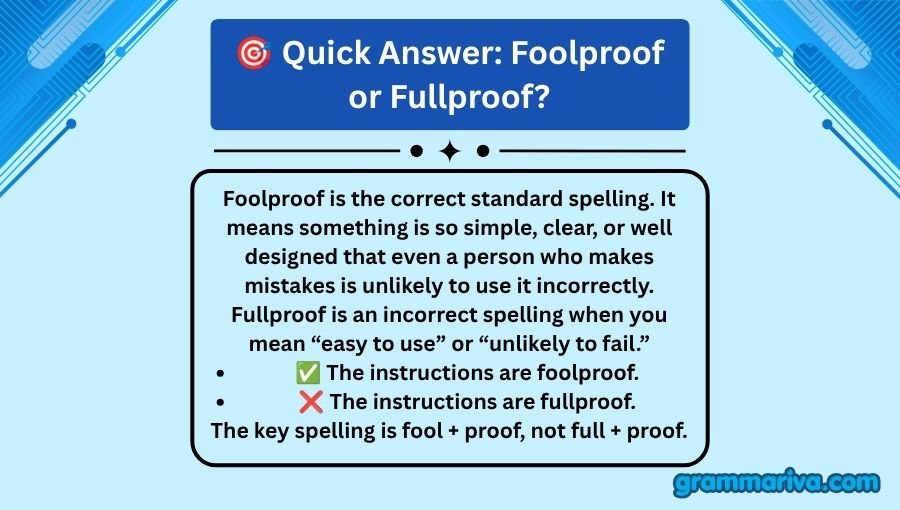
Foolproof is the correct standard spelling. It means something is so simple, clear, or well designed that even a person who makes mistakes is unlikely to use it incorrectly.
Fullproof is an incorrect spelling when you mean “easy to use” or “unlikely to fail.”
- ✅ The instructions are foolproof.
- ❌ The instructions are fullproof.
The key spelling is fool + proof, not full + proof.
📚 What Does Foolproof Mean?
Foolproof is an adjective that describes something designed to prevent mistakes or make errors very difficult.
For example:
The new system is foolproof.
This means the system is very easy to operate and has been designed so that users are unlikely to make a serious mistake.
The word can describe instructions, plans, systems, methods, machines, recipes, designs, and many other things.
Examples of the Meaning
- A foolproof recipe is very easy to follow.
- A foolproof plan is designed to avoid common problems.
- A foolproof system is simple and resistant to user errors.
- A foolproof method is easy to carry out correctly.
The word does not mean that something can never fail. It usually means that it is designed to make mistakes or failure less likely.
🔎 Is Foolproof the Same as Fullproof?
No. Foolproof is the standard word. Fullproof is generally a spelling mistake when someone intends to use the word foolproof.
The confusion comes from the familiar word full. Since “full” is a common English word, writers may naturally type fullproof. However, the standard expression uses fool, not full.
Foolproof vs Fullproof at a Glance
| Form | Type | Meaning | Example | Correct/Incorrect |
|---|---|---|---|---|
| foolproof | Adjective | Very easy to use or unlikely to fail because of mistakes | This method is foolproof. | ✅ Correct |
| fullproof | Nonstandard spelling | Usually intended to mean foolproof | This method is fullproof. | ❌ Incorrect |
| fool-proof | Hyphenated form | Older or context-dependent styling | The process is fool-proof. | ⚠️ Usually use foolproof |
| fool proof | Two words | Not the standard spelling for the adjective | We need a fool proof plan. | ❌ Incorrect |
For modern general writing, foolproof is the safest choice.
🧠 Why Do People Confuse Foolproof and Fullproof?
People confuse these spellings mainly because full is a familiar English word, while fool can seem less obvious in this compound.
The word foolproof combines the idea of a “fool” with “proof.” In plain English, it describes something made so simple that even an inexperienced or careless user should have trouble getting it wrong.
I once reviewed a short office guide where the writer used fullproof several times. The writer knew exactly what the guide meant. The problem was simply the spelling. After replacing each instance with foolproof, the meaning became immediately clear.
Other factors can also cause the mistake:
- Fast typing can turn fool into full.
- Autocorrect may not always catch a wrong compound.
- People may spell the word the way they think it sounds.
- Writers may never have seen the word in edited writing.
- The familiar word full can make fullproof look believable.
Similar Spelling Confusions
| Confusion | Correct Form | Common Wrong Form | Why It Happens |
|---|---|---|---|
| foolproof/fullproof | foolproof | fullproof | Familiar word substitution |
| definitely/definately | definitely | definately | Pronunciation confusion |
| separate/seperate | separate | seperate | Sound-based spelling |
| receive/recieve | receive | recieve | Letter-order confusion |
| occurrence/occurence | occurrence | occurence | Missing repeated letter |
| necessary/neccessary | necessary | neccessary | Extra letter |
The lesson is simple: a word can look logical and still be wrong.
✍️ Foolproof: Meaning and Correct Use
Foolproof works as an adjective. It normally comes before a noun or after a linking verb.
Consider these examples:
- We need a foolproof solution.
- The instructions are foolproof.
- She created a foolproof system.
- This recipe is almost foolproof.
In each sentence, foolproof describes something.
Foolproof Before a Noun
When foolproof comes directly before a noun, it tells us that the noun is designed to be easy to use or hard to misuse.
Examples:
- a foolproof method
- a foolproof plan
- a foolproof system
- a foolproof recipe
- a foolproof guide
- a foolproof process
Foolproof After a Linking Verb
The word can also appear after verbs such as is, seems, and looks.
Examples:
- The process is foolproof.
- The setup seems foolproof.
- Her plan looks foolproof.
The basic grammar stays the same.
Meaning Summary
| Meaning | Word Type | Example Sentence |
|---|---|---|
| Easy to use correctly | Adjective | The software has a foolproof design. |
| Designed to prevent mistakes | Adjective | We need a foolproof safety process. |
| Very unlikely to fail from user error | Adjective | This recipe is nearly foolproof. |
💡 How Can You Test the Spelling?
Here is a quick test: if you mean “designed so people are unlikely to make mistakes,” choose foolproof.
Think of the word as:
fool + proof = foolproof
Do not change the first part to full.
Test Tip 💡
Ask yourself:
“Am I describing something that is easy enough for even an inexperienced person to use?”
If the answer is yes, write foolproof.
- ✅ I need a foolproof way to organize these files.
- ❌ I need a fullproof way to organize these files.
This simple mental test works especially well when you are writing quickly.
📝 Case Study: Foolproof in the Workplace
Imagine that a manager sends an email to a team about a new expense system.
The manager writes:
“I created a fullproof process for submitting receipts.”
The intended meaning is clear. However, fullproof is not the standard spelling.
A polished version would be:
“I created a foolproof process for submitting receipts.”
That small correction makes the sentence look more professional.
I once caught a similar typo while editing instructions for a small team. The writer had used the wrong spelling because they had heard the word many times but had rarely written it. The correction took only a few seconds, but it made the document look much cleaner.
Practical Comparison
| Situation | Incorrect | Correct |
|---|---|---|
| Team email | We need a fullproof process. | We need a foolproof process. |
| Product description | A fullproof design for beginners. | A foolproof design for beginners. |
| School paper | The author gives a fullproof method. | The author gives a foolproof method. |
| Instructions | Follow this fullproof system. | Follow this foolproof system. |
📖 Foolproof or Fullproof in Grammar Rules
The standard spelling is foolproof because it is an established compound adjective. The first part is fool, not full.
The spelling fullproof does not normally represent a separate standard English word with the same meaning. It is usually a misspelling of foolproof.
The important point is that English compounds do not always follow the spelling patterns we might expect. A writer cannot replace one part with a similar-looking word simply because it seems logical.
Most standard dictionaries and edited English references list foolproof as the established form.
Correct vs Incorrect at a Glance
| Sentence | Correct/Incorrect | Why |
|---|---|---|
| This is a foolproof method. | ✅ Correct | Foolproof is the standard spelling. |
| This is a fullproof method. | ❌ Incorrect | Fullproof is not the standard spelling for this meaning. |
| She designed a foolproof system. | ✅ Correct | The adjective correctly describes the system. |
| He created a fullproof plan. | ❌ Incorrect | The first part should be fool. |
| The recipe is almost foolproof. | ✅ Correct | The adjective is used correctly. |
⚠️ Common Mistakes With Foolproof
The most common mistake is simply writing fullproof instead of foolproof.
This often happens because people type quickly. Autocorrect can also create unexpected changes. In other cases, a writer may not know the established spelling.
The problem is easy to fix. Learn the word as a single unit.
Why These Errors Happen
1. Fast typing
When typing quickly, fool and full are easy to mix up.
2. Autocorrect
Spell-check tools do not always understand what you intended to say.
3. Lack of exposure
A person may know the word from speech but have little experience seeing it in writing.
4. Sound-based spelling
People sometimes spell words based on how they think they sound.
Common Grammar and Spelling Mix-Ups
| Common Confusion | Correct Choice | Basic Rule |
|---|---|---|
| it’s / its | Depends on meaning | It’s = it is; its shows possession |
| your / you’re | Depends on meaning | Your shows possession; you’re = you are |
| their / they’re | Depends on meaning | Their shows possession; they’re = they are |
| then / than | Depends on meaning | Then relates to time; than compares |
| affect / effect | Depends on use | They have different common grammatical roles |
| foolproof / fullproof | foolproof | Use foolproof for the standard adjective |
Specific Wrong Spellings
| Wrong Form | What’s Wrong | Correct Form |
|---|---|---|
| fullproof | Wrong first part | foolproof |
| full-proof | Incorrect first word | foolproof |
| fool proof | Usually incorrectly separated | foolproof |
| fool-proof | Hyphen is generally unnecessary in modern standard use | foolproof |
| full proof | Incorrect spelling and spacing | foolproof |
The best habit is to memorize foolproof as one complete word.
🕰️ Where Does the Word Foolproof Come From?
The history of foolproof is fairly easy to understand at a broad level. It is a compound built from fool and proof.
The idea is that something is “proof against a fool,” meaning it is designed so that even an inexperienced or careless person is unlikely to make it fail through ordinary misuse.
You do not need to memorize a complicated history to spell the word correctly. The useful point is that the established compound is foolproof.
Because the spelling has been standardized as one word in modern English, changing fool to full creates a spelling error rather than a new form of the same adjective.
Simple Development
| Period | Form | General Note |
|---|---|---|
| Earlier English use | fool + proof | The two ideas combine to express resistance to mistakes. |
| Compound development | foolproof | The compound becomes established as a single expression. |
| Modern English | foolproof | This is the standard spelling used today. |
The exact historical details are less important than the modern spelling rule: write foolproof as one word.
🌎 How Is Foolproof Used in Different Contexts?
Foolproof works in many types of writing. The meaning stays almost the same, but the context changes what it describes.
Everyday Conversation
People often use foolproof when talking about simple methods.
“Do you have a foolproof way to open this jar?”
Professional Writing
In business writing, foolproof can describe systems, instructions, or processes.
“We need a foolproof process for checking invoices.”
Creative Writing
Writers can use the word to describe a character’s plan or method.
“Maya believed she had a foolproof escape plan.”
Social Media and Texting
The word also works naturally in casual posts.
“My foolproof study trick actually worked!”
Context Table
| Context | Which Term to Use | Example |
|---|---|---|
| Everyday conversation | foolproof | Do you know a foolproof trick? |
| Professional writing | foolproof | We designed a foolproof process. |
| Creative writing | foolproof | His plan seemed foolproof. |
| Social media/texting | foolproof | My foolproof recipe saved dinner! |
Fullproof should not replace foolproof in these contexts.
💬 What Common Phrases Use Foolproof?
There are many natural combinations with foolproof, although they are not fixed idioms in the strict sense.
Common phrases include:
- foolproof plan
- foolproof method
- foolproof system
- foolproof recipe
- foolproof solution
- foolproof way
These phrases all describe something designed to be simple, reliable, or resistant to mistakes.
Common Combinations
| Phrase | Meaning |
|---|---|
| foolproof plan | A plan designed to avoid mistakes or failure |
| foolproof method | A method that is very easy to follow correctly |
| foolproof system | A system designed to reduce user errors |
| foolproof recipe | A recipe that is very difficult to get wrong |
| foolproof solution | A solution designed to work reliably |
| foolproof way | A very reliable or simple approach |
For example:
“She found a foolproof way to remember new vocabulary.”
🔄 What Words Can Replace Foolproof?
Sometimes you can replace foolproof with another word or phrase. The best choice depends on the exact meaning.
Possible alternatives include reliable, simple, easy, fail-safe, and straightforward.
However, these words are not always exact replacements.
Alternatives to Foolproof
| Alternative | Works When | Does Not Work When |
|---|---|---|
| reliable | You mean something can be trusted to work | You specifically mean easy for beginners |
| simple | You mean something is easy to understand | You mean it is resistant to failure |
| easy | You mean something requires little effort | You mean the system prevents mistakes |
| fail-safe | You mean a system is designed to limit danger or failure | You only mean a task is easy |
| straightforward | You mean instructions are clear and direct | You mean a system cannot easily fail |
For example, reliable and foolproof can overlap, but they are not identical.
A reliable machine may work consistently. A foolproof machine is designed to be difficult to operate incorrectly.
❓ Can Foolproof Be Used for People?
Usually, foolproof describes a thing, method, plan, system, or process rather than a person.
You can say:
This training system is foolproof.
You would not normally say:
She is foolproof.
The second sentence does not express the usual meaning.
This distinction matters because the word focuses on how something handles mistakes. It is generally not a standard adjective for describing a person’s intelligence, skill, or personality.
🧩 Is Foolproof Always Completely Reliable?
No. Foolproof is not a guarantee that something can never fail.
In normal use, it suggests that something is designed to reduce mistakes or make incorrect use difficult.
For example:
“This guide is foolproof.”
The speaker is saying the guide is very easy to follow. That does not mean every imaginable problem has been eliminated.
This is an important difference between everyday language and an absolute guarantee.
Similar Meanings Compared
| Word | Main Idea | Absolute? |
|---|---|---|
| foolproof | Very hard to use incorrectly | No |
| reliable | Usually works well | No |
| fail-safe | Designed to reduce harmful failure | Not necessarily |
| simple | Easy to understand or do | No |
| perfect | Without faults | Often treated as absolute |
Choosing the right word helps you communicate the exact idea.
⚠️ Why Does the Spelling Matter?
Spelling matters because readers expect standard words in professional and educational writing.
A typo such as fullproof may not prevent someone from understanding your sentence. Still, it can make your writing look less polished.
Clarity in Communication
Correct spelling lets readers focus on your message instead of stopping to decode a strange word.
Professionalism
A correct spelling can make an email, report, resume, or business page look more carefully edited.
Digital Communication
Online writing spreads quickly. A spelling error in a website, product page, or social post can be seen by many readers.
Why Accuracy Matters
| Situation | Why Getting It Right Matters |
|---|---|
| Resume | Shows care with written communication |
| Client email | Creates a polished professional impression |
| Published content | Protects the quality of the writing |
| Social post | Makes the message easier to trust and read |
A useful writing rule is:
Clear writing makes the reader’s job easier.
That is especially true with words that have confusing spellings.
📝 Foolproof in Real Sentences
The fastest way to master the spelling is to see it in different sentence patterns.
Examples
- This is a foolproof way to make pancakes.
- We need a foolproof backup plan.
- The software has a foolproof setup process.
- Her instructions were simple and almost foolproof.
- He wanted a foolproof method for remembering names.
- The company created a foolproof checklist.
- I need a foolproof strategy for organizing my notes.
- The machine was designed to be foolproof.
Correct vs Incorrect Practice
| Correct Example | Incorrect Example |
|---|---|
| This recipe is foolproof. | This recipe is fullproof. |
| We need a foolproof plan. | We need a fullproof plan. |
| The system is foolproof. | The system is fullproof. |
| She found a foolproof method. | She found a fullproof method. |
| Follow this foolproof guide. | Follow this fullproof guide. |
The correct form stays the same in every example: foolproof.
🧠 How To Remember Foolproof Forever
When comparing foolproof or fullproof, the easiest way to remember the correct spelling is to connect the word with its meaning. Think of fool + proof, which gives you foolproof. A simple memory trick can help.
Think:
A fool can make mistakes. A foolproof system is designed to stop those mistakes from causing trouble.
That gives you the spelling:
FOOL + PROOF = FOOLPROOF
Do not think of full + proof.
Memory Sentence
A foolproof plan is a plan that even a fool should find hard to mess up.
The phrase is memorable because it connects the meaning directly to the spelling.
Quick Memory Table
| Remember | Avoid |
|---|---|
| foolproof | fullproof |
| fool + proof | full + proof |
| one word | two words |
| adjective | invented spelling |
If you remember only one thing, remember foolproof.
📋 Quick Recap Checklist
Use this checklist whenever you are unsure.
| Question | If Yes → Use |
|---|---|
| Do you mean something that is very easy to use? | foolproof |
| Do you mean a method designed to prevent mistakes? | foolproof |
| Are you describing a plan or system that is hard to misuse? | foolproof |
| Are you thinking of “full + proof”? | Stop and check |
| Are you writing fullproof as the adjective? | Change it to foolproof |
Practice Examples
- The new system is foolproof. ✅
- She created a foolproof study plan. ✅
- This is a fullproof solution. ❌ → This is a foolproof solution.
🔍 Is Foolproof One Word?
Yes. Foolproof is normally written as one word when it functions as the adjective meaning easy to use correctly or resistant to mistakes.
- ✅ a foolproof method
- ❌ a fool proof method
The one-word form is the best choice for standard modern writing.
✏️ Is Fullproof Ever Correct?
In the normal context of this spelling comparison, fullproof should not be used as a replacement for foolproof.
If you want to describe something as easy to use or difficult to misuse, write foolproof.
This is one of those cases where a single letter changes a familiar-looking word into a nonstandard spelling.
📱 Should You Use Foolproof in Formal Writing?
Yes. Foolproof is suitable for formal, professional, academic, and casual writing when its meaning fits the sentence.
However, in highly technical writing, you may sometimes want a more precise phrase such as error-resistant, fail-safe, or designed to prevent user error.
For general writing, foolproof is clear and natural.
❓ FAQs About Foolproof vs Fullproof
What is the correct spelling, foolproof or fullproof?
The correct standard spelling is foolproof. It is used to describe something designed to be very easy to use or difficult to get wrong. Fullproof is generally a misspelling of foolproof.
Is foolproof one word or two words?
Foolproof is normally written as one word. For example, “This is a foolproof method.” Writing fool proof as two separate words is not the standard modern spelling for this adjective.
Why is foolproof spelled with “fool”?
The word combines fool and proof. The idea is that something is designed to be resistant to mistakes by an inexperienced or careless user. That is why the correct spelling is foolproof, not fullproof.
Is fullproof a real word?
Fullproof is not the standard spelling of the adjective meaning “easy to use or unlikely to fail because of mistakes.” If that is the meaning you want, use foolproof.
What does foolproof mean?
Foolproof means designed to be very easy to use correctly or difficult to misuse. For example, “The instructions are foolproof” means the instructions are clear and easy to follow.
Can I say “a foolproof plan”?
Yes. A foolproof plan is a natural and common phrase. It describes a plan designed to avoid mistakes or make failure less likely.
Can foolproof describe a person?
Usually, no. Foolproof normally describes things such as plans, methods, systems, instructions, recipes, or processes. It is not normally used to describe a person’s personality or intelligence.
Is foolproof the same as fail-safe?
Not exactly. Foolproof usually focuses on preventing mistakes or making something difficult to use incorrectly. Fail-safe focuses more on limiting the harmful effects of failure. The two words can overlap in some situations.
What is another word for foolproof?
Depending on the sentence, alternatives include reliable, simple, straightforward, and fail-safe. None is a perfect replacement in every context because each word has a slightly different meaning.
How can I remember the spelling of foolproof?
Break it into two parts: fool + proof. Think of a system designed so that even a fool is unlikely to make it fail. The correct spelling is therefore foolproof.
✅ Final Takeaway: Foolproof or Fullproof?
Foolproof or fullproof can be confusing because full is a familiar English word. But the standard spelling is simple: foolproof.
Use foolproof when you mean something that is very easy to use, difficult to misuse, or designed to prevent mistakes. Write it as one word.
Remember this formula:
FOOL + PROOF = FOOLPROOF
So write:
- ✅ a foolproof plan
- ✅ a foolproof recipe
- ✅ a foolproof system
- ❌ a fullproof plan
- ❌ a fullproof recipe
- ❌ a fullproof system
I recommend treating foolproof as a word you memorize rather than trying to recreate its spelling each time. That small habit can prevent an easy typo in your emails, assignments, website content, and everyday messages. ✨
When in doubt, remember the simple rule: If you mean “hard to get wrong,” it is foolproof.

Hi, I’m Nathan Reed. I’m a grammar and writing specialist at Grammariva. I work on practical grammar content that helps readers understand sentence structure, punctuation, vocabulary, and better writing habits.



[…] you real examples, cover common mistakes, and give you easy ways to remember the correct form. 😊 Foolproof or Fullproof | Leotard vs Tights | Fair vs […]
[…] cover common mistakes, and give you quick tests you can use when writing. Of Course or Ofcourse | Foolproof or Fullproof | Leotard vs […]