When you are trying to describe something, fair vs good can be confusing because both words can sound positive. A person may say a movie was “fair,” while someone else says it was “good.” A teacher may call a student’s work “fair,” but a friend may call the same work “good.” So, what is the real difference? 🤔
The key is simple: good usually expresses a stronger positive judgment, while fair often means acceptable, reasonable, or average rather than excellent. The meaning can also change based on context. For example, “a fair price” means a reasonable price, while “a good price” often means a price that is favorable or attractive.
I teach word choice by looking at the job each word does in a sentence. That approach makes this pair much easier. In this guide, I’ll explain when to use each word, show common mistakes, compare real-life examples, and give you simple tests you can use when writing. ✨Moose vs Mousse | Polite vs Courteous | Which One Is You vs Which One Are You
🎯 Quick Answer: What Is the Difference Between Fair and Good?
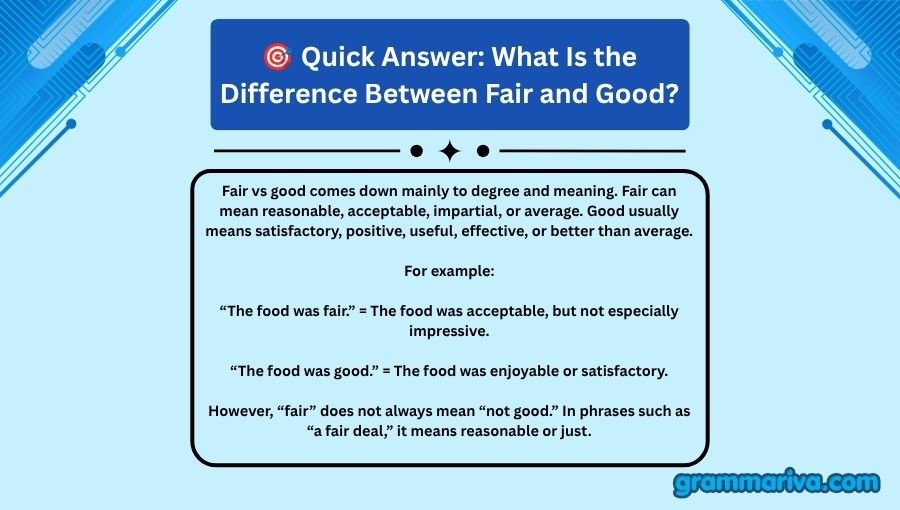
Fair vs good comes down mainly to degree and meaning. Fair can mean reasonable, acceptable, impartial, or average. Good usually means satisfactory, positive, useful, effective, or better than average.
For example:
- “The food was fair.” = The food was acceptable, but not especially impressive.
- “The food was good.” = The food was enjoyable or satisfactory.
However, “fair” does not always mean “not good.” In phrases such as “a fair deal,” it means reasonable or just.
📚 Fair vs Good at a Glance
The easiest way to understand these words is to compare their common meanings side by side.
| Form | Type | Meaning | Example | Correct/Incorrect |
|---|---|---|---|---|
| fair | Adjective | Reasonable or acceptable | The price is fair. | ✅ Correct |
| fair | Adjective | Impartial or just | The judge was fair. | ✅ Correct |
| fair | Adjective | Average or moderate | His performance was fair. | ✅ Correct |
| good | Adjective | Positive or satisfactory | She did a good job. | ✅ Correct |
| good | Adjective | Effective or useful | This is a good plan. | ✅ Correct |
| fair | Adjective | Always meaning excellent | The meal was fair and amazing. | ❌ Usually unclear |
| good | Adjective | Always meaning perfect | The answer was good and flawless. | ❌ Not necessarily |
The biggest point is that fair and good are not always direct substitutes. They overlap in some situations, but they can carry different levels of approval.
Is Fair the Same as Good? 🤔
No. Fair and good are not exact synonyms. Fair often suggests that something is acceptable, reasonable, or average, while good usually gives a more clearly positive judgment.
Consider these examples:
“The movie was fair.”
This often tells the listener that the movie was okay but not special.
“The movie was good.”
This gives a more positive impression. The speaker likely enjoyed it.
The difference becomes even clearer with prices:
“That is a fair price.”
This means the price is reasonable.
“That is a good price.”
This can mean the price is attractive, low, or favorable.
So, replacing one word with the other can change the message.
🎯 Fair: Meaning and Correct Use
Fair has several common meanings. It can describe something that is reasonable, just, impartial, or only moderately good.
Fair Means Reasonable
When discussing prices, offers, deals, or requests, fair often means reasonable.
Examples:
The seller offered a fair price. ✅
The price is reasonable and acceptable.
The seller offered a good price. ✅
The price is favorable or attractive.
Both sentences can work. However, they do not express exactly the same idea.
Fair Means Just or Impartial
Fair can also describe a person or decision that treats people equally.
The teacher was fair to every student. ✅
Here, “good” would not express the same meaning.
The teacher was good to every student. ❌
This could mean the teacher treated students kindly. It does not clearly mean the teacher was impartial.
Fair Means Average
Fair can describe a result that is acceptable but not outstanding.
His test score was fair. ✅
This usually suggests a middle-level result.
His test score was good. ✅
This suggests a stronger result.
💡 Test Tip
Ask yourself:
Am I talking about fairness, reasonableness, or an average result?
If yes, fair may be the better choice.
| Meaning of Fair | Word Type | Example Sentence |
|---|---|---|
| Reasonable | Adjective | We agreed on a fair price. |
| Just | Adjective | The decision was fair. |
| Impartial | Adjective | She is a fair manager. |
| Average | Adjective | His performance was fair. |
| Light in color | Adjective | She has fair hair. |
👍 Good: Meaning and Correct Use
When comparing fair vs good, good usually gives a stronger positive judgment. Good is one of the most common positive adjectives in English. It can describe quality, ability, behavior, results, usefulness, and many other things.
Good Means Positive Quality
The restaurant serves good food. ✅
The food has pleasing or satisfactory quality.
Good Means Skillful
Maria is a good writer. ✅
This means Maria writes well.
Good Means Useful or Effective
That is a good idea. ✅
The idea seems useful or sensible.
Good Means Morally Positive
He is a good person. ✅
Here, good describes character.
Good Means Satisfactory
I had a good day. ✅
This usually means the day was enjoyable or positive.
| Meaning of Good | Word Type | Example Sentence |
|---|---|---|
| High or positive quality | Adjective | This is a good book. |
| Skillful | Adjective | She is a good dancer. |
| Useful | Adjective | That is a good tool. |
| Positive experience | Adjective | We had a good time. |
| Positive character | Adjective | He is a good friend. |
⚖️ Key Differences Between Fair and Good
The main difference is the type and strength of judgment being expressed.
| Feature | Fair | Good |
|---|---|---|
| Positive judgment | Sometimes | Usually |
| Means reasonable | Yes | Sometimes |
| Means impartial | Yes | No |
| Means average | Often | Usually no |
| Means high quality | Not usually | Yes |
| Describes moral character | Rarely | Yes |
| Describes useful ideas | Sometimes, with a different meaning | Yes |
| Can describe prices | Yes | Yes |
| Can describe performance | Yes | Yes |
A useful rule is this:
Fair often tells you that something meets a reasonable standard. Good usually tells you that something performs or feels positively.
Why Do People Confuse Fair and Good? 🧠
People confuse these words because both can describe something that is acceptable or positive. Context decides which meaning fits.
I once reviewed a short school report where a student wrote, “The project was fair, so everyone liked it.” The student meant that the project was successful. In that sentence, good would have been clearer. “Fair” made the reader wonder whether the student meant the project was average or fair to everyone.
Another reason is that people learn words through conversation. A phrase like “That’s fair” is common in everyday English. It can mean “I understand” or “That seems reasonable.” Learners may then assume that “fair” is simply another word for “good.”
It is not.
Common situations
- Fair price = reasonable price
- Good price = favorable price
- Fair decision = impartial decision
- Good decision = sensible or beneficial decision
- Fair performance = acceptable or average performance
- Good performance = strong or successful performance
| Situation | Fair | Good |
|---|---|---|
| Price | Reasonable | Favorable |
| Decision | Impartial | Sensible |
| Performance | Average/acceptable | Strong |
| Treatment | Just | Kind or positive |
| Weather | Pleasant enough | Pleasant |
| Result | Acceptable | Successful |
📝 Case Study: Fair vs Good in a Workplace Email
Imagine that a manager asks an employee to review a project.
The employee writes:
“The final project was fair, and the team completed the main tasks.”
The manager may wonder what “fair” means. Was the project average? Was the process impartial? Was the price reasonable?
A clearer version would be:
“The final project was good, and the team completed the main tasks.”
Now the message clearly gives positive feedback.
But imagine the employee is discussing a budget:
“The client offered a fair price for the work.”
That sentence works well because fair means reasonable.
| Workplace Sentence | Best Choice | Why |
|---|---|---|
| The team did a ___ job. | good | Positive evaluation |
| The client offered a ___ price. | fair | Reasonable price |
| The manager made a ___ decision. | fair | Impartial decision |
| We found a ___ solution. | good | Useful solution |
| The employee gave a ___ performance. | good | Positive evaluation |
📖 Grammar Rules Explanation
Fair and good are both commonly used as adjectives, but they do different jobs in meaning.
The word fair can describe something that is reasonable, impartial, acceptable, average, or light in color. The intended meaning comes from context.
The word good commonly describes positive quality, ability, behavior, usefulness, or results.
Neither word is grammatically “more correct” in every sentence. The correct choice depends on what you want to say.
For example:
The price is fair. ✅
This means the price is reasonable.
The price is good. ✅
This can mean the price is favorable or attractive.
Both sentences are grammatically correct. The meanings are different.
Correct vs Incorrect at a Glance
| Sentence | Correct/Incorrect | Why |
|---|---|---|
| The judge made a fair decision. | ✅ Correct | Fair means impartial. |
| The judge made a good decision. | ✅ Correct | Good means sensible or beneficial. |
| She is a fair writer. | ⚠️ Context needed | Usually suggests average or reasonable ability. |
| She is a good writer. | ✅ Correct | Clearly means she writes well. |
| We received a fair offer. | ✅ Correct | Fair means reasonable. |
| We received a fair offer that was excellent. | ⚠️ Context needed | “Fair” and “excellent” may create mixed signals. |
Most standard English reference sources treat fair and good as separate words with overlapping but distinct meanings. The safest approach is to choose the word that matches your intended message.
⚠️ Common Mistakes With Fair and Good
These mistakes usually happen for three simple reasons:
- Fast typing can cause people to choose the first familiar word.
- Autocorrect can change words without making the sentence sound obviously wrong.
- Lack of knowledge about subtle word differences can lead to direct substitution.
I once caught myself typing “a good price” when I was writing a message about whether a seller’s offer was reasonable. I changed it to “a fair price” because that was the exact idea I wanted.
Similar Grammar Confusions
| Confusion | Correct Difference |
|---|---|
| its / it’s | Possession vs “it is” |
| your / you’re | Possession vs “you are” |
| their / there / they’re | Possession, place, or “they are” |
| then / than | Time/order vs comparison |
| affect / effect | Usually verb vs noun |
| fair / good | Reasonable/just/average vs positive quality |
Specific Fair vs Good Mistakes
| Wrong Form | What’s Wrong | Better Form |
|---|---|---|
| The judge was good to everyone. | Does not clearly mean impartial. | The judge was fair to everyone. |
| The meal was fair and delicious. | “Fair” may weaken the intended praise. | The meal was good and delicious. |
| Give me a good price that is reasonable. | “Fair” is more precise for reasonable. | Give me a fair price. |
| She is a fair writer. | May sound like average praise. | She is a good writer. |
| That was a fair movie! | May sound like only average praise. | That was a good movie! |
Is Fair More Negative Than Good?
Often, yes, when fair is used to rate quality. Saying something is “fair” can suggest that it is acceptable but not especially impressive.
For example:
“The movie was fair.”
This may sound like mild praise.
“The movie was good.”
This sounds more positive.
However, fair is not inherently negative. In “a fair decision,” it is strongly positive because it means the decision was just.
| Sentence | Likely Meaning |
|---|---|
| The food was fair. | Acceptable or average |
| The food was good. | Pleasant or satisfactory |
| The price was fair. | Reasonable |
| The price was good. | Favorable |
| The judge was fair. | Impartial |
| The judge was good. | Competent or kind |
Can You Use Fair and Good for the Same Thing?
Sometimes, but changing the word can change the meaning.
Take the noun price:
That is a fair price.
The price is reasonable.
That is a good price.
The price is attractive or favorable.
Now take performance:
Her performance was fair.
Her performance was acceptable or average.
Her performance was good.
Her performance was clearly positive.
So, while both words can fit the same noun, they may not communicate the same judgment.
🌎 Usage in Different Contexts
The best word depends heavily on the setting. The difference between fair vs good becomes clearer when you look at different writing and speaking situations.
| Context | Which Term to Use | Example |
|---|---|---|
| Everyday conversation | Either, depending on meaning | That seems fair. |
| Professional writing | Either, depending on meaning | The client offered a fair price. |
| Creative writing | Either | He gave a good smile. |
| Social media/texting | Either | That deal is good! |
Everyday Conversation
“Fair” is very common when agreeing with someone’s point.
“Fair enough.”
This means you accept or understand the person’s point.
“Good” is common for positive reactions.
“That’s good!”
This expresses approval.
Professional Writing
Precision matters more in work settings.
Use fair when discussing reasonable prices, impartial decisions, or equal treatment.
Use good when evaluating quality, results, or performance.
Creative Writing
Writers can use either word based on the mood they want.
“She was a good friend.”
“He was fair to everyone.”
The words create different pictures of the person.
Social Media and Texting
Short messages often depend on tone.
“Good deal!” = positive reaction.
“Fair deal.” = reasonable deal.
| Context | Fair Example | Good Example |
|---|---|---|
| Conversation | That sounds fair. | That sounds good. |
| Work | We agreed on a fair rate. | We had a good meeting. |
| Creative writing | He was fair to his workers. | He was a good friend. |
| Social media | Fair deal! | Good deal! |
💬 Common Phrases With Fair
Fair appears in several common expressions. These phrases often have meanings that cannot be replaced naturally with “good.”
| Phrase | Meaning |
|---|---|
| fair enough | That seems reasonable or acceptable |
| fair deal | A reasonable agreement |
| fair price | A reasonable price |
| fair chance | A reasonable opportunity |
| fair play | Honest and just behavior |
| fair treatment | Equal or just treatment |
For example:
“Fair enough.” means you accept someone’s point.
You would not normally replace it with “Good enough” because the meaning changes.
Can Good Replace Fair in Common Expressions?
Usually, no. Some expressions are fixed or strongly preferred with fair.
For example:
That is a fair deal. ✅
That is a good deal. ✅
Both are possible, but they can differ slightly. A “fair deal” stresses reasonableness. A “good deal” often stresses value.
Another example:
Give everyone a fair chance. ✅
Give everyone a good chance. ⚠️
“Good chance” usually means a strong possibility, not equal treatment. That distinction matters.
| Phrase | Meaning | Replacement With Good? |
|---|---|---|
| fair chance | Equal opportunity | Usually no |
| fair price | Reasonable price | Sometimes, with a different shade |
| fair deal | Reasonable agreement | Sometimes |
| fair play | Honest behavior | No |
| fair treatment | Equal treatment | Usually no |
| fair enough | Reasonable/acceptable | No |
🔄 Synonyms and Alternatives
When you understand fair vs good, you can also choose more precise alternatives. Sometimes another word can make your sentence even clearer.
| Alternative | Works When | Does Not Work When |
|---|---|---|
| reasonable | You mean acceptable or sensible | You mean high quality |
| just | You mean morally or legally fair | You mean average quality |
| acceptable | You mean something meets a standard | You want strong praise |
| positive | You mean favorable | You mean impartial |
| excellent | You mean very high quality | You mean merely reasonable |
For example:
“The price is reasonable.”
This is close to “The price is fair.”
But:
“The price is excellent.”
does not sound natural because excellent usually describes quality, not the price itself.
💡 How to Remember the Difference
A simple way to remember fair vs good is to connect fair with reasonableness and good with positive quality. Use this simple memory trick:
Fair = reasonable or equal.
Good = positive or high quality.
Think about a sports game.
If a referee treats both teams equally, the referee is fair.
If a player performs very well, the player is good.
If a restaurant charges a reasonable amount, the price is fair.
If the restaurant serves tasty food, the food is good.
| If You Mean… | Choose |
|---|---|
| reasonable | fair |
| equal treatment | fair |
| impartial | fair |
| average | fair |
| high quality | good |
| useful | good |
| enjoyable | good |
| skillful | good |
Why It Matters for Clear Communication ✍️
Knowing fair vs good helps you choose words that communicate your exact meaning. Word choice can change how readers understand your message.
A resume should describe strong skills clearly. A client email should avoid vague praise. Published content should use precise words. Even a short social post can sound different depending on the adjective you choose.
A simple rule I often give students is:
“Choose the word that says exactly what you mean.”
That rule works far beyond this pair.
| Situation | Why Getting It Right Matters |
|---|---|
| Resume | Shows the strength of your skills |
| Client email | Prevents confusion about offers or results |
| Published content | Makes writing more precise |
| Social post | Communicates tone clearly |
If you tell a client that the price is fair, you are saying it is reasonable. If you say the price is good, the client may understand that it is favorable or attractive. That small difference can matter.
Are Fair and Good Interchangeable in Every Sentence?
No. They are interchangeable only in some contexts, and even then the meaning may shift.
Compare:
She is a fair manager.
This can mean she treats people equally.
She is a good manager.
This means she performs the job well.
These are very different compliments.
Another example:
He gave me a fair chance.
He gave me an equal or reasonable opportunity.
He gave me a good chance.
This may mean he gave me a strong opportunity or that success was likely.
The noun stays the same, but the adjective changes the message.
🧩 Quick Recap Checklist
Use this checklist whenever you are unsure.
| Question | If Yes → Use |
|---|---|
| Do you mean reasonable? | fair |
| Do you mean equal or impartial? | fair |
| Do you mean average or acceptable? | fair |
| Do you mean high quality? | good |
| Do you mean skillful? | good |
| Do you mean useful or effective? | good |
| Do you mean enjoyable? | good |
| Do you mean morally positive? | good |
Practice Examples
- The manager treated both employees equally. → The manager was fair. ✅
- The restaurant served tasty food. → The food was good. ✅
- The seller asked for a reasonable amount. → The price was fair. ✅
FAQs About Fair vs Good
Is fair better than good?
Not necessarily. The words describe different ideas. Fair can mean reasonable, impartial, or average. Good usually expresses positive quality, ability, usefulness, or results.
Does fair mean average?
It can. When fair is used to rate quality or performance, it often suggests that something is acceptable or average rather than excellent.
Is a fair price the same as a good price?
Not exactly. A fair price is reasonable. A good price often means a favorable or attractive price. Both can be positive, but the focus is different.
Which is better: fair performance or good performance?
Good performance is stronger praise. Fair performance usually means the performance was acceptable or average.
What does “fair enough” mean?
“Fair enough” usually means that you accept a point, explanation, or decision as reasonable. It does not simply mean “good.”
Can fair describe a person?
Yes. “Fair” can describe someone who treats people equally or makes impartial decisions. For example, “She is a fair teacher.”
Can good describe a person?
Yes. “Good” can describe someone’s character, behavior, skills, or performance. For example, “He is a good teacher.”
Should I say “a fair decision” or “a good decision”?
Choose fair decision when you mean the decision treats people equally or follows a just standard. Choose good decision when you mean the decision is sensible, useful, or beneficial.
Is “fair enough” the same as “good enough”?
No. Fair enough usually means “that is reasonable” or “I accept your point.” Good enough means something meets the needed standard.
How can I quickly remember fair vs good?
Remember: fair = reasonable or equal; good = positive or high quality. If you are talking about justice, equal treatment, or a reasonable price, “fair” is often the better choice. If you are praising quality or performance, “good” is usually better.
🎯 Final Takeaway
Fair vs good is easier to understand once you focus on meaning instead of trying to memorize a single rule. Fair usually means reasonable, impartial, equal, or average. Good usually means positive, useful, skillful, enjoyable, or satisfactory.
Think about what you want your reader to hear. If you say, “The price is fair,” you are talking about reasonableness. If you say, “The price is good,” you are giving a positive opinion about its value. If you say, “She is fair,” you may be praising her impartial treatment of people. If you say, “She is good,” you may be praising her character or ability.
I recommend using the reasonable/equal vs positive/quality test whenever you are unsure. It takes only a few seconds and works in conversation, school assignments, workplace emails, and online writing. ✨
The memorable rule is simple: fair means reasonable or equal, while good means positively valuable or high in quality. Once you learn that difference, choosing the right word becomes much easier.

Hi, I’m Lucas Bennett. I’m a grammar content specialist at Grammariva. I work on articles covering everyday grammar questions, sentence usage, and writing tips that readers can apply with confidence.
[…] speech, professional writing, and online shopping. By the end, the difference should feel easy. ✨ Fair vs Good | Moose vs Mousse | Polite vs […]
[…] why foolproof is correct, you will have an easy way to remember it. 😊 Leotard vs Tights | Fair vs Good | Moose vs […]