Have you ever looked at two photos, two people, or two choices and wondered, “which one is you vs which one are you?” 🤔 This is a small grammar question, but it can feel confusing because both versions sound possible when spoken quickly.
The correct choice depends on what you are trying to ask. In standard English, “Which one are you?” is the normal and grammatically correct question when you are asking someone to identify themselves from a group of people or choices. “Which one is you?” is generally not standard English for that meaning, even though you may hear it in casual speech.
I have seen this confusion many times when editing simple English questions. The problem is usually not the word “which.” The real issue is the verb are versus is.
Once you understand that the question is about the person being identified, the rule becomes much easier. In this guide, I’ll explain the difference, show clear examples, cover common mistakes, and give you a few quick tests you can use whenever you are unsure. 😊 Unorganized or Disorganized | Say Your Peace or Say Your Piece | Stay in Touch or Keep in Touch
Quick Answer: Which One Is You vs Which One Are You? 🎯
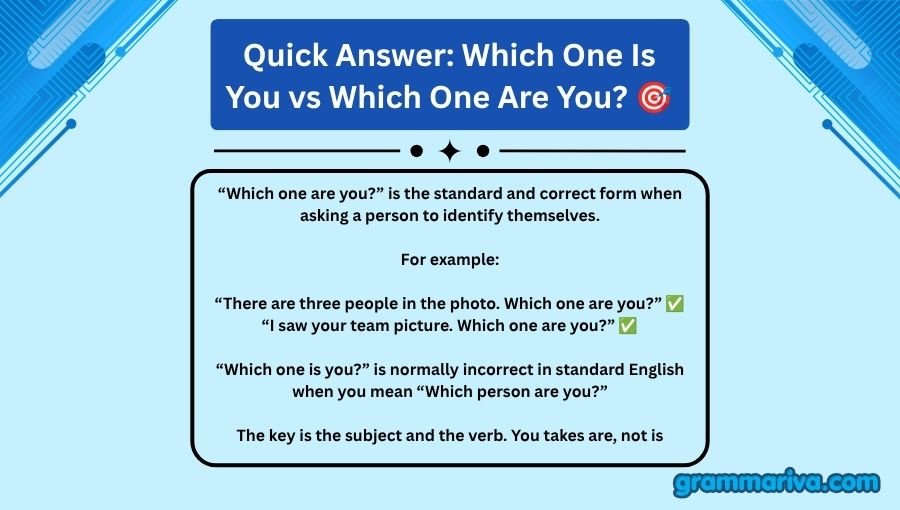
“Which one are you?” is the standard and correct form when asking a person to identify themselves.
For example:
- “There are three people in the photo. Which one are you?” ✅
- “I saw your team picture. Which one are you?” ✅
“Which one is you?” is normally incorrect in standard English when you mean “Which person are you?”
The key is the subject and the verb. You takes are, not is.
Is “Which One Are You?” the Correct Form? 🤔
Yes. “Which one are you?” is the correct standard form when you are asking someone to identify which person they are.
The basic pattern is:
Which one + are + you?
Here, you is the person being identified. The verb must agree with you, so we use are.
Consider these examples:
- “Which one are you?” ✅
- “Which student are you?” ✅
- “Which person are you?” ✅
- “Which player are you?” ✅
Now compare them with the incorrect pattern:
- “Which one is you?” ❌
- “Which student is you?” ❌
- “Which person is you?” ❌
The problem is is. We do not normally use is with you.
A simple grammar pattern
| Form | Type | Meaning | Example | Correct/Incorrect |
|---|---|---|---|---|
| Which one are you? | Question | Asks someone to identify themselves | Which one are you in this picture? | ✅ Correct |
| Which one is you? | Question | Attempts to ask which person someone is | Which one is you in this picture? | ❌ Incorrect |
| Which one is he? | Question | Asks about a male person | Which one is he? | ✅ Correct |
| Which one is she? | Question | Asks about a female person | Which one is she? | ✅ Correct |
Notice something important. “Which one is he?” is correct because he takes is.
But “Which one are you?” is correct because you takes are.
Why Do People Confuse “Which One Is You” and “Which One Are You”? 🧠
People often confuse these forms because “which one” comes before the verb. That can make it seem as if one should control the verb.
Grammatically, however, the question is built around the person being identified.
A useful way to think about it is this:
Which one are you?
The hidden meaning is:
You are which one?
The verb agrees with you, so are is needed.
I once helped a student who kept writing “Which one is you?” in short exercises. He understood that “one” is singular, so he thought “is” had to follow it. Once I changed the question into “You are which one?” he immediately saw why are was correct.
That is a very useful trick.
The basic agreement pattern
| Pronoun | Correct verb | Example |
|---|---|---|
| I | am | Which one am I? |
| You | are | Which one are you? |
| He | is | Which one is he? |
| She | is | Which one is she? |
| It | is | Which one is it? |
| We | are | Which ones are we? |
| They | are | Which ones are they? |
The important point is simple:
You → are
That rule does not change just because which one appears before it.
“Which One Is You” vs “Which One Are You” at a Glance 📊
The difference between the two forms is mainly a matter of subject-verb agreement.
| Sentence | Correct/Incorrect | Why |
|---|---|---|
| Which one are you? | ✅ Correct | “You” takes “are.” |
| Which one is you? | ❌ Incorrect | “You” does not take “is.” |
| Which one is he? | ✅ Correct | “He” takes “is.” |
| Which one are they? | ✅ Correct | “They” takes “are.” |
| Which one is she? | ✅ Correct | “She” takes “is.” |
This also explains why the sentence can feel confusing. One is singular, but it is not the person controlling the verb in the same way that you does.
The fastest rule
If you are directly asking someone:
Which one are you? ✅
If you are asking about another person:
Which one is he? ✅
Which one is she? ✅
If you are asking about several people:
Which ones are they? ✅
This pattern works in many everyday situations.
How Does “Which One Are You?” Work in Grammar? 📝
“Which one are you?” is an interrogative sentence. It asks the listener to choose or identify themselves from a group of possibilities.
The sentence has three main parts:
- Which one = asks for a choice or identification
- are = the verb
- you = the subject
The normal statement behind the question can be understood as:
You are one of them.
The question changes the order:
Which one are you?
This is similar to other questions:
- “Who are you?”
- “Where are you?”
- “Which student are you?”
- “Which team are you on?”
- “Which person are you?”
In all of these, you takes are.
Test Tip 💡
When you are unsure, temporarily remove which one.
Ask yourself:
Would I say “You is…” or “You are…” ?
Of course, the correct answer is:
You are.
So:
Which one are you? ✅
This quick test can save you from the common mistake.
Can You Ever Say “Which One Is You”? ⚠️
In standard English, you should avoid “Which one is you?” when you mean “Which person are you?”
However, real conversations do not always follow formal grammar perfectly. You may hear unusual versions in informal speech, certain dialects, learner English, jokes, or deliberately broken English.
That does not make the form the best choice for standard writing.
If you are writing:
- an email,
- an article,
- a school assignment,
- a professional message,
- a website,
- a social media post where you want polished English,
use:
“Which one are you?” ✅
Do not use:
“Which one is you?” ❌
The safest approach is to follow standard subject-verb agreement.
Standard English versus casual speech
| Situation | Recommended Form | Example |
|---|---|---|
| School assignment | Which one are you? | Which one are you in the photo? |
| Professional writing | Which one are you? | Which one are you referring to? |
| Everyday conversation | Which one are you? | Which one are you? |
| Social media | Which one are you? | Which one are you in this group? |
| Informal nonstandard speech | May hear “Which one is you?” | Not recommended in polished writing |
Which One Are You in Everyday Conversation? 💬
In everyday conversation, “Which one are you?” is useful when the listener belongs to a group that you cannot easily identify.
You might use it when looking at:
- old photos,
- team pictures,
- family pictures,
- school photos,
- group videos,
- online profiles,
- event pictures.
For example:
“I found your old school photo. Which one are you?” ✅
Or:
“There are five people here. Which one are you?” ✅
The question is short and natural.
Everyday examples
| Situation | Natural Question |
|---|---|
| Family photo | Which one are you? |
| School picture | Which one are you in the photo? |
| Team photo | Which player are you? |
| Group selfie | Which one are you? |
| Old class photo | Which person are you? |
The phrase can also be used in a playful way.
For example:
“Okay, I know your friends now. Which one are you?” 😄
The meaning is clear because the speaker wants the listener to point themselves out.
How Should You Use It in Professional Writing? 💼
Professional writing usually needs clear, standard grammar. “Which one are you?” is grammatically correct, but the best wording can depend on the situation.
For example, if you are asking someone to identify a person in a photo, you could write:
“Which person are you in the photograph?”
That version is slightly more formal.
If you are asking someone to select a role, option, or category, you may need a different sentence.
For example:
“Which option applies to you?”
The exact wording should match the meaning.
Professional examples
| Context | Best Wording | Reason |
|---|---|---|
| Identifying a person | Which one are you? | Direct and natural |
| Formal photo identification | Which person are you? | More formal |
| Selecting a category | Which option applies to you? | More precise |
| Selecting a role | Which role do you have? | Clearer than “which one” |
| Selecting a team | Which team are you on? | Natural and specific |
So, while “Which one are you?” is correct, a more specific noun can sometimes make professional writing clearer.
Is “Which One Are You?” Different From “Which One Do You Want”? 🎯
Yes. These questions look similar, but they ask for different information.
“Which one are you?” asks the person to identify themselves.
“Which one do you want?” asks the person to choose something.
Compare:
“There are four people in the picture. Which one are you?” ✅
“There are four shirts on the table. Which one do you want?” ✅
The verbs are different because the sentence structures are different.
Compare the patterns
| Question | Purpose | Example |
|---|---|---|
| Which one are you? | Identify a person | Which one are you in the photo? |
| Which one do you want? | Choose something | Which one do you want? |
| Which one is he? | Identify another person | Which one is he? |
| Which one is yours? | Identify ownership | Which one is yours? |
| Which one should I choose? | Ask for advice | Which one should I choose? |
This is why you should not choose is simply because one appears in the sentence.
Which One Is Yours vs Which One Are You? 🔍
These questions may look almost identical, but they have different grammar.
“Which one is yours?” is correct because yours refers to the thing that belongs to you.
“Which one are you?” is correct because you is the person being identified.
Compare:
- “Which one is yours?” ✅
- “Which one are you?” ✅
Now compare the incorrect forms:
- “Which one are yours?” ❌
- “Which one is you?” ❌
Why?
In “Which one is yours?”, the structure means something like:
Which one = yours
In “Which one are you?”, the structure identifies the person:
You are which one
The two sentences have different grammatical relationships.
A Real-Life Case Study: A Group Photo 📸
Imagine that a friend sends you an old college photo.
There are six people in it. You recognize the photo, but you do not know which person your friend is.
You might text:
“This is such a cool picture! Which one are you?” ✅
Your friend can reply:
“I’m the person in the blue shirt.”
Now imagine writing:
“Which one is you?” ❌
Your friend would probably understand what you mean. Communication might still work. But the grammar is not standard.
I once caught myself typing a similar sentence while answering a quick message. I had written it fast and nearly sent it. When I read it again, the is + you combination stood out immediately. I changed it to “Which one are you?” before sending it.
That small check is useful when writing quickly.
Grammar Rules for “Is” and “Are” 📚
The main rule is subject-verb agreement.
The verb must match the subject.
With the pronoun you, standard English uses are:
- You are.
- Are you?
- Which one are you?
With he, she, and it, standard English uses is:
- He is.
- She is.
- It is.
So the difference is not really about the word one. The key is the pronoun that follows the verb.
Subject and verb patterns
| Subject | Verb | Question |
|---|---|---|
| I | am | Which one am I? |
| You | are | Which one are you? |
| He | is | Which one is he? |
| She | is | Which one is she? |
| It | is | Which one is it? |
| We | are | Which ones are we? |
| They | are | Which ones are they? |
Standard grammar references and well-known dictionaries use the normal English agreement pattern in which you takes are.
That makes the answer straightforward:
Which one are you? ✅
Correct vs Incorrect at a Glance ✅
Here are several examples you can use as a quick reference.
| Sentence | Correct/Incorrect | Why |
|---|---|---|
| Which one are you? | ✅ Correct | “You” takes “are.” |
| Which one is you? | ❌ Incorrect | “You” cannot take “is” in standard English. |
| Which one is she? | ✅ Correct | “She” takes “is.” |
| Which one are they? | ✅ Correct | “They” takes “are.” |
| Which one is yours? | ✅ Correct | “Yours” works with “is” here. |
The fastest lesson is:
you → are
Once that becomes automatic, this grammar question becomes easy.
What Are the Most Common Mistakes? ⚠️
The most common mistake is choosing is because the word one is singular.
People see:
which one
and think:
one = is
But that shortcut does not work here.
The question is asking about you, and you takes are.
Common grammar mix-ups
| Confusion | Correct Form | Common Reason for Mistake |
|---|---|---|
| its / it’s | its / it’s | Apostrophe confusion |
| your / you’re | your / you’re | Similar sound |
| their / there / they’re | their / there / they’re | Same or similar sounds |
| then / than | then / than | Fast writing |
| is / are | Match the subject | Subject-verb confusion |
| which one is you / which one are you | Which one are you? | “One” seems to control the verb |
Three common causes are especially worth remembering:
1. Fast typing
When people type quickly, they often choose the first form that sounds acceptable.
2. Autocorrect
Autocorrect may not understand the intended grammar. It can sometimes leave an awkward sentence untouched.
3. Lack of grammar knowledge
If someone has not learned subject-verb agreement clearly, “one is” can feel more natural than “one are.”
But the real structure is about you.
Specific Wrong Forms to Avoid ❌
Here are common versions you may see online.
| Wrong Form | What’s Wrong | Correct Form |
|---|---|---|
| Which one is you? | “Is” does not agree with “you.” | Which one are you? |
| Which one are your? | “Your” is a possessive determiner. | Which one are you? |
| Which one is yours are? | The sentence mixes structures. | Which one is yours? |
| Which one you are? | Word order is wrong for a direct question. | Which one are you? |
| Which one are you is? | Two verbs are incorrectly combined. | Which one are you? |
| Which one is you in? | The structure is incomplete or confused. | Which one are you in? |
One especially common error is “Which one you are?”
That form can appear inside a larger sentence:
“I don’t know which one you are.” ✅
But as a direct question, use:
“Which one are you?” ✅
This difference is very important.
Why “Which One You Are” Can Sometimes Be Correct 🧩
There is a useful exception in sentence structure.
“Which one you are” can be correct when it is part of a larger sentence.
For example:
“I don’t know which one you are.” ✅
This is not a direct question. It is an embedded question.
Compare:
Direct question:
“Which one are you?” ✅
Embedded question:
“I don’t know which one you are.” ✅
The word order changes.
Direct vs embedded questions
| Sentence Type | Correct Example |
|---|---|
| Direct question | Which one are you? |
| Embedded question | I don’t know which one you are. |
| Direct question | Which person are you? |
| Embedded question | She asked which person you are. |
| Direct question | Who are you? |
| Embedded question | I don’t know who you are. |
This is one of the most useful points to remember.
Which One Are You in Different Contexts? 🌎
The phrase works across many situations, but the best wording can change depending on the setting.
| Context | Which Term to Use | Example |
|---|---|---|
| Everyday conversation | Which one are you? | Which one are you in the picture? |
| Professional writing | Which person are you? | Which person are you in the photograph? |
| Creative writing | Which one are you? | Which one are you beneath the old masks? |
| Social media/texting | Which one are you? | Okay, which one are you? 😂 |
For casual communication, the short version is usually enough.
For formal writing, adding a noun can make the question more precise.
How Can You Remember the Difference? 💡
Use a simple three-step method.
Step 1: Find the person
Ask who the sentence is talking to.
If the person is you, remember:
You are.
Step 2: Remove “which one”
Take:
Which one are you?
and reduce it mentally to:
You are.
That sounds correct.
Step 3: Check the verb
If you have you + is, stop.
If you have you + are, you are probably on the right track.
Memory trick
Think:
You are = Which one are you?
This works because the verb remains the same even when the sentence becomes a question.
Common Phrases With “Which One” 🗣️
There are several useful patterns with which one. The correct verb depends on the subject.
| Phrase | Meaning |
|---|---|
| Which one are you? | Identify yourself |
| Which one is he? | Identify a male person |
| Which one is she? | Identify a female person |
| Which one is yours? | Identify something belonging to you |
| Which one do you want? | Ask someone to choose |
| Which one should I pick? | Ask for a recommendation |
These phrases show why there is no single rule saying “which one” always takes is.
The rest of the sentence matters.
Alternatives to “Which One Are You?” ✨
Sometimes you can replace the phrase with a clearer or more specific question.
| Alternative | Works When | Does Not Work When |
|---|---|---|
| Which person are you? | Identifying someone in a group | Asking about an object |
| Which person is you? | — | This is not standard English |
| Who are you in the picture? | Identifying someone | When “who” would be unclear |
| Where are you in the picture? | Asking about location | When you need identity only |
| Which one is yours? | Asking about ownership | Asking which person someone is |
The best alternative depends on your exact meaning.
If you want to know which person the listener is, “Which one are you?” is usually the simplest choice.
Why Getting This Small Grammar Point Right Matters 🎯
Grammar does not exist only for exams. It helps readers understand your meaning quickly.
A small error may not stop someone from understanding you, but it can make your writing look less polished.
| Situation | Why Getting It Right Matters |
|---|---|
| Resume or application | Shows attention to language |
| Client email | Creates a professional impression |
| Published content | Keeps writing polished |
| Social post | Makes short messages clearer |
A useful writing principle is:
Clear words make clear ideas.
You do not need complicated grammar to sound smart. You need the right grammar for the meaning you want to express.
Does the Same Rule Apply to “Who Are You”? 👤
Yes. “Who are you?” is correct because you takes are.
You can use the same rule with several questions:
- Who are you? ✅
- Where are you? ✅
- Which one are you? ✅
- Which team are you on? ✅
- Which person are you? ✅
Now compare:
- Who is you? ❌
- Where is you? ❌
- Which one is you? ❌
The same subject-verb rule explains all of them.
Can “Which One Is He?” Be Correct? 👨
Yes. “Which one is he?” is completely different from “Which one is you?”
The pronoun he takes is.
For example:
“There are three men in the picture. Which one is he?” ✅
Likewise:
“There are three women in the picture. Which one is she?” ✅
But:
“Which one are you?” ✅
This gives us a simple pattern:
You → are
He/She → is
Pronoun comparison
| Person | Correct Question |
|---|---|
| I | Which one am I? |
| You | Which one are you? |
| He | Which one is he? |
| She | Which one is she? |
| We | Which ones are we? |
| They | Which ones are they? |
This is a strong pattern to memorize.
What About “Which One Is It?” 📌
“Which one is it?” is also correct.
Here, it is the subject, and it takes is.
For example:
“There are five buttons. Which one is it?” ✅
Compare that with:
“There are five people. Which one are you?” ✅
Both sentences are correct because the verbs match their subjects.
| Subject | Verb | Example |
|---|---|---|
| You | are | Which one are you? |
| It | is | Which one is it? |
| He | is | Which one is he? |
| She | is | Which one is she? |
| They | are | Which ones are they? |
So the phrase “which one” does not automatically decide whether you need is or are.
Quick Recap Checklist ✅
Use this checklist whenever you are unsure.
| Question | If Yes → Use |
|---|---|
| Are you asking the listener to identify themselves? | Which one are you? |
| Are you asking about a male person? | Which one is he? |
| Are you asking about a female person? | Which one is she? |
| Are you asking about an object? | Which one is it? |
| Are you asking about ownership? | Which one is yours? |
| Is the question embedded inside another sentence? | Use normal embedded-question word order |
Practice examples
1. There are four people in the photo. ______ are you?
Answer: Which one are you? ✅
2. I don’t know ______ you are.
Answer: which one you are ✅
3. There are three bags here. ______ is yours?
Answer: Which one is yours? ✅
The main rule remains simple:
You takes are.
FAQs About Which One Is You vs Which One Are You? ❓
Is “Which one are you?” grammatically correct?
Yes. “Which one are you?” is grammatically correct standard English. It is used when asking someone to identify themselves from a group of people or choices.
Is “Which one is you?” correct English?
No, not in standard English when you mean “Which person are you?” The standard form is “Which one are you?” because the pronoun you takes the verb are.
Why is “Which one are you?” correct?
The verb must agree with the subject you. Standard English uses are with you, so the correct question is “Which one are you?”
Should I say “Which one is you” or “Which one are you”?
Say “Which one are you?” when asking someone to identify themselves. That is the normal standard-English form.
Can I say “Which one you are?”
Yes, but normally only inside a larger sentence. For example: “I don’t know which one you are.” As a direct question, use “Which one are you?”
Is “Which one is he?” correct?
Yes. “Which one is he?” is correct because he takes is. This shows why the verb depends on the subject, not simply on the word one.
Is “Which one is she?” correct?
Yes. “Which one is she?” is grammatically correct because she takes is.
Is “Which one is yours?” correct?
Yes. “Which one is yours?” is correct when asking which item belongs to someone. It has a different structure from “Which one are you?”
Why does “which one” not always use “is”?
Because which one does not automatically control the verb in every question. The verb must fit the grammatical subject. Compare “Which one are you?” with “Which one is he?”
What is the easiest way to remember the rule?
Remember the pair “you are.” If the question is asking someone to identify themselves, use “Which one are you?” Never switch are to is just because one is singular.
Final Takeaway: Which One Is You vs Which One Are You? 🏁
Which one is you vs which one are you becomes much easier once you focus on the subject instead of the word one. If you are asking someone to identify themselves, the correct standard-English question is “Which one are you?” because you always pairs with are in this structure. 😊
Use “Which one is he?”, “Which one is she?”, or “Which one is it?” when the subject changes to he, she, or it. Also remember that “which one you are” can be correct inside an embedded sentence, such as “I don’t know which one you are.”
I recommend using the simple “you are” test whenever you hesitate. Remove “which one” and check the verb. If the statement is “You are,” the question will normally be “Which one are you?”
Good grammar does not have to be hard. Learn the pattern, practice it a few times, and this common confusion disappears. Keep one rule in mind: when the subject is you, choose are. ✅

Hi, I’m Nathan Reed. I’m a grammar and writing specialist at Grammariva. I work on practical grammar content that helps readers understand sentence structure, punctuation, vocabulary, and better writing habits.
[…] rules, and easy memory tips. By the end, choosing between these two words should feel much easier. Which One Is You vs Which One Are You | Unorganized or Disorganized | Say Your Peace or Say Your […]