Have you ever wanted to tell someone exactly how you feel, but then stopped because you were unsure whether to say your peace or say your piece? You are not alone. These two phrases sound exactly the same when spoken, but they have different meanings and uses. One refers to expressing your thoughts or opinion. The other is a common spelling mistake that can change the meaning of what you write.
I have seen this mix-up many times in casual messages, emails, social posts, and even school writing. The good news is that the rule is simple once you understand what say your piece really means. 📝
In this guide, I will explain the difference between say your peace or say your piece, show you which phrase is correct, and give you easy examples to remember the rule. You will also see common mistakes, real-life examples, memory tricks, and answers to common questions.
By the end, you should be able to choose the right phrase with confidence. 😊 Stay in Touch or Keep in Touch | In Which vs Where | Traveling or Travelling
🎯 Quick Answer: Say Your Peace or Say Your Piece
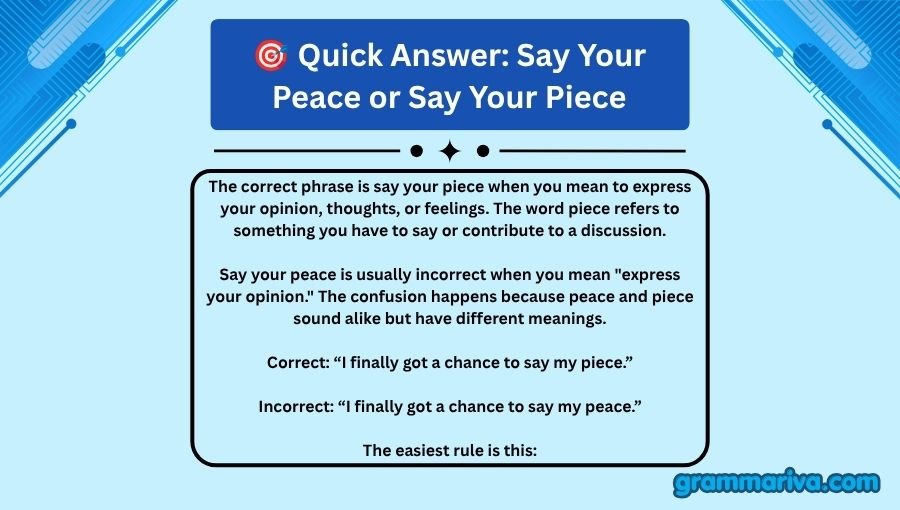
The correct phrase is say your piece when you mean to express your opinion, thoughts, or feelings. The word piece refers to something you have to say or contribute to a discussion.
Say your peace is usually incorrect when you mean “express your opinion.” The confusion happens because peace and piece sound alike but have different meanings.
Correct: “I finally got a chance to say my piece.”
Incorrect: “I finally got a chance to say my peace.”
The easiest rule is this:
If you mean your opinion or what you want to say, use “piece.”
🧩 Related Word Forms and Expressions
The phrase say your piece can appear with different possessive words depending on who is speaking. The key word stays piece.
| Form | Type | Example |
|---|---|---|
| say your piece | Fixed phrase | You should say your piece before we decide. |
| say my piece | First-person form | I need to say my piece. |
| say his piece | Third-person form | He said his piece and left. |
| say her piece | Third-person form | She wanted to say her piece. |
| say their piece | Plural possessive form | They each had a chance to say their piece. |
| said my piece | Past-tense version | I said my piece yesterday. |
These forms all keep the word piece because the phrase is about expressing something you want to contribute.
📚 Understanding Say Your Peace or Say Your Piece
The main difference between say your peace or say your piece is the meaning of the final word.
Piece can mean a part, contribution, or something being expressed. In say your piece, it refers to your contribution to a conversation or argument.
Peace means calm, quiet, or freedom from conflict. It does not normally fit the phrase when you want to say that someone is expressing an opinion.
Say Your Piece
Use say your piece when someone gets a chance to speak openly.
For example:
“You have been quiet during the meeting. Go ahead and say your piece.”
Here, piece means the person’s contribution to the discussion.
Say Your Peace
Say your peace is generally not the standard form when the intended meaning is “express your opinion.”
The word peace has a completely different meaning.
For example:
“The two countries finally reached peace.”
Here, peace means the absence of fighting or conflict.
Comparison at a Glance
| Form | Type | Meaning | Example | Correct/Incorrect |
|---|---|---|---|---|
| say your piece | Fixed expression | Express your opinion | Say your piece before we vote. | ✅ Correct |
| say your peace | Incorrect phrase for this meaning | Does not mean express your opinion | Say your peace before we vote. | ❌ Incorrect |
| piece | Noun | A part or contribution | She gave her piece of the story. | ✅ Correct |
| peace | Noun | Calm or absence of conflict | We all want peace. | ✅ Correct |
The important point is that peace is a real and correct word. It is simply the wrong word for this particular expression.
❓ Is Say Your Piece the Correct Phrase?
Yes. Say your piece is the standard phrase when you mean “express your opinion” or “have your turn to speak.”
The phrase is often used when someone has something important, emotional, or strongly worded to say.
For example:
“I listened to everyone else. Now I want to say my piece.”
The speaker wants to express an opinion. That is why piece is correct.
When Should You Say Your Piece?
You can use the phrase when:
- You want to explain your side.
- You want to share an opinion.
- You want to respond to criticism.
- You want to speak during an argument.
- You want to make your feelings known.
- You have been waiting for your turn to talk.
Here are more examples:
“Let me say my piece before you make a decision.” ✅
“She said her piece and walked away.” ✅
“Everyone had a chance to say their piece.” ✅
The expression works in both casual and serious conversations.
❓ Why Do People Confuse Say Your Peace and Say Your Piece?
People confuse the two phrases because peace and piece are homophones. They sound alike but have different spellings and meanings.
I once edited a short workplace message that said, “I need to say my peace before we finish.” The writer clearly meant that they wanted to explain their side. Once we changed peace to piece, the sentence made sense immediately.
This type of mistake is common because English has many words that sound the same but are spelled differently.
Common Sound-Alike Pairs
| Word 1 | Word 2 | Difference |
|---|---|---|
| peace | piece | calm vs. part/contribution |
| your | you’re | possession vs. you are |
| their | there | possession vs. place |
| its | it’s | possession vs. it is |
| hear | here | receive sound vs. location |
| right | write | correct vs. form words |
The problem is usually not pronunciation. It is choosing the correct spelling when writing.
📝 Say Your Piece in Real-Life Conversations
In everyday speech, say your piece often sounds natural when someone wants to express a strong opinion.
Imagine two friends are having a disagreement.
One person says:
“You have explained your side. Let me say my piece now.”
This means the person wants a fair chance to respond.
The phrase can sound calm, serious, annoyed, or even humorous. The tone depends on the situation.
Everyday Examples
“I just want to say my piece and then we can move on.” ✅
“He said his piece and refused to argue anymore.” ✅
“Let her say her piece before we judge her.” ✅
“Everyone should get a chance to say their piece.” ✅
The expression is useful because it focuses on someone’s right to express a thought.
💼 How Should You Use Say Your Piece in Professional Writing?
In professional writing, say your piece is grammatically correct, but it can sometimes sound informal or emotional.
For a workplace email, you may prefer a more direct phrase such as:
- share my perspective
- explain my position
- express my concerns
- give my opinion
- explain my side
For example, instead of:
“I would like to say my piece about this issue.”
You might write:
“I would like to share my perspective on this issue.”
Both can work. The second sounds more professional.
Professional Context Table
| Context | Which Term to Use | Example |
|---|---|---|
| Everyday conversation | say your piece | Let me say my piece. |
| Professional writing | say your piece or formal alternative | I would like to share my perspective. |
| Creative writing | say your piece | She finally said her piece. |
| Social media/texting | say your piece | I said my piece. I’m done. |
The phrase is not grammatically wrong in professional writing. It is simply less formal than some alternatives.
❓ Can You Say “I Said My Piece”?
Yes. I said my piece is correct.
It means you expressed your opinion or explained your side.
For example:
“I said my piece, so there is nothing else I need to explain.” ✅
This version uses the past tense said because the speaking already happened.
You can change the phrase to match the tense and subject.
| Tense/Person | Example |
|---|---|
| Present | I say my piece. |
| Future | I will say my piece. |
| Past | I said my piece. |
| First person | I need to say my piece. |
| Second person | You should say your piece. |
| Third person | She said her piece. |
| Plural | They said their piece. |
The spelling of piece does not change.
💡 How To Remember the Difference
A simple memory trick can help.
Think about piece as your piece of the conversation.
Everyone in a discussion may have a different piece to add. When you say your piece, you share your part.
Think about peace as calm.
For example:
- peace = calm
- piece = part
So:
“I want peace.” means you want calm.
“I want to say my piece.” means you want to speak.
Easy Memory Test
Ask yourself:
“Am I talking about calm or my opinion?”
If you mean calm, choose peace.
If you mean your opinion or contribution, choose piece.
That tiny question can prevent the mistake.
🎯 Test Tip: Use the Meaning Test
Here is my favorite test for this confusion.
Replace the word with opinion or calm.
If opinion makes sense, choose piece.
“I need to say my opinion.”
That points you toward:
“I need to say my piece.” ✅
If calm makes sense, choose peace.
“We need calm.”
That points you toward:
“We need peace.” ✅
Meaning Summary
| Meaning | Word Type | Example Sentence |
|---|---|---|
| A contribution or opinion | Noun | I want to say my piece. |
| Calm or lack of conflict | Noun | The family wanted peace. |
| A part of something | Noun | She ate one piece of cake. |
| A written or artistic work | Noun | He published a short piece. |
This test works because it focuses on meaning instead of sound.
📝 Case Study: A Workplace Conversation
Consider a team meeting where three employees disagree about a project.
The manager asks everyone to explain their concerns. One employee stays quiet.
Near the end of the meeting, the employee says:
“I have listened to everyone. I would like to say my piece before we finish.”
That sentence is correct because the employee wants to give an opinion.
The manager could respond:
“Of course. We want everyone to have a chance to speak.”
Now imagine the employee writes:
“I would like to say my peace before we finish.”
The meaning becomes unclear. Peace refers to calm, not a person’s contribution to a discussion.
I once caught myself typing the wrong spelling of a homophone while writing quickly. I stopped, checked the meaning, and fixed it before sending the message. That is why I always recommend a meaning check rather than relying on how a word sounds.
🔍 Grammar Rules Explanation
The phrase say your piece uses piece as a noun. Here, the noun refers to a person’s contribution to a conversation, discussion, disagreement, or situation.
The phrase is a set expression. The meaning is not simply the literal meaning of “say” plus “piece.” Instead, the full expression means to express what you think, feel, or want to say.
Peace is also a noun, but its meaning is different. It refers to a state of calm, nonviolence, or freedom from conflict.
Because the two words sound alike, speakers may not notice the difference. Writing makes the difference visible.
Most standard English references and dictionaries distinguish peace and piece as separate words with different meanings.
Correct vs. Incorrect at a Glance
| Sentence | Correct/Incorrect | Why |
|---|---|---|
| I need to say my piece. | ✅ Correct | The speaker wants to express an opinion. |
| I need to say my peace. | ❌ Incorrect | Peace does not mean an opinion here. |
| She said her piece and left. | ✅ Correct | She expressed her thoughts. |
| He finally got to say his piece. | ✅ Correct | He had a chance to speak. |
| They wanted to say their peace. | ❌ Incorrect | The intended word is piece. |
The grammar itself is simple. The main challenge is spelling the correct homophone.
⚠️ Common Mistakes With Say Your Peace or Say Your Piece
Mistakes happen for several reasons.
Fast Typing
When people type quickly, they often write the word that comes to mind first. Since peace and piece sound identical, the wrong spelling can slip through.
Autocorrect
Autocorrect may not always understand the intended meaning. Both words are valid English words, so a spell checker may not flag the mistake.
Lack of Knowledge
Some writers simply have not learned that the phrase uses piece.
Similar Grammar Confusions
| Confusion | Correct Use |
|---|---|
| your / you’re | your = possession; you’re = you are |
| their / there | their = possession; there = place |
| its / it’s | its = possession; it’s = it is |
| affect / effect | affect is usually a verb; effect is usually a noun |
| then / than | then = time; than = comparison |
| peace / piece | peace = calm; piece = part or contribution |
Specific Wrong Forms
| Wrong Form | What’s Wrong | Correct Form |
|---|---|---|
| say your peace | Wrong homophone | say your piece |
| said my peace | Wrong homophone | said my piece |
| say her peace | Wrong homophone | say her piece |
| say his peace | Wrong homophone | say his piece |
| say their peace | Wrong homophone | say their piece |
| saying your peace | Wrong homophone | saying your piece |
The key point is simple: changing the spelling changes the word.
❓ Is Say Your Peace Ever Correct?
Say your peace can be grammatically possible only if peace is being used in a literal or creative way. It is not the normal expression for giving an opinion.
For example, a writer could create a poetic sentence such as:
“Before leaving, he wanted to say his peace to the crowd.”
But this would be unusual and would not have the standard meaning of say your piece.
If your intended meaning is “express your opinion,” use say your piece.
For normal writing, there is no reason to choose say your peace when you mean speaking your mind.
✍️ Say Your Piece vs. Speak Your Mind
Say your piece and speak your mind are close in meaning.
Both can describe expressing your honest opinion.
However, they are not always interchangeable.
| Expression | Meaning | Example |
|---|---|---|
| say your piece | Give your contribution or opinion | I need to say my piece. |
| speak your mind | Say what you really think | She always speaks her mind. |
| give your opinion | State your view | Please give your opinion. |
| share your thoughts | Explain your ideas | He shared his thoughts. |
| explain your side | Present your view of an issue | Let me explain my side. |
Speak your mind can suggest honesty or directness. Say your piece often suggests that someone has been waiting for a chance to make their point.
❓ What Is the Difference Between Piece and Peace?
Piece and peace are different words with different meanings.
Piece can mean a part of something or a person’s contribution to a discussion.
Peace refers to calm, harmony, or freedom from conflict.
Compare these sentences:
“I ate a piece of pizza.” ✅
“The countries signed an agreement for peace.” ✅
“I want to say my piece.” ✅
The words may sound alike, but their meanings are not alike.
🌎 Usage in Different Contexts
The expression works across many settings, but the tone can change.
Everyday Conversation
Use say your piece when someone wants to share an opinion.
“Go ahead and say your piece.”
Professional Writing
The phrase is acceptable, but a formal alternative may sound better.
“I would like to share my perspective.”
Creative Writing
Writers can use the phrase to show conflict, emotion, or a character’s desire to speak.
“She waited until everyone was silent before saying her piece.”
Social Media and Texting
The phrase can sound casual and direct.
“I said my piece. Now I’m logging off.”
Context Table
| Context | Which Term to Use | Example |
|---|---|---|
| Everyday conversation | say your piece | Let me say my piece. |
| Professional writing | say your piece or formal alternative | I want to explain my position. |
| Creative writing | say your piece | He finally said his piece. |
| Social media/texting | say your piece | I said my piece. I’m done. |
💬 Common Phrases With Piece
The word piece appears in several common expressions.
| Phrase | Meaning |
|---|---|
| say your piece | Express your opinion |
| a piece of advice | One bit of advice |
| a piece of information | One item of information |
| a piece of cake | Something easy, or literally cake |
| a piece of the action | A share in an activity or opportunity |
| a piece of the puzzle | One part of a larger problem or solution |
These expressions show why piece can refer to a part, contribution, or individual item.
🕊️ Common Phrases With Peace
The word peace also appears in many familiar expressions.
| Phrase | Meaning |
|---|---|
| keep the peace | Prevent or reduce conflict |
| make peace | End a disagreement |
| peace and quiet | A calm environment |
| world peace | Peace among countries or people |
| rest in peace | A traditional expression used after someone’s death |
| peace of mind | A feeling of calm or security |
These examples make the difference easier to remember.
Peace belongs with ideas of calm and harmony.
Piece belongs with ideas of parts, contributions, and things being said.
🔄 Synonyms and Alternatives to Say Your Piece
Sometimes you may want a different expression.
| Alternative | Works When | Does Not Work When |
|---|---|---|
| speak your mind | You want to express an honest opinion | You need a formal business tone |
| share your thoughts | You want a gentle, neutral phrase | You want a strong or forceful tone |
| give your opinion | You want a clear and direct phrase | You want an emotional expression |
| explain your side | There is a disagreement | There is no conflict or opposing view |
| share your perspective | You want a professional tone | You want a very casual expression |
Choosing an alternative can help match your tone to the situation.
❓ Why Does Getting the Spelling Right Matter?
Correct spelling matters because peace and piece have completely different meanings.
A reader may understand what you meant from context, but the wrong spelling still makes the sentence look careless.
This matters most in:
- Professional emails
- School assignments
- Published articles
- Resumes
- Business messages
- Social media posts
Why Accuracy Matters
| Situation | Why Getting It Right Matters |
|---|---|
| Resume | Shows attention to detail |
| Client email | Creates a professional impression |
| Published content | Protects writing quality |
| Social post | Makes your message easier to understand |
A useful writing rule is:
If two words sound the same, check their meanings before choosing the spelling.
That small habit can prevent many common English mistakes.
❓ How Can You Quickly Remember Say Your Piece?
Remember this simple connection:
Piece = part.
Your opinion is your part of the conversation.
So:
Your part → your piece → say your piece.
For peace, think about:
Peace = calm.
You want peace when you want conflict to stop.
The One-Line Memory Trick
Say your piece when you have something to say. Seek peace when you want conflict to stop.
That sentence gives you the entire rule in one line.
🧠 Say Your Peace or Say Your Piece in Digital Communication
Digital writing makes homophone mistakes especially easy.
When you text, you usually type the word based on how it sounds. Since both words sound the same, your brain may select the wrong spelling.
Social media captions can also make mistakes more visible because people often write quickly.
For example:
❌ “I said my peace, and now I’m done.”
✅ “I said my piece, and now I’m done.”
The second sentence clearly means the writer expressed their opinion.
For polished digital writing, take a few seconds to check words that sound alike.
❓ Is “Say Your Piece” Formal or Informal?
Say your piece is grammatically correct but usually has a conversational tone.
It can appear in professional settings, but it may sound less formal than phrases such as share your perspective or explain your position.
For example:
Casual: “Go ahead and say your piece.”
Professional: “Please take a moment to explain your position.”
Both communicate the idea of giving someone a chance to speak.
The best choice depends on your audience and purpose.
📌 Quick Recap Checklist
Use this checklist whenever you are unsure.
| Question | If Yes → Use |
|---|---|
| Do you mean your opinion? | piece |
| Do you mean your contribution? | piece |
| Do you mean your side of an argument? | piece |
| Do you mean calm or harmony? | peace |
| Do you mean freedom from conflict? | peace |
Practice Examples
- I need to say my piece before we finish. ✅
- The two sides finally made peace. ✅
- She said her piece and left the room. ✅
If you remember piece = your part and peace = calm, you will usually choose correctly.
❓ What Does Say Your Piece Mean?
Say your piece means to express your opinion, thoughts, feelings, or side of an issue.
Example:
“I listened to everyone, and now I want to say my piece.”
The speaker wants an opportunity to express their view.
❓ Should I Say My Peace or Say My Piece?
You should say say my piece when you mean that you want to express your opinion.
Correct:
“I need to say my piece.” ✅
Incorrect for that meaning:
“I need to say my peace.” ❌
The word piece is the standard choice in this expression.
❓ Is “I Said My Piece” Correct?
Yes. I said my piece is correct.
It means that you already expressed your opinion or explained your side.
Example:
“I said my piece, so I am ready to listen now.”
The phrase can be used in casual conversation, writing, dialogue, and other settings.
❓ What Does Peace Mean?
Peace means a state of calm, harmony, or freedom from conflict.
Examples include:
“The community wanted peace.”
“They worked together to keep the peace.”
“I enjoy the peace and quiet of the countryside.”
Peace is not the normal word for someone’s contribution to a conversation.
❓ What Does Piece Mean?
Piece can mean a part of something, an individual item, or a contribution.
For example:
“I want a piece of cake.”
It can also appear in the expression:
“I want to say my piece.”
In that phrase, piece refers to what someone has to contribute or say.
❓ Are Peace and Piece Homophones?
Yes. Peace and piece are homophones in standard English pronunciation. They sound alike but have different spellings and meanings.
This is why writers often confuse them.
The best way to avoid the error is to focus on meaning instead of sound.
❓ Can I Use Say Your Piece in an Email?
Yes, but consider your tone.
In a casual email, say your piece may be perfectly natural.
In a formal business email, you may prefer:
- share your perspective
- explain your position
- express your concerns
- provide your feedback
For example:
Casual: “I would like to say my piece about the issue.”
Professional: “I would like to share my perspective on the issue.”
❓ Is Say Your Peace Always Wrong?
No, the words say and peace can appear together in a sentence in unusual or creative contexts. However, say your peace is not the standard phrase when you mean “express your opinion.”
For the normal expression, use say your piece.
That is the spelling you should choose in everyday, academic, and professional writing when you mean “give your opinion.”
❓ What Is an Easy Way to Remember Piece vs. Peace?
Use this memory trick:
Piece = part.
Your opinion is your part of the discussion.
Peace = calm.
You want peace when you want an end to conflict.
So remember:
Say your piece. Find peace.
That short contrast makes the spelling easy to recall.
❓ What Is Another Way to Say Say Your Piece?
Depending on the context, you can say:
- speak your mind
- share your thoughts
- give your opinion
- explain your side
- share your perspective
- express your views
The best alternative depends on your tone.
For casual speech, speak your mind works well. For professional writing, share your perspective is often a better choice.
✅ Final Answer: Say Your Peace or Say Your Piece
Say your peace or say your piece is a common homophone confusion, but the correct phrase for expressing an opinion is say your piece.
Remember the simple rule:
Piece = your part or contribution.
Peace = calm or harmony.
So if you are telling someone, “I want to explain my side,” you should write:
“I want to say my piece.” ✅
If you are talking about calm, use peace:
“I just want some peace and quiet.” ✅
The two words sound alike, but their meanings are completely different. Once you connect piece with “your part of the conversation,” the correct spelling becomes much easier to remember.
When I edit English writing, I always recommend checking meaning before sound when two words are homophones. That one habit can fix many small errors before they reach a reader.
Say your piece when you have something to say, and choose peace when you want calm. 📝✨
That is the rule worth remembering.

Hi, I’m Lucas Bennett. I’m a grammar content specialist at Grammariva. I work on articles covering everyday grammar questions, sentence usage, and writing tips that readers can apply with confidence.


[…] the rule. ✨ By the end, you should feel confident choosing the right word for your sentence. Say Your Peace or Say Your Piece | Stay in Touch or Keep in Touch | In Which vs […]
[…] give you a few quick tests you can use whenever you are unsure. 😊 Unorganized or Disorganized | Say Your Peace or Say Your Piece | Stay in Touch or Keep in […]