Have you ever written a sentence and stopped because you could not decide between in which vs where? You are not alone. These two forms often appear in similar sentences, especially when talking about places, situations, events, or conditions. The good news is that the difference becomes much easier once you understand what each word is doing. 😊
In which is usually more formal and often refers to a situation, setting, condition, or place. Where is shorter, more natural, and very common in everyday English. In some sentences, both can work. In others, only one sounds correct.
I teach grammar by looking at what a sentence actually means instead of asking students to memorize long rules. That approach works well here, too. Once you identify the noun being described and understand whether the sentence needs a place word or a more formal relative structure, the choice becomes much clearer. Let’s make in which vs where simple. ✨ Traveling or Travelling | Stalactite vs Stalagmite | Lying Around vs Laying Around
🎯 Quick Answer: In Which vs Where
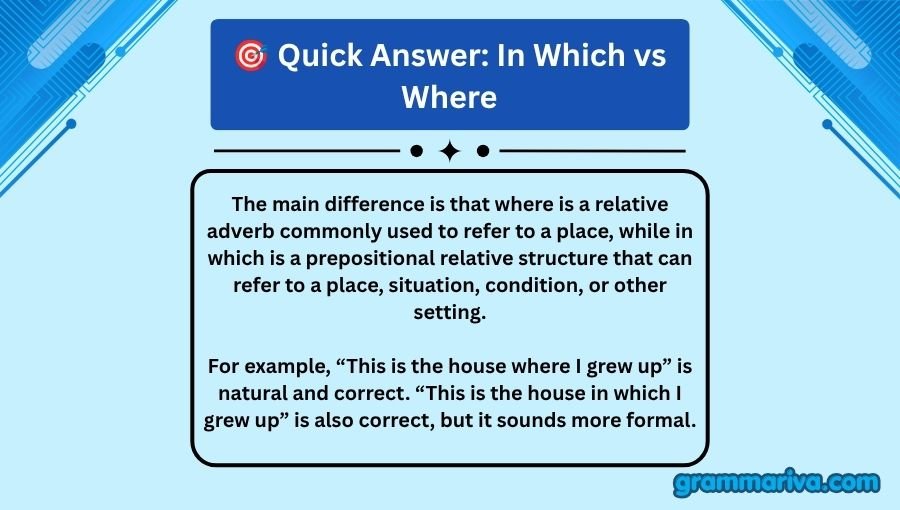
The main difference is that where is a relative adverb commonly used to refer to a place, while in which is a prepositional relative structure that can refer to a place, situation, condition, or other setting.
For example, “This is the house where I grew up” is natural and correct. “This is the house in which I grew up” is also correct, but it sounds more formal.
| Form | Main Use | Example |
|---|---|---|
| where | Places and settings | This is the room where we met. |
| in which | Places, situations, conditions, and formal contexts | This is the room in which we met. |
| where | Natural everyday English | I remember the town where she lived. |
| in which | More formal written English | I remember the town in which she lived. |
The easiest rule is this: where usually points to a place or setting, while in which can be broader and more formal.
📚 Understanding the Basics of In Which vs Where
The difference between these forms is mainly about grammar, meaning, and style. Both can introduce information that describes a noun, but they do not always work in exactly the same situations.
Where as a Relative Adverb
Where is commonly used after a noun referring to a place. It connects that place to information about what happens there.
Consider:
This is the café where we had lunch.
The word where means something close to “at which” in this sentence.
The sentence can be understood as:
This is the café at which we had lunch.
However, the first version sounds much more natural in everyday conversation.
In Which as a Prepositional Relative Structure
In which contains the preposition in plus the relative pronoun which.
It can describe a place:
This is the building in which the company operates.
It can also describe a situation:
We entered a situation in which nobody knew what to do.
Here, where may sometimes be possible, but in which makes the relationship clearer and sounds more formal.
Comparison at a Glance
| Form | Type | Meaning | Example | Correct/Incorrect |
|---|---|---|---|---|
| where | Relative adverb | Place or setting | The park where we met was quiet. | ✅ Correct |
| in which | Prepositional relative structure | Place or setting | The park in which we met was quiet. | ✅ Correct |
| in which | Prepositional relative structure | Situation | It was a situation in which everyone felt nervous. | ✅ Correct |
| where | Relative adverb | Situation in some informal uses | We reached a point where nobody agreed. | ✅ Correct |
| in where | Incorrect combination | Unnecessary double structure | The room in where we met was small. | ❌ Incorrect |
A key point is that in where is normally not the form you want. Choose where or in which, depending on the sentence.
🧐 Is In Which the Same as Where?
In which and where can have the same basic meaning when they refer to a physical place. However, they are not identical in every situation.
Compare these examples:
This is the office where I work.
This is the office in which I work.
Both are grammatical. The first is more natural in ordinary speech. The second has a more formal tone.
The difference becomes more useful when the noun does not describe a physical place.
We faced a difficult situation in which everyone had to make a choice.
Here, in which clearly refers to the situation.
You may also hear:
We reached a point where we had to make a choice.
This is common and natural English. Where has expanded beyond physical locations in many everyday constructions.
Quick Comparison
| Sentence | Natural? | Style |
|---|---|---|
| This is the house where I grew up. | ✅ | Everyday |
| This is the house in which I grew up. | ✅ | Formal |
| We faced a situation in which time was limited. | ✅ | Formal/neutral |
| We reached a point where we had to stop. | ✅ | Natural |
| We reached a point in which we had to stop. | ⚠️ | Usually less natural |
🗺️ When Should You Use Where?
Use where when you want to refer naturally to a place, location, or setting. It is especially common in conversation and informal writing.
Examples include:
I visited the town where my father was born.
She found the restaurant where we ate last year.
Do you remember the hotel where we stayed?
This is the street where I learned to ride a bike.
The word where keeps these sentences short and smooth.
Physical Places
When a noun clearly represents a location, where is often the easiest choice.
The school where I studied is nearby.
The park where we played has been renovated.
The room where the meeting took place was crowded.
Situations and Points
Modern English also uses where after words such as point, stage, and situation in certain constructions.
We reached a point where we had no choice.
The project is at a stage where changes are difficult.
She described a situation where nobody had enough information.
These uses are common, especially in spoken and general written English.
✍️ When Should You Use In Which?
Use in which when the sentence calls for the preposition in and you want to keep a formal or precise style.
It is especially useful in academic, legal, business, and formal writing.
For example:
The study describes a process in which several factors interact.
The phrase in which clearly connects the process with the action taking place inside that process.
It can also describe physical places:
The laboratory in which the experiment was conducted has strict safety rules.
This sentence is correct, but a less formal version would be:
The laboratory where the experiment was conducted has strict safety rules.
Formal Situations
In which works especially well with abstract nouns.
Common examples include:
- situation
- process
- system
- condition
- environment
- context
- case
- circumstance
Examples:
The company created a system in which employees could submit feedback anonymously.
The report explains the conditions in which the test was performed.
The article examines the context in which the decision was made.
Meaning Summary
| Meaning | Word Type | Example Sentence |
|---|---|---|
| Physical place | Relative adverb | This is the house where she lives. |
| Physical place, formal | Relative structure | This is the house in which she lives. |
| Situation | Relative structure | It was a situation in which nobody felt safe. |
| Process | Relative structure | We studied a process in which heat is transferred. |
| Point or stage | Relative adverb | We reached a stage where changes were needed. |
💡 How Can You Test In Which vs Where?
A simple replacement test can help.
If the sentence refers to a place, try replacing where with in which.
This is the room where we met.
Becomes:
This is the room in which we met.
If both versions make sense, the choice may depend mainly on style.
Another useful test is to ask whether in naturally belongs before the relative pronoun.
The environment in which children learn matters.
You would not normally say:
The environment where children learn matters.
Actually, this second version is also grammatical and natural. But in which emphasizes the formal relationship between the environment and the learning process.
Test Tip
Test Tip: If you can naturally say “in that place,” where may work. If the sentence describes a formal situation, process, or condition, in which is often a strong choice.
📝 Case Study: In Which vs Where at Work
Imagine an employee writing this sentence in a company report:
“We created a system where employees can report problems anonymously.”
This sentence is understandable and commonly used. However, the writer wants a formal business style.
A stronger formal version would be:
“We created a system in which employees can report problems anonymously.”
The meaning is almost the same. The second version simply fits formal writing better.
I once edited a workplace report where the writer used where repeatedly after abstract nouns such as “process” and “system.” Nothing was seriously wrong with the sentences, but the report sounded less formal than the writer wanted. Replacing a few uses with in which improved the tone without making the writing harder to understand.
The lesson is simple: grammar and style work together.
| Situation | Natural Choice | Example |
|---|---|---|
| Casual conversation | where | This is the place where we met. |
| Business report | in which | This is the process in which the data is reviewed. |
| Academic paper | in which | The study examines the conditions in which people learn. |
| Friendly email | where | Here is the café where we had lunch. |
⚙️ Grammar Rules Explanation
The grammar becomes easier when you look at the parts of each expression.
Where functions as a relative adverb. It normally introduces information connected to a place or setting.
In which combines a preposition with the relative pronoun which. The preposition shows the relationship between the noun and the following clause.
For example:
The room in which we met was small.
The underlying idea is:
We met in the room.
The preposition in remains in the relative structure.
With where, the same relationship is expressed more compactly:
The room where we met was small.
Standard English grammar references generally recognize both patterns. The main difference is often one of structure, context, and formality rather than simple right-versus-wrong grammar.
Correct vs Incorrect at a Glance
| Sentence | Correct/Incorrect | Why |
|---|---|---|
| This is the house where I grew up. | ✅ Correct | Where refers to the house. |
| This is the house in which I grew up. | ✅ Correct | In which formally refers to the house. |
| This is the house in where I grew up. | ❌ Incorrect | Do not combine in with where. |
| We faced a situation in which nobody agreed. | ✅ Correct | In which refers to the situation. |
| We faced a situation in where nobody agreed. | ❌ Incorrect | In where is not the standard structure. |
The biggest rule to remember is that where already carries the location relationship. Adding in before it usually creates an incorrect structure.
⚠️ Common Mistakes With In Which vs Where
People often confuse these forms because they communicate similar ideas.
There are several reasons for this.
Fast Typing
When people type quickly, they may combine two patterns they know.
For example:
❌ The place in where we stayed was beautiful.
The writer may have started with “the place in which” and switched to “where” without removing in.
Autocorrect
Autocorrect can also affect sentence structure. It may change words without understanding the grammar of the entire sentence.
Lack of Grammar Knowledge
Some learners memorize phrases without understanding how the pieces work. If they know both in which and where, they may assume they can combine them.
I once caught myself typing “the situation in where” in a quick note. I knew the rule, but I had written the sentence too fast. I deleted in, reread the sentence, and moved on. Even experienced writers can make small slips when they rush.
Similar Grammar Confusions
| Confusion | Correct Form | Basic Difference |
|---|---|---|
| it’s / its | it’s = it is; its = possession | Different functions |
| your / you’re | your = possession; you’re = you are | Different meanings |
| their / there / they’re | Different functions | Possession, place, “they are” |
| then / than | Different uses | Time vs comparison |
| affect / effect | Usually verb vs noun | Different grammatical roles |
Specific Wrong Forms
| Wrong Form | What’s Wrong | Correct Form |
|---|---|---|
| in where | Combines two structures | where / in which |
| in where we met | Extra preposition | where we met |
| where in we met | Incorrect word order | where we met |
| the place in where | Nonstandard combination | the place where / in which |
| a situation in where | Incorrect relative structure | a situation where / in which |
| the system in where | Incorrect combination | the system where / in which |
🧠 Why Do People Confuse In Which and Where?
The difference between in which vs where can be confusing because both forms can describe similar places. People confuse these expressions because they can produce nearly identical meanings when talking about locations.
For example:
The building where she works is downtown.
and:
The building in which she works is downtown.
Both describe the same building and the same workplace.
The difference is easier to notice when the sentence becomes formal or abstract.
The conditions in which the workers operated were difficult.
The phrase sounds precise and formal.
In everyday English, people often prefer a simpler construction:
The conditions where the workers operated were difficult.
This second sentence is less natural to many speakers because conditions often pair better with under which or in which depending on the intended meaning.
That is why context matters. You should not simply replace every in which with where.
🏢 Usage in Different Contexts
The best choice depends partly on the type of writing.
In everyday conversation, where is usually more natural. In formal writing, in which often gives a more polished tone.
| Context | Which Term to Use | Example |
|---|---|---|
| Everyday conversation | where | That’s the restaurant where we ate. |
| Professional writing | in which | We developed a system in which users can submit requests. |
| Creative writing | Either | She returned to the village where she was born. |
| Social media/texting | where | Remember the café where we took that photo? |
Everyday Conversation
Use where freely when speaking.
Do you remember where we parked?
That’s the store where I bought my jacket.
The shorter form sounds natural.
Professional Writing
Formal documents may favor in which, especially after abstract nouns.
The company established a process in which each complaint is reviewed.
This style can make the relationship clearer.
Creative Writing
Both can work.
She returned to the house where she spent her childhood.
This version feels smooth and personal.
Social Media and Texting
Shorter language usually works best.
That beach where we watched the sunset 🌅
There is little reason to use the more formal in which in a casual post.
🔍 In Which vs Where in Formal Writing
Formal writing often benefits from in which because it makes the sentence structure explicit.
Compare:
The report describes the environment where the tests were conducted.
with:
The report describes the environment in which the tests were conducted.
The second version has a more formal academic tone.
However, formal does not automatically mean better. A sentence can become stiff if you use in which when where would be simpler.
Good writing chooses the form that fits the audience.
| Writing Goal | Better Choice | Example |
|---|---|---|
| Simple and natural | where | The place where we met |
| Formal | in which | The context in which the decision was made |
| Academic | in which | The conditions in which the study occurred |
| Casual | where | The café where we talked |
| Very clear location | where | The room where the class takes place |
🧩 Common Phrases and Structures
There are several common structures that help you recognize the difference.
| Phrase | Meaning |
|---|---|
| where I live | the place I live |
| where we met | the place we met |
| where she works | the place she works |
| in which case | in that situation |
| in which context | within that context |
| in which situation | under that situation or condition |
Notice that in which case is a fixed and useful formal expression.
For example:
You may cancel the order, in which case you will receive a refund.
Here, where would not normally replace the whole phrase.
This shows why in which has uses that go beyond simple physical locations.
🔄 Synonyms and Alternatives
Sometimes you can rewrite the sentence completely.
This can make your writing more natural.
| Alternative | Works When | Does Not Work When |
|---|---|---|
| that | Referring to a thing in many relative clauses | A location relationship needs to be expressed |
| in which | Formal setting or situation | Casual writing where it sounds too stiff |
| at which | The meaning requires “at” | The intended relationship is “in” |
| on which | The meaning requires “on” | The relationship is not “on” |
| in that | Explaining a reason or respect | Referring directly to a place |
For example:
This is the table on which I placed the book.
You cannot replace on which with in which because the preposition changes the meaning.
Likewise:
This is the room in which we met.
The preposition in matters.
🎯 How to Remember the Difference
Understanding in which vs where becomes easier when you focus on the meaning and tone of the sentence. A simple memory trick can make this much easier.
Think:
Where = place or setting.
In which = in + a noun relationship, often formal.
When you see a physical location, ask:
“Would where sound natural here?”
If yes, you can often use where.
Then ask:
“Would in which make the sentence more formal or precise?”
If yes, it may be a good choice.
Three-Step Test
- Find the noun being described.
- Ask whether it represents a place, setting, situation, or condition.
- Choose the form that matches the relationship and tone.
For example:
The school ___ I studied was old.
Both can work:
The school where I studied was old.
The school in which I studied was old.
But the first sounds more natural in ordinary conversation.
🚫 Is “In Where” Correct?
No. In where is generally not the standard form when you are choosing between where and in which.
Use:
The restaurant where we ate.
or:
The restaurant in which we ate.
Do not write:
❌ The restaurant in where we ate.
The reason is simple. Where already works as the relative adverb. It does not normally need in placed before it.
| Incorrect | Correct |
|---|---|
| ❌ the place in where | ✅ the place where |
| ❌ the room in where | ✅ the room where |
| ❌ the house in where | ✅ the house in which |
| ❌ the situation in where | ✅ the situation in which |
💬 Can Where Be Used for Situations?
Yes. Where is commonly used after words such as point, stage, and situation, especially in everyday English.
For example:
We reached a point where we had to stop.
This is natural.
However, in which may be preferred in formal writing when it clearly expresses an “in” relationship.
We entered a situation in which every decision mattered.
The important thing is not to assume that where only refers to physical buildings, streets, or cities. English often uses location words in broader ways.
📖 Why Does This Difference Matter?
Getting this distinction right helps your writing sound clear and controlled.
Clarity in Communication
A correct relative structure helps readers understand how ideas connect.
Professionalism
Formal writing often requires careful word choice. Using in which in the right context can create a polished tone.
Digital Communication
Even short messages can benefit from clean grammar. Clear writing is easier to read and less likely to be misunderstood.
A useful rule is:
Good grammar should make your meaning easier to see, not harder to read.
| Situation | Why Getting It Right Matters |
|---|---|
| Resume | Shows careful writing |
| Client email | Creates a professional tone |
| Published content | Improves clarity |
| Social post | Keeps casual writing clean and natural |
📝 Practice Examples With In Which vs Where
Try choosing the better option before looking at the answers.
Example 1
This is the restaurant ___ we celebrated her birthday.
Answer: where
This is the restaurant where we celebrated her birthday. ✅
In which is also grammatically possible, but it sounds more formal.
Example 2
The process ___ the data is checked takes several hours.
Answer: in which
The process in which the data is checked takes several hours. ✅
Here, in which fits the formal description of a process.
Example 3
I remember the street ___ we first met.
Answer: where
I remember the street where we first met. ✅
Example 4
The conditions ___ the test was performed were carefully controlled.
Answer: in which
The conditions in which the test was performed were carefully controlled. ✅
The formal structure fits the sentence well.
✅ Quick Recap Checklist
Use this checklist whenever you are unsure.
| Question | If Yes → Use |
|---|---|
| Am I referring naturally to a place? | where |
| Do I want a simple conversational sentence? | where |
| Am I writing formally about a process or situation? | in which |
| Does the sentence need the preposition “in”? | in which |
| Am I tempted to write “in where”? | Stop and choose where or in which |
Practice
1. This is the town ___ my mother grew up. These examples make in which vs where easier to recognize in real writing.
Answer: where ✅
2. The system ___ the data is stored is secure.
Answer: in which ✅
3. We reached a point ___ we could not continue.
Answer: where ✅
The more examples you read, the faster the choice becomes automatic.
❓ FAQs About In Which vs Where
What is the difference between in which and where?
Where is a relative adverb commonly used for places and settings. In which uses a preposition plus the relative pronoun which. Both can describe physical places, but in which is often more formal and can work well with situations, processes, and conditions.
Is “in which” more formal than “where”?
Usually, yes. When both forms are grammatically possible, in which often sounds more formal or academic. Where is usually shorter and more natural in everyday speech.
Can I use where for a situation?
Yes. English commonly uses where after words such as “point,” “stage,” and “situation.” For example, “We reached a point where we had to decide.” This is natural English.
Is “in where” grammatically correct?
Generally, no. Do not combine in directly with where in this structure. Use where or in which instead.
Can where and in which be used interchangeably?
Sometimes, especially when they refer to a physical place. For example, “the house where I lived” and “the house in which I lived” are both correct. They differ mainly in style and structure.
Which is better for academic writing, in which or where?
In which is often a good choice in academic writing when describing a formal relationship involving a process, condition, context, or situation. However, where is still correct and useful when referring to a clear place or setting.
Is “the place in which” correct?
Yes. “The place in which we met” is grammatically correct. “The place where we met” is also correct and usually sounds more natural in everyday English.
Can where replace in which?
Sometimes. If in which refers to a location, where can often replace it. For example, “the room in which we met” can become “the room where we met.” The replacement does not work in every sentence.
Which sounds more natural, where or in which?
In everyday English, where usually sounds more natural. In which often sounds more formal. The best choice depends on the sentence, audience, and desired tone.
What should I remember about in which vs where?
Remember this simple rule: where is the natural choice for many places and settings, while in which is a more formal structure that can describe places, situations, processes, and conditions. Never normally combine them as in where.
🏁 Conclusion
In which vs where becomes much easier once you focus on the role each form plays. Use where for a natural, simple reference to a place or setting. Use in which when the sentence needs the preposition in, especially in formal writing or when discussing situations, processes, conditions, and contexts.
For physical locations, both may be correct:
The office where I work is downtown.
The office in which I work is downtown.
The first feels more conversational. The second feels more formal.
The most important mistake to avoid is in where. When you see that combination, stop and choose either where or in which.
I always tell my students to read the whole sentence aloud. If where sounds smooth, it is often the best everyday choice. If the sentence is formal and needs in, in which may be the stronger option. 😊
Grammar does not have to feel complicated. Learn the relationship, check the context, and choose the form that makes your meaning clear. ✨
Remember: Where keeps it natural. In which keeps it formal. Choose the structure that fits the sentence.

Hi, I’m Olivia Carter. I’m an English language editor at Grammariva, and I work on making grammar lessons clear, accurate, and easy to follow. I especially enjoy writing about common grammar mistakes and everyday English.



[…] the small difference in meaning and tone, choosing the right phrase becomes much easier. 😊 In Which vs Where | Traveling or Travelling | Stalactite vs […]
[…] should be able to choose the right phrase with confidence. 😊 Stay in Touch or Keep in Touch | In Which vs Where | Traveling or […]