When you want to tell someone that you want to remain connected, should you say stay in touch or keep in touch? 🤔 Both phrases are correct, and both are very common in American English. The tricky part is that they can sound almost identical in many situations. That makes it easy to wonder if one is more natural, more formal, or more grammatically correct than the other.
The good news is simple: you usually do not have to choose based on grammar alone. Stay in touch or keep in touch can both describe continuing communication with someone. The difference is mostly about focus and context. “Stay in touch” often sounds like maintaining an existing connection. “Keep in touch” can also mean maintaining contact, but it can feel a little more like an active promise or request to continue communicating.
I have seen this confusion many times in emails, texts, and even student writing. Once you understand the small difference in meaning and tone, choosing the right phrase becomes much easier. 😊 In Which vs Where | Traveling or Travelling | Stalactite vs Stalagmite
🎯 Quick Answer: Stay in Touch or Keep in Touch
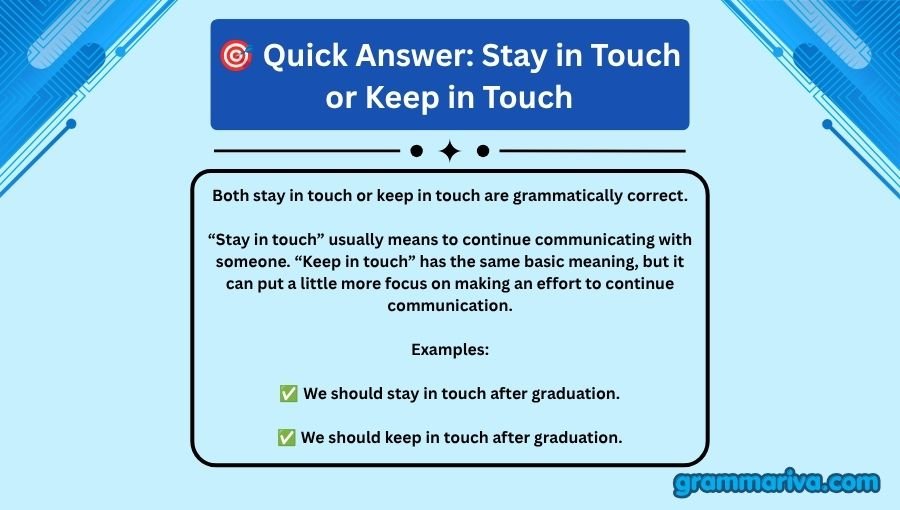
Both stay in touch or keep in touch are grammatically correct.
“Stay in touch” usually means to continue communicating with someone. “Keep in touch” has the same basic meaning, but it can put a little more focus on making an effort to continue communication.
Examples:
✅ We should stay in touch after graduation.
✅ We should keep in touch after graduation.
Both sentences are natural. The first can sound like a simple wish to remain connected. The second can sound slightly more like an active intention.
Is Stay in Touch the Same as Keep in Touch? 💬
Yes, in most everyday situations, stay in touch and keep in touch have nearly the same meaning. Both tell someone that communication should continue.
The main difference is the feeling behind the verbs.
- Stay in touch focuses on remaining connected.
- Keep in touch can focus more on continuing the action of communicating.
- Both work in casual and professional settings.
- Neither phrase is grammatically wrong.
Think of “stay” as remaining in a state and “keep” as continuing an action.
A Simple Comparison
| Form | Type | Meaning | Example | Correct/Incorrect |
|---|---|---|---|---|
| Stay in touch | Verb phrase | Remain in contact | We should stay in touch. | ✅ Correct |
| Keep in touch | Verb phrase | Continue communicating | We should keep in touch. | ✅ Correct |
| Stay touch | Incorrect phrase | Missing “in” | Please stay touch. | ❌ Incorrect |
| Keep touch | Incorrect phrase | Missing “in” | Let’s keep touch. | ❌ Incorrect |
The word in matters. You say “stay in touch” and “keep in touch,” not “stay touch” or “keep touch.”
What Does Stay in Touch Mean? 📱
Stay in touch means to continue communicating with someone over time.
The phrase often appears when people expect a change in their situation. For example, coworkers may say it when one person changes jobs. Friends may say it after moving to different cities.
The idea is simple: the relationship already exists, and you want it to continue.
Example 1
✅ Let’s stay in touch after you move.
Here, “stay in touch” means “let’s continue talking even though you will live somewhere else.”
Example 2
✅ I hope we can stay in touch.
This expresses a wish to keep the relationship or communication active.
Example 3
❌ I hope we can stay touch.
This is incorrect because the fixed expression requires in.
Test Tip 💡
If you can replace the phrase with “continue communicating,” “stay in touch” is probably a good choice.
For example:
We should stay in touch.
→ We should continue communicating.
The meaning stays clear.
Main Uses of Stay in Touch
| Meaning | Word Type | Example Sentence |
|---|---|---|
| Remain connected | Verb phrase | We stayed in touch after college. |
| Continue communicating | Verb phrase | Please stay in touch with me. |
| Maintain a relationship | Verb phrase | They stayed in touch for years. |
| Keep communication open | Verb phrase | I hope we stay in touch. |
What Does Keep in Touch Mean? 📞
Keep in touch also means to continue communicating with someone.
It is often used as a friendly request, suggestion, or promise. Someone might say it when ending a conversation or when two people are about to be separated.
Example 1
✅ Keep in touch!
This is a very common friendly goodbye.
It means, “Continue communicating with me.”
Example 2
✅ I’ll keep in touch while I’m away.
The speaker promises to continue communicating.
Example 3
❌ I’ll keep touch while I’m away.
This is incorrect because the phrase needs in.
“Keep in touch” can sometimes feel slightly more active than “stay in touch.” The speaker may be thinking about making an effort to call, text, email, or meet.
A Useful Table
| Phrase | Basic Meaning | Common Feeling |
|---|---|---|
| Stay in touch | Remain connected | Calm and natural |
| Keep in touch | Continue communicating | Active and friendly |
| Stay connected | Remain connected | Slightly broader |
| Communicate regularly | Talk often | More direct and formal |
Stay in Touch or Keep in Touch: Key Differences 🔎
The phrases are extremely close, but their verb choices create a small difference in focus.
Stay in touch presents communication as a continuing state. Keep in touch presents communication as something that continues through action.
Consider these examples:
✅ We stayed in touch after high school.
This focuses on the fact that the connection remained.
✅ We kept in touch after high school.
This can suggest that both people continued making an effort to communicate.
The difference is small. In many conversations, native speakers can use either sentence without changing the basic message.
Comparison at a Glance
| Feature | Stay in Touch | Keep in Touch |
|---|---|---|
| Basic meaning | Remain in contact | Continue contact |
| Grammar | Correct | Correct |
| Casual use | Very common | Very common |
| Professional use | Natural | Natural |
| Friendly goodbye | Common | Especially common |
| Focus | Remaining connected | Continuing communication |
Why Do People Confuse Stay in Touch and Keep in Touch? 🤔
People confuse these phrases because they describe almost the same idea. Both contain in touch, and both can be used when people want communication to continue.
I once reviewed a short student email that ended with, “I hope we can keep in touch with each other.” The student worried that “keep in touch” sounded informal. It did not. The phrase was completely natural for that friendly message.
Another reason for the confusion is that English has many pairs of verbs that produce similar meanings. For example, we can say “remain calm” or “stay calm.” Small verb changes can affect tone without making one sentence wrong.
Common Reasons for Confusion
- The meanings overlap.
- Both phrases use “in touch.”
- Both work with friends and coworkers.
- Both appear in emails and texts.
- Learners may expect only one correct form.
The important lesson is that this is not a simple right-versus-wrong grammar problem.
How Do You Use Stay in Touch in a Sentence? ✍️
Use stay in touch when you want to say that communication should continue or that people have remained connected.
Common patterns include:
- stay in touch with someone
- stay in touch after something
- stay in touch while doing something
- stay in touch by email
- stay in touch regularly
Examples
✅ Please stay in touch with your former classmates.
❌ Please stay touch with your former classmates.
The first sentence is correct because it uses the complete phrase stay in touch.
✅ We stayed in touch after I moved to Texas.
❌ We stayed in touch after I move to Texas.
The second example has a separate tense problem. “Moved” is needed because the move happened in the past.
Sentence Pattern Table
| Pattern | Example |
|---|---|
| Stay in touch with + person | Stay in touch with your family. |
| Stay in touch after + event | We stayed in touch after college. |
| Stay in touch while + activity | We stayed in touch while traveling. |
| Stay in touch by + method | We stayed in touch by email. |
How Do You Use Keep in Touch in a Sentence? 📧
Use keep in touch when you want to describe continued communication or encourage someone to continue communicating.
Common patterns include:
- keep in touch with someone
- keep in touch after something
- keep in touch by email
- keep in touch regularly
- keep in touch while away
Examples
✅ Let’s keep in touch after the project ends.
❌ Let’s keep touch after the project ends.
The first sentence uses the complete fixed phrase.
You can also use keep in touch as a short goodbye:
✅ It was great meeting you. Keep in touch!
This sounds warm and friendly.
More Examples
| Sentence | Meaning |
|---|---|
| Keep in touch! | Continue communicating. |
| I’ll keep in touch. | I promise to communicate. |
| We kept in touch. | We continued communicating. |
| Keep in touch with your team. | Continue communicating with your team. |
Can You Use Both Phrases in Professional Writing? 💼
Yes. Both stay in touch and keep in touch can work in professional writing.
Your choice depends on the tone you want.
“Stay in touch” often sounds smooth in professional emails:
✅ I hope we can stay in touch.
“Keep in touch” is also professional when the relationship is friendly:
✅ It was a pleasure working with you. Let’s keep in touch.
For a very formal business message, you may prefer something more specific, such as:
I look forward to staying connected.
I hope we have an opportunity to work together again.
These alternatives can sound more polished when writing to a client, executive, or formal business contact.
Professional Context Table
| Situation | Recommended Phrase | Example |
|---|---|---|
| Leaving a job | Stay in touch | I hope we can stay in touch. |
| Friendly coworker | Keep in touch | Let’s keep in touch. |
| Client relationship | Stay in touch | I hope we can stay in touch. |
| Formal business letter | Stay connected | I hope we can stay connected. |
Case Study: A Farewell Email at Work 📝
Imagine that Sarah is leaving a company after five years. She wants to send a short message to her team.
A natural ending would be:
✅ Thank you all for your support over the years. I’ve enjoyed working with you, and I hope we can stay in touch.
She could also write:
✅ Thank you all for your support over the years. I’ve enjoyed working with you, and I hope we can keep in touch.
Both versions work.
The first feels slightly more focused on preserving the relationship. The second can feel slightly more active, as if Sarah is encouraging everyone to continue communicating.
Neither choice creates a grammar problem.
Case Study Breakdown
| Part | Purpose |
|---|---|
| Thank you all | Shows appreciation |
| I’ve enjoyed working with you | Reflects on the relationship |
| I hope | Shows a future wish |
| We can stay in touch | Expresses continued connection |
Grammar Rules for Stay in Touch and Keep in Touch 📖
The grammar behind both phrases is simple.
Stay and keep are verbs. In touch is a fixed phrase that describes being connected or communicating.
The preposition in is required in these standard expressions.
You can say:
✅ Stay in touch.
✅ Keep in touch.
You cannot normally say:
❌ Stay touch.
❌ Keep touch.
The phrases can also change tense.
Different Tenses
✅ We stay in touch.
Present tense.
✅ We stayed in touch.
Past tense.
✅ We will stay in touch.
Future meaning.
✅ We keep in touch.
Present tense.
✅ We kept in touch.
Past tense.
✅ We will keep in touch.
Future meaning.
The basic grammar rule does not require one phrase to replace the other. Both are standard English expressions.
Correct vs. Incorrect at a Glance
| Sentence | Correct/Incorrect | Why |
|---|---|---|
| We should stay in touch. | ✅ Correct | Complete fixed phrase |
| We should keep in touch. | ✅ Correct | Complete fixed phrase |
| We should stay touch. | ❌ Incorrect | Missing “in” |
| We should keep touch. | ❌ Incorrect | Missing “in” |
| Let’s stay in touches. | ❌ Incorrect | “Touch” is not plural here |
Common Mistakes With These Phrases ⚠️
Most mistakes happen because people type quickly or remember only part of the expression.
I once caught myself typing “keep touch” in a quick message. I noticed it before sending it, but it showed how easy it is to drop one small word when typing fast.
Why These Mistakes Happen
Fast typing: People often leave out short words.
Autocorrect: Automatic corrections can change phrases in unexpected ways.
Lack of knowledge: English learners may not know that “in” is required.
Overthinking: Writers sometimes assume one phrase must be wrong because the two phrases look so similar.
Similar Grammar Confusions
| Confusion | Correct Form | Common Error |
|---|---|---|
| it’s / its | It’s cold. | Its cold. |
| your / you’re | You’re right. | Your right. |
| they’re / their / there | They’re here. | Their here. |
| affect / effect | It affected me. | It effected me. |
| stay in touch / keep in touch | Keep in touch. | Keep touch. |
Specific Mistakes
| Wrong Form | What’s Wrong | Correct Form |
|---|---|---|
| Stay touch | Missing “in” | Stay in touch |
| Keep touch | Missing “in” | Keep in touch |
| Stay in touches | “Touch” should not be plural | Stay in touch |
| Keep in touches | “Touch” should not be plural | Keep in touch |
| Stay on touch | Wrong preposition | Stay in touch |
| Keep on touch | Wrong fixed expression | Keep in touch |
When Should You Say Stay in Touch? 🎯
Choose stay in touch when your main idea is that a connection should remain.
It is especially natural when talking about relationships that may face a change.
For example:
✅ Even though we’re moving to different cities, let’s stay in touch.
The phrase fits because the physical situation is changing, but the relationship should remain.
Good Situations for Stay in Touch
- Moving away
- Leaving school
- Changing jobs
- Ending a trip
- Saying goodbye
- Maintaining friendships
- Keeping professional connections
Quick Guide
| Situation | Stay in Touch? | Example |
|---|---|---|
| Friend moves away | ✅ Yes | Let’s stay in touch. |
| Coworker leaves | ✅ Yes | I hope we stay in touch. |
| Old classmate | ✅ Yes | We still stay in touch. |
| Client relationship | ✅ Yes | We should stay in touch. |
When Should You Say Keep in Touch? 🤝
Choose keep in touch when you want to stress continued communication or make a friendly request.
It is particularly common as a farewell:
Keep in touch!
This short expression is friendly, natural, and widely understood.
Good Situations for Keep in Touch
- Saying goodbye
- Promising to call
- Promising to email
- Talking to an old friend
- Ending a friendly professional meeting
- Moving to another place
For example:
✅ I’ll keep in touch when I get settled.
This sounds like a promise to make an effort to communicate.
Stay in Touch or Keep in Touch in Everyday Conversation 🗣️
In everyday American English, both expressions are natural.
If a friend is leaving town, you might say:
Stay in touch!
You might also say:
Keep in touch!
The difference is not large enough to cause confusion.
Native speakers often choose based on personal habit and the exact feeling they want. You do not need to worry that one phrase will make your sentence sound grammatically wrong.
Everyday Examples
| Situation | Natural Choice |
|---|---|
| Friend moving away | Stay in touch! |
| Friend leaving work | Keep in touch! |
| Old friend | We still stay in touch. |
| Regular communication | We keep in touch by text. |
Stay in Touch or Keep in Touch in Texting and Social Media 📱
Both phrases work well in texts, DMs, and social media conversations.
Because these platforms are informal, either phrase can sound friendly.
Examples:
✅ It was so good seeing you! Stay in touch 😊
✅ Great meeting you! Keep in touch!
Short versions are especially common because texting favors quick, natural language.
You may also see variations such as:
- Stay in touch!
- Keep in touch!
- Let’s stay in touch.
- Let’s keep in touch.
- We should stay in touch.
- We should keep in touch.
All of these are standard when used correctly.
Common Phrases With Stay in Touch and Keep in Touch 🔗
These phrases often appear in predictable patterns.
Common Expressions
| Phrase | Meaning |
|---|---|
| Stay in touch | Continue communicating |
| Keep in touch | Continue communicating |
| Stay in touch with someone | Continue communication with a person |
| Keep in touch with someone | Continue communication with a person |
| Stay in touch by email | Continue communication through email |
| Keep in touch regularly | Continue communicating often |
Examples:
✅ Please stay in touch with your old classmates.
✅ Please keep in touch with your old classmates.
Both are correct.
Synonyms and Alternatives for These Phrases 🔄
Sometimes you may want a different expression. The best alternative depends on your setting.
Useful Alternatives
| Alternative | Works When | Does Not Work When |
|---|---|---|
| Stay connected | You want a broad, modern phrase | You need very casual goodbye language |
| Keep communicating | You want direct wording | You want a warm, friendly tone |
| Remain in contact | You need formal wording | You want relaxed conversation |
| Talk soon | You expect another conversation soon | You do not expect quick contact |
| Stay connected with me | You want to stress an ongoing relationship | You need a short goodbye |
“Remain in contact” is more formal than either “stay in touch” or “keep in touch.”
For a casual friend, keep in touch usually sounds warmer.
Why Getting These Phrases Right Matters ✨
Small grammar details can affect how clear your writing feels.
Using the complete phrase makes your English sound natural. This matters in emails, social posts, school assignments, and professional communication.
Why It Matters
| Situation | Why Getting It Right Matters |
|---|---|
| Resume or cover letter | Shows careful language use |
| Client email | Creates a polished impression |
| Published content | Improves clarity |
| Social post | Makes the message sound natural |
A useful rule I tell writers is:
Clear words make simple messages stronger.
You do not need complicated vocabulary to sound professional. A correct, natural phrase often works better than a fancy one.
How To Remember the Difference 🧠
Here is an easy memory trick.
Think of stay as remain.
Stay in touch = remain connected.
Think of keep as continue.
Keep in touch = continue communicating.
The meanings overlap, so do not treat this as a strict rule that forces you to choose only one phrase.
Memory Table
| Verb | Easy Memory | Example |
|---|---|---|
| Stay | Remain | Stay in touch. |
| Keep | Continue | Keep in touch. |
| Stay in touch | Remain connected | We stayed in touch. |
| Keep in touch | Continue communicating | We kept in touch. |
Is One More Formal Than the Other? 🏢
Not by a large margin. Both phrases can be used in professional English.
However, context can affect how each one feels.
Stay in touch may sound slightly softer when used in a professional farewell.
Keep in touch may sound more friendly and active.
Compare:
✅ I hope we can stay in touch.
This sounds warm and professional.
✅ Let’s keep in touch!
This sounds friendly and positive.
Neither sentence is grammatically better.
Can You Say “Let’s Stay in Touch” and “Let’s Keep in Touch”? ✅
Yes. Both are correct.
These are two of the most useful versions of the expressions.
Let’s stay in touch means that you want the connection to continue.
Let’s keep in touch means that you want both people to continue communicating.
Examples
✅ Let’s stay in touch after graduation.
✅ Let’s keep in touch after graduation.
Both sound natural.
The choice depends mostly on tone and personal preference.
Can Stay in Touch and Keep in Touch Be Used With “With”? 🔤
Yes. Both can be followed by with + person.
Examples:
✅ I stay in touch with my cousins.
✅ I keep in touch with my cousins.
Both mean that the speaker continues communicating with their cousins.
The same pattern works with friends, coworkers, classmates, clients, and other people.
Pattern Table
| Structure | Example |
|---|---|
| Stay in touch with + person | I stay in touch with Mike. |
| Keep in touch with + person | I keep in touch with Mike. |
| Stayed in touch with + person | We stayed in touch with our teacher. |
| Kept in touch with + person | We kept in touch with our neighbors. |
Quick Recap Checklist ✅
Use these questions when you are unsure.
| Question | If Yes → Use |
|---|---|
| Do I mean “remain connected”? | Stay in touch |
| Do I mean “continue communicating”? | Keep in touch |
| Am I saying goodbye to a friend? | Either works |
| Am I writing a friendly professional email? | Either works |
| Did I leave out “in”? | Add “in” |
Practice Examples
- We should ___ in touch after college.
→ stay or keep - It was great working with you. Let’s ___ in touch.
→ stay or keep - I hope we can ___ in touch after you move.
→ stay or keep
The answer to all three can be either stay or keep.
FAQs About Stay in Touch vs Keep in Touch ❓
Is “stay in touch” grammatically correct?
Yes. Stay in touch is a standard and grammatically correct English expression. It means to remain in contact or continue communicating with someone.
Is “keep in touch” grammatically correct?
Yes. Keep in touch is also correct. It means to continue communicating with someone. It is especially common as a friendly request or goodbye.
Which is better, stay in touch or keep in touch?
Neither is always better. Both are correct. Stay in touch can emphasize remaining connected, while keep in touch can emphasize continuing communication.
Can I say “let’s stay in touch”?
Yes. Let’s stay in touch is natural and common. It is often used when people want to continue a friendship or professional relationship after a change or goodbye.
Can I say “let’s keep in touch”?
Yes. Let’s keep in touch is also completely correct. It often sounds friendly and can suggest that both people should make an effort to communicate.
Is “keep touch” correct English?
No. In standard English, the usual expression is keep in touch. The word in should not be removed.
Is “stay touch” correct English?
No. The standard phrase is stay in touch. You need the preposition in.
Is “stay in touch” formal or informal?
It can be both. It is common in casual conversations and can also work well in professional emails. The surrounding message determines how formal it feels.
What is another way to say “stay in touch”?
Possible alternatives include stay connected, remain in contact, and keep communicating. The best option depends on the tone and context.
Can “stay in touch” and “keep in touch” be used interchangeably?
Usually, yes. In most everyday situations, they communicate the same basic idea: continuing contact with someone. The difference is mainly one of focus and tone, not basic grammar.
Conclusion: Stay in Touch or Keep in Touch Made Easy 🌟
Stay in touch or keep in touch can both be correct, so you do not need to worry that one phrase is automatically wrong. “Stay in touch” usually highlights remaining connected, while “keep in touch” can highlight continuing communication. In real conversations, however, the two expressions overlap a lot.
Remember the simple rule: always include in. Say stay in touch or keep in touch, not “stay touch” or “keep touch.”
Both expressions work with friends, coworkers, classmates, clients, and family members. Both can appear in texts, emails, conversations, and professional writing.
When I am writing a friendly farewell, I choose the phrase that best matches the mood. If I want a warm, simple goodbye, either one works beautifully.
So the next time you are unsure, relax. Think stay = remain and keep = continue, then choose the phrase that sounds most natural for your message. 😊
Clear English is not about choosing the fanciest phrase. It is about choosing the phrase that clearly says what you mean.

Hi, I’m Ethan Brooks. I’m an English grammar writer at Grammariva, where I work on clear explanations, practical examples, and useful writing tips. I enjoy making difficult grammar topics easier to understand.



[…] the end, you should be able to choose the right phrase with confidence. 😊 Stay in Touch or Keep in Touch | In Which vs Where | Traveling or […]
[…] should feel confident choosing the right word for your sentence. Say Your Peace or Say Your Piece | Stay in Touch or Keep in Touch | In Which vs […]