Have you ever seen two words that look almost the same but seem to belong in completely different sentences? Aether vs ether is one of those confusing pairs. The words share a similar spelling, but they are not simply two interchangeable versions of the same word. One has a mainly historical, literary, or philosophical sense, while the other has important uses in science and chemistry.
I have seen this confusion show up in school writing, science discussions, and even creative work. The problem gets worse because both words can sound similar in casual speech. A reader may understand what you mean, but the wrong spelling can still change the meaning of a sentence.
In this guide, I will explain the difference in plain US English. We will look at definitions, grammar, examples, history, common mistakes, professional usage, and easy ways to remember the distinction. By the end, you should be able to choose the right word with confidence. 🧠 To Be Content or Contented | Born in or Born on | Stink vs Stank vs Stunk
🎯 Quick Answer: Aether vs Ether
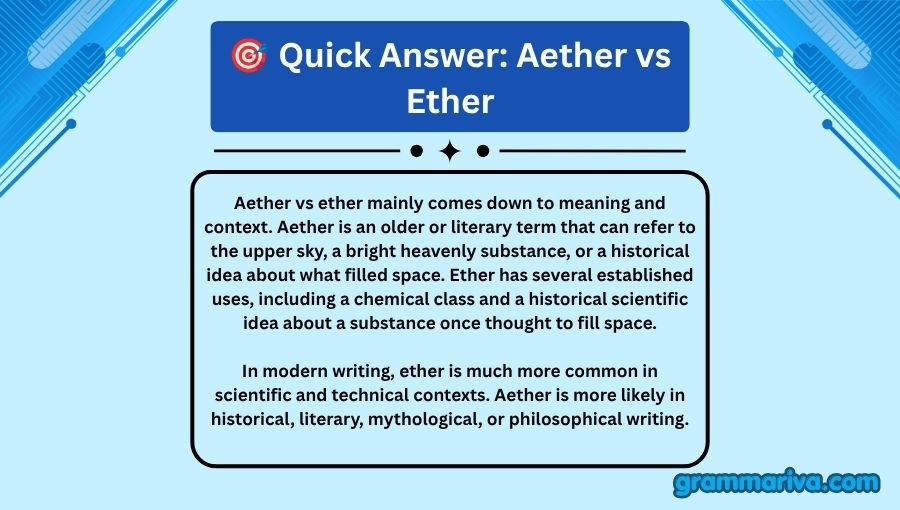
Aether vs ether mainly comes down to meaning and context. Aether is an older or literary term that can refer to the upper sky, a bright heavenly substance, or a historical idea about what filled space. Ether has several established uses, including a chemical class and a historical scientific idea about a substance once thought to fill space.
In modern writing, ether is much more common in scientific and technical contexts. Aether is more likely in historical, literary, mythological, or philosophical writing.
Aether: Meaning and Correct Use
Understanding aether vs ether starts with knowing that the two words can point to different meanings. is a noun with an old-fashioned or literary feel. It can refer to the upper sky or heavens. It may also describe a supposed substance that ancient or historical thinkers believed filled the heavens.
The word is often used when a writer wants to create a sense of the heavens, outer space, or an old philosophical idea.
Examples
- The ancient writer imagined the stars moving through the aether. ✅
- The ancient writer imagined the stars moving through the ether. ❌
The first sentence uses the historical or literary spelling.
Another example:
- The poet described the moon as floating through the aether. ✅
- The poet described the moon as floating through the aether in a chemistry report about solvents. ❌
The second sentence shows how context matters. A chemistry report would normally need ether if it is discussing the chemical substance.
Ether: Meaning and Correct Use
Ether is a noun with several established meanings. In chemistry, an ether is a type of organic compound with an oxygen atom connected to two carbon-containing groups. This distinction is one of the most useful things to remember when learning aether vs ether.
The word also appears in older scientific writing about a supposed substance filling space. That older scientific idea is different from the chemical meaning.
For example:
- The laboratory stored the ether in a properly labeled container. ✅
- The laboratory stored the aether in a properly labeled container. ❌
Here, ether is the correct form because the sentence refers to the chemical.
Ether can also appear in expressions such as in the ether, especially in informal or figurative writing. This can suggest that something is floating around without a clear physical location.
Is Aether the Same as Ether?
No, aether and ether are not always the same word. They overlap in some historical uses, but modern English usually treats them as different spellings with different common contexts.
The easiest way to understand them is to look at the setting. If you are discussing chemistry, ether is normally the right choice. If you are writing about ancient ideas, the heavens, or a deliberately old-fashioned setting, aether may be the better choice.
| Form | Type | Main Meaning | Example | Correct/Incorrect |
|---|---|---|---|---|
| aether | Noun | Upper sky or historical heavenly substance | The gods were said to live in the aether. | ✅ Correct |
| ether | Noun | Chemical compound or historical space-filling substance | The chemist worked with ether. | ✅ Correct |
| aether | Noun | Chemical compound | The lab ordered aether for the experiment. | ❌ Incorrect in standard modern chemical usage |
| ether | Noun | Upper sky in literary writing | The stars crossed the ether. | ⚠️ Possible, but context-dependent |
🔍 Key Differences Between Aether and Ether
The main difference is not grammar. Both forms can function as nouns. The key difference is meaning, context, and style.
Aether tends to feel older, literary, philosophical, or heavenly. Ether is the normal modern spelling for the chemical term and is also used in historical scientific contexts.
| Feature | Aether | Ether |
|---|---|---|
| Common modern use | Limited | Common |
| Chemistry | Usually not used | Standard |
| Literary use | Commoner | Sometimes used |
| Historical sky concept | Yes | Yes, depending on context |
| Formal science writing | Rare | Common |
| Old-fashioned tone | Strong | Less marked |
This difference becomes especially useful when editing technical writing. A word that looks right because it resembles a familiar spelling may still be wrong for the subject.
Why Do People Confuse Aether and Ether?
People confuse these words because their spellings are extremely close and their histories overlap. Both have been used in discussions of the heavens and ideas about what might exist beyond ordinary matter.
Another reason is that older books may use forms differently from modern technical writing. A reader who encounters aether in a novel may later see ether in a chemistry textbook and assume the two are simply spelling variants.
I once reviewed a short science assignment in which a student used aether several times. The student clearly understood the scientific idea but had picked the spelling from an older fantasy novel. The fix was simple: change the spelling to ether in the chemistry passages.
A quick context test
Ask yourself:
- Am I talking about chemistry?
- Am I talking about a historical idea about space?
- Am I deliberately using an old literary or heavenly image?
- Am I writing technical or academic material?
Your answer will usually point you toward the right form.
| Context | Likely Choice | Reason |
|---|---|---|
| Chemistry | ether | Standard modern scientific spelling |
| Ancient heavens | aether | Literary or historical sense |
| Fantasy writing | aether | Creates an old or heavenly feel |
| Modern laboratory report | ether | Technical accuracy |
| Historical science discussion | ether or aether | Depends on the source and style |
Aether vs Ether in Modern English
In modern English, ether is generally the safer choice when the context is scientific or technical. Aether is more specialized and often carries an older flavor.
This does not mean aether is wrong. It means that the spelling should match the meaning you intend.
Consider these examples:
- The chemist carefully handled the ether. ✅
- The chemist carefully handled the aether. ❌
Now compare:
- The poet imagined a silver road through the aether. ✅
- The poet imagined a silver road through the ether. ⚠️
The second sentence may be understandable, but the first has a stronger literary and old-fashioned feel.
📚 Grammar Rules Explanation
There is no complicated grammar rule separating these words. The main issue is word choice.
Both words are nouns, so both can appear after articles such as a and the. They can also appear as objects or subjects.
For example:
- The ether was stored safely. ✅
- The aether appeared above the mountains. ✅
The grammar is correct in both sentences. The meanings are different.
In standard modern usage, ether is the established spelling for the chemical term. Aether is used in certain historical, literary, and philosophical contexts.
Most major dictionaries and standard reference works recognize these words as distinct entries or uses. The safest approach is to select the spelling based on the meaning rather than choosing it because it looks familiar.
Correct vs Incorrect at a Glance
| Sentence | Correct/Incorrect | Why |
|---|---|---|
| The scientist studied ether in the laboratory. | ✅ Correct | The sentence refers to chemistry. |
| The scientist studied aether in the laboratory. | ❌ Incorrect | The spelling does not fit the normal chemical term. |
| The poet wrote about spirits moving through the aether. | ✅ Correct | The context is literary and heavenly. |
| The stars seemed to drift through the aether. | ✅ Correct | The word creates an old or poetic image. |
| The chemist poured aether into the container. | ❌ Incorrect | Modern chemical writing uses ether. |
💡 Test Tip: How Can You Remember the Difference?
Use this simple test:
Chemistry = ether.
If you are talking about a chemical, choose ether.
If you are writing about an old idea of the heavens or using a poetic image, aether may fit better.
I teach this as a context-first rule because spelling alone is not enough.
Think of the extra a in aether as a visual reminder of ancient air or an ancient heavenly idea. It is not a formal grammar rule, but it can help you remember the literary association.
| Question | If Yes | Choose |
|---|---|---|
| Is this about a chemical? | Yes | ether |
| Is this a modern lab report? | Yes | ether |
| Is this historical or literary? | Yes | aether may fit |
| Am I describing the heavens poetically? | Yes | aether may fit |
| Am I unsure in technical writing? | Yes | ether is usually safer |
📝 Case Study: A Simple Workplace Example
Imagine that you are editing a workplace document for a laboratory.
The original sentence says:
“The technician placed the aether in a secure storage area.”
At first glance, the sentence looks polished. However, if the writer means the chemical, the spelling should be ether.
The edited sentence becomes:
“The technician placed the ether in a secure storage area.”
The meaning is now clear, and the terminology fits a technical document.
I once caught myself making a similar kind of mistake while editing a technical paragraph. The word looked familiar, so I almost left it alone. Then I checked the surrounding sentence. The context made the intended meaning obvious, and the spelling needed to match that meaning.
The lesson is simple: Do not proofread these words by appearance alone. Read the whole sentence.
| Original Use | Problem | Better Version |
|---|---|---|
| aether in a chemistry report | Wrong context | ether |
| ether in a fantasy poem | May lose the intended old tone | aether |
| aether in a history discussion | May be appropriate | aether |
| ether in a chemical procedure | Appropriate | ether |
⚠️ Common Mistakes With Aether and Ether
The most common mistake is treating the two spellings as completely interchangeable.
Other mistakes happen because writers remember hearing one form but forget where they saw it.
Three everyday causes are especially common:
- Fast typing: A writer types the familiar spelling without checking the context.
- Autocorrect: A writing program may not understand the intended historical or literary meaning.
- Lack of knowledge: The writer may never have learned that the two forms have different modern uses.
Similar spelling confusions
| Confusion | Correct Choice | Basic Rule |
|---|---|---|
| its / it’s | depends | Possession vs. “it is” |
| your / you’re | depends | Possession vs. “you are” |
| their / there / they’re | depends | Possession, place, or “they are” |
| affect / effect | depends | Usually verb vs. noun, with exceptions |
| aether / ether | depends | Meaning and context |
Specific Aether and Ether Mistakes
| Wrong Form or Use | What’s Wrong | Correct Form |
|---|---|---|
| aether in a chemistry experiment | Not the normal modern chemical spelling | ether |
| aether compound in a lab report | Technical context calls for ether | ether |
| ether used to create an intentionally ancient tone | May not give the desired literary feel | aether |
| aether solution in modern chemistry | Spelling does not fit the standard term | ether |
| aether used without considering context | Meaning may become unclear | Choose based on meaning |
| ether used for every heavenly reference | Can remove the intended historical or literary tone | aether when appropriate |
🕰️ Word Origin and History
The history of these words is closely connected. Older ideas about the heavens used a term that entered English in forms including aether. Over time, ether became a widely established English spelling and developed important scientific uses.
The historical scientific idea of an invisible substance filling space later became associated with the word ether. Modern science no longer uses that old idea as a working explanation of space.
The chemical meaning of ether is now much more important in technical English.
The spelling aether survived in literary, historical, philosophical, and fantasy writing. This is why readers may still encounter it even though it is far less common in everyday modern technical English.
| Period | Form | General Development |
|---|---|---|
| Ancient thought | aether-like forms | Associated with the heavens or upper sky |
| Medieval and early modern writing | aether / ether | Both forms appeared in English traditions |
| Scientific writing | ether | Became established in discussions of physical theories |
| Modern chemistry | ether | Standard technical term for a class of compounds |
| Modern literature | aether | Often retained for historical or poetic effect |
🌎 Usage in Different Contexts
The correct spelling depends heavily on the type of writing. Context is especially important when choosing between aether vs ether in different types of writing.
Everyday Conversation
Most everyday speakers rarely need either word. If the subject comes up, ether is more likely in a scientific discussion.
Professional Writing
Professional writers should be especially careful. In chemistry, laboratory, medical, or technical material, use the established scientific term ether when that is what you mean.
Creative Writing
Creative writers have more freedom. Aether can create a mythic, ancient, heavenly, or fantasy-like feeling.
Social Media and Texting
Informal posts may use either spelling depending on the intended meaning. However, using the correct spelling still helps readers understand the message.
| Context | Which Term to Use | Example |
|---|---|---|
| Everyday conversation | Usually ether if needed | “The discussion turned to ether.” |
| Professional writing | ether for chemistry | “The sample contains ether.” |
| Creative writing | aether for a heavenly image | “She vanished into the aether.” |
| Social media/texting | Depends on meaning | “Lost somewhere in the aether.” |
Is Ether More Common Than Aether?
Yes. Ether is generally much more common in modern English because it has established scientific and technical uses.
Aether remains useful when a writer wants a historical, poetic, philosophical, or fantasy-related tone.
This difference matters when you are writing for a broad audience. A reader who sees ether in a chemistry article is likely to understand the intended field. A reader who sees aether may expect a literary or historical meaning.
| Word | Modern Frequency | Typical Feeling |
|---|---|---|
| ether | Higher | Scientific, technical, historical |
| aether | Lower | Literary, ancient, poetic, fantasy |
Can Aether Be Used in Science Writing?
It can appear in science writing when the writer is discussing the history of science or an old theory. However, it should not normally replace ether when referring to the modern chemical term.
For example:
- Historians discussed the old concept of the luminiferous ether. ✅
- The chemist measured the ether used in the experiment. ✅
- The chemist measured the aether used in the experiment. ❌
The key is to distinguish the historical scientific idea from modern chemistry.
| Scientific Situation | Preferred Word |
|---|---|
| Modern chemical compound | ether |
| Historical theory about space | ether, depending on terminology |
| History of old scientific ideas | ether or aether, depending on the source |
| Modern laboratory procedure | ether |
| Literary description of space | aether |
Common Phrases and Expressions With Ether
Ether appears in several phrases and older expressions. Some are technical, while others are figurative.
| Phrase | Meaning |
|---|---|
| in the ether | Existing somewhere without a clear physical location |
| into the ether | Sent away or seemingly lost |
| the ether | A figurative or historical idea of an unseen medium |
| ethereal ether | A poetic expression suggesting something light or heavenly |
| ether theory | A historical scientific idea involving an unseen medium |
Not every phrase is equally common in everyday American English. Some have a literary or historical tone.
Common Phrases With Aether
Aether has fewer fixed modern expressions. It is more often used as a stylistic noun in literature, fantasy, mythology, or philosophical writing.
| Expression | Typical Meaning |
|---|---|
| into the aether | Into an unseen or heavenly space |
| the aether | A poetic or ancient heavenly realm |
| through the aether | Through an imagined heavenly medium |
| voice of the aether | A poetic image for an unseen realm |
| realms of the aether | Fantasy or literary reference to heavenly space |
These phrases are best understood as stylistic rather than everyday fixed expressions.
✍️ Aether vs Ether in Creative Writing
Creative writing gives these words a special role. Writers often choose aether because it has a more unusual and ancient appearance.
Compare:
The signal disappeared into the ether.
This can sound modern, figurative, or technical.
Now compare:
The silver spirit vanished into the aether.
This sounds more mythic and poetic.
Neither sentence is automatically better. The writer’s goal determines the choice.
| Writing Goal | Better Choice | Why |
|---|---|---|
| Technical accuracy | ether | Standard scientific term |
| Ancient atmosphere | aether | Strong historical feel |
| Fantasy world | aether | Fits mythic language |
| Scientific history | ether often fits | Common historical scientific term |
| Casual figurative phrase | ether | More familiar modern form |
🔄 Synonyms and Alternatives
There is no perfect synonym for either word in every context. The best replacement depends on the intended meaning.
For aether, possible alternatives include heavens, upper sky, or celestial realm in literary contexts.
For ether, possible alternatives include chemical solvent when that is exactly what the writer means. However, this should not be treated as a universal replacement because not every ether is best described simply as a solvent.
| Alternative | Works When | Does Not Work When |
|---|---|---|
| heavens | Talking about a poetic sky | Referring to a chemical |
| upper sky | Explaining an old heavenly idea | Writing about laboratory chemistry |
| celestial realm | Fantasy or literary writing | Technical chemical writing |
| chemical solvent | Explaining a relevant chemical use | Replacing every meaning of ether |
| unseen medium | Historical or figurative discussion | Modern chemistry |
Why It Matters
Choosing between these spellings may seem like a tiny detail. In technical writing, however, tiny details can affect trust.
A chemistry student who writes aether when they mean the chemical term may make the work look less precise. A novelist who uses ether when they wanted an intentionally ancient word may weaken the mood.
Clear word choice helps in several areas:
- Clarity: Readers understand your intended meaning faster.
- Professionalism: Technical writing looks more accurate.
- Digital communication: Search engines and readers can better identify the subject.
- Creative style: The right spelling can support the mood of a story.
| Situation | Why Getting It Right Matters |
|---|---|
| Resume or professional document | Shows careful word choice |
| Client email | Prevents confusion |
| Published content | Improves accuracy and reader trust |
| Social post | Helps readers understand your meaning |
A useful rule I give writers is this:
“Choose the spelling that matches the meaning, not the one that merely looks familiar.”
That single habit prevents many word-choice errors.
🎯 How To Remember the Difference
The easiest memory trick is: This simple approach makes aether vs ether much easier to remember and use correctly.
Ether = chemistry.
When you see a laboratory, chemical compound, or technical chemistry context, think ether.
Aether = ancient or airy.
When you see poetry, mythology, fantasy, old ideas about the heavens, or an intentionally ancient style, aether may be the better fit.
| Memory Clue | Word |
|---|---|
| Chemistry | ether |
| Laboratory | ether |
| Modern technical writing | ether |
| Ancient heavens | aether |
| Poetry | aether |
| Fantasy | aether |
Which Word Should You Use in Academic Writing?
When dealing with aether vs ether in academic writing, the subject should guide your choice. In academic writing, the subject should guide your choice. If your paper discusses chemistry, use ether for the chemical term. If your paper discusses a historical or literary use of aether, keep that spelling when it reflects the source or idea being discussed.
Academic writing rewards precision. Avoid choosing aether simply because it looks more sophisticated.
For example:
- The experiment involved ether as part of the chemical procedure. ✅
- The experiment involved aether as part of the chemical procedure. ❌
But:
- The paper examines the ancient idea of aether. ✅
The second sentence works because the topic is historical rather than chemical.
Can Ether and Aether Be Interchanged?
Not safely in all contexts. Although the words share a connected history and can overlap in older discussions, modern readers often expect different meanings from them. Understanding aether vs ether is mainly about matching the spelling to the meaning and context.
Use ether when the context is modern chemistry or when a modern technical term is intended.
Use aether when you deliberately mean the older heavenly concept or want a literary and historical tone.
| Intended Meaning | Best Choice |
|---|---|
| Chemical compound | ether |
| Modern chemistry | ether |
| Old heavenly substance | aether |
| Poetic upper sky | aether |
| Historical scientific concept | Often ether, depending on context |
| Fantasy realm | aether |
⚡ Aether vs Ether Examples You Can Copy
Here are several quick examples that show the difference.
- The chemist worked with ether in the laboratory. ✅
- The chemist worked with aether in the laboratory. ❌
- The ancient poem describes the gods moving through the aether. ✅
- The ancient poem describes the gods moving through the ether. ⚠️
- The report discusses the chemical properties of ether. ✅
- The report discusses the chemical properties of aether. ❌
- The fantasy hero disappeared into the aether. ✅
- The fantasy hero disappeared into the ether. ⚠️
The ⚠️ examples are not necessarily impossible. They simply show that ether can also have figurative or historical uses. The important point is that the intended meaning should determine the choice.
🧩 Quick Recap Checklist
Use this checklist whenever you are unsure.
| Question | If Yes → Use |
|---|---|
| Am I talking about chemistry? | ether |
| Am I describing a chemical compound? | ether |
| Am I writing a laboratory report? | ether |
| Am I describing an ancient heavenly concept? | aether |
| Am I writing fantasy or poetic prose? | aether |
| Am I discussing an old historical idea? | Check the intended terminology |
Practice Examples
- The scientist prepared the ether for the experiment. ✅
- The wizard disappeared into the aether. ✅
- The chemistry textbook explains how ether behaves. ✅
FAQs About Aether vs Ether
What is the difference between aether and ether?
Aether is mainly used for historical, literary, philosophical, or heavenly meanings. Ether is the standard modern spelling for the chemical term and also appears in historical scientific contexts.
Is aether a correct word?
Yes. Aether is a legitimate English word. It is especially useful in literary, historical, philosophical, and fantasy contexts.
Is ether the correct spelling for the chemical?
Yes. Ether is the standard spelling used for the chemical class in modern English.
Is aether used in modern English?
Yes, but it is much less common than ether. It is most likely to appear in literary, historical, philosophical, fantasy, or poetic writing.
Can I use aether instead of ether in chemistry?
Generally, no. If you mean the modern chemical term, use ether. Using aether can make the sentence look incorrect or confusing in a chemistry context.
Is ether an old word for the sky?
Ether has been used historically in discussions of an invisible medium or the heavens. However, modern English also uses ether for the chemical term, so context matters.
Which spelling is better for fantasy writing?
Aether is often a strong choice for fantasy writing when you want an ancient, mystical, heavenly, or poetic feeling.
Which word should I use in a science paper?
Use ether when you mean the chemical term. If your paper discusses an older historical idea, follow the terminology appropriate to that historical discussion.
Is aether the same as ethereal?
No. The words are related in appearance and history, but aether and ethereal do not have the same grammatical function or exact meaning. Choose each word according to the sentence.
How can I remember aether vs ether?
Remember ether = chemistry. Think of aether = ancient or airy for literary and heavenly uses. This is a memory aid rather than a formal grammar rule.
Conclusion
Aether vs ether becomes much easier once you focus on meaning instead of spelling. Use ether when you are talking about the chemical term or a modern technical context. Use aether when you are referring to an old heavenly idea or creating a literary, poetic, mythic, or fantasy atmosphere.
The two words have a connected history, so confusion is understandable. Still, modern usage gives each spelling a useful role. In a laboratory report, ether is normally the right choice. In a fantasy story about ancient skies, aether may be exactly what you need.
When editing your own work, do not simply ask, “Which spelling looks right?” Ask, “What do I actually mean?” That question usually reveals the answer quickly. ✨
The best writing is not about choosing the fanciest word. It is about choosing the right word for the meaning. Once you connect ether with modern chemistry and aether with older or poetic heavenly language, this confusing pair becomes much easier to remember. 📚

Hi, I’m Olivia Carter. I’m an English language editor at Grammariva, and I work on making grammar lessons clear, accurate, and easy to follow. I especially enjoy writing about common grammar mistakes and everyday English.


[…] writing style, common mistakes, examples, and practical ways to remember the difference. 🌿 Aether vs Ether | To Be Content or Contented | Born in or Born […]
[…] uses of both expressions so you can choose the right phrase with confidence. 🌟 Creek or Crick | Aether vs Ether | To Be Content or […]