Have you ever stopped while writing a sentence and wondered whether to say, “I was born in July” or “I was born on July”? The same question comes up with years, weekdays, exact dates, cities, and even countries. The choice can seem small, but the wrong preposition can make an otherwise correct sentence sound unnatural.
The confusion between born in or born on is common because both prepositions can appear with information about someone’s birth. The key is to look at the kind of time or place you are naming. 📝
In this guide, I’ll explain the rule in plain US English. I’ll show you when to use born in, when to use born on, and when neither one is the right choice. You’ll also see practical examples, common mistakes, quick tests, and real-life situations that make the difference easy to remember.
By the end, you should be able to choose the right preposition without stopping to think about it every time. 😊 Stink vs Stank vs Stunk | I Will Like To vs I Would Like To | Anyplace vs Any Place
🎯 Quick Answer: Born in or Born on
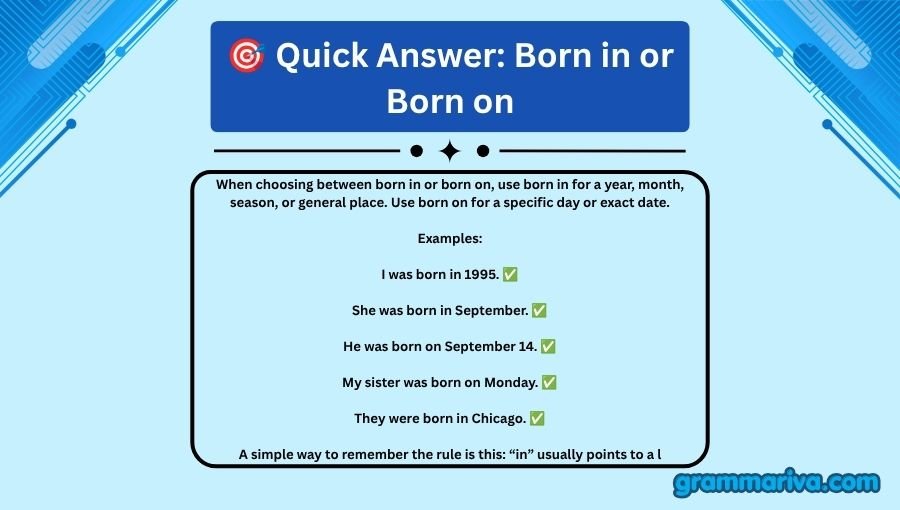
When choosing between born in or born on, use born in for a year, month, season, or general place. Use born on for a specific day or exact date.
Examples:
- I was born in 1995. ✅
- She was born in September. ✅
- He was born on September 14. ✅
- My sister was born on Monday. ✅
- They were born in Chicago. ✅
A simple way to remember the rule is this: “in” usually points to a larger period or place, while “on” points to a particular day or date.
Understanding Born in or Born on
The main difference is the type of information that follows the preposition. Born in usually introduces a broad time period or location. Born on normally introduces a specific day or calendar date.
This distinction is the same pattern we use with many other time expressions in English.
| Form | Type | Meaning | Example | Correct/Incorrect |
|---|---|---|---|---|
| born in | Year | Birth occurred during a year | I was born in 2001. | ✅ Correct |
| born in | Month | Birth occurred during a month | She was born in May. | ✅ Correct |
| born in | Season | Birth occurred during a season | He was born in winter. | ✅ Correct |
| born in | Country | General birthplace | She was born in Canada. | ✅ Correct |
| born in | City | General birthplace | I was born in Dallas. | ✅ Correct |
| born on | Day | Birth occurred on a particular day | I was born on Friday. | ✅ Correct |
| born on | Exact date | Specific calendar date | He was born on June 8. | ✅ Correct |
| born on | Specific day and date | Exact calendar information | She was born on Monday, June 8. | ✅ Correct |
| born on | Month alone | Month without a date | She was born on May. | ❌ Incorrect |
| born in | Exact date | Specific calendar date | He was born in June 8. | ❌ Incorrect |
The basic idea is simple. If the information gives you a larger time frame, choose in. If it gives you a specific day, choose on.
What Does Born in Mean?
Born in is used when you identify the year, month, season, or general place of someone’s birth.
For time, think of in as placing the birth inside a larger period.
Born in + year
Use born in before a year.
- I was born in 1998. ✅
- My brother was born in 2004. ✅
- She was born in 1987. ✅
Do not use on before a year by itself.
- I was born on 1998. ❌
- I was born in 1998. ✅
The year is a large period. You are saying that the birth happened sometime within that year.
Born in + month
Use born in before a month when no exact date follows.
- He was born in March. ✅
- She was born in November. ✅
- I was born in August. ✅
Compare that with an exact date:
- I was born in August. ✅
- I was born on August 17. ✅
The first sentence gives only the month. The second gives the exact day.
Born in + season
You can also use born in with seasons.
- She was born in spring. ✅
- He was born in summer. ✅
- I was born in the winter. ✅
Both “in winter” and “in the winter” can be natural depending on the sentence and style.
Born in + place
Born in is also used with cities, states, countries, and other broad locations.
- She was born in New York. ✅
- He was born in Texas. ✅
- I was born in the United States. ✅
- They were born in Mexico. ✅
Here, in shows that the birthplace is within a particular area.
When Should You Use Born on?
Use born on when you are talking about a particular day or exact calendar date.
Born on + day of the week
Use on before a weekday.
- I was born on Monday. ✅
- She was born on Friday. ✅
- He was born on Sunday. ✅
The day is specific. You are identifying one particular day rather than a whole month or year.
Born on + exact date
Use on before a complete date.
- I was born on July 4. ✅
- She was born on December 25. ✅
- He was born on March 12, 1999. ✅
This is one of the most important rules to remember.
Compare:
- She was born in March. ✅
- She was born on March 12. ✅
The month uses in. The exact date uses on.
Born on + day and date
You can combine a weekday with a date.
- He was born on Tuesday, May 6. ✅
- She was born on Saturday, October 19. ✅
Because the expression identifies a particular calendar day, on is correct.
Is Born in Used for Months and Years?
Yes. Born in is the standard choice for months and years when they appear without a specific day.
The rule is easy:
Month → in
Year → in
Examples:
- I was born in January. ✅
- I was born in 1990. ✅
- I was born in January 1990. ✅
Notice that even when a month and year appear together, in remains correct.
However:
- I was born on January 15, 1990. ✅
Adding the exact day changes the preposition from in to on.
| Birth Information | Correct Preposition | Example |
|---|---|---|
| Year | in | born in 1990 |
| Month | in | born in January |
| Month + year | in | born in January 1990 |
| Season | in | born in summer |
| Weekday | on | born on Monday |
| Exact date | on | born on January 15 |
| Weekday + exact date | on | born on Monday, January 15 |
Is Born on Used for Exact Dates?
Yes. Born on is used for a specific calendar date.
For example:
- She was born on April 2. ✅
- He was born on November 11, 2000. ✅
- My daughter was born on Tuesday, June 3. ✅
The important question is not whether a month appears in the sentence. The important question is whether you are giving a specific day.
Consider these examples:
- She was born in April. ✅
- She was born on April 2. ✅
Both are correct because they give different amounts of information.
Why Do People Confuse Born in and Born on?
People often confuse these forms because both prepositions are connected with time. The difference becomes easier when you stop thinking about the word “birth” and focus on the time expression after it.
I once helped a student proofread a short biography. The student had written, “The author was born on 1996.” The sentence looked almost right at first glance. Once we changed on to in, the problem disappeared.
There are several reasons this mistake happens.
Fast typing
When people type quickly, they often choose a familiar preposition without checking the time expression.
Autocorrect
Typing software may suggest or preserve a preposition that does not fit the sentence.
Lack of knowledge
Some learners memorize “born on” as a fixed phrase. Others memorize “born in.” Both are incomplete rules.
Influence from other phrases
English uses on with days and dates in many situations:
- on Monday
- on Friday
- on June 10
It uses in with months and years:
- in June
- in 2010
The birth phrase follows the same general pattern.
Born in vs Born on at a Glance
The easiest comparison is to put matching examples side by side.
| Information | Correct Sentence | Why |
|---|---|---|
| Year | I was born in 2002. | A year is a broad period. |
| Month | She was born in July. | A month is a broader period. |
| Season | He was born in spring. | A season covers a period. |
| Day | I was born on Tuesday. | Tuesday identifies a particular day. |
| Exact date | She was born on July 21. | The date identifies one calendar day. |
| Month + year | He was born in July 2002. | No exact day is given. |
A useful memory trick is:
IN = inside a period. ON = one specific day.
This is not a complete grammar rule for every use of these prepositions, but it works very well for birth dates.
💡 Test Tip: How Can You Check the Right Preposition?
Here is my favorite quick test.
Ask yourself:
“Am I giving a month, year, season, or general place?”
If yes, in is usually right.
Then ask:
“Am I giving one exact day or date?”
If yes, on is usually right.
Try the test:
- 1995 → in 1995
- May → in May
- winter → in winter
- Monday → on Monday
- May 14 → on May 14
This test takes only a few seconds.
| Question | If Yes → Use | Example |
|---|---|---|
| Is it a year? | in | born in 1995 |
| Is it a month? | in | born in May |
| Is it a season? | in | born in winter |
| Is it a city or country? | in | born in Boston |
| Is it a weekday? | on | born on Monday |
| Is it an exact date? | on | born on May 14 |
📝 Case Study: Choosing the Right Birth Preposition
Imagine that Maya is writing a short professional biography:
“Maya Chen was born in Seattle in 1992. She moved to California after college.”
This version is correct because Seattle is a city and 1992 is a year.
Now suppose Maya wants to give her exact birth date:
“Maya Chen was born in Seattle on September 18, 1992.”
Again, the sentence is correct. In introduces the location, while on introduces the exact date.
I once edited a company profile that had a similar problem. The writer used “born on” before a year because they had remembered seeing “born on” in biographies. The fix was simple: the year needed in, while an exact date would have needed on.
The lesson is clear: do not memorize only one phrase. Look at what comes after the preposition.
Grammar Rules Explanation
The grammar rule comes from the normal use of English prepositions for time and place.
In commonly introduces a broader time period. That includes years, months, and seasons. It can also introduce a location such as a city, state, or country.
On commonly introduces a specific day or date.
So:
- born in 1985
- born in October
- born in California
- born on Monday
- born on October 7
The same pattern appears outside birth statements:
- We met in 2015.
- We met in October.
- We met on Monday.
- We met on October 7.
Standard English reference sources follow this basic distinction. The important point is not to memorize a special rule only for the word “born.” Instead, learn how in and on normally work with time.
Correct vs Incorrect at a Glance
| Sentence | Correct/Incorrect | Why |
|---|---|---|
| I was born in 1999. | ✅ Correct | A year takes “in.” |
| She was born on 1999. | ❌ Incorrect | “On” does not normally introduce a year. |
| He was born in June. | ✅ Correct | A month takes “in.” |
| He was born on June. | ❌ Incorrect | The month has no exact day. |
| She was born on June 12. | ✅ Correct | An exact date takes “on.” |
What About Born in a City or Country?
Use born in when naming a city, state, country, region, or other broad location.
Examples:
- I was born in Miami. ✅
- She was born in California. ✅
- He was born in France. ✅
- They were born in a small town. ✅
You would not normally use born on simply because the location is specific.
For example:
- I was born on Chicago. ❌
- I was born in Chicago. ✅
The preposition on can be used with some physical surfaces or certain geographical features, but that is a different rule. For ordinary birthplace statements involving cities and countries, in is the natural choice.
Can You Say Born on a Street?
Yes, but this is a special location pattern rather than a birth-date rule.
For example, someone might say:
- She was born on Oak Street.
Here, on is connected to the street expression. It does not mean that the person was born on a particular date.
Compare:
- She was born in Chicago. ✅
- She was born on Oak Street. ✅
- She was born on March 4. ✅
The first describes a city. The second describes a street location. The third describes a date.
⚠️ Common Mistakes With Born in and Born on
Most mistakes happen because writers focus on the word born instead of the information that follows it.
| Common Confusion | Example | Better Choice |
|---|---|---|
| Year vs. exact date | born on 1995 | born in 1995 |
| Month vs. exact date | born on July | born in July |
| Day vs. month | born in Monday | born on Monday |
| Exact date vs. month | born in July 5 | born on July 5 |
| City vs. date | born on Chicago | born in Chicago |
| Country vs. date | born on Canada | born in Canada |
Specific wrong forms
| Wrong Form | What’s Wrong | Correct Form |
|---|---|---|
| born on 1990 | A year is not a specific day. | born in 1990 |
| born on March | No exact day is given. | born in March |
| born in Monday | A weekday takes “on.” | born on Monday |
| born in March 10 | An exact date takes “on.” | born on March 10 |
| born on New York | A city normally takes “in.” | born in New York |
| born on 1988 | A year normally takes “in.” | born in 1988 |
Why do these errors happen?
Fast typing: Writers may choose the first preposition that comes to mind.
Autocorrect: Software can make a sentence look polished even when the grammar is wrong.
Lack of knowledge: Some learners have learned examples but not the underlying rule.
Overgeneralization: Someone may learn “born on” from an exact date and then use it before every birth year or month.
Born in or Born on in Different Contexts
The correct preposition does not change simply because the writing style changes. The same time rule works in conversation, professional writing, creative writing, and digital communication.
| Context | Which Term to Use | Example |
|---|---|---|
| Everyday conversation | in/on based on the time expression | I was born in 2000. |
| Professional writing | in/on based on the time expression | The director was born in Boston in 1978. |
| Creative writing | in/on based on the time expression | She was born on a rainy Tuesday. |
| Social media/texting | in/on based on the time expression | Born in July! 🎂 |
The tone can change. The grammar rule does not.
How Does the Rule Work With Full Birth Dates?
A full birth date usually contains a month, day, and year. Because the date identifies one specific calendar day, use on.
- She was born on August 22, 1994. ✅
- He was born on January 1, 2001. ✅
Do not let the year confuse you. Although a year normally takes in, the complete date is treated as a specific day.
Compare:
- He was born in 2001. ✅
- He was born on January 1, 2001. ✅
Both sentences are correct. One gives a broad time period. The other gives an exact date.
What Happens When a Month and Year Appear Together?
Use in when a month and year are given without a specific day.
- She was born in September 1985. ✅
- He was born in February 2003. ✅
The month and year together still describe a period rather than one exact day.
But add a day, and use on:
- She was born on September 14, 1985. ✅
- He was born on February 9, 2003. ✅
| Birth Information | Correct Form |
|---|---|
| 1985 | born in 1985 |
| September | born in September |
| September 1985 | born in September 1985 |
| September 14 | born on September 14 |
| September 14, 1985 | born on September 14, 1985 |
| Friday | born on Friday |
| Friday, September 14 | born on Friday, September 14 |
How To Remember the Difference
I recommend remembering three simple levels.
Level 1: Big period → IN
Think:
- in 1990
- in July
- in winter
Level 2: One day → ON
Think:
- on Monday
- on Friday
Level 3: Exact date → ON
Think:
- on July 10
- on December 25, 1995
A short memory line can help:
IN gives the period. ON gives the day.
This rule is short enough to remember when you are writing a resume, biography, school assignment, or social media post.
Common Birth-Date Phrases
There are several natural expressions that commonly appear when people discuss birth information.
| Phrase | Meaning |
|---|---|
| born in 1995 | born during the year 1995 |
| born in July | born during July |
| born in winter | born during winter |
| born in New York | birthplace is New York |
| born on Monday | birth occurred on Monday |
| born on July 15 | birth occurred on July 15 |
These phrases can be expanded with more information.
For example:
- She was born in Texas in 1989.
- He was born on Saturday, April 3, 1999.
- I was born in December.
- My cousin was born on Christmas Day.
Synonyms and Alternatives for Birth Information
Sometimes you can avoid the phrase entirely. This can be useful when you want to vary your writing.
| Alternative | Works When | Does Not Work When |
|---|---|---|
| born in | Giving a year, month, season, or place | Giving a specific day or date |
| born on | Giving a day or exact date | Giving only a year or month |
| birth date | Referring to the date itself | Replacing a complete sentence naturally |
| date of birth | Formal forms and records | Casual conversation may sound too formal |
| birthplace | Naming the place of birth | Giving the birth date |
| birthday | Referring to the yearly celebration | Giving the original birth year in formal writing |
For example, a form may ask for your date of birth, while a biography may say, “She was born on May 5, 1990.”
These expressions overlap in meaning, but they do not always work as direct replacements.
Why Correct Birth Prepositions Matter
Using the right preposition makes your writing clearer and more professional. A small grammar error can distract readers, especially in formal biographies, resumes, school work, and published content.
| Situation | Why Getting It Right Matters |
|---|---|
| Resume | Professional writing should be clean and accurate. |
| Biography | Birth information is often presented as factual detail. |
| Client email | Small grammar mistakes can reduce confidence in your writing. |
| Social post | Correct wording makes short posts easier to read. |
A useful writing principle is:
Clear writing makes simple facts easy to understand.
That is especially true with dates. Readers should not have to stop and decode a basic birth statement.
Is Born in or Born on Used for Birthplaces?
For ordinary cities, states, countries, and regions, use born in.
Examples:
- She was born in Los Angeles. ✅
- He was born in Ohio. ✅
- They were born in Brazil. ✅
However, a specific address or street may use a different preposition based on the normal grammar of the location expression.
The important distinction is:
Time:
- born in 1995
- born on June 7
Place:
- born in Boston
- born in Canada
Do not transfer the date rule to every kind of location.
Does Born in or Born on Change in American English?
No major difference in the basic rule exists here. In standard US English, use in with years and months, and on with specific days and dates.
For example:
- I was born in 1998.
- I was born in November.
- I was born on November 6.
- I was born on Tuesday.
These are natural forms in American English.
Practice Examples
Try choosing the correct preposition before checking the answers.
Example 1
“I was born ___ 2005.”
Answer: in ✅
A year is a broad period.
Example 2
“She was born ___ August.”
Answer: in ✅
A month takes in when no exact day is given.
Example 3
“He was born ___ August 21.”
Answer: on ✅
An exact date takes on.
Example 4
“My sister was born ___ Sunday.”
Answer: on ✅
A weekday takes on.
Example 5
“My parents were born ___ California.”
Answer: in ✅
A state is a general place.
Born in or Born on: Quick Recap Checklist
Use this checklist whenever you are unsure.
| Question | If Yes → Use |
|---|---|
| Is the information a year? | in |
| Is it a month? | in |
| Is it a season? | in |
| Is it a city? | in |
| Is it a country? | in |
| Is it a weekday? | on |
| Is it an exact date? | on |
| Does the date include a specific day? | on |
Practice
- I was born ___ 1997.
Answer: in ✅ - She was born ___ March 16.
Answer: on ✅ - He was born ___ March.
Answer: in ✅
These three examples capture the main rule.
FAQs About Born in vs Born on
When should I use born in?
Use born in before a year, month, season, city, state, country, or other broad location or period.
Example: “She was born in 1995.”
When should I use born on?
Use born on before a specific day or exact calendar date.
Example: “She was born on June 12.”
Is it correct to say “I was born on 1990”?
No. The natural form is “I was born in 1990.” A year is a broad time period, so it normally takes in.
Is it “born in July” or “born on July”?
Use “born in July” when you mean the month generally. If you give an exact date, use on, as in “born on July 15.”
Is it “born in Monday” or “born on Monday”?
Use “born on Monday.” A weekday refers to a particular day, so on is the correct preposition.
Is it “born in June 5” or “born on June 5”?
Use “born on June 5.” An exact date takes on.
Do I say “born in New York” or “born on New York”?
Use “born in New York” when New York refers to the city or state. In is the normal preposition for this type of birthplace.
Is “born in 2000” grammatically correct?
Yes. “Born in 2000” is completely correct because 2000 is a year.
Can I say “born on Friday, July 12”?
Yes. This is correct because the expression identifies one specific calendar day.
What is the easiest way to remember born in and born on?
Remember: in usually goes with broader periods such as years and months, while on goes with specific days and dates.
Conclusion
Born in or born on becomes easy once you focus on the information after the preposition. Use born in for years, months, seasons, and broad places. Use born on for weekdays and exact dates.
So remember these core examples:
- born in 1990
- born in September
- born in California
- born on Monday
- born on September 18
- born on Monday, September 18
The most useful shortcut is simple: a period takes “in,” while a specific day or date takes “on.”
When you are unsure, look at the expression after born instead of memorizing the entire phrase. If it is a year or month, choose in. If it is one particular day or date, choose on. That small habit will help you write cleaner biographies, forms, emails, assignments, and everyday messages.
Once you remember that distinction, this common grammar problem becomes much easier. Think “IN for the period, ON for the day,” and you’ll rarely get it wrong. ✨

Hi, I’m Madison Hayes. I’m an English learning writer at Grammariva, where I work on simple lessons and examples for people who want to improve their grammar and writing. I love turning confusing rules into easy-to-follow explanations.



[…] also show you examples, common mistakes, useful tests, and practical ways to remember the rule. Born in or Born on | Stink vs Stank vs Stunk | I Will Like To vs I Would Like […]