Have you ever typed a sentence and stopped because you were not sure whether anyplace vs any place was the right form? You are not alone. These two forms look almost identical, and both can appear in sentences about location. That makes the choice easy to miss, especially when writing quickly. 😊
The good news is that the rule is much simpler than it first seems. Anyplace is a single word that means “anywhere.” Any place is two words and refers to any particular location, spot, or place. The difference is mainly about how the phrase works in the sentence.
As an editor, I often tell writers to ask one simple question: “Could I replace this with anywhere?” If the answer is yes, anyplace may be the better choice. If you mean any specific location or any location at all as a noun phrase, any place is usually the better form.
Let’s break down the difference step by step so you can choose the correct form with confidence. Plane vs Plain | Supercede vs Supersede | Chateaus vs Chateaux
🎯 Quick Answer: Anyplace vs Any Place
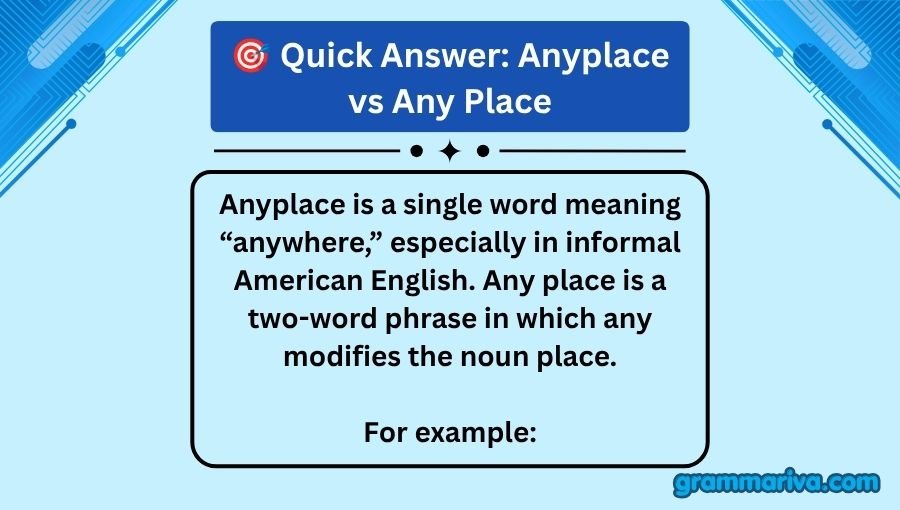
Anyplace is a single word meaning “anywhere,” especially in informal American English. Any place is a two-word phrase in which any modifies the noun place.
For example:
- ✅ You can sit anyplace you want.
- ❌ You can sit any place you want.
In this meaning, anyplace is more natural because the sentence means “anywhere.”
But:
- ✅ Is there any place where we can meet privately?
- ❌ Is there anyplace where we can meet privately?
This version can occur in informal English, but the two-word form is often clearer when place is being treated as a noun.
A useful shortcut is this:
Anyplace = anywhere.
Any place = any location or spot.
🔎 Anyplace vs Any Place at a Glance
The main difference is grammatical. Anyplace functions as an adverb, while any place is generally a noun phrase.
| Form | Type | Meaning | Example | Correct/Incorrect |
|---|---|---|---|---|
| anyplace | Adverb | Anywhere | You can go anyplace. | ✅ Correct |
| any place | Noun phrase | Any location or spot | Any place would be better than this. | ✅ Correct |
| any place | Noun phrase | Any location | We could meet at any place near the station. | ✅ Correct |
| anyplace | Adverb | Anywhere | She looked anyplace for her keys. | ❌ Usually incorrect in this structure |
| anyplace | Adverb | Anywhere | You can park anyplace. | ✅ Correct |
The forms can sometimes overlap in meaning, especially in casual American English. However, they are not always interchangeable.
🧠 What Does Anyplace Mean?
Anyplace means “anywhere.” It is normally used to talk about location without treating place as a separate noun.
For example:
- ✅ I can’t find my phone anyplace.
- ❌ I can’t find my phone any place.
Here, the speaker means “I can’t find my phone anywhere.” There is no specific noun place being described.
You can think of anyplace as a location word. It tells us where something can happen, where something is, or where something is not.
Anyplace as an Adverb
An adverb can give information about where an action happens. In this use, anyplace works much like anywhere.
Consider:
You can sit anyplace.
The word anyplace tells us where the person can sit. It does not name a particular location.
More examples:
- ✅ We can eat anyplace tonight.
- ✅ You can work anyplace with a good internet connection.
- ✅ I don’t want to go anyplace crowded.
- ✅ She couldn’t find the book anyplace.
The word is especially common in casual American speech and writing.
When Anyplace Means Anywhere
The easiest test is substitution.
| Sentence | Replace With “Anywhere” | Result |
|---|---|---|
| You can go anyplace. | You can go anywhere. | Natural |
| I can’t find it anyplace. | I can’t find it anywhere. | Natural |
| We can meet anyplace. | We can meet anywhere. | Natural |
| She looked anyplace for help. | She looked anywhere for help. | Awkward |
| Put it anyplace safe. | Put it anywhere safe. | Natural |
If anywhere fits naturally, anyplace may also fit.
📍 What Does Any Place Mean?
Any place consists of two separate words: the determiner any and the noun place.
It means any location, spot, area, or site that fits the situation.
For example:
Any place with enough seats will work.
Here, place is clearly a noun. The speaker is talking about a location that has enough seats.
Other examples include:
- ✅ Any place near the beach would be expensive.
- ✅ We need any place that can hold fifty people.
- ✅ Do you know any place that sells fresh bread?
- ✅ She would choose any place with a quiet view.
In these sentences, place can be modified by additional information.
🏠 When Should You Use Any Place?
Use any place when you are treating place as an actual noun.
This often happens when another phrase describes the place.
For example:
Any place with a parking lot would be fine.
The phrase with a parking lot describes place. That makes the noun structure easy to see.
You can also use any place that…
- ✅ Any place that serves breakfast is fine.
- ✅ Any place that allows children will work.
- ✅ Any place that has Wi-Fi is acceptable.
The word place remains a noun in each example.
Any Place as a Noun Phrase
Here are several common patterns:
| Pattern | Example | Meaning |
|---|---|---|
| any place + description | Any place near here is fine. | Any location nearby |
| any place + that clause | Any place that accepts cards will work. | Any suitable location |
| any place + with phrase | Any place with a view is popular. | Any location having a view |
| at any place | We could stop at any place along the road. | At any location |
| from any place | The signal works from any place in the building. | From any location |
❓ Is Anyplace the Same as Any Place?
Anyplace and any place can have similar meanings, but they are not always grammatically identical. The one-word form usually means “anywhere,” while the two-word form treats place as a noun.
Compare:
You can work anyplace.
This means:
You can work anywhere.
Now compare:
Any place with a desk will work.
This means:
Any location with a desk will work.
The meanings are related, but the grammar is different.
I once edited a short workplace guide where a writer had changed every instance of any place to anyplace because they thought the one-word version was simply a shorter spelling. That created awkward sentences such as “anyplace with a valid permit.” The original two-word forms were better because place was functioning as a noun.
📝 Understanding Anyplace vs Any Place in Grammar
The key grammatical difference is simple: anyplace acts as an adverb, while any place contains the noun place.
That difference explains most cases.
Anyplace as an Adverb
When anyplace means anywhere, it describes location.
You can leave the package anyplace.
The word tells us where the package can be left.
Any Place as a Noun Phrase
When place is a noun, another word or phrase may describe it.
Any place near the entrance will be convenient.
Here, near the entrance describes the place.
The following table makes the contrast clearer.
| Form | Grammatical Role | Basic Idea | Example |
|---|---|---|---|
| anyplace | Adverb | anywhere | Sit anyplace. |
| any place | Noun phrase | any location | Any place near me is fine. |
| anyplace | Adverb | anywhere | We can go anyplace. |
| any place | Noun phrase | any particular location | Any place with food will work. |
🎯 How Can You Tell Which Form Is Correct?
Use the anywhere test.
If you can replace the word with anywhere without changing the basic meaning, anyplace is usually a good choice.
For example:
We can meet anyplace.
Change it:
We can meet anywhere.
The meaning stays almost the same.
Now consider:
Any place with a table will work.
Try replacing any place with anywhere:
Anywhere with a table will work.
That sentence sounds different and less natural. The original noun phrase is clearer.
The Anywhere Test
| If You Mean… | Better Form | Example |
|---|---|---|
| anywhere | anyplace | You can sit anyplace. |
| any location | any place | Any place near here is fine. |
| any spot | any place | Any place with shade will work. |
| anywhere at all | anyplace | I couldn’t find it anyplace. |
| a location described by a phrase | any place | Any place with Wi-Fi is fine. |
💡 Test Tip: Remove the Extra Description
Here is another useful test.
Look at:
Any place near the station will work.
Remove near the station:
Any place will work.
The noun place still makes sense.
Now look at:
You can sit anyplace.
There is no separate noun being described. The whole word means “anywhere.”
This test can help when you are unsure.
📝 Case Study: Choosing the Right Form at Work
Imagine a manager sends this message:
“You may work anyplace on Friday.”
The manager means the employee can work anywhere. The one-word form works well in this informal sentence.
Now imagine a company policy says:
“Any place with restricted access must remain locked.”
Here, place refers to a location that has a certain condition. The two-word form is much clearer.
| Situation | Sentence | Best Choice |
|---|---|---|
| Casual instruction | Work anyplace you like. | anyplace |
| Company policy | Any place with restricted access must remain locked. | any place |
| Casual conversation | We can eat anyplace. | anyplace |
| Location description | Any place near the office is convenient. | any place |
| General statement | You can find these products anyplace. | anyplace |
The context tells you which structure makes the meaning easiest to understand.
⚙️ Grammar Rules Explanation
The rule comes from the grammatical role of place.
In anyplace, the word functions as a single adverb meaning “anywhere.” It does not normally behave like an ordinary noun that can be followed by descriptive modifiers in the same way.
In any place, place remains a noun. The word any modifies that noun.
This is similar to other English pairs where a single word and a two-word phrase have related meanings but different grammatical jobs.
Most standard English reference sources recognize anyplace as a word meaning “anywhere,” while any place remains the ordinary noun phrase.
The distinction becomes especially useful when a sentence includes a phrase that clearly describes the location.
Correct vs Incorrect at a Glance
| Sentence | Correct/Incorrect | Why |
|---|---|---|
| You can sit anyplace. | ✅ Correct | Anyplace means “anywhere.” |
| Any place near the window is fine. | ✅ Correct | Place is a noun described by “near the window.” |
| I couldn’t find my wallet anyplace. | ✅ Correct | Anyplace means “anywhere.” |
| Anyplace with a quiet room will work. | ❌ Usually awkward | The noun place is being described by “with a quiet room.” |
| Any place will do. | ✅ Correct | Place is being used as a noun. |
❌ Why Do People Confuse Anyplace and Any Place?
People confuse these forms because the difference is small on the page. Both contain the same two words, and both relate to location.
There are three common reasons.
1. Fast Typing
When people type quickly, they may join words or separate them without thinking about grammar.
2. Autocorrect
Autocorrect can sometimes change spacing or suggest a form based on common patterns. Writers may accept the suggestion without checking the sentence.
3. Lack of Knowledge
Many writers know that anywhere is one word and assume that any place must always become anyplace. That is not the case.
I once caught myself making the same kind of mistake while quickly editing a sentence. I had joined any place into anyplace without noticing that the following phrase described the noun. Slowing down and reading the sentence aloud immediately exposed the problem.
⚠️ Common Mistakes With Anyplace and Any Place
The most common error is treating the two forms as interchangeable in every sentence.
Here are some patterns to watch.
| Confusion | Problem | Better Approach |
|---|---|---|
| anyplace / any place | Assuming both forms always work equally | Check whether “anywhere” fits |
| every day / everyday | Confusing noun phrase and adjective | Ask whether the word describes a noun |
| a lot / alot | Treating a phrase as one word | Keep standard spacing |
| in to / into | Confusing separate words with a preposition | Check the sentence structure |
| any one / anyone | Confusing “any individual” with the pronoun | Check the intended meaning |
The lesson is broader than this one pair: spacing can affect grammar and meaning.
🚫 Common Wrong Spellings and Uses
Some forms appear in informal writing but should not be treated as standard choices.
| Wrong Form or Use | What’s Wrong | Correct Form |
|---|---|---|
| anyplace with a table | Often awkward when place is a noun being described | any place with a table |
| any place I want to go | May be unclear when meaning “anywhere” | anyplace I want to go |
| any-place | Unnecessary hyphen | anyplace or any place |
| anyplace that has parking | Often clearer with noun structure | any place that has parking |
| anyplace at all | Can be correct, but style depends on meaning | anyplace at all |
| any place at all | Can also be correct when emphasizing a location | any place at all |
The last two are especially important. Context matters.
🌎 Anyplace in American English
Anyplace is especially familiar in American English, particularly in informal conversation and casual writing. Understanding anyplace vs any place is especially useful when choosing between casual American English and a more neutral alternative such as “anywhere.”
For many readers, it sounds natural in sentences such as:
- You can park anyplace.
- I can’t find it anyplace.
- We can go anyplace you want.
In more formal writing, anywhere is often a cleaner alternative.
For example:
Employees may work anywhere with an approved internet connection.
This can sound more neutral than:
Employees may work anyplace with an approved internet connection.
The choice is not always about right versus wrong. Sometimes it is about clarity and style.
💬 Anyplace in Everyday Conversation
In everyday speech, anyplace vs any place is usually easy to understand once you know whether “place” is acting as a noun or whether the whole word means “anywhere.” In casual conversation, anyplace can sound relaxed and natural when it means “anywhere.”
Examples:
- Let’s go anyplace that’s open.
- You can sit anyplace.
- I don’t want to go anyplace tonight.
- We can meet anyplace downtown.
However, many speakers will choose anywhere instead.
| Casual Sentence | Natural Alternative |
|---|---|
| Let’s go anyplace. | Let’s go anywhere. |
| You can sit anyplace. | You can sit anywhere. |
| I can’t find it anyplace. | I can’t find it anywhere. |
| We can meet anyplace. | We can meet anywhere. |
💼 Any Place in Professional Writing
Professional writing often benefits from the clearer noun phrase any place when a location is being described.
For example:
Any place with restricted access must remain secure.
This is clear because with restricted access modifies place.
In other cases, anywhere may be even more natural:
Employees can access the system anywhere with a secure connection.
That avoids the choice altogether.
| Professional Situation | Recommended Form | Example |
|---|---|---|
| General location | anywhere | Access the system anywhere. |
| Described location | any place | Any place with restricted access requires approval. |
| Informal policy | anyplace | Staff may work anyplace. |
| Formal instructions | anywhere | You may complete the task anywhere. |
✍️ Anyplace and Any Place in Creative Writing
Creative writers have more freedom because voice matters.
A character might naturally say:
I’ll meet you anyplace.
That can help the dialogue sound casual.
Narrative writing may instead use:
Any place near the river seemed peaceful.
Here, the writer is describing possible locations.
The best form depends on the meaning and the voice of the writing.
📱 Anyplace and Any Place in Texting and Social Media
The anyplace vs any place distinction can make professional writing clearer because the two forms do not always serve the same grammatical role. In texts and social posts, both forms can appear.
If you mean “anywhere,” anyplace is acceptable in casual writing:
We can go anyplace after dinner 😂
If you are naming a type of location, use any place:
Any place with good food is fine with me.
However, social media often favors anywhere because it is shorter and extremely familiar.
| Context | Which Term to Use | Example |
|---|---|---|
| Everyday conversation | anyplace or anywhere | We can meet anyplace. |
| Professional writing | any place or anywhere | Any place with parking will work. |
| Creative writing | Either, depending on meaning | She searched anyplace she could. |
| Social media/texting | anyplace or anywhere | Let’s go anyplace fun. |
🔑 Key Differences Between Anyplace and Any Place
The easiest way to remember the distinction is to focus on the job of place.
Anyplace is a location adverb.
Any place is a noun phrase.
That gives us a simple comparison.
| Feature | Anyplace | Any Place |
|---|---|---|
| Number of words | One | Two |
| Main role | Adverb | Noun phrase |
| Similar word | anywhere | any location |
| Can mean “anywhere”? | Yes | Sometimes, depending on structure |
| Often followed by a description of place? | Not usually | Yes |
| Common in casual American English? | Yes | Yes |
🧩 How To Remember the Difference
The simplest way to remember anyplace vs any place is to ask whether you could replace the expression with “anywhere.” Use this memory trick:
If you can say “anywhere,” think “anyplace.”
For example:
You can sit anywhere.
You can sit anyplace.
Both work.
But:
Any place with a view is expensive.
Here, place is a noun. The phrase with a view describes it.
Another trick is to look for words that follow place.
If you see patterns such as:
- any place with…
- any place near…
- any place that…
- any place where…
the two-word form is often the clearest choice.
📚 Common Phrases With Anyplace and Any Place
Neither form has many fixed idioms of its own. Still, several useful patterns occur often.
| Phrase | Meaning |
|---|---|
| anyplace at all | anywhere whatsoever |
| go anyplace | go anywhere |
| work anyplace | work anywhere |
| any place near here | any nearby location |
| any place with parking | any location with parking |
| any place that works | any suitable location |
These are not all fixed idioms. They are common sentence patterns that can help you recognize the grammar.
🔄 Synonyms and Alternatives
When the anyplace vs any place choice feels awkward, alternatives such as “anywhere” or “any location” can sometimes make the sentence clearer. Sometimes the best way to avoid uncertainty is to choose another word.
Anywhere is the strongest alternative to anyplace because they often have the same basic meaning.
Any location is useful in formal writing.
Any spot is useful when referring to a particular physical position.
Any site works well for certain professional or technical contexts.
| Alternative | Works When | Does Not Work When |
|---|---|---|
| anywhere | You mean any location | You need to emphasize place as a noun |
| any location | Writing is formal or precise | The tone is very casual |
| any spot | Referring to a particular physical position | Discussing broad locations |
| any site | Referring to a location such as a work site | Talking about casual movement |
| wherever | You mean any location that fits a condition | You simply mean an unspecified location |
For example:
You can sit anywhere.
is often more natural than:
You can sit anyplace.
Both are grammatical.
🎯 Is Any Place Always Better Than Anyplace?
No. Any place is not always better than anyplace. The correct choice depends on what the sentence means.
Use anyplace when it means “anywhere.”
Use any place when place is a noun that refers to a location, especially when that noun is described by another phrase.
For example:
- ✅ We can eat anyplace.
- ✅ Any place with outdoor seating would be great.
Neither form wins every time.
The goal is not to choose the form that looks more formal. The goal is to choose the form that matches the grammar.
🧪 Practice: Can You Choose the Right Form?
Try these before looking at the answers.
Example 1
“You can leave your bag ______.”
The intended meaning is “anywhere.”
Answer: anyplace
- ✅ You can leave your bag anyplace.
- ❌ You can leave your bag any place.
Example 2
“______ near the entrance would be convenient.”
The speaker means any location near the entrance.
Answer: any place
- ✅ Any place near the entrance would be convenient.
- ❌ Anyplace near the entrance would be convenient.
Example 3
“I couldn’t find my keys ______.”
The intended meaning is “anywhere.”
Answer: anyplace
- ✅ I couldn’t find my keys anyplace.
- ❌ I couldn’t find my keys any place.
💡 A Simple Editing Rule for Writers
When I edit a sentence containing anyplace or any place, I first identify the meaning.
I ask:
- Does the word mean anywhere?
- Is place being used as a noun?
- Does another phrase describe place?
- Would anywhere make the sentence clearer?
This takes only a few seconds.
If the answer to the first question is yes, anyplace is usually appropriate.
If place is clearly a noun, keep the two words separate.
⚠️ Why Getting Anyplace vs Any Place Right Matters
Knowing the difference between anyplace vs any place helps you make small but useful improvements in clarity, especially in professional and published writing. This distinction may seem tiny, but small grammar choices affect clarity.
A reader should not have to stop and guess what you mean.
| Situation | Why Getting It Right Matters |
|---|---|
| Resume | Clean wording makes your writing look polished |
| Client email | Clear location language prevents confusion |
| Published content | Correct grammar builds reader trust |
| Social post | Natural wording makes the message easier to read |
Good writing is often about small decisions.
A useful principle is:
Clear writing makes the intended meaning easy to see.
That is exactly what this distinction helps you do.
📝 Real-Life Editing Example
Imagine an event planner writes:
Any place with enough parking can host the event.
That is clear because with enough parking describes place.
Now imagine someone writes:
Guests can park anyplace.
That is also clear because anyplace means “anywhere.”
If the writer switched the forms without considering the grammar, the sentences could become less natural.
The difference is small, but the reasoning is useful.
📋 Quick Recap Checklist
Use this checklist whenever you hesitate.
| Question | If Yes → Use |
|---|---|
| Does it mean “anywhere”? | anyplace |
| Is place a noun? | any place |
| Is place followed by “with,” “near,” or “that”? | any place |
| Could you replace the word with “anywhere”? | anyplace |
| Are you writing formal content? | Consider anywhere for a neutral style |
Practice Examples
1. We can meet ______ after work.
Answer: anyplace
2. ______ near the airport would be expensive.
Answer: any place
3. I looked ______ for my glasses.
Answer: anyplace
Remember: anyplace = anywhere, while any place = any location or spot.
❓ FAQs About Anyplace vs Any Place
Is anyplace one word or two words?
Anyplace is one word. It is commonly used as an adverb meaning “anywhere.” Any place is two words when place functions as a noun.
Is anyplace the same as anywhere?
Yes, in many sentences. Anyplace can mean “anywhere,” especially in informal American English. For example, “You can sit anyplace” means “You can sit anywhere.”
Is any place grammatically correct?
Yes. Any place is grammatically correct when place is being used as a noun. For example, “Any place near the entrance will work.”
Should I write anyplace or any place?
Use anyplace when you mean “anywhere.” Use any place when you mean any location, spot, or place, especially when another phrase describes that location.
Can anyplace and any place be used interchangeably?
Not always. They can overlap in some sentences, particularly informal ones, but their grammatical structures differ. Check whether place is acting as a noun.
Is anyplace formal English?
Anyplace is standard English, but it often has a casual tone. In formal writing, anywhere may sound more neutral and natural.
Is any place more formal than anyplace?
Not necessarily. The two forms serve different grammatical purposes. Formality alone should not determine the choice. Meaning and sentence structure matter more.
Can I say “any place with parking”?
Yes. Any place with parking is correct because with parking describes the noun place.
Can I say “I can’t find it anyplace”?
Yes. I can’t find it anyplace is grammatically correct and means “I can’t find it anywhere.”
Which is better: “go anyplace” or “go anywhere”?
Both can be correct. Go anywhere is more universally familiar and often sounds more neutral, while go anyplace is also natural in informal American English.
🏁 Conclusion
Anyplace vs any place becomes much easier once you focus on grammar instead of spelling. Anyplace is one word that usually means “anywhere.” Any place is two words because place is functioning as a noun.
When you mean that someone can go, sit, work, search, or move anywhere, anyplace can often work. When you mean any location or spot, especially when that location is followed by a description such as with parking, near the office, or that has enough space, use any place.
If you are still unsure, try the anywhere test. Replace the word with “anywhere.” If the sentence keeps the same basic meaning, anyplace may be the right choice. If place is clearly being described as a noun, keep the words separate.
You do not need to memorize a complicated rule. Just ask what place is doing in the sentence. That small habit can make your writing clearer, smoother, and more professional. ✨
Remember: If it means “anywhere,” think “anyplace.” If it means “any location,” think “any place.”

Hi, I’m Olivia Carter. I’m an English language editor at Grammariva, and I work on making grammar lessons clear, accurate, and easy to follow. I especially enjoy writing about common grammar mistakes and everyday English.



[…] us look at the difference step by step so you can choose the right form with confidence. Anyplace vs Any Place | Plane vs Plain | Supercede vs […]