The words stink vs stank vs stunk can make even confident English writers stop and think. 😅 They all come from the same verb, but they do not work in the same sentence. The main problem is that stink is irregular, so its past forms do not follow the usual “add -ed” pattern. You cannot simply treat all three words as interchangeable.
I teach English usage by looking first at time and then at the grammar structure around the verb. That approach makes this group much easier.
Stink is the base form and is used for the present. Stank is commonly used as a simple past form. Stunk is normally used as a past participle, usually with a helping verb such as has, have, had, or sometimes been.
Once you know that pattern, the difference becomes much clearer. In this guide, I will explain the forms, show correct and incorrect examples, cover everyday and professional use, and give you simple tests you can use whenever you are unsure. I Will Like To vs I Would Like To | Anyplace vs Any Place | Plane vs Plain
🎯 Quick Answer: Stink vs Stank vs Stunk
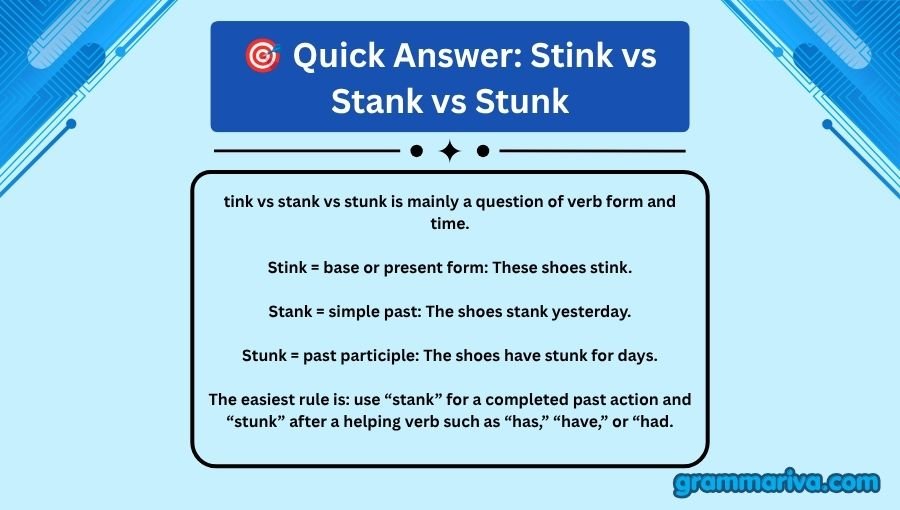
Stink vs stank vs stunk is mainly a question of verb form and time.
- Stink = base or present form: These shoes stink.
- Stank = simple past: The shoes stank yesterday.
- Stunk = past participle: The shoes have stunk for days.
The easiest rule is: use “stank” for a completed past action and “stunk” after a helping verb such as “has,” “have,” or “had.”
🧩 Related Word Forms and Forms of Stink
The verb stink has several forms that appear in different grammatical settings. The most useful forms are stink, stinks, stinking, stank, and stunk.
| Form | Type | Example |
|---|---|---|
| stink | Base form | These socks stink. |
| stinks | Present, third person singular | This room stinks. |
| stinking | Present participle | The trash is stinking. |
| stank | Simple past | The kitchen stank yesterday. |
| stunk | Past participle | The kitchen has stunk all morning. |
These forms are not simply different spellings of the same tense. Their grammatical jobs are different.
🔎 What Is the Difference Between Stink, Stank, and Stunk?
The core difference is grammatical. Stink is the base form, stank is commonly used as the simple past form, and stunk is normally used as the past participle.
| Form | Type | Meaning | Example | Correct/Incorrect |
|---|---|---|---|---|
| stink | Base/present | Have a bad smell | These shoes stink. | ✅ Correct |
| stank | Simple past | Had a bad smell in the past | The room stank yesterday. | ✅ Correct |
| stunk | Past participle | Had a bad smell with a helping verb | The room has stunk all day. | ✅ Correct |
| stunk | Simple past | Had a bad smell in a simple past sentence | The room stunk yesterday. | ⚠️ Less standard in formal usage |
| stank | Past participle | Used after has/have/had | The room has stank all day. | ❌ Incorrect |
The key is not just the word itself. Look at the words around it.
Is Stink the Present Form?
Yes. Stink is the base form of the verb and is commonly used for present-time statements.
For example:
These old shoes stink.
The sentence describes the smell of the shoes now. No past-time marker is needed.
You also use stink after modal verbs and certain helping structures:
- They might stink.
- These socks can stink after a long workout.
- The garbage will stink if we leave it outside.
- Some foods tend to stink after a few days.
Third-person singular
With he, she, it, or another singular subject, the present form becomes stinks.
- The trash stinks.
- His jacket stinks.
- That drain really stinks.
So, if you are talking about something that smells bad now, stink or stinks is usually the form you need.
When Should You Use Stank?
Use stank as the simple past form when you are describing a bad smell that existed at a past time.
For example:
The kitchen stank after the power went out.
The bad smell happened in the past. The sentence uses the simple past, so stank fits naturally.
More examples:
- The garage stank after the garbage spilled.
- My shoes stank after the hike.
- The basement stank when we opened the door.
- The fish stank before we threw it away.
Sentence breakdown
Consider:
The basement stank yesterday.
- The basement = subject
- stank = simple past verb
- yesterday = past-time marker
Because the sentence describes a completed past situation, stank is the natural standard choice.
💡 Test Tip
Try adding yesterday, last night, or last week.
If the sentence describes a completed past event, stank will often be the right choice.
The refrigerator ___ last night.
Answer: stank.
When Should You Use Stunk?
Use stunk as the past participle. It usually appears with a helping verb such as has, have, or had.
Examples include:
The refrigerator has stunk all week.
The room had stunk before we opened the windows.
Those shoes have stunk since Monday.
Here, stunk does not stand alone as the main simple past form in standard formal English. It works with a helping verb to form a perfect construction.
Present perfect
Use has/have + stunk when the past situation connects to the present.
The kitchen has stunk all morning.
Past perfect
Use had + stunk when the bad smell happened before another past event.
The kitchen had stunk for hours before the plumber arrived.
Modal perfect
You can also see stunk after structures such as:
It must have stunk in there.
The pattern is:
modal + have + past participle
So:
must have stunk
is correct.
📊 Stink, Stank, and Stunk in Different Tenses
Understanding the tense pattern makes these three forms much easier to remember.
| Tense/Structure | Correct Form | Example |
|---|---|---|
| Present | stink/stinks | These shoes stink. |
| Simple past | stank | These shoes stank yesterday. |
| Present perfect | has/have stunk | These shoes have stunk all week. |
| Past perfect | had stunk | The shoes had stunk before I washed them. |
| Future | will stink | The shoes will stink if they stay wet. |
| Modal perfect | might have stunk | They might have stunk after the rain. |
| Progressive | is/are stinking | The garbage is stinking. |
This table shows why stank and stunk cannot usually be swapped freely.
How Does Stink Work in Everyday Conversation?
In everyday speech, stink is very common when people describe unpleasant smells. It can also be used informally to say that something is very bad.
The literal meaning is about smell:
My gym bag stinks.
The informal figurative meaning can describe poor quality:
That movie stinks.
This plan stinks.
The figurative use is casual. It is generally not the best choice for formal business writing.
I once heard a student say, “My homework stunk yesterday,” and then ask whether “stink” or “stunk” sounded better. I asked her to identify the time first. Once she saw yesterday, she immediately recognized the past form.
Can Stink Mean Something Other Than Smell?
Yes. Stink can also be used informally to describe something unpleasant, unfair, disappointing, or poor.
For example:
That deal stinks.
Here, the speaker does not mean that the deal has a bad smell. The meaning is closer to “That deal is terrible.”
Another example:
Missing the final train really stinks.
This means the situation is frustrating or unpleasant.
| Meaning | Word Type | Example Sentence |
|---|---|---|
| Have a bad smell | Verb | The garbage stinks. |
| Have had a bad smell | Past form | The garbage stank yesterday. |
| Continue to have a bad smell | Perfect construction | The garbage has stunk all day. |
| Be very bad or unpleasant | Informal verb | That situation stinks. |
The figurative use is strongly connected to the literal idea of a bad smell.
❓ Is Stank the Same as Stunk?
No. Stank and stunk are different verb forms, even though both refer to past situations.
Stank normally works as the simple past form:
The room stank yesterday.
Stunk normally works as the past participle:
The room has stunk since yesterday.
Compare the structures:
| Sentence | Form | Correct/Incorrect |
|---|---|---|
| The room stank yesterday. | Simple past | ✅ Correct |
| The room has stunk since yesterday. | Present perfect | ✅ Correct |
| The room had stunk before we arrived. | Past perfect | ✅ Correct |
| The room has stank since yesterday. | Present perfect | ❌ Incorrect |
| The room stunk for three hours before we arrived. | Simple past | ✅ Correct |
The helping verb is often the biggest clue.
❓ Can You Say “It Stunk” in Standard English?
Yes. It stunk is a standard simple past construction.
For example:
The milk stunk after it spoiled.
The room stunk when we entered.
His shoes stunk after the game.
Some speakers may also use stunk as a simple past form in casual or regional speech. However, if you want a clear standard form for formal writing, stank is the safer simple past choice.
This distinction matters because informal speech can contain forms that are less common in edited writing.
❓ Can You Say “It Has Stunk”?
Yes. It has stunk is a standard present perfect construction.
The structure is:
has + past participle
Since stunk is the past participle form, this works:
The kitchen has stunk all day.
This does not work in standard formal English:
The kitchen has stank all day. ❌
The helping verb has needs the past participle.
📝 Case Study: A Workplace Conversation
Imagine that an employee notices a strong smell near the office kitchen.
At 9 a.m., the employee says:
“The break room stinks.”
That is present tense because the smell exists now.
At lunch, the employee explains what happened earlier:
“The break room stank this morning.”
That is simple past.
Later, the manager says:
“The break room has stunk since early morning.”
That is present perfect. The smell began earlier and continues to matter now.
Now compare the three:
| Situation | Sentence | Form |
|---|---|---|
| Smell exists now | The break room stinks. | Present |
| Completed earlier event | The break room stank this morning. | Simple past |
| Past situation connected to now | The break room has stunk all morning. | Present perfect |
This is how I recommend learning the forms. Do not memorize three isolated words. Learn the sentence pattern attached to each one.
📚 Grammar Rules Explanation
The main grammar rule is simple: irregular verbs can change form instead of taking a regular -ed ending.
The base form is stink. Its simple past form is commonly stank, while its past participle is stunk.
A simple past verb can normally stand alone:
The room stank.
A past participle usually needs a helping verb in this type of construction:
The room has stunk.
The difference comes from the grammar structure, not from a difference in the basic idea of the verb.
Standard English references generally recognize the distinction between the simple past and past participle forms. When writing for school, work, publishing, or formal communication, following this standard pattern is the clearest approach.
Correct vs Incorrect at a Glance
| Sentence | Correct/Incorrect | Why |
|---|---|---|
| The garbage stank yesterday. | ✅ Correct | Simple past |
| The garbage has stunk all day. | ✅ Correct | Present perfect |
| The garbage had stunk before we arrived. | ✅ Correct | Past perfect |
| The garbage has stank all day. | ❌ Incorrect | Past participle is needed after has |
| The garbage had stank before dinner. | ❌ Incorrect | Past participle is needed after had |
⚠️ Common Mistakes With These Verb Forms
People often confuse these words because they sound related and describe the same basic action. The problem becomes worse when someone writes quickly.
Common causes include:
- Fast typing: People often choose the first form that comes to mind.
- Autocorrect: A device may change an unusual verb form without the writer noticing.
- Lack of knowledge: Learners may assume that stank and stunk have the same grammatical job.
- Informal speech: Regional and conversational forms can affect what writers expect to see.
- Tense confusion: Writers may notice the past meaning but forget to check the helping verb.
I once edited a short workplace message that said, “The storage room has stank for days.” The writer knew the smell started in the past, but the helping verb has was the clue that the sentence needed stunk.
Similar Grammar Confusions
| Confusion | Correct Forms | Main Difference |
|---|---|---|
| it’s / its | it’s, its | Contraction vs possession |
| your / you’re | your, you’re | Possession vs “you are” |
| their / there / they’re | their, there, they’re | Possession, place, contraction |
| then / than | then, than | Time/order vs comparison |
| affect / effect | affect, effect | Different common grammatical roles |
| stank / stunk | stank, stunk | Simple past vs past participle |
Specific Wrong Forms to Avoid
| Wrong Form/Use | What’s Wrong | Correct Form |
|---|---|---|
| has stank | Uses the simple past after has | has stunk |
| had stank | Uses the simple past after had | had stunk |
| will stank | Uses a past form after will | will stink |
| did stank | Uses a past form after did | did stink |
| to stank | Uses a past form after to | to stink |
| have stank | Uses a past form after have | have stunk |
❓ Why Do People Confuse Stink, Stank, and Stunk?
The three forms are easy to mix up because they all refer to the same verb. The spelling changes in a way that does not follow the regular verb + -ed pattern.
The best solution is to connect each form with a grammar signal.
| Signal | Form to Consider | Example |
|---|---|---|
| Now | stink/stinks | It stinks now. |
| Yesterday | stank | It stank yesterday. |
| Has | stunk | It has stunk all day. |
| Have | stunk | They have stunk for hours. |
| Had | stunk | They had stunk before we left. |
| Will | stink | It will stink tomorrow. |
| Did | stink | Did it stink? |
This method is much easier than trying to remember three definitions.
🧠 How To Remember the Difference
I use a simple three-step memory trick: When you understand stink vs stank vs stunk, you can quickly choose the right form by checking the tense and the helping verb.
Now → stink
The trash stinks.
Past → stank
The trash stank yesterday.
Has/have/had → stunk
The trash has stunk all day.
Think of the pattern as:
stink → stank → stunk
But do not stop at memorizing the sequence. Attach a grammar job to each form.
| Memory Cue | Word | Example |
|---|---|---|
| Present | stink | They stink. |
| Simple past | stank | They stank yesterday. |
| Past participle | stunk | They have stunk for hours. |
💡 Test Tip
When unsure about stank or stunk, look for a helping verb.
If you see has, have, or had, use stunk:
has stunk ✅
have stunk ✅
had stunk ✅
If there is no helping verb and you are describing a completed past event, stank is usually the standard choice:
It stank yesterday. ✅
🌎 Usage in Different Contexts
The three forms appear in everyday speech, professional writing, creative writing, and social media. The grammar stays the same, but the tone can change.
| Context | Which Term to Use | Example |
|---|---|---|
| Everyday conversation | stink/stank/stunk according to tense | My shoes stank after the hike. |
| Professional writing | Use the standard form for the tense | The storage area stank after the leak. |
| Creative writing | Any grammatically suitable form | The hallway stank of smoke. |
| Social media/texting | Informal use is common | Bro, those shoes stink 😂 |
In professional writing, the literal meaning is usually safer than the informal figurative meaning.
For example:
The waste container produced an unpleasant odor.
may be more suitable for a formal report than:
The waste container stinks.
Both can be grammatically correct. The difference is tone.
❓ Should You Use Stink in Professional Writing?
You can use stink when you are describing an actual smell, but professional writing may call for a more neutral phrase.
For example:
The storage room stinks.
is grammatical, but:
The storage room has a strong odor.
sounds more formal.
The choice depends on your purpose.
| Situation | Natural Choice |
|---|---|
| Talking to a friend | This room stinks. |
| Personal message | My shoes stank after the game. |
| Formal report | The room had a strong odor. |
| Technical description | An unpleasant odor was detected. |
The verb itself is not grammatically wrong in professional writing. It is simply more direct and informal.
❓ Can Stink Be Used as a Figurative Verb?
Yes. In informal English, stink can describe something that is bad, unfair, disappointing, or unpleasant.
Examples:
That deal stinks.
Losing the game really stinks.
The new rule stinks.
In the past:
The old plan stank.
With a perfect construction:
The old plan has stunk from the beginning.
This figurative use is casual, so choose a more neutral word when the setting requires formal language.
Common Phrases With Stink
There are several familiar expressions involving stink. They are especially common in informal English.
| Phrase | Meaning |
|---|---|
| stink up the place | Make a place smell bad |
| stink to high heaven | Smell extremely bad |
| stink at something | Be very bad at an activity |
| stink of something | Have a strong smell of something |
| something stinks | Something smells bad or seems wrong |
| stink about something | Complain or make a fuss, depending on context |
For example:
Someone stunk up the kitchen by leaving the trash inside.
The phrase stink up is especially common in casual conversation.
🔄 Synonyms and Alternatives
Sometimes you do not need stink at all. A different word may fit your sentence better.
| Alternative | Works When | Does Not Work When |
|---|---|---|
| smell | You want a neutral description | You specifically need a strong negative meaning |
| smell bad | You want clear everyday English | You need formal technical language |
| have an odor | You want a neutral or formal tone | You want a strongly emotional casual tone |
| reek | The smell is very strong and unpleasant | You want a mild or neutral description |
| stink | You want direct, informal language | A very formal tone is required |
Reek is usually stronger than smell. Have an odor is more neutral. Stink is direct and often informal.
❓ Does Stunk Always Need a Helping Verb?
In standard formal English, stunk is primarily used as a past participle, so it normally appears with a helping verb in perfect constructions.
Examples:
It has stunk for hours. ✅
It had stunk before we arrived. ✅
It must have stunk inside. ✅
For a simple past sentence, stank is the standard choice:
It stank yesterday. ✅
This distinction is especially useful in formal writing.
❓ What Happens After “Did”?
After did, use the base form stink, not stank or stunk.
Correct:
Did the room stink?
Incorrect:
Did the room stank? ❌
Incorrect:
Did the room stunk? ❌
Why? The auxiliary did already carries the past tense. The main verb returns to its base form.
The same rule applies to many irregular verbs:
Did you go?
Did she eat?
Did they see it?
Not:
Did you went?
Did she ate?
Did they saw it?
The same pattern gives us:
Did it stink? ✅
❓ What Happens After “Will”?
After will, use the base form stink.
It will stink tomorrow. ✅
Not:
It will stank tomorrow. ❌
And not:
It will stunk tomorrow. ❌
The pattern is:
will + base verb
So:
will stink
is correct.
Why It Matters: Clarity and Professionalism
Using the right verb form makes your writing easier to understand. It also shows that you understand how English verb structures work.
A small error can make a sentence sound awkward:
The office has stank for two days. ❌
The reader can probably understand it, but the structure is not standard.
A better version is:
The office has stunk for two days. ✅
A useful rule to remember is:
Good grammar makes your meaning easier to trust.
| Situation | Why Getting It Right Matters |
|---|---|
| Resume or application | Shows careful language control |
| Client email | Creates a polished impression |
| Published content | Improves clarity and credibility |
| Social post | Keeps informal writing understandable |
Even when a grammar mistake does not change the meaning, it can distract the reader.
🔍 Stink vs Stank vs Stunk at a Glance
Here is the entire rule in one place. This stink vs stank vs stunk guide gives you a quick way to compare all three forms and use them correctly.
| Form | Main Job | Example |
|---|---|---|
| stink | Base/present form | These shoes stink. |
| stinks | Present with singular third-person subject | This shoe stinks. |
| stank | Simple past | The shoe stank yesterday. |
| stunk | Past participle | The shoe has stunk all day. |
| stinking | Present participle | The shoe is stinking. |
If you remember only one thing, remember this:
Stank = simple past. Stunk = past participle.
🧪 Practice: Choose the Correct Form
Try these before looking at the answers.
1. The garbage ___ yesterday.
Answer: stank ✅
The sentence uses simple past.
2. The garbage has ___ all morning.
Answer: stunk ✅
The sentence uses present perfect.
3. The garbage will ___ tomorrow.
Answer: stink ✅
The sentence uses will + base verb.
4. Did the garbage ___?
Answer: stink ✅
The sentence uses did + base verb.
| Question | Correct Answer |
|---|---|
| It smells bad now. | stink/stinks |
| It smelled bad yesterday. | stank |
| It has smelled bad all day. | has stunk |
| It had smelled bad before we arrived. | had stunk |
| It will smell bad tomorrow. | will stink |
| Did it smell bad? | did it stink |
📝 More Correct and Incorrect Examples
Present
The garbage stinks. ✅
The garbage stank now. ❌
The word now points to the present, so stinks is correct.
Simple past
The garbage stank last night. ✅
The garbage stink last night. ❌
The phrase last night points to the past, so use stank.
Present perfect
The garbage has stunk for hours. ✅
The garbage has stank for hours. ❌
After has, use the past participle stunk.
Past perfect
The garbage had stunk before the truck arrived. ✅
The garbage had stank before the truck arrived. ❌
After had, use stunk.
❓ Is “Stinked” Ever Correct?
For the ordinary verb meaning “to have a bad smell,” stinked is not the standard past form.
Use:
stank
for the simple past, and:
stunk
for the past participle.
So:
The room stank yesterday. ✅
The room has stunk all day. ✅
Avoid treating stink like a regular verb:
The room stinked yesterday. ❌
This is one of the most common mistakes learners make when they expect every English verb to form its past with -ed.
❓ Which Is More Correct: Stank or Stunk?
Neither is universally “more correct.” They perform different grammatical jobs.
Stank is the standard simple past form.
Stunk is the standard past participle form.
So the correct choice depends on the sentence:
The room stank yesterday. ✅
The room has stunk all day. ✅
Asking whether stank or stunk is “better” without looking at the sentence misses the main point. They belong to different grammatical structures.
🧭 A Simple Decision Guide
When you see a blank in a sentence, ask these questions in order.
| Question | If Yes → Use |
|---|---|
| Are you describing the present? | stink/stinks |
| Are you describing a completed past event? | stank |
| Is the sentence using has? | stunk |
| Is the sentence using have? | stunk |
| Is the sentence using had? | stunk |
| Is the sentence using will? | stink |
| Is the sentence using did? | stink |
This guide works well because it focuses on grammar signals instead of guesswork.
⚠️ A Note About Informal and Regional Usage
English changes across regions and communities. You may hear stunk used as a simple past form in casual speech. You may also encounter unusual forms in songs, dialogue, humor, or regional writing.
That does not mean every form is equally suitable for every setting.
For standard edited US English, the clearest pattern is:
stink → stank → stunk
Use stank for simple past and stunk for the past participle.
In creative dialogue, a writer may intentionally reproduce a particular speech pattern. That is a style choice, not a reason to use the form everywhere.
🎯 Quick Recap Checklist
| Question | If Yes → Use |
|---|---|
| Is the action happening now? | stink/stinks |
| Did it happen in the past? | stank |
| Does the sentence contain has? | stunk |
| Does it contain have? | stunk |
| Does it contain had? | stunk |
| Does it contain will? | stink |
| Does it contain did? | stink |
Practice Examples
- The kitchen ___ yesterday. → stank ✅
- The kitchen has ___ since breakfast. → stunk ✅
- Will the kitchen ___ if we leave the food there? → stink ✅
FAQs About Stink vs Stank vs Stunk
What is the past tense of stink?
The standard simple past form is stank.
The garbage stank yesterday. ✅
Stunk is normally used as the past participle.
The garbage has stunk all day. ✅
Is “stunk” the past tense of stink?
Stunk is primarily the past participle form in standard English. The usual simple past form is stank.
It stank yesterday. ✅
It has stunk all day. ✅
Is “stank” grammatically correct?
Yes. Stank is the standard simple past form of stink.
The room stank after the storm. ✅
Is “has stank” correct?
No. In standard English, use the past participle after has.
The room has stunk all day. ✅
Not:
The room has stank all day. ❌
Is “had stunk” correct?
Yes. Had stunk uses the past perfect structure.
The room had stunk before we opened the windows. ✅
Should I say “it stank” or “it stunk”?
For standard US English, it stank is the clearest choice for the simple past.
It stank yesterday. ✅
Use stunk in a perfect construction:
It has stunk since yesterday. ✅
Can I say “did it stink”?
Yes. After did, use the base form stink.
Did it stink? ✅
Do not use the past forms after did:
Did it stank? ❌
Did it stunk? ❌
Can I say “it will stink”?
Yes. Will + base verb requires stink.
It will stink if we leave the trash outside. ✅
Not:
It will stank. ❌
What is the easiest way to remember stink, stank, and stunk?
Remember three basic patterns:
- Stink = present or base form
- Stank = simple past
- Stunk = past participle
A quick memory sentence is:
It stinks now, it stank yesterday, and it has stunk all week.
That one sentence gives you all three forms in context.
Conclusion
Stink vs stank vs stunk becomes much easier once you connect each form to its grammatical job. Stink is the base form used for the present and after words such as will and did. Stank is the standard simple past form for a completed past situation. Stunk is the past participle, so it normally follows helping verbs such as has, have, and had.
When I check these forms in a sentence, I do not ask which word “sounds right” first. I look for the tense and the helping verb. That quick habit prevents most mistakes. 👍
Keep this simple pattern in mind: stink for the base form, stank for simple past, and stunk for the past participle. Once you practice the forms in complete sentences, the difference starts to feel natural. ✨
When in doubt, check the grammar around the verb, not just the verb itself.

Hi, I’m Lucas Bennett. I’m a grammar content specialist at Grammariva. I work on articles covering everyday grammar questions, sentence usage, and writing tips that readers can apply with confidence.



[…] should be able to choose the right preposition without stopping to think about it every time. 😊 Stink vs Stank vs Stunk | I Will Like To vs I Would Like To | Anyplace vs Any […]