Have you ever written a sentence and stopped because you were unsure whether to say “to be content or contented”? You are not alone. These two words look closely related, and both can describe a person who feels satisfied. The difference is small, but the choice can change the tone of a sentence. 😊
I often see this question in student writing, emails, and everyday conversations. A writer may know that content and contented both connect with satisfaction, yet still wonder which one sounds natural after to be.
The good news is that both forms can be correct. The real issue is how they are being used and what style you want. Content is usually the more common and flexible choice. Contented is also correct, but it often sounds more literary or emphasizes a settled feeling of satisfaction.
In this guide, I will explain the difference in plain English. I will also show you examples, common mistakes, useful tests, and practical ways to remember the rule. Born in or Born on | Stink vs Stank vs Stunk | I Will Like To vs I Would Like To
🎯 Quick Answer: To Be Content or Contented
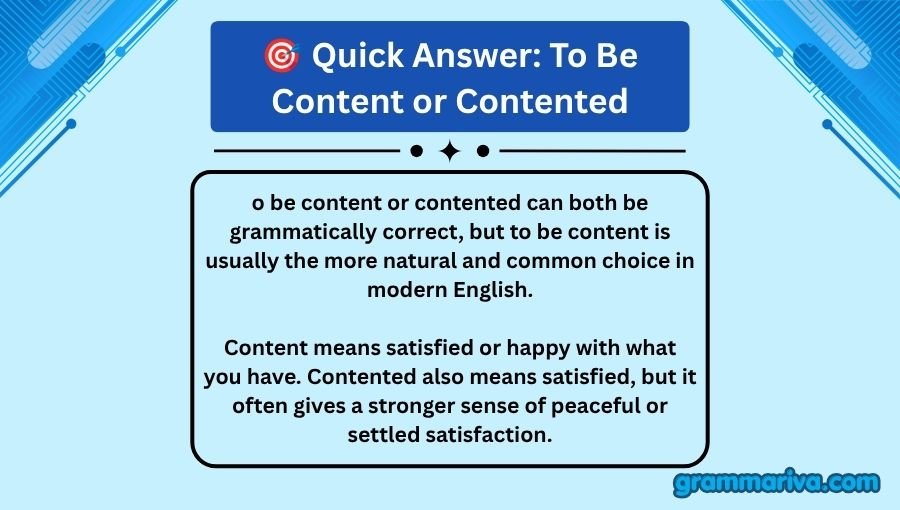
To be content or contented can both be grammatically correct, but to be content is usually the more natural and common choice in modern English.
Content means satisfied or happy with what you have. Contented also means satisfied, but it often gives a stronger sense of peaceful or settled satisfaction.
Quick rule: Use content for the normal everyday choice. Use contented when you want to stress a calm, satisfied state or create a slightly more literary tone.
What Does Content Mean?
Content is an adjective when it means satisfied with a situation or with what you have. It commonly follows forms of the verb be.
For example:
- ✅ She is content with her life.
- ❌ She is contented with her life. — This is not grammatically wrong, but it sounds less natural in many everyday contexts.
The adjective content can describe a person who does not feel a strong need for something different.
Consider:
After years of travel, he was finally content with his quiet home.
The sentence tells us that he feels satisfied with his situation.
Content as a noun
There is another very common meaning of content. As a noun, it can refer to what is inside something.
For example:
The box contains the content of the package.
It can also refer to material published online:
The website has useful content about grammar.
That meaning is completely different from the adjective meaning satisfied.
| Form | Type | Meaning | Example | Correct/Incorrect |
|---|---|---|---|---|
| content | Adjective | Satisfied | She is content with her job. | ✅ Correct |
| content | Noun | What something contains | The content of the book is useful. | ✅ Correct |
| contented | Adjective | Satisfied and peaceful | He looked contented after dinner. | ✅ Correct |
| contented | Noun | Not normally used this way | She is a contented with her job. | ❌ Incorrect |
Is Contented a Correct Word?
Yes. Contented is a correct English adjective. It describes someone who feels satisfied, peaceful, or pleased with their situation.
For example:
- ✅ The child looked contented after his nap.
- ✅ She felt contented in her new home.
However, contented is not simply a required replacement for content. In many ordinary sentences, content sounds more natural.
Compare:
I am content with my decision.
and:
I am contented with my decision.
Both can work, but the first is more direct and natural for most modern writing.
Contented often paints a picture of someone who appears peaceful and deeply satisfied.
🔍 To Be Content or Contented: Key Differences
The main difference is style and emphasis, not basic grammar. Both adjectives can describe satisfaction, but content is more common and versatile.
| Feature | Content | Contented |
|---|---|---|
| Word type | Adjective | Adjective |
| Basic meaning | Satisfied | Satisfied and peaceful |
| Everyday use | Very common | Less common |
| Formal writing | Common | Possible |
| Literary tone | Possible | More likely |
| Describes a satisfied person | Yes | Yes |
| Often used with “with” | Yes | Yes |
| Can follow “be” | Yes | Yes |
A simple comparison
- She is content with her salary.
- She looks contented with her simple life.
The first sentence sounds neutral. The second creates a stronger image of peaceful satisfaction.
Why Do People Confuse Content and Contented?
People confuse these words because they share the same basic idea: satisfaction. The ending -ed can also make writers think that contented must be the more complete adjective.
That is not the case.
I once reviewed a student’s essay about a family moving to the countryside. The student repeatedly changed content to contented because they thought the longer form sounded more grammatically correct. It did not. In several sentences, the shorter form was actually more natural.
English has many pairs where a shorter adjective and an -ed form can both exist. That does not mean they are always interchangeable in style.
| Confusion | Common Reason |
|---|---|
| content / contented | Both express satisfaction |
| tired / tiring | Similar-looking adjective forms |
| bored / boring | Confusion about the person and cause |
| interested / interesting | The endings signal different meanings |
| pleased / pleasing | Related but not identical uses |
| satisfied / satisfying | Similar idea with different grammar |
The key lesson is simple: do not assume the longer form is automatically better.
When Should You Use Content?
Use content when you want to say that someone is satisfied with a person, situation, possession, or way of life.
Content with a situation
She is content with her current position.
Here, content means satisfied.
Content with what you have
He is content with what he has.
This suggests that he does not feel a strong need for more.
Content to do something
Content can also appear before an infinitive.
She was content to wait.
This means she was willing or satisfied to wait rather than demanding something else.
That structure is useful because it shows that content has several natural patterns.
Content in everyday speech
You might hear:
I’m content with the results.
or:
They seem content with their decision.
These are normal, clear sentences.
| Meaning | Word Type | Example Sentence |
|---|---|---|
| Satisfied with a situation | Adjective | I am content with my choice. |
| Satisfied with possessions | Adjective | He is content with what he owns. |
| Willing to do something | Adjective | She was content to stay home. |
| Peacefully satisfied | Adjective | The baby looked content. |
When Should You Use Contented?
Use contented when you want to describe someone who appears or feels peacefully satisfied.
It can work especially well when the sentence focuses on a person’s emotional state.
For example:
The old man sat by the window with a contented smile.
Here, contented helps create a picture. We can imagine someone calm and satisfied.
Another example is:
After finishing the meal, the guests looked contented.
The word adds a sense of comfort and quiet satisfaction.
Contented often describes appearance
You may see it in phrases such as:
- a contented smile
- a contented expression
- a contented child
- a contented look
- a contented sigh
These phrases are natural because contented can help describe visible signs of satisfaction.
| Expression | Natural? | Example |
|---|---|---|
| content person | ✅ | He is a content person. |
| contented person | ✅ | She seemed like a contented person. |
| content smile | Less common | He had a content smile. |
| contented smile | ✅ | He had a contented smile. |
| contented expression | ✅ | She wore a contented expression. |
Can You Say “I Am Content”?
Yes. “I am content” is completely correct.
It is one of the clearest ways to express satisfaction.
Examples:
- ✅ I am content with my life.
- ✅ I am content with the result.
- ✅ I am content to stay here.
- ✅ I am content where I am.
The word does not need an extra -ed ending.
A common mistake is thinking that contented must be used because the person is experiencing an emotion. That is not how this adjective works.
Can You Say “I Am Contented”?
Yes. “I am contented” is also grammatically possible.
However, it is less common in ordinary conversation.
For example:
After retiring, he felt contented with his peaceful routine.
This sentence emphasizes a settled, peaceful feeling.
Compare:
After retiring, he felt content with his peaceful routine.
This version is simpler and more natural in everyday English.
So, if you are unsure, content is usually the safer choice.
💡 Test Tip: How Can You Choose the Right Word?
Here is the easiest test I teach:
Ask yourself whether you simply mean “satisfied.”
If yes, content will usually work.
For example:
I am ___ with my new job.
Replace the blank with satisfied:
I am satisfied with my new job.
Because that meaning works directly, content is a natural choice:
I am content with my new job.
If the sentence is describing someone’s peaceful appearance or emotional state, contented may be a stronger stylistic choice.
The replacement test
| Test | Result | Best Choice |
|---|---|---|
| Means simply “satisfied” | Yes | content |
| Describes peaceful satisfaction | Yes | contented can work |
| Everyday conversation | Yes | content |
| Describes a smile or expression | Often | contented |
| You are unsure | — | content is usually safer |
📝 Case Study: Choosing the Natural Form at Work
Imagine that an employee has just received a promotion. A coworker asks how she feels.
She says:
I am content with my new position.
That sounds natural.
Now imagine a manager writing a personal note:
She left the meeting with a contented smile.
That also sounds natural because the writer is describing her visible emotional state.
I once edited a short workplace message in which the writer used contented three times in two paragraphs. The meaning was clear, but the repeated word made the message sound unusually formal. I replaced two instances with content, and the writing became much smoother.
| Situation | Original Idea | Better Natural Choice |
|---|---|---|
| Employee discussing a job | Satisfied with the position | content |
| Person describing a smile | Peacefully satisfied | contented |
| Casual conversation | Satisfied with life | content |
| Descriptive story | Calm emotional state | contented |
| Professional email | Satisfied with a result | content |
Grammar Rules Explanation
Both content and contented can function as adjectives that describe a person’s state of satisfaction.
The adjective content commonly follows a linking verb such as be, feel, seem, or look.
Examples include:
She is content.
He feels content.
They seem content.
The adjective contented can also follow these verbs:
She is contented.
He feels contented.
They seem contented.
The difference is therefore not that one form is grammatically valid and the other is grammatically invalid. Instead, the difference is mainly one of frequency, tone, and emphasis.
Content is generally the more neutral adjective. Contented can suggest a deeper or more visibly peaceful state of satisfaction.
The phrase content with is especially common:
She is content with her life.
The phrase content to + verb is also standard:
He is content to wait.
Most standard English reference works recognize content and contented as valid adjective forms. The important point is to match the word to the meaning and tone of the sentence.
Correct vs Incorrect at a Glance
| Sentence | Correct/Incorrect | Why |
|---|---|---|
| She is content with her life. | ✅ Correct | Content naturally means satisfied. |
| He looks contented after dinner. | ✅ Correct | Contented describes peaceful satisfaction. |
| I am content to wait. | ✅ Correct | Content works naturally before an infinitive. |
| She is a contented with her job. | ❌ Incorrect | An article cannot directly come before the adjective in this structure. |
| He is contented to the result. | ❌ Incorrect | Use content with, not contented to. |
How Do “Content With” and “Content to” Work?
These two structures are especially useful.
Content with
Use content with when you identify the thing or situation that satisfies someone.
She is content with her salary.
They are content with the arrangement.
I am content with my decision.
Content to
Use content to + verb when you describe an action someone is willing or satisfied to take.
He was content to remain silent.
She was content to wait outside.
They were content to let the matter rest.
Notice the pattern:
content + with + noun
but
content + to + verb
| Pattern | Example | Correct/Incorrect |
|---|---|---|
| content + with + noun | She is content with her job. | ✅ Correct |
| content + to + verb | She is content to wait. | ✅ Correct |
| content + with + verb | She is content with wait. | ❌ Incorrect |
| content + to + noun | She is content to her job. | ❌ Incorrect |
| contented + with + noun | He is contented with his life. | ✅ Possible |
| contented + to + verb | He was contented to stay. | Possible, but less natural |
⚠️ Common Mistakes With Content and Contented
Mistakes often happen because the two forms look almost identical.
Mistake 1: Assuming -ed is always required
Some writers think:
“The person feels satisfied, so I need contented.”
That is false.
Content is already a complete adjective.
Mistake 2: Using contented everywhere
Contented is correct, but using it in every sentence can make ordinary writing sound stiff.
Mistake 3: Confusing adjective and noun meanings
Remember that content can also be a noun meaning material or what is contained.
| Common Confusion | Correct Form | Example |
|---|---|---|
| it’s / its | its | The company changed its policy. |
| your / you’re | you’re | You’re right about the answer. |
| their / there / they’re | their | Their house is nearby. |
| then / than | than | She is taller than me. |
| affect / effect | effect | The change had an effect. |
| content / contented | depends on context | She is content with her life. |
Why do these mistakes happen?
Three common causes are:
Fast typing: People often choose the first familiar-looking word.
Autocorrect: Software can encourage writers to accept a form without checking the sentence.
Lack of knowledge: If someone has never learned the difference in tone, both words may look interchangeable.
Common Wrong Forms and Uses
Here are some specific mistakes to watch for.
| Wrong Form | What’s Wrong | Correct Form |
|---|---|---|
| She is a content with her life. | The article does not fit this structure. | She is content with her life. |
| He is contented with to stay. | The two structures are mixed. | He is content to stay. |
| I am contented to my job. | The wrong preposition is used. | I am content with my job. |
| They are content with stay here. | A verb form is missing. | They are content to stay here. |
| She feels contented with the result. | Not wrong, but may sound more formal than needed. | She feels content with the result. |
| He is content to his situation. | To is incorrect before the noun. | He is content with his situation. |
How Should You Use These Words in Everyday Conversation?
In everyday conversation, content is usually the easiest choice.
You might say:
I’m content with where I am.
She’s content with her life.
We’re content to wait.
These sentences sound simple and natural.
Contented is still possible, but it may sound more descriptive or formal.
| Context | Which Term to Use | Example |
|---|---|---|
| Everyday conversation | content | I’m content with my life. |
| Professional writing | content | We are content with the results. |
| Creative writing | contented can add detail | He wore a contented smile. |
| Social media/texting | content | I’m content with the simple things. |
Content in Professional Writing
Professional writing usually benefits from the neutral tone of content.
For example:
The client was content with the final design.
This is clear and direct.
A sentence such as:
The client was contented with the final design.
is understandable, but it may sound more literary than necessary.
In business writing, simple wording is often better.
Examples
- ✅ The customer was content with the service.
- ✅ We are content with the current arrangement.
- ✅ The team was content to proceed with the plan.
The word works well because it communicates satisfaction without adding unnecessary emotion.
Contented in Creative Writing
Creative writing gives you more freedom to use contented.
Writers often need words that help readers picture an emotional state.
Compare:
The farmer was content.
with:
The farmer sat beneath the tree with a contented smile.
The second sentence gives us a stronger visual image.
That does not make contented more grammatically correct. It simply makes it more useful for a certain style.
Is Content Better Than Contented?
Not always. Content is usually more common, but contented has a useful role.
Think of the difference this way:
Content = neutral satisfaction
Contented = peaceful or visibly satisfied
The distinction is not absolute. Native speakers may use the words in overlapping ways.
| Goal | Better Choice |
|---|---|
| Simple statement | content |
| Everyday conversation | content |
| Business email | content |
| Describing a smile | contented |
| Describing a peaceful expression | contented |
| Creating a gentle literary tone | contented |
| Saying “satisfied” plainly | content |
What Are Common Phrases With Content?
Several useful expressions use content naturally.
| Phrase | Meaning |
|---|---|
| content with something | satisfied with something |
| content to do something | satisfied or willing to do something |
| content with what you have | satisfied with your possessions or situation |
| content with life | satisfied with one’s life |
| content where you are | satisfied with your current position |
| live a content life | live with satisfaction and peace |
Examples:
She is content with what she has.
He is content to work quietly.
They are content where they are.
These expressions are useful in both casual and formal writing.
Can Contented Be Used Before a Noun?
Yes. Contented can naturally appear before a noun.
For example:
a contented child
a contented smile
a contented expression
a contented life
Content can also appear before nouns in some contexts, but contented often sounds more natural when it directly describes a person’s peaceful emotional state.
Compare:
- a content child — correct
- a contented child — correct and more descriptive
- a content smile — less natural
- a contented smile — very natural
This is one reason writers sometimes prefer contented in descriptive passages.
Synonyms and Alternatives for Content
You do not always need either word. Several alternatives can express similar ideas.
| Alternative | Works When | Does Not Work When |
|---|---|---|
| satisfied | You mean pleased with a result or situation | You need a softer, calmer tone |
| happy | You mean general positive emotion | You specifically mean acceptance or satisfaction |
| pleased | You mean happy about something | You mean a long-term state of peace |
| fulfilled | You mean deeply satisfied with your life or purpose | You mean simple satisfaction with a small matter |
| at peace | You mean calm and emotionally settled | You need a direct adjective meaning satisfied |
For example:
I am satisfied with the result.
is close to:
I am content with the result.
But:
I am happy
is broader. A person can be happy for many reasons without being content with their situation.
Why Does the Difference Matter?
Choosing the right word helps your reader understand the exact feeling you mean.
Clarity in communication
If you simply mean satisfied, content is usually clear.
Professionalism
A workplace email often sounds better with a simple word rather than an unnecessarily literary one.
Digital communication
Short messages benefit from familiar language. Content is easy to understand.
Published writing
Creative writers may choose contented when they want a more vivid emotional picture.
A useful writing principle is:
Choose the word that expresses your meaning without making the sentence harder than it needs to be.
| Situation | Why Getting It Right Matters |
|---|---|
| Resume | Shows control of clear language |
| Client email | Keeps communication direct |
| Published content | Improves tone and readability |
| Social post | Makes the message sound natural |
How Can You Remember the Difference?
Use this simple memory trick:
Content = calm satisfaction
Think:
I am content.
That is the basic statement.
Contented = a peaceful picture
Think:
She has a contented smile.
If you can picture the emotion on someone’s face, contented may fit especially well.
Another useful trick is to remember that content is the default choice.
When you are unsure, ask:
“Do I simply mean satisfied?”
If the answer is yes, choose content.
Are There Any Special Exceptions?
There is no major grammatical exception that forces you to use contented instead of content after be.
The important special case is that content has another common meaning as a noun.
For example:
The content of the article is helpful.
Here, content does not mean satisfied.
This matters because context determines the meaning.
| Sentence | Meaning of Content |
|---|---|
| She is content with her life. | Satisfied |
| He is content to wait. | Satisfied or willing |
| The content is interesting. | Material or information |
| I checked the content of the box. | What was inside |
How Does Context Change the Best Choice?
Context can make one form sound much more natural than the other.
In a casual conversation:
I’m content with my life.
sounds normal.
In a story:
He leaned back with a contented smile.
sounds natural because the writer is painting a picture.
In a business report:
The customer was content with the service.
is usually better than the more literary contented.
So, the correct choice depends not only on grammar but also on tone and purpose.
Practice Examples: Can You Choose the Right Word?
Try these sentences before checking the answers.
Example 1
I am ___ with my decision.
Answer: content
- ✅ I am content with my decision.
- ❌ I am contented with my decision. — Grammatically possible, but less natural as the neutral choice.
Example 2
The baby looked ___ after feeding.
Answer: contented
- ✅ The baby looked contented after feeding.
- ❌ The baby looked contentedly after feeding. — Contentedly is an adverb, so it does not work as the adjective complement here.
Example 3
She was ___ to wait.
Answer: content
- ✅ She was content to wait.
- ❌ She was content with wait.
Example 4
He had a ___ smile.
Answer: contented
- ✅ He had a contented smile.
- ❌ He had a content smile. — Possible in some contexts, but much less natural for this fixed descriptive pattern.
✅ Quick Recap Checklist
Use this checklist whenever you hesitate.
| Question | If Yes → Use |
|---|---|
| Do you simply mean satisfied? | content |
| Are you writing a normal sentence? | content |
| Are you using “with” before a noun? | content with |
| Are you using “to” before a verb? | content to |
| Are you describing a peaceful smile? | contented |
| Are you describing a calm emotional state? | contented can work |
| Are you writing a professional email? | content is usually best |
Three quick practice sentences
- I am content with my new home. ✅
- She was content to wait for her turn. ✅
- He gave a contented smile after hearing the news. ✅
The key is not to treat contented as the “correct” version of content. Both can be correct. They simply have different strengths.
FAQs About Content vs Contented
Is “to be content” grammatically correct?
Yes. To be content is completely correct. It means to be satisfied with a situation, person, possession, or choice.
Is “to be contented” grammatically correct?
Yes. To be contented is also grammatically correct. It often suggests a peaceful or settled feeling of satisfaction.
Is content more common than contented?
Yes. Content is generally the more common and neutral choice, especially in everyday and professional English.
What is the difference between content and contented?
Both can mean satisfied. Content is usually neutral and direct, while contented can emphasize a peaceful or visibly satisfied emotional state.
Should I say “I am content” or “I am contented”?
Usually, say “I am content.” It is natural, simple, and widely used. Choose contented when you want to emphasize peaceful satisfaction or use a more descriptive tone.
Is “content with” correct?
Yes. Content with is a standard structure when you name the thing or situation that satisfies someone.
Example:
She is content with her job.
Is “content to” correct?
Yes. Content to + verb is correct.
Example:
He was content to wait.
It means he was satisfied or willing to wait.
Can contented be used before a noun?
Yes. For example, “a contented child” and “a contented smile” are natural expressions.
Can content mean something other than satisfied?
Yes. Content can also be a noun meaning the material or information contained in something.
Example:
The content of the article is useful.
Which word should I use in a formal email?
Content is usually the better choice because it is neutral, clear, and natural.
Is “contented with” wrong?
No. Contented with can be grammatically correct. However, content with is usually more natural when you simply mean satisfied with something.
🎯 Final Rule: To Be Content or Contented
To be content or contented are both grammatically possible, but content is normally the best default choice when you simply mean “satisfied.” Contented is useful when you want to show a peaceful, settled, or visibly satisfied emotional state.
The easiest rule is this: use content with a noun or situation, and use content to before a verb. For descriptive phrases such as a contented smile or a contented expression, contented often sounds more natural.
I recommend not treating this as a strict right-versus-wrong spelling issue. Instead, think about the feeling and tone you want. If your sentence simply says that someone is satisfied, content will usually be the cleanest choice. If your sentence creates a picture of someone peacefully enjoying a moment, contented may give the sentence more warmth. 🌿
Once you remember that content is the neutral default and contented adds a more descriptive sense of peaceful satisfaction, this pair becomes much easier to handle.
When in doubt, keep it simple: satisfied → content; peaceful and visibly satisfied → contented.

Hi, I’m Nathan Reed. I’m a grammar and writing specialist at Grammariva. I work on practical grammar content that helps readers understand sentence structure, punctuation, vocabulary, and better writing habits.
[…] the distinction. By the end, you should be able to choose the right word with confidence. 🧠 To Be Content or Contented | Born in or Born on | Stink vs Stank vs […]