Have you ever stopped while writing a sentence and wondered whether to say “take a rest vs have a rest”? 🤔 You are not alone. Both expressions can talk about stopping an activity so you can relax or recover.
The main difference is not the basic idea. It is how natural each expression sounds in different types of English. American English often prefers “take a rest” or, even more commonly, “take a break.” British English commonly uses “have a rest” as well.
This small difference can make a sentence sound more natural depending on your audience. I have seen learners struggle with this choice because both phrases seem to follow familiar English patterns.
The good news is that the rule is simple once you understand the pattern. In this guide, I will explain the meaning, grammar, context, common mistakes, and practical uses of both expressions so you can choose the right phrase with confidence. 🌟 Creek or Crick | Aether vs Ether | To Be Content or Contented
🎯 Quick Answer: Take a Rest vs Have a Rest
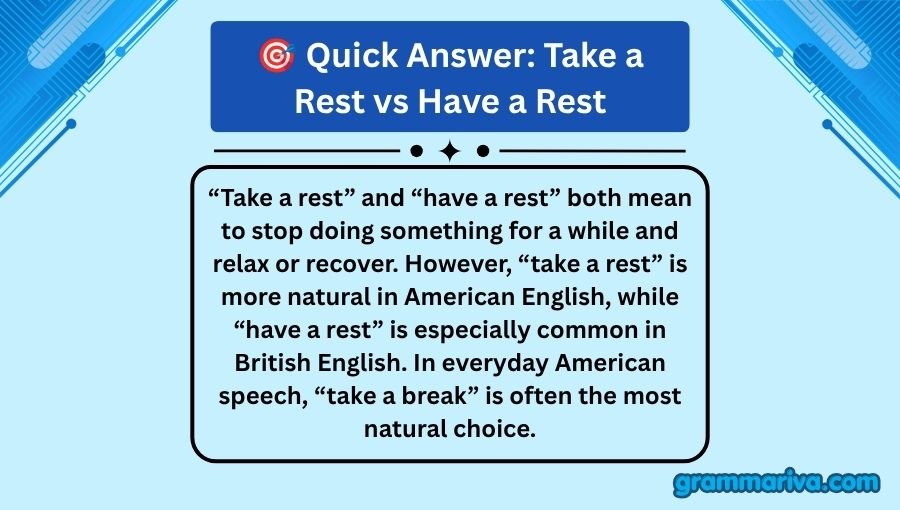
“Take a rest” and “have a rest” both mean to stop doing something for a while and relax or recover. However, “take a rest” is more natural in American English, while “have a rest” is especially common in British English. In everyday American speech, “take a break” is often the most natural choice.
| Expression | General Meaning | Common Use |
|---|---|---|
| Take a rest | Stop and relax or recover | Common and natural, especially in US English |
| Have a rest | Stop and relax or recover | Common, especially in UK English |
| Take a break | Stop an activity for a short time | Very common in US English |
| Have a break | Stop an activity for a short time | Common in UK English |
So, neither “take a rest” nor “have a rest” is automatically wrong. The better choice depends on regional usage and context.
🧩 Related Word Forms and Expressions
The word rest is a noun in these expressions. It does not change into another form simply because you use take or have.
Here are some related forms and phrases that learners may encounter.
| Form | Type | Example |
|---|---|---|
| rest | Noun | I need some rest. |
| rest | Verb | You should rest today. |
| rested | Adjective | I feel rested now. |
| resting | Present participle | She is resting upstairs. |
| take a rest | Verb phrase | Let’s take a rest. |
| have a rest | Verb phrase | Let’s have a rest. |
| take a break | Verb phrase | Let’s take a break. |
The key point is that rest can work as both a noun and a verb. In “take a rest” and “have a rest,” it functions as a noun.
📚 Understanding the Basics of Take a Rest vs Have a Rest
The core difference is mainly about regional preference and natural phrasing, not meaning. Both expressions can describe stopping an activity to relax, recover, or regain energy.
Take a Rest
“Take a rest” means to stop what you are doing for a period of time so your body or mind can recover.
Examples:
- I am tired, so I need to take a rest. ✅
- You have been walking for hours. Take a rest. ✅
- We stopped to take a rest before climbing the hill. ✅
The phrase works well when someone needs physical recovery. It can also describe a mental pause.
Have a Rest
“Have a rest” carries the same basic meaning. It is especially natural in British English.
Examples:
- You look tired. Have a rest. ✅
- We can have a rest after lunch. ✅
- She went upstairs to have a rest. ✅
In American English, these sentences may sound more natural with “take a rest” or “take a break.”
Comparison at a Glance
| Form | Type | Meaning | Example | Correct/Incorrect |
|---|---|---|---|---|
| Take a rest | Verb phrase | Stop to recover | I need to take a rest. | ✅ Correct |
| Have a rest | Verb phrase | Stop to recover | I need to have a rest. | ✅ Correct |
| Take rest | Verb phrase | Rest without article | I need to take rest. | ⚠️ Unnatural in standard US English |
| Have rest | Verb phrase | Rest without article | I need to have rest. | ❌ Usually incorrect |
| Take a break | Verb phrase | Stop an activity briefly | I need to take a break. | ✅ Correct |
🗣️ Is Take a Rest the Same as Have a Rest?
Yes, the two expressions have essentially the same basic meaning. Both tell someone to stop an activity and spend some time resting.
The main difference is where and how they are commonly used.
For example:
- I need to take a rest after this walk. ✅
- I need to have a rest after this walk. ✅
Both sentences communicate the same idea.
However, an American speaker might be more likely to say:
- I need to take a break after this walk. ✅
A British speaker might naturally say:
- I need to have a rest after this walk. ✅
This is a useful lesson for English learners. A phrase can be grammatically acceptable while another phrase sounds more natural in a particular region.
🇺🇸 Which Expression Is More Natural in American English?
“Take a rest” is generally more natural than “have a rest” in American English, although “take a break” is often even more common for everyday situations.
Consider these examples:
| Situation | Natural US English | Another Possible Form |
|---|---|---|
| At work | Let’s take a break. | Let’s take a rest. |
| After exercise | I need to take a rest. | I need to take a break. |
| After a long walk | Let’s take a rest. | Let’s sit down for a while. |
| Feeling exhausted | I need some rest. | I need to take a rest. |
| Casual conversation | Let’s take a break. | Let’s rest for a while. |
The phrase “have a rest” is understandable to American speakers, but it can sound more British.
I once edited a short American English article in which the writer used “have a rest” several times. The grammar was understandable, but replacing some examples with “take a break” made the article sound much more natural for its US audience.
🇬🇧 When Is Have a Rest Natural?
“Have a rest” is especially natural in British English and other varieties influenced by British usage.
For example:
- You’ve been working all morning. Have a rest. ✅
- We should have a rest before we continue. ✅
- He went home to have a rest. ✅
The phrase often appears in friendly advice and everyday conversation.
| Sentence | Meaning | Usage |
|---|---|---|
| Have a rest. | Stop and relax. | Natural UK English |
| Have a little rest. | Relax for a short time. | Natural |
| Have a good rest. | Get enough rest. | Natural |
| Have some rest. | Get some rest. | Possible, but context matters |
| Have a break. | Pause an activity. | Very common |
There is nothing inherently wrong with “have a rest.” The important point is knowing your audience.
🤔 Why Do People Confuse Take a Rest and Have a Rest?
People confuse these expressions because English uses both take and have with nouns that describe activities or experiences.
We say:
- take a break
- take a shower
- take a walk
- have a rest
- have a break
- have a shower
- have a walk
This creates a natural problem for learners. They may remember one pattern and apply it to another expression.
A student once asked me why “take a break” sounds normal but “take a rest” sometimes feels different. I explained that English expressions are often learned as complete phrases. Knowing the individual words is not always enough. That small distinction helped the student stop translating directly from another language.
Why the confusion happens
| Reason | Example |
|---|---|
| Similar meanings | Rest and break both involve stopping |
| Regional English | US and UK usage can differ |
| Direct translation | Learners may translate word by word |
| Similar verb patterns | English uses both “take” and “have” |
| Limited exposure | Learners may hear one version more often |
The safest approach is to learn the full phrase rather than trying to choose the verb from a general rule.
📝 Correct Uses of Take a Rest
“Take a rest” is used when someone stops an activity to recover or relax.
After Physical Activity
You can use it after walking, running, hiking, lifting, or other physical activities.
- We walked five miles, so we decided to take a rest. ✅
- You have been running for an hour. Take a rest. ✅
During a Long Task
The phrase can also describe a pause during work or another long activity.
- I need to take a rest before I finish this project. ✅
- Let’s take a rest and continue later. ✅
When Someone Is Tired
It can be used as advice.
- You look exhausted. You should take a rest. ✅
- Your legs hurt. Take a rest before you continue. ✅
Meaning Summary
| Meaning | Word Type | Example Sentence |
|---|---|---|
| Recover physically | Noun phrase | I need to take a rest. |
| Relax mentally | Noun phrase | I want to take a rest from studying. |
| Pause an activity | Noun phrase | Let’s take a rest before dinner. |
| Regain energy | Noun phrase | She took a rest after the race. |
💡 Test Tip
Ask yourself:
“Am I telling someone to stop and recover for a while?”
If yes, “take a rest” can work. In casual US English, also consider whether “take a break” sounds more natural.
🛋️ Correct Uses of Have a Rest
“Have a rest” means to stop and relax or recover, with especially strong use in British English.
Examples include:
- You should have a rest before you drive home. ✅
- Let’s have a rest for a few minutes. ✅
- She went to her room to have a rest. ✅
It can also appear with words such as little, short, or good.
- Let’s have a short rest. ✅
- You need to have a little rest. ✅
- Have a good rest tonight. ✅
| Expression | Meaning | Example |
|---|---|---|
| Have a rest | Relax or recover | Have a rest before dinner. |
| Have a short rest | Rest briefly | Let’s have a short rest. |
| Have a little rest | Rest for a little while | Have a little rest. |
| Have a good rest | Rest well | Have a good rest tonight. |
The expression is perfectly understandable in American English, but “take a rest,” “take a break,” or simply “rest” may sound more natural depending on the sentence.
💡 Take a Rest vs Take a Break
These phrases are related, but they are not always identical.
“Take a break” usually focuses on stopping an activity, while “take a rest” more strongly suggests physical or mental recovery.
Compare:
- I need to take a break from my computer. ✅
- I need to take a rest after running. ✅
You can often use either phrase, but the focus changes slightly.
| Expression | Main Focus | Example |
|---|---|---|
| Take a rest | Recovery | I need to take a rest after exercising. |
| Take a break | Pause from an activity | I need to take a break from work. |
| Rest | Recovery or relaxation | I need to rest after work. |
| Have a rest | Recovery or relaxation | I need to have a rest. |
| Have a break | Pause | Let’s have a break. |
In US workplace English, “take a break” is usually the most natural choice for scheduled pauses.
📝 Case Study: A Workplace Conversation
Imagine that Maya has been working on a report for three hours. Her coworker notices that she looks tired.
Maya says:
“I need to take a rest before I finish this report.”
The sentence is understandable. But in a typical American office, this would often sound more natural:
“I need to take a break before I finish this report.”
Now imagine Maya has just completed a long hike.
“I need to take a rest.”
That sentence fits the situation well because the focus is physical recovery.
A British speaker might naturally say:
“I need to have a rest.”
Both versions communicate the same basic idea.
What the case study shows
| Situation | Natural Choice |
|---|---|
| Office pause | Take a break |
| Physical exhaustion | Take a rest |
| British casual speech | Have a rest |
| General recovery | Rest |
| Formal health advice | Get some rest |
The lesson is simple: context and regional English both matter.
📖 Grammar Rules Explanation
The grammar behind these expressions is straightforward. Take and have are both verbs, while rest is a noun in these phrases. The article a is used because the phrase refers to one period or instance of rest.
The structure is:
verb + a + noun
Examples:
- take + a + rest
- have + a + rest
- take + a + break
- have + a + break
This is why “take a rest” and “have a rest” are grammatically possible.
The difference is mainly one of usage and regional preference, rather than a simple correct-versus-incorrect grammar rule. Standard English reference works and common usage patterns recognize both constructions.
One important point is that “take rest” without an article is not the normal pattern in standard US English. Learners should usually say “take a rest” or “get some rest.”
Correct vs Incorrect at a Glance
| Sentence | Correct/Incorrect | Why |
|---|---|---|
| I need to take a rest. | ✅ Correct | Natural noun phrase |
| I need to have a rest. | ✅ Correct | Natural, especially in UK English |
| I need to take a break. | ✅ Correct | Very common US expression |
| I need to take rest. | ❌ Incorrect/Unnatural | Missing article or determiner |
| I need to have rest. | ❌ Incorrect/Unnatural | Missing article or determiner |
The key rule is not that one expression is always right and the other is always wrong. Instead, choose the phrase that fits your variety of English and the situation.
⚠️ Common Mistakes With Rest Expressions
English learners often make mistakes with these phrases because they focus on individual words rather than the full expression.
Mistakes Often Come From These Causes
| Cause | How It Creates Mistakes | Example |
|---|---|---|
| Fast typing | Articles get left out | “take rest” |
| Autocorrect | The writer accepts an unexpected suggestion | Wrong phrase remains unchanged |
| Lack of knowledge | Learner does not know the fixed pattern | “have rest” |
| Direct translation | Native-language structure is copied | Unnatural English |
| Regional exposure | Learner hears one variety only | Confusion over “have” and “take” |
I once caught myself typing “have rest” in a quick message after switching between British and American writing examples. The missing a immediately made the sentence look wrong. It was a useful reminder that short expressions deserve the same care as longer sentences.
Similar Grammar Confusions
| Common Confusion | Correct Form | Main Issue |
|---|---|---|
| its / it’s | its / it’s | Possession vs contraction |
| your / you’re | your / you’re | Possession vs “you are” |
| their / they’re | their / they’re | Possession vs “they are” |
| affect / effect | affect / effect | Different word functions |
| advice / advise | advice / advise | Noun vs verb |
| take rest / take a rest | take a rest | Missing article |
Specific Wrong Forms
| Wrong Form | What’s Wrong | Correct Form |
|---|---|---|
| Take rest | Usually missing a determiner | Take a rest |
| Have rest | Usually missing a determiner | Have a rest |
| Take rests | Wrong for the usual one-time meaning | Take a rest |
| Have rests | Unnatural in most everyday contexts | Have a rest |
| Take the rest | Different meaning | Take a rest, if you mean relax |
| Have the rest | Different meaning | Have a rest, if you mean relax |
Be careful with “the rest.” It is a different expression.
For example:
- I need to take a rest. = I need to relax.
- I will take the rest of the cake. = I will take what remains.
The article changes the meaning.
🌎 Usage in Different Contexts
The best expression can change depending on your audience and purpose.
Everyday Conversation
In everyday American conversation, “take a break” is often the most natural choice. “Take a rest” works when physical recovery is the main idea.
Professional Writing
In professional writing, “take a break” and “get some rest” are often clearer and more natural.
Creative Writing
Writers can use either expression to match a character’s voice or regional background.
Social Media and Texting
Short forms are usually preferred. “I need a break” or “Time to rest” may sound more natural than either longer expression.
| Context | Which Term to Use | Example |
|---|---|---|
| Everyday US conversation | Take a break / take a rest | Let’s take a break. |
| Everyday UK conversation | Have a rest / have a break | Let’s have a rest. |
| Professional writing | Take a break / get some rest | Employees should take regular breaks. |
| Creative writing | Depends on character | “Let’s have a rest,” she said. |
| Texting | Break / rest | I need a break! |
🔄 Common Phrases With Rest
Several natural expressions can help you avoid repeating the same phrase.
| Phrase | Meaning |
|---|---|
| Get some rest | Spend time recovering or sleeping |
| Take a rest | Stop and recover |
| Have a rest | Stop and relax |
| Take a break | Stop an activity temporarily |
| Get plenty of rest | Rest enough to recover |
| Rest for a while | Stop and relax for some time |
Notice that “get some rest” is especially useful when talking about health, sleep, tiredness, or recovery.
For example:
- You look tired. Get some rest. ✅
- You have been sick. Get plenty of rest. ✅
- After the hike, we stopped to take a rest. ✅
🧠 How To Remember the Difference
The easiest way to remember the difference is to connect the expressions with common patterns.
Think of these pairs:
- take a break
- take a rest
- have a break
- have a rest
All four can occur in English. Your choice depends partly on regional usage and context.
For American English, remember:
Work pause → take a break
Physical recovery → take a rest
For British English, “have a rest” is also a very natural choice.
A Simple Memory Trick
If you are writing for a US audience and you mean “stop working for a short time,” choose “take a break.”
If you mean “recover because you are tired,” “take a rest” can work well.
If you are writing British English, “have a rest” is a natural option.
✍️ Synonyms and Alternatives
Sometimes the best solution is to use another phrase entirely.
| Alternative | Works When | Does Not Work When |
|---|---|---|
| Take a break | You want to pause an activity | You specifically mean sleep or long recovery |
| Get some rest | Someone is tired or needs recovery | You mean a scheduled work pause |
| Rest for a while | You want a simple general phrase | A formal schedule requires a specific break |
| Sit down for a while | Physical tiredness is clear | You do not mean sitting |
| Take some time off | You need a longer period away from work | You only need a five-minute pause |
For example:
- I need to take a break from studying. ✅
- I need to get some rest after the trip. ✅
- Let’s sit down for a while. ✅
- I am taking some time off next week. ✅
These alternatives can make your writing more precise.
🎯 Why It Matters for Clear English
Choosing the right phrase helps your writing sound natural. It also helps readers understand your intended meaning without stopping to think about the wording.
Clarity in Communication
A natural phrase makes your message easier to understand.
Professionalism
In an email, report, or workplace message, familiar expressions can make your writing sound polished.
Digital Communication
Text messages, social posts, and online articles are read quickly. Simple wording helps readers understand your point immediately.
A useful writing principle is:
Clear words make simple ideas easier to understand.
| Situation | Why Getting It Right Matters |
|---|---|
| Resume | Shows control of standard English |
| Client email | Keeps communication clear |
| Published content | Creates a polished reading experience |
| Social post | Helps readers understand the message quickly |
The goal is not to make every sentence sound formal. The goal is to make each sentence sound natural for its audience.
🧪 Practice: Choose the Better Expression
Try these examples before looking at the answers.
Example 1
You just finished a long run.
“I need to ___.”
Best choice:
take a rest ✅
have a rest can also work, especially in British English.
Example 2
You have worked at your computer for three hours.
“I need to ___.”
Best American English choice:
take a break ✅
Example 3
You are speaking casually in British English.
“Let’s ___ before we continue.”
have a rest ✅
Practice Table
| Situation | Best Choice | Reason |
|---|---|---|
| After a long run | Take a rest | Physical recovery |
| During office work | Take a break | Common US workplace phrase |
| British casual speech | Have a rest | Natural regional usage |
| After being sick | Get some rest | Focuses on recovery |
| During a hike | Take a rest | Physical pause |
🚫 When Take a Rest and Have a Rest Should Not Be Confused With Other Expressions
Some phrases look similar but have different meanings.
“Take the rest” does not mean “relax.”
For example:
- Take a rest before dinner. = Relax before dinner. ✅
- Take the rest of the food home. = Take what remains home. ✅
Likewise, “have the rest” can refer to what remains.
- You can have the rest of my sandwich. ✅
The words a, the, and some can change the meaning of a noun phrase.
| Expression | Meaning |
|---|---|
| Take a rest | Relax or recover |
| Take the rest | Take what remains |
| Have a rest | Relax or recover |
| Have the rest | Have what remains |
| Get some rest | Rest or recover |
| Get the rest | Obtain what remains |
This is why articles and determiners matter even in short phrases.
🔍 Take a Rest vs Have a Rest in Questions
Both expressions can appear naturally in questions.
Examples:
- Do you need to take a rest? ✅
- Do you need to have a rest? ✅
- Should we take a rest? ✅
- Should we have a rest? ✅
In American English, you might also hear:
- Should we take a break? ✅
Questions with need to, should, and let’s are especially common when suggesting a pause.
| Pattern | Example |
|---|---|
| Do you need to + phrase? | Do you need to take a rest? |
| Should we + phrase? | Should we take a rest? |
| Let’s + phrase | Let’s have a rest. |
| You should + phrase | You should take a rest. |
| Why don’t we + phrase? | Why don’t we take a break? |
🧾 Quick Recap Checklist
Use this checklist when you are unsure.
| Question | If Yes → Use |
|---|---|
| Do I mean physical recovery? | Take a rest / have a rest |
| Am I writing standard US English? | Take a rest or take a break |
| Am I writing British English? | Have a rest is natural |
| Do I mean a short pause from work? | Take a break |
| Do I mean general recovery? | Get some rest |
| Am I talking about what remains? | The rest |
Practice Examples
- I have been walking all day, so I need to take a rest. ✅
- You look tired. You should have a rest. ✅
- I have been working for two hours, so I need to take a break. ✅
Remember that the first two can both be correct. The difference is largely based on context and regional preference.
❓ FAQs About Take a Rest vs Have a Rest
Is “take a rest” grammatically correct?
Yes. “Take a rest” is grammatically correct and means to stop an activity so you can relax or recover. It is especially useful when physical tiredness is involved.
Is “have a rest” grammatically correct?
Yes. “Have a rest” is also grammatically correct. It is particularly common in British English and is easily understood in American English.
Which is more common in American English, “take a rest” or “have a rest”?
American English generally favors “take a rest” over “have a rest,” although “take a break” is often the more common everyday expression for pausing work or another activity.
Is “take a rest” better than “have a rest”?
Neither is universally better. “Take a rest” fits American English well, while “have a rest” is especially natural in British English.
Can I say “take rest” without “a”?
In standard US English, “take rest” is generally not the natural form. Use “take a rest,” “get some rest,” or simply “rest.”
Can I say “have rest” without “a”?
Usually, no. When you mean one period of relaxation, the normal phrase is “have a rest.” Another natural option is “get some rest.”
Is “take a break” the same as “take a rest”?
They are similar but not always identical. “Take a break” usually means stopping an activity, while “take a rest” can put more focus on physical or mental recovery.
Should I use “have a rest” in American English?
You can, and people will understand you. However, if you want a strongly natural American style, “take a rest,” “take a break,” or “get some rest” may fit better depending on the context.
Which phrase should I use in professional writing?
For US professional writing, “take a break” is often the clearest choice when discussing work pauses. Use “get some rest” when talking about recovery or tiredness.
What is the easiest way to remember the difference?
Remember this simple guide: American English often uses “take,” British English often uses “have” with this expression, and “take a break” is very common when you mean a pause from an activity.
✅ Final Conclusion
Take a rest vs have a rest is mainly a question of natural usage, regional preference, and context rather than a simple right-or-wrong grammar rule. Both expressions can mean stopping for a while to relax or recover. “Take a rest” is a natural choice in American English, while “have a rest” is especially common in British English. When you mean a short pause from work, studying, or another activity, “take a break” is often the most natural American expression. If you are talking about recovery, “get some rest” is another excellent option.
I recommend learning these phrases as complete expressions instead of trying to translate each word separately. That habit will help you sound more natural and avoid small grammar mistakes. 🌟 When in doubt, ask yourself what you really mean: a pause, physical recovery, or general rest. Once that becomes clear, the right expression is usually easy to choose. Keep your English simple, natural, and suited to your audience, and these small differences will become much easier to handle.

Hi, I’m Lucas Bennett. I’m a grammar content specialist at Grammariva. I work on articles covering everyday grammar questions, sentence usage, and writing tips that readers can apply with confidence.
[…] recurring vs reoccurring can make your everyday and professional writing much clearer.” Take a Rest vs Have a Rest | Creek or Crick | Aether vs […]
[…] that connection, choosing the right word becomes much easier. 🧠✨ Recurring vs Reoccurring | Take a Rest vs Have a Rest | Creek or […]
[…] The good news is simple: you do not need to memorize two different meanings. You mainly need to know where each spelling is preferred and how to keep your writing consistent. ✍️ Jibe vs Jive | Recurring vs Reoccurring | Take a Rest vs Have a Rest […]