Have you ever typed a word and then stopped because two spellings looked right? specialty vs speciality is one of those confusing pairs. Both forms are real English words, and both refer to a special area of skill, study, work, or interest. The main difference is not meaning. It is usually regional spelling and usage.
If you write for an American audience, specialty is the standard spelling. If you write for a British audience, speciality is common and accepted. The same difference appears in other forms of English around the world. 🌎
I often see this issue in resumes, professional profiles, school assignments, and websites. The writer knows exactly what they mean, but the spelling does not match the audience. That can make an otherwise polished piece of writing look inconsistent.
The good news is simple: you do not need to memorize two different meanings. You mainly need to know where each spelling is preferred and how to keep your writing consistent. ✍️ Jibe vs Jive | Recurring vs Reoccurring | Take a Rest vs Have a Rest
🎯 Quick Answer: Specialty vs Speciality
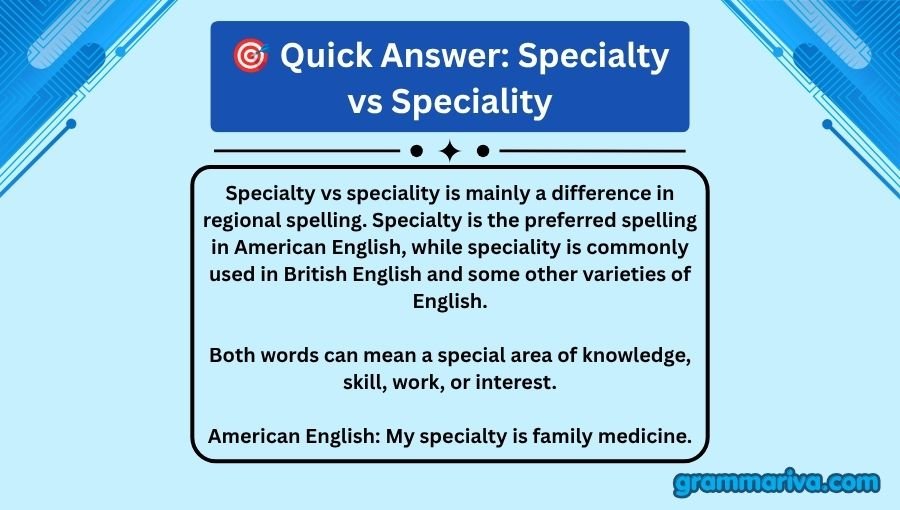
Specialty vs speciality is mainly a difference in regional spelling. Specialty is the preferred spelling in American English, while speciality is commonly used in British English and some other varieties of English.
Both words can mean a special area of knowledge, skill, work, or interest.
American English: My specialty is family medicine.
British English: My speciality is family medicine.
The meaning stays the same. The spelling changes based on the variety of English being used.
Related Word Forms of Specialty and Speciality
The two spellings have several related forms. Most of these forms keep the same regional pattern.
| Form | Type | Example |
|---|---|---|
| specialty | American noun | Cooking is her specialty. |
| speciality | British noun | Cooking is her speciality. |
| specialties | American plural | The clinic offers several specialties. |
| specialities | British plural | The clinic offers several specialities. |
| specialty’s | American possessive | The specialty’s requirements are strict. |
| speciality’s | British possessive | The speciality’s requirements are clear. |
The plural forms are especially useful to remember. American English usually changes -y to -ies, giving specialties. British English commonly uses specialities.
Is Specialty the Same as Speciality?
Yes. In most normal uses, specialty and speciality have the same basic meaning. The main difference is which form of English prefers the spelling.
For example:
- American English: Her specialty is pediatric care. ✅
- British English: Her speciality is pediatric care. ✅
Neither sentence has a grammar problem. The choice depends on the intended variety of English.
The important point is that you should not treat one spelling as a misspelling everywhere. Speciality is not simply a bad version of specialty, and specialty is not wrong in American writing.
| Form | Main Use | Meaning | Example | Correct/Incorrect |
|---|---|---|---|---|
| specialty | American English | A special area of skill or study | Writing is my specialty. | ✅ Correct |
| speciality | British English | A special area of skill or study | Writing is my speciality. | ✅ Correct |
| specialty in British writing | Less typical regional choice | Same basic meaning | Writing is my specialty. | ✅ Grammatically correct, but regional |
| speciality in American writing | Less typical regional choice | Same basic meaning | Writing is my speciality. | ✅ Grammatically understandable, but less standard for US English |
What Does Specialty Mean in American English?
In American English, specialty is the standard spelling for a special area of skill, knowledge, business, or study.
For example:
My specialty is digital marketing.
Here, specialty is a noun. It identifies the particular field in which the person has special knowledge or ability.
The word can appear in many settings:
- medicine
- education
- business
- cooking
- sports
- technology
- art
- professional services
Specialty in Professional Work
A doctor may have a specialty in cardiology.
A lawyer may have a specialty in immigration law.
A writer may have a specialty in technical content.
A chef may have a specialty in French desserts.
In each case, the word points to an area that receives special focus.
Specialty for Products or Services
The word can also describe something a business is especially known for.
For example:
Handmade bread is the bakery’s specialty.
This means handmade bread is one of the bakery’s notable or special products.
Specialty in Personal Interests
You can also use the word outside formal work.
Organizing large family events is my specialty.
The sentence does not mean the person has a formal qualification. It simply means they are especially good at that activity.
Test Tip 💡
When writing for a US audience, ask yourself:
“Am I writing in American English?”
If the answer is yes, choose specialty.
| Meaning | Word Type | Example Sentence |
|---|---|---|
| Special area of study | Noun | Biology became her specialty. |
| Special professional field | Noun | Surgery is his specialty. |
| Product a business is known for | Noun | Pizza is the restaurant’s specialty. |
| Skill someone is especially good at | Noun | Problem-solving is her specialty. |
What Does Speciality Mean in British English?
Speciality is the common British English spelling of the same basic noun. It can describe a special area of knowledge, skill, work, or interest.
For example:
Her speciality is children’s literature.
The meaning is the same as:
Her specialty is children’s literature.
The difference is spelling preference rather than a difference in the basic idea.
You may see speciality in British books, websites, newspapers, academic writing, and professional documents. It is also used in other English varieties influenced by British spelling.
A British writer might say:
The restaurant’s speciality is homemade pasta.
An American writer would usually write:
The restaurant’s specialty is homemade pasta.
Both sentences communicate the same idea.
Why Do People Confuse Specialty and Speciality?
People confuse these words because both spellings are correct in different varieties of English. The pronunciation and meaning are close enough that writers may not notice which spelling they are using.
I once edited a short company profile that switched between specialty and speciality several times. The writer was not making a meaning error. The real issue was consistency. The document was written for American customers, so I changed the British-style spellings to the American form.
Other factors can make the confusion worse:
- exposure to British websites
- international workplaces
- autocorrect settings
- reading books from different countries
- copying wording from online sources
- uncertainty about American and British spelling
If you read both American and British English regularly, seeing both forms is normal.
Specialty vs Speciality at a Glance
The easiest way to remember the difference is to connect the spelling with the variety of English.
| Feature | Specialty | Speciality |
|---|---|---|
| Main variety | American English | British English |
| Basic meaning | Special area of skill or knowledge | Special area of skill or knowledge |
| Singular | specialty | speciality |
| Plural | specialties | specialities |
| Meaning difference | Usually none | Usually none |
| Best choice for US audience | Yes | No, generally |
| Best choice for UK audience | Less typical | Yes |
This is why the question is not simply “Which spelling is correct?”
A better question is:
“Which variety of English am I writing?”
That question gives you the answer quickly.
Which Spelling Should American Writers Use?
American writers should normally use specialty.
This applies to:
- resumes
- cover letters
- websites
- blog posts
- school assignments
- business emails
- product descriptions
- professional profiles
- marketing materials
For example:
My specialty is creating clear technical content. ✅
For a US audience, this spelling fits standard American usage.
If you are writing for a US company, using speciality may look unusual because American readers generally expect specialty.
That does not make the British spelling meaningless or universally wrong. It simply makes it a less natural choice for standard US English.
Which Spelling Should British Writers Use?
British writers generally use speciality.
For example:
Her speciality is modern European history. ✅
This follows a common British spelling pattern.
If the rest of a document uses British forms such as colour, centre, and organise, then speciality will usually fit that spelling system naturally.
The key is consistency. A document should not randomly switch between American and British spelling unless there is a clear reason for doing so.
Can You Use Specialty in British English?
Yes, specialty can appear in British English, but speciality is generally the more familiar British form when the word means a special area of knowledge or skill.
The important distinction is between grammatical correctness and regional preference.
A British reader can understand:
Medicine is her specialty.
But a British writer may naturally choose:
Medicine is her speciality.
This is similar to many other spelling differences between American and British English.
Can You Use Speciality in American English?
Yes, an American reader will understand speciality, but it is not the usual standard American spelling.
For US-focused writing, specialty is the safer and more natural choice.
Consider these examples:
- My specialty is marketing. ✅
- My speciality is marketing. ⚠️
The second sentence is understandable. However, if the document is specifically written in standard US English, the first spelling is the better fit.
Correct Meanings and Uses of Specialty
The noun specialty has several closely related uses. They all center on something that receives special attention or is a particular area of skill.
A Professional Area
Neurology is her specialty.
The word identifies her professional field.
A Special Skill
Finding errors in complicated documents is his specialty.
Here, specialty means a skill the person is particularly good at.
A Special Product
The restaurant’s specialty is fresh seafood.
Here, specialty identifies a product or type of food the restaurant is known for.
A Special Area of Study
Environmental science became his specialty.
The word refers to a focused area of study.
| Use | Example | Meaning |
|---|---|---|
| Profession | Surgery is her specialty. | Her professional field |
| Skill | Solving puzzles is his specialty. | Something he does especially well |
| Product | Cheesecake is the café’s specialty. | A product it is known for |
| Study | Ancient history is her specialty. | Her focused academic field |
How To Remember the Difference
Use a simple two-word memory trick:
US = specialty
UK = speciality
The American form has -ty at the end.
The British form has -ity at the end.
You can also remember the plural forms:
American: specialties
British: specialities
I once caught myself typing speciality in an American client document after reading several UK-based articles that morning. I noticed the spelling during proofreading. Since the document was for US readers, I changed it to specialty. That small check saved me from mixing regional styles.
How Does the Spelling Change in the Plural?
The plural forms are different:
- specialty → specialties
- speciality → specialities
American English commonly uses specialties, while British English commonly uses specialities.
For example:
The hospital offers several medical specialties. ✅
British English may use:
The hospital offers several medical specialities. ✅
The basic meaning remains unchanged.
| Singular | Plural | Variety |
|---|---|---|
| specialty | specialties | American English |
| speciality | specialities | British English |
A common mistake is to write specialtys. That is incorrect.
The y changes to ies when the plural is formed.
Is Specialty a Noun or an Adjective?
Specialty is normally used as a noun.
For example:
Baking is her specialty.
It names a thing, area, or skill.
The word special is different because it can work as an adjective.
Compare:
This is her specialty.
She has a special skill.
Do not assume that every form related to “special” can be used in the same grammatical role.
| Word | Part of Speech | Example |
|---|---|---|
| specialty | Noun | Writing is my specialty. |
| speciality | Noun | Writing is my speciality. |
| special | Adjective | She has a special skill. |
| specialize | Verb | She specializes in editing. |
| specialized | Adjective | He has specialized training. |
📝 Case Study: Specialty in a Workplace Email
Imagine a marketing manager is preparing a US company profile.
The original sentence says:
Our speciality is helping small businesses grow.
The meaning is clear, but the company serves mainly US customers and uses American English throughout its website.
The edited sentence would be:
Our specialty is helping small businesses grow.
The change does not alter the message. It simply makes the spelling consistent with the intended audience.
Now imagine the same company has a UK branch using British English. The UK version could naturally say:
Our speciality is helping small businesses grow.
This example shows why context matters more than simply labeling one spelling “right” and the other “wrong.”
Grammar Rules Explanation
The core rule is based on regional English usage, not a difference in grammar. Understanding specialty vs speciality is mainly about matching your spelling to your target audience.
Specialty is the standard American spelling.
Speciality is the standard British spelling.
Both function as nouns.
Neither spelling changes the basic meaning when used in the normal sense of a special field, skill, or product.
Most major English reference sources recognize the two forms as part of regional English usage. The key for writers is to match the spelling to the variety of English they have chosen.
The same principle applies to many spelling differences between American and British English. A document becomes easier to read when its spelling system stays consistent from beginning to end.
Correct vs Incorrect at a Glance
| Sentence | Correct/Incorrect | Why |
|---|---|---|
| Writing is my specialty. | ✅ Correct | Standard American spelling |
| Writing is my speciality. | ✅ Correct | Standard British spelling |
| Writing is my specialty in a US resume. | ✅ Correct | Fits American English |
| Writing is my speciality in a UK CV. | ✅ Correct | Fits British English |
| Writing is my specialty in a document that otherwise uses British spelling. | ⚠️ Less consistent | The spelling may conflict with the document’s regional style |
The last example is not grammatically broken. It is mainly a consistency issue.
⚠️ Common Mistakes With Specialty and Speciality
Most mistakes happen because writers see both forms online and assume one must be a typo.
Other mistakes come from fast typing, autocorrect, or limited knowledge of regional spelling.
| Similar Confusion | Correct Forms | Main Issue |
|---|---|---|
| it’s / its | it’s, its | Contraction vs possession |
| your / you’re | your, you’re | Possession vs contraction |
| there / their / they’re | there, their, they’re | Different meanings and roles |
| affect / effect | affect, effect | Different common uses |
| practice / practise | practice, practise | Regional and grammatical differences |
| specialty / speciality | specialty, speciality | Regional spelling preference |
Why These Mistakes Happen
Fast typing: When people type quickly, they often choose the spelling that feels familiar.
Autocorrect: A keyboard may use a language setting that does not match the audience.
Lack of knowledge: Writers may not know that American and British English use different spelling patterns.
Mixed reading habits: A person who reads websites from several countries may naturally pick up both forms.
Specific Wrong Forms to Avoid
| Wrong Form | What’s Wrong | Correct Form |
|---|---|---|
| specialtys | Incorrect plural formation | specialties |
| specialitys | Incorrect plural formation | specialities |
| speciality in a US-focused document | Regional inconsistency | specialty |
| specialty in a UK-focused document | Less typical regional choice | speciality |
| specialities in standard US writing | British-style plural | specialties |
| specialties in standard UK writing | American-style plural | specialities |
The important thing is not to treat every cross-regional spelling as a grammar error. The bigger issue is choosing the form that fits your audience.
Does Specialty Have a Different Meaning From Speciality?
In the normal sense discussed here, no major meaning difference exists.
Both can refer to:
- a special field
- a professional area
- a particular skill
- a product a business is known for
- an area of study
The spelling changes more than the meaning.
For example:
Graphic design is her specialty.
and
Graphic design is her speciality.
Both tell the reader that graphic design is her special area of skill.
Usage in Different Contexts
The best spelling depends on your target variety of English. When writing for an international audience, knowing specialty vs speciality can help you keep your spelling consistent.
| Context | Which Term to Use | Example |
|---|---|---|
| Everyday conversation | Match your regional English | Cooking is my specialty. |
| Professional writing | Match the audience | Finance is his specialty. |
| Creative writing | Match the setting or narrator | Baking was Grandma’s speciality. |
| Social media/texting | Either may appear, but consistency helps | Coffee is my specialty. |
Creative writing deserves special attention. If a story is set in Britain and the narrator uses British English, speciality may fit naturally. If the story uses American English, specialty may be more appropriate.
Common Phrases With Specialty
There are several natural phrases that commonly use specialty in American English.
| Phrase | Meaning |
|---|---|
| medical specialty | A specific field of medicine |
| specialty store | A store focused on a particular type of product |
| specialty food | Food with a special or distinctive focus |
| specialty coffee | Coffee presented as a specialized product |
| specialty service | A service focused on a particular need |
| area of specialty | A specific field of skill or knowledge |
In British English, the corresponding noun can be spelled speciality.
For example:
The hospital has a new medical speciality.
Specialty in Medical Writing
Medical writing is one area where the word appears often.
In American English, you may see:
- medical specialty
- surgical specialty
- specialty clinic
- specialty care
- medical specialties
For example:
Cardiology is a medical specialty.
In British English, speciality is commonly used instead:
Cardiology is a medical speciality.
The meaning is essentially the same.
The important point is to follow the spelling system used by the medical organization, publication, or audience.
Specialty in Business and Marketing
Businesses often use the word to show what they are especially known for.
For example:
Our specialty is custom website design.
A restaurant might say:
Our specialty is handmade pasta.
A consulting firm might say:
Data analysis is our specialty.
These sentences all use specialty as a noun.
For British audiences, the same sentences may use speciality.
When creating marketing content, consistency matters because customers often judge a business by small details. A single regional spelling is not usually a serious problem, but inconsistent spelling across a whole website can make the copy look less polished.
Synonyms and Alternatives
Sometimes you can avoid the spelling question by choosing another word. However, the replacement must fit the sentence.
| Alternative | Works When | Does Not Work When |
|---|---|---|
| expertise | Talking about strong knowledge or skill | Referring to a restaurant’s signature product |
| specialty area | Describing a focused professional field | When a shorter phrase sounds more natural |
| field | Talking about an area of study or work | When describing a special product |
| focus | Describing what someone concentrates on | When referring to a traditional specialty |
| strength | Talking about something someone does well | When a formal professional field is meant |
For example:
Writing is my specialty.
can become:
Writing is my area of expertise.
But:
Chocolate cake is the bakery’s specialty.
does not always work naturally as:
Chocolate cake is the bakery’s expertise.
That changes the meaning.
Why It Matters in Professional Writing
Choosing the right regional spelling helps your writing stay clear and consistent. It also shows that you understand the audience you are writing for.
| Situation | Why Getting It Right Matters |
|---|---|
| Resume | Keeps professional language consistent |
| Client email | Matches the client’s regional English |
| Published content | Maintains a consistent editorial style |
| Social post | Makes the wording look polished and intentional |
A simple rule I use when editing is:
Good spelling should serve the reader, not distract the reader.
You do not need to make every English variety look the same. You need to make your chosen variety consistent.
Why Consistency Matters More Than Choosing One Universal Form
There is no single spelling that must be used by every English speaker worldwide.
American English has its own spelling conventions. British English has its own conventions. Both are established forms of English.
Problems arise when a document starts in one style and switches randomly to another.
For example, a US website might use:
color
center
organize
specialty
That pattern feels consistent.
A British website might use:
colour
centre
organise
speciality
That also feels consistent.
The strongest writing usually has a clear regional style.
How To Choose the Right Form for Your Audience
Use this quick process:
- Identify your audience.
- Decide whether you are using American or British English.
- Check the spelling of related words.
- Use the same style throughout the document.
- Proofread before publishing.
If you are writing specifically for US readers, choose specialty.
If you are writing specifically for UK readers, choose speciality.
If your organization has an established style guide, follow that guide.
💡 Test Tip: Use the Audience Test
When you are unsure, ask:
“Would my target readers expect American or British spelling?”
If the answer is American, use specialty.
If the answer is British, use speciality.
This test is more useful than asking which word “looks more correct.”
You can also scan the rest of your document. If you already use American spellings such as color and center, specialty will probably fit. If you use colour and centre, speciality may fit better.
Quick Recap Checklist
Use this checklist before publishing your writing.
| Question | If Yes → Use |
|---|---|
| Am I writing standard US English? | specialty |
| Am I writing standard UK English? | speciality |
| Am I describing a special professional field? | specialty/speciality based on region |
| Am I writing the American plural? | specialties |
| Am I writing the British plural? | specialities |
| Am I mixing regional spelling styles? | Choose one style and stay consistent |
Practice Examples
- Medicine is her specialty. → American English ✅
- Medicine is her speciality. → British English ✅
- The hospital offers several specialties. → American English ✅
Is Specialty or Speciality More Common in American English?
Specialty is the standard choice in American English.
If your article, resume, website, or email is written for a US audience, use specialty.
Is Speciality or Specialty More Common in British English?
Speciality is the standard choice in British English.
British writers commonly use speciality for a special field of skill, study, work, or interest.
Can Specialty and Speciality Be Used Interchangeably?
They can usually be substituted for each other without changing the basic meaning, but the spelling should match the variety of English being used.
Use specialty for American English and speciality for British English.
What Is the Plural of Specialty?
The American English plural is specialties.
For example:
The hospital offers several medical specialties.
The British English equivalent is specialities.
What Is the Plural of Speciality?
The plural of speciality is specialities.
For example:
The university offers several scientific specialities.
In American English, the equivalent is specialties.
Is Speciality Wrong in American English?
No, it is understandable and established in other varieties of English. However, specialty is the usual standard spelling for American English.
If you are writing specifically for US readers, specialty is normally the better choice.
Is Specialty Wrong in British English?
No. British readers can understand specialty, but speciality is the more typical British spelling for this meaning.
The issue is mainly regional preference and consistency.
Should I Use Specialty on an American Resume?
Yes. If your resume is written in standard American English, specialty is the natural choice.
For example:
Specialty: Digital Marketing
or:
My specialty is content strategy.
How Do I Remember Specialty vs Speciality?
Remember this simple pattern:
American English → specialty
British English → speciality
Then remember the plurals:
American → specialties
British → specialities
This small pattern handles most situations.
What Is the Main Difference Between Specialty and Speciality?
The main difference is spelling preference by region. Specialty is the usual American form, while speciality is the usual British form.
Their basic meaning is the same.
Conclusion
Specialty vs speciality is mainly a question of regional spelling, not a difference in basic meaning. Specialty is the standard choice for American English, while speciality is commonly preferred in British English. Both can describe a special area of skill, study, work, knowledge, or interest.
When I edit English content, I always look at the audience before deciding which spelling to use. A US article should normally use specialty, while a UK article will usually sound more natural with speciality. The same rule applies to their plural forms: specialties in American English and specialities in British English.
The best way to avoid confusion is to choose one regional style and stay consistent throughout your writing. ✨ Once you connect specialty with American English and speciality with British English, this spelling difference becomes much easier to remember.
Choose the spelling that matches your audience, keep your style consistent, and your writing will stay clear and polished.

Hi, I’m Olivia Carter. I’m an English language editor at Grammariva, and I work on making grammar lessons clear, accurate, and easy to follow. I especially enjoy writing about common grammar mistakes and everyday English.

[…] distinction easy to remember. By the end, choosing between these words should feel natural. 😊 Specialty vs Speciality | Jibe vs Jive | Recurring vs […]
[…] to avoid, and when a simpler word such as “about” may be better. Invaluable vs Valuable | Specialty vs Speciality | Jibe vs […]