Have you ever stopped while writing an email and wondered whether something is recurring vs reoccurring? 🤔 The two words look almost the same, and both describe something that happens again. That is why even careful writers sometimes choose the wrong one.
The good news is that the difference is easier to understand than it first appears. Recurring usually describes something that happens again and again as part of a pattern or schedule. Reoccurring means something happens again, but it does not always suggest a regular pattern.
As an editor, I often see these words mixed up in emails, reports, calendars, and online content. The mistake usually does not change the basic idea, but the wrong word can make a sentence less precise.
In this guide, I’ll explain the difference in simple US English. You’ll see clear examples, practical rules, common mistakes, memory tips, and real-life situations. By the end, you should know exactly when to use each word. ✍️ “Understanding recurring vs reoccurring can make your everyday and professional writing much clearer.” Take a Rest vs Have a Rest | Creek or Crick | Aether vs Ether
🎯 Quick Answer: Recurring vs Reoccurring
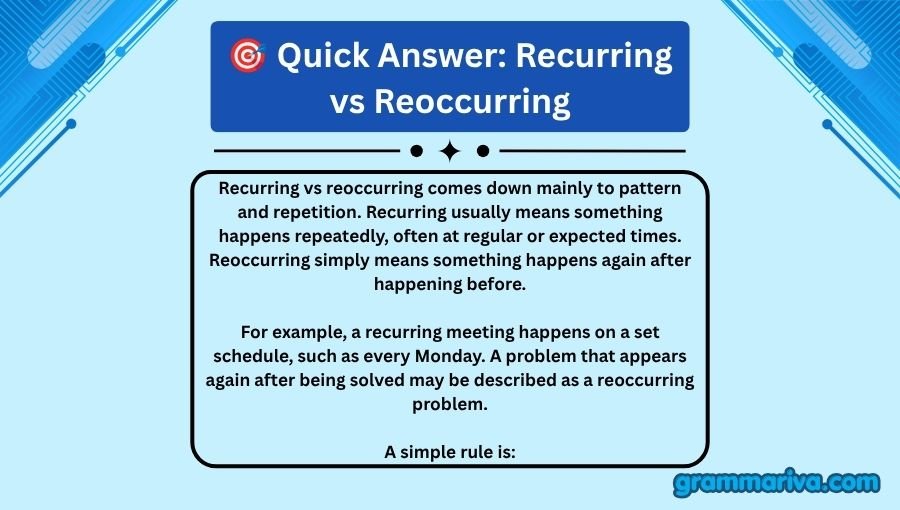
Recurring vs reoccurring comes down mainly to pattern and repetition. Recurring usually means something happens repeatedly, often at regular or expected times. Reoccurring simply means something happens again after happening before.
For example, a recurring meeting happens on a set schedule, such as every Monday. A problem that appears again after being solved may be described as a reoccurring problem.
A simple rule is:
Recurring = happening repeatedly, often as a pattern.
Reoccurring = happening again, without necessarily following a pattern.
Both words can be correct. The best choice depends on what you want to say.
🔤 Related Word Forms of Recurring and Reoccurring
The two words come from the verbs recur and reoccur. Their forms change depending on how they are used in a sentence.
| Form | Type | Example |
|---|---|---|
| recur | Verb | The issue may recur next month. |
| recurring | Present participle/adjective | We have a recurring meeting. |
| recurred | Past-tense verb | The problem recurred last week. |
| reoccur | Verb | The error may reoccur. |
| reoccurring | Present participle/adjective | We noticed a reoccurring issue. |
| reoccurred | Past-tense verb | The error reoccurred after the update. |
These forms are grammatically related, but they are not always interchangeable. The main difference is still the meaning behind the repeated event.
🧩 Understanding Recurring vs Reoccurring
The easiest way to understand the difference is to focus on regular repetition. “The key to recurring vs reoccurring is recognizing whether you mean a repeated pattern or simply another occurrence.”
Recurring is strongly connected with repetition that happens more than once and often follows a pattern. A subscription, monthly payment, weekly class, or yearly event can all be recurring.
Reoccurring focuses more simply on an event happening again. The second event may be unexpected or irregular.
Recurring
Use recurring when an event happens repeatedly or is expected to keep happening.
- We have a recurring staff meeting every Friday. ✅
- The customer has a recurring monthly payment. ✅
- She suffers from recurring headaches. ✅
The repetition may be scheduled, predictable, or simply part of an ongoing pattern.
Reoccurring
Use reoccurring when something happens again after happening before, especially when there is no clear regular schedule.
- The software bug is reoccurring after each update. ✅
- The same issue is reoccurring in several reports. ✅
- The error reoccurred after we restarted the system. ✅
The focus is on the fact that something happened again.
Comparison at a Glance
| Form | Type | Meaning | Example | Correct/Incorrect |
|---|---|---|---|---|
| recurring | Adjective | Happening repeatedly or regularly | We have a recurring meeting. | ✅ Correct |
| reoccurring | Adjective | Happening again | The problem is reoccurring. | ✅ Correct |
| recur | Verb | Happen again repeatedly | The problem may recur. | ✅ Correct |
| reoccur | Verb | Happen again | The problem may reoccur. | ✅ Correct |
| recurring for one isolated second event | Adjective | May sound less precise | The accident was recurring once. | ❌ Incorrect |
The final example is wrong because recurring normally suggests repeated behavior, not one isolated return.
❓ Is Recurring the Same as Reoccurring?
No, recurring and reoccurring are closely related, but they are not exactly the same.
Recurring normally suggests repeated events or a pattern. Reoccurring emphasizes that something occurs again. In some sentences, either word may work because the difference is small.
Consider these examples:
- The company has a recurring meeting every Tuesday. ✅
- The company has a reoccurring meeting every Tuesday. ⚠️
The first sentence is more natural because a scheduled meeting is clearly a repeated event.
Now consider a software problem:
- The software has a recurring error. ✅
- The software has a reoccurring error. ✅
Both can work. The first may suggest an ongoing pattern, while the second highlights the fact that the error appears again.
📅 When Should You Use Recurring?
Use recurring when repetition is expected, regular, repeated, or part of a pattern.
Common examples include:
Recurring Payments
A payment made on a regular schedule is normally called a recurring payment.
- The customer canceled the recurring payment. ✅
- The customer canceled the reoccurring payment. ⚠️
The first sentence is more natural because the payment is expected to happen repeatedly.
Recurring Events
Events that happen regularly are also recurring.
- The festival is a recurring annual event. ✅
- The festival is a reoccurring annual event. ⚠️
The word annual already establishes a pattern, so recurring fits very well.
Recurring Problems
A problem that keeps returning can also be described as recurring.
- We need to solve this recurring problem. ✅
Here, recurring tells readers that the problem has happened repeatedly.
Meaning Summary
| Meaning | Word Type | Example Sentence |
|---|---|---|
| Repeated regularly | Adjective | She attends a recurring class. |
| Happening repeatedly | Adjective | He has recurring dreams. |
| Continuing as a pattern | Adjective | The team faces recurring delays. |
| Happening on a schedule | Adjective | This is a recurring appointment. |
💡 Test Tip
Ask yourself:
“Does this happen repeatedly as a pattern?”
If the answer is yes, recurring is usually your best choice.
❓ When Should You Use Reoccurring?
Use reoccurring when you want to stress that something has happened again. The distinction in recurring vs reoccurring becomes clearer when something happens again without a fixed schedule.
The word is especially useful when the repeated event is not clearly scheduled.
For example:
- The error is reoccurring after every restart. ✅
- The same conflict is reoccurring in different meetings. ✅
- The issue reoccurred unexpectedly. ✅
In these examples, the important point is that the event appeared again.
A Useful Distinction
Imagine that a website crashes once. A technician fixes it. Several days later, it crashes again.
You could say:
The website problem reoccurred.
That sentence focuses on its return.
If the website keeps crashing every few days, you could say:
The website has a recurring problem.
Now the focus is on the repeated pattern.
| Situation | Better Choice | Reason |
|---|---|---|
| Weekly meeting | recurring | Regular schedule |
| Monthly bill | recurring | Predictable repetition |
| Annual event | recurring | Repeated pattern |
| Problem appears again | reoccurring | Focuses on return |
| Problem keeps returning | recurring | Ongoing pattern |
❓ Why Do People Confuse Recurring and Reoccurring?
People confuse these words because they share most of the same letters and both involve repetition.
Another reason is that everyday speech does not always require such a fine distinction. Speakers may use either word when they simply mean “happening again.”
I once edited a workplace report where the writer used reoccurring for every scheduled event. The meaning was understandable, but replacing it with recurring made the report much cleaner because every event followed a fixed schedule.
The similarity between the words also makes them easy to mix up while typing.
Common Reasons for Confusion
- The words look nearly identical.
- Both describe repetition.
- People often use them as synonyms.
- Autocorrect may not catch the choice.
- Writers may know the general meaning but not the difference in nuance.
🔍 Key Differences Between Recurring and Reoccurring
The core difference is the type of repetition being emphasized.
| Feature | Recurring | Reoccurring |
|---|---|---|
| Happens again | Yes | Yes |
| Suggests repetition | Strongly | Yes |
| Suggests a pattern | Often | Not necessarily |
| Works well with schedules | Yes | Less natural |
| Focuses on return | Sometimes | More strongly |
| Common in business writing | Very common | Less common |
A useful way to remember the distinction is to think about a calendar.
If you can put the event on your calendar again and again, recurring is usually the natural choice.
If something disappeared and then appeared again, reoccurring may better highlight that return.
📝 Case Study: A Workplace Scheduling Problem
Imagine that a manager sends this email:
“Our reoccurring team meeting will take place every Monday.”
The sentence is understandable, but recurring is the better choice:
“Our recurring team meeting will take place every Monday.” ✅
Why?
The meeting is not simply happening again. It is part of a fixed weekly pattern.
Now imagine a different email:
“The login error reoccurred after the latest update.” ✅
This sentence describes a problem that appeared again. It does not necessarily describe a scheduled event.
I once caught myself typing reoccurring in a calendar notice for a monthly meeting. I changed it before sending the message because the event was clearly scheduled. That small edit made the wording more precise.
📚 Grammar Rules Explanation
The grammar itself is simple. Both recurring and reoccurring can work as adjectives, and recur and reoccur can work as verbs.
The main issue is not whether one form is grammatically possible. The issue is meaning and natural usage.
Recur describes something happening again, often more than once. Its related adjective is recurring.
Reoccur means to occur again. Its related adjective is reoccurring.
The difference becomes clearer when repetition is predictable.
A recurring event normally has an established pattern. A reoccurring event simply returns or happens again.
Standard English reference sources generally recognize both forms, although usage can vary depending on context. The safest approach is to choose the word that matches the type of repetition you mean.
Correct vs Incorrect at a Glance
| Sentence | Correct/Incorrect | Why |
|---|---|---|
| We have a recurring meeting every Friday. | ✅ Correct | The meeting follows a schedule. |
| The error reoccurred after the repair. | ✅ Correct | The error happened again. |
| She has recurring dreams. | ✅ Correct | The dreams happen repeatedly. |
| We have a reoccurring meeting every Friday. | ⚠️ Less natural | “Recurring” better expresses a fixed pattern. |
| The monthly bill is reoccurring. | ⚠️ Less natural | “Recurring” is the standard choice for scheduled payments. |
The important point is that “incorrect” and “less natural” are not always the same thing. Reoccurring can be grammatically possible in contexts where recurring sounds more precise.
⚠️ Common Mistakes With These Words
“One of the most common mistakes with recurring vs reoccurring is treating the two words as completely interchangeable.”
The most common mistake is treating the two words as perfectly interchangeable.
They overlap, but their usual emphasis is different.
Similar Grammar Confusions
| Confusion | Correct Choice | Basic Difference |
|---|---|---|
| its / it’s | Depends on meaning | Possession vs. “it is” |
| your / you’re | Depends on meaning | Possession vs. “you are” |
| their / there / they’re | Depends on meaning | Possession, place, or “they are” |
| affect / effect | Depends on meaning | Usually verb vs. noun |
| recurring / reoccurring | Depends on context | Pattern vs. happening again |
Why These Mistakes Happen
Fast typing:
Writers often choose the first familiar-looking word without checking its meaning.
Autocorrect:
Spell-check tools usually cannot understand every difference in meaning.
Lack of knowledge:
Some writers learn that both words mean “again” but never learn the difference in emphasis.
Habit:
Once a writer uses one form repeatedly, that form can become automatic.
I once reviewed a short business proposal that used reoccurring for a monthly charge three times. The writer clearly understood the idea. The issue was simply word choice. Changing each instance to recurring made the document sound more polished.
Common Wrong Spellings and Uses
| Wrong Form | What’s Wrong | Correct Form |
|---|---|---|
| reccurring | Extra “c” | recurring |
| recurrring | Extra “r” | recurring |
| reoccuring | Missing “r” | reoccurring |
| recuring | Missing “r” | recurring |
| recurring event that happened only once | Meaning does not fit | reoccurring event / occurred again |
| reoccurring monthly payment | Less precise for a schedule | recurring monthly payment |
🕰️ Word History and Development
Both words are built around the idea of something happening again. They are related to the verb occur, but they developed with slightly different uses in modern English.
Recur is commonly used for something that happens repeatedly or returns. Reoccur is used for something that occurs again.
Over time, recurring became especially common in contexts involving schedules, repeated patterns, payments, events, and conditions.
The development can be summarized simply:
| Period | Form | General Note |
|---|---|---|
| Earlier English use | recur | Used for something happening again |
| Later development | reoccur | Emphasized something occurring again |
| Modern English | recurring | Common for repeated patterns and schedules |
| Modern English | reoccurring | Used for something happening again |
| Current usage | Both | Meaning overlaps in many contexts |
You do not need to memorize the history to choose the correct word. The modern distinction is much more useful for everyday writing.
🌎 Usage in Different Contexts
The best choice can become especially clear when you look at common writing situations. Looking at recurring vs reoccurring in different contexts makes it easier to choose the word that sounds most natural.
Everyday Conversation
In casual speech, people often use the words loosely.
“That same problem keeps recurring.” ✅
This sounds natural when the problem keeps returning.
Professional Writing
Professional writing benefits from the more precise choice.
“The client receives a recurring invoice every month.” ✅
The schedule makes recurring the natural option.
Creative Writing
Creative writers can choose either word depending on the intended meaning.
“A recurring memory followed him everywhere.” ✅
This suggests a repeated mental experience.
Social Media and Texting
In casual posts, either word may appear, but recurring is often shorter and more familiar.
“My recurring Monday mood.” ✅
| Context | Which Term to Use | Example |
|---|---|---|
| Everyday conversation | Usually recurring | This problem keeps recurring. |
| Professional writing | Usually recurring | This is a recurring payment. |
| Creative writing | Depends on meaning | A recurring dream haunted her. |
| Social media/texting | Usually recurring | My recurring weekend plan. |
💬 Common Phrases With Recurring
Recurring appears in many useful phrases. These phrases often describe something that happens repeatedly or according to a schedule.
| Phrase | Meaning |
|---|---|
| recurring payment | A payment made repeatedly |
| recurring charge | A repeated financial charge |
| recurring meeting | A meeting held regularly |
| recurring issue | A problem that repeatedly appears |
| recurring event | An event that happens repeatedly |
| recurring theme | An idea that appears again and again |
These phrases are especially common in business, finance, technology, education, and everyday planning.
🔄 Common Phrases With Reoccurring
Reoccurring is less common in fixed phrases, but it can still be useful when the focus is on something happening again.
| Phrase | Meaning |
|---|---|
| reoccurring problem | A problem that appears again |
| reoccurring error | An error that returns |
| reoccurring issue | An issue that happens again |
| reoccurring event | An event that happens again |
| reoccurring conflict | A conflict that returns |
| reoccurring symptom | A symptom that appears again |
In many of these cases, recurring may also work. The choice depends on whether you want to emphasize a pattern or simply a return.
🔁 Synonyms and Alternatives
Sometimes you can avoid the choice entirely by using another phrase. If you are unsure about recurring vs reoccurring, a simple alternative such as “happens again” can sometimes make your meaning clearer.
| Alternative | Works When | Does Not Work When |
|---|---|---|
| repeated | You want to stress that something happened more than once | You need to stress a regular schedule |
| regular | Something happens according to a pattern | The event only happened again once |
| periodic | Something happens at intervals | The timing is completely unpredictable |
| happens again | You want simple, direct wording | You need a concise adjective |
| ongoing | Something continues over time | You mean only one additional occurrence |
For example, instead of:
“The issue is reoccurring.”
You could write:
“The issue keeps happening.”
That version is very clear and works well in casual writing.
❓ Can Recurring and Reoccurring Be Interchanged?
Sometimes they can, but not always.
If the sentence describes something that repeatedly happens, both words may communicate the general idea. However, recurring is usually better when the event follows a pattern.
For example:
The company has recurring training sessions. ✅
This clearly suggests a repeated schedule.
By contrast:
The same mistake reoccurred during the next review. ✅
This focuses on the mistake happening again.
So, while the words overlap, replacing one with the other can change the tone or precision of the sentence.
❓ Is Recurring More Common Than Reoccurring?
In many everyday and professional contexts, recurring is the more natural choice when describing regular repetition.
You commonly see it with:
- payments
- meetings
- appointments
- events
- themes
- problems
- dreams
- symptoms
- tasks
- expenses
Reoccurring is useful when the main idea is that something has happened again.
The difference is therefore not simply “one is correct and one is wrong.” Context matters.
❓ Is a Monthly Payment Recurring or Reoccurring?
A monthly payment is normally described as a recurring payment.
Why? Because the payment follows a repeated schedule.
- The customer has a recurring monthly payment. ✅
- The customer has a reoccurring monthly payment. ⚠️
The second version can be understood, but the first is more natural and precise.
❓ Is a Repeated Problem Recurring or Reoccurring?
Both can work, but recurring problem is usually the better choice when the problem keeps returning as a pattern.
For example:
We need to fix this recurring problem. ✅
If you are describing one return after an earlier solution, reoccurred may be more precise:
The problem reoccurred after the repair. ✅
The key is whether you are describing a pattern or one additional occurrence.
❓ Is Recurring Always Related to a Schedule?
No. A recurring event does not have to happen on a strict calendar schedule.
For example:
She has recurring nightmares.
Nightmares do not necessarily happen every Monday or every month. The word simply tells us that the experience happens repeatedly.
So recurring can describe both scheduled repetition and repeated patterns.
❓ Is Reoccurring a Correct English Word?
Yes. Reoccurring is a valid English form related to reoccur.
However, it is not automatically the best choice whenever something happens again.
When the event is regular or follows a repeated pattern, recurring is often more natural.
❓ Should I Say Recurring or Reoccurring Issue?
In most professional situations, recurring issue is the safer and more natural choice when the issue keeps appearing.
For example:
We need to address this recurring issue. ✅
If you simply want to say that an issue appeared again, you can use reoccurred:
The issue reoccurred after the update. ✅
❓ What Is the Easiest Way to Remember the Difference?
Think of a calendar.
If you can imagine putting the event on your calendar again and again, choose recurring.
If something happened before and then simply happened again, reoccurring can emphasize that return.
A second memory trick is:
Recurring = repeated pattern.
Reoccurring = occurring again.
This simple distinction will handle most everyday writing situations.
🎯 How to Remember the Difference
A quick way to remember recurring vs reoccurring is to connect recurring with a repeated pattern and reoccurring with something happening again. Here is the shortcut I teach writers:
Recurring means “again and again.” Reoccurring means “again.”
It is not a perfect rule for every possible sentence, but it is an excellent practical guide.
Think about these examples:
- Recurring appointment → happens repeatedly on a schedule. ✅
- Recurring problem → keeps coming back. ✅
- Reoccurring error → appears again. ✅
- Reoccurred after the update → happened again after a previous occurrence. ✅
If you are writing a business email and feel unsure, recurring will often be the better choice when you are describing something planned, regular, or repeated.
⚠️ Why Getting the Choice Right Matters
Choosing the right word makes your writing easier to understand.
| Situation | Why Getting It Right Matters |
|---|---|
| Resume | Shows careful word choice |
| Client email | Makes instructions more precise |
| Published content | Improves clarity and professionalism |
| Social post | Keeps wording natural and easy to read |
Consider a client who sees:
“You will receive a reoccurring charge every month.”
The meaning is understandable. But:
“You will receive a recurring charge every month.”
sounds more natural because the charge follows a known schedule.
A useful writing principle is:
Clear words make clear messages.
That matters even when two words have nearly the same basic meaning.
❓ How Do Recurring and Reoccurring Work in Sentences?
Both words can appear before a noun or after a linking verb.
Before a Noun
- recurring payment ✅
- recurring problem ✅
- reoccurring error ✅
- reoccurring conflict ✅
After a Linking Verb
- The problem is recurring. ✅
- The error is reoccurring. ✅
However, the context still determines which adjective sounds more natural.
| Position | Recurring Example | Reoccurring Example |
|---|---|---|
| Before noun | recurring issue | reoccurring issue |
| After “is” | The issue is recurring. | The issue is reoccurring. |
| Business context | recurring payment | reoccurring payment |
| Problem returns | recurring problem | reoccurring problem |
🧠 Quick Recap Checklist
Use this checklist before publishing or sending your sentence.
| Question | If Yes → Use |
|---|---|
| Does it happen regularly? | recurring |
| Is there a repeated pattern? | recurring |
| Is it scheduled? | recurring |
| Did it simply happen again? | reoccurring |
| Did an earlier problem return? | reoccurred/reoccurring |
| Are you describing a monthly charge? | recurring |
| Are you describing repeated behavior? | recurring |
Practice Examples
- We have a ______ meeting every Wednesday.
Answer: recurring ✅ - The software error ______ after the update.
Answer: reoccurred ✅ - She has ______ dreams about the same place.
Answer: recurring ✅
These examples show the main difference clearly: recurring usually describes an ongoing pattern, while reoccurring focuses more directly on something happening again.
FAQs About Recurring vs Reoccurring
What is the difference between recurring and reoccurring?
Recurring usually describes something that happens repeatedly or follows a pattern. Reoccurring means something happens again and does not necessarily suggest a regular pattern.
Is recurring or reoccurring correct?
Both are correct words. Recurring is generally preferred for regular or repeated events, while reoccurring can describe something happening again.
Is a recurring payment correct?
Yes. Recurring payment is the natural phrase for a payment that happens repeatedly on a schedule, such as monthly or yearly.
Can I say reoccurring problem?
Yes. Reoccurring problem is understandable and can be correct. However, recurring problem is often more natural when the problem keeps returning as part of a pattern.
Is recurring the same as repeated?
They are similar, but not identical. Repeated simply means something happened more than once. Recurring often suggests that the repetition continues or forms a pattern.
Should I use recurring for a weekly meeting?
Yes. Recurring meeting is the best choice for a meeting that happens every week or follows another regular schedule.
Should I use reoccurring for something that happened again?
Yes, especially when you want to emphasize that something happened again after an earlier occurrence. For example, “The error reoccurred after the update” is clear and natural.
Is reoccurring a real word?
Yes. Reoccurring is a valid word formed from reoccur. It is used to describe something happening again.
Which word is better in professional writing?
Recurring is often the better choice when you are discussing scheduled payments, meetings, appointments, events, or repeated problems. Use reoccurring when the main point is that something happened again.
How can I remember recurring vs reoccurring?
Remember this simple contrast: recurring = a repeated pattern; reoccurring = happening again. When something appears again and again, recurring is usually the safest choice.
🔚 Conclusion
Recurring vs reoccurring is mainly a question of how you want to describe repetition. Recurring is the better choice for something that happens repeatedly, regularly, or as part of a pattern. Reoccurring is useful when you want to emphasize that something has happened again.
Think about a monthly payment, weekly meeting, yearly event, or repeated problem. These are natural situations for recurring. If an error disappears and then appears again, reoccurred can clearly describe what happened.
As an editor, I recommend checking the pattern before choosing the word. Ask yourself whether you are describing an ongoing pattern or simply another occurrence. That one question can prevent most mistakes.
You do not need a complicated grammar rule. Just remember:
Recurring means repeated as a pattern. Reoccurring means occurring again. 🧠
Once that distinction becomes familiar, choosing between these two similar words becomes much easier. ✨

Hi, I’m Madison Hayes. I’m an English learning writer at Grammariva, where I work on simple lessons and examples for people who want to improve their grammar and writing. I love turning confusing rules into easy-to-follow explanations.


[…] common meaning. Once you know that connection, choosing the right word becomes much easier. 🧠✨ Recurring vs Reoccurring | Take a Rest vs Have a Rest | Creek or […]