If you have ever stopped while writing and wondered about ageing or aging, you are not alone. Both spellings appear in real English writing, so the choice can feel confusing. The good news is that the difference is much simpler than it first seems. 😊
In American English, aging is the standard spelling. In British English and some other varieties of English, ageing is commonly used. The meaning does not change. Both forms describe the process of getting older or causing something to become older.
I have seen this spelling question come up in school assignments, business documents, websites, and even social media posts. The key is not to ask which spelling is always correct. Instead, ask which form matches the variety of English you are using.
This guide explains the difference in plain English. You will learn when to use each spelling, why both exist, how to remember the rule, and how to avoid common mistakes. By the end, choosing the right form should feel easy. ✨ Patron vs Benefactor | Of Course or Ofcourse | Foolproof or Fullproof
🎯 Quick Answer: Ageing or Aging
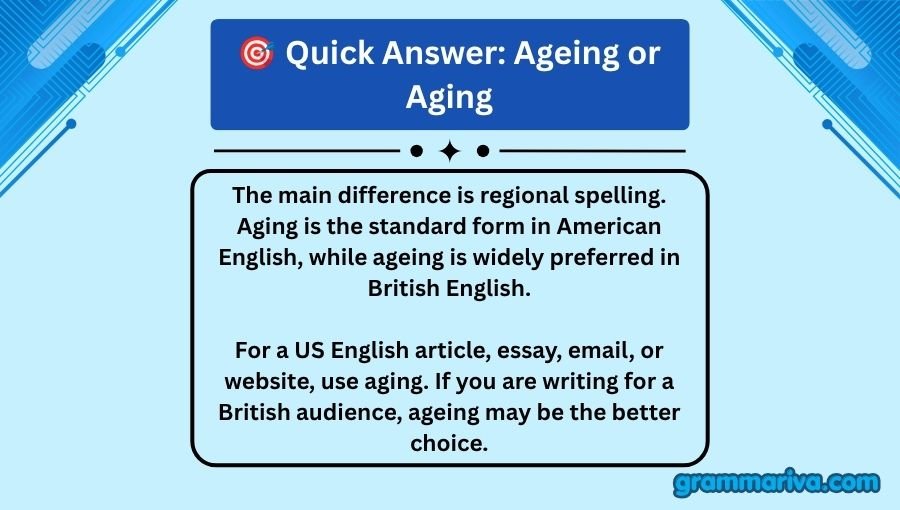
The main difference is regional spelling. Aging is the standard form in American English, while ageing is widely preferred in British English.
For a US English article, essay, email, or website, use aging. If you are writing for a British audience, ageing may be the better choice.
Is Ageing or Aging Correct in English? 📚
Both spellings are correct, but they belong to different spelling conventions. Aging is standard in American English, while ageing is common in British English.
For example:
- ✅ The skin changes naturally with aging.
- ❌ The skin changes naturally with ageing.
This is not grammatically wrong, but it is less suitable if you are consistently using US English.
In British English, the second sentence is perfectly natural:
- ✅ The skin changes naturally with ageing.
The same pattern appears with words formed from age and -ing. American English generally drops the extra e, while British English often keeps it in this word.
The Basic Spelling Rule
The easiest rule is this:
Use “aging” for American English and “ageing” for British English.
| Form | English Variety | Meaning | Example | Correct/Incorrect |
|---|---|---|---|---|
| aging | American English | Getting older | Aging is a natural process. | ✅ Correct |
| ageing | British English | Getting older | Ageing is a natural process. | ✅ Correct |
| aging | British English | Getting older | Aging is a natural process. | ✅ Acceptable, but US-style |
| ageing | American English | Getting older | Ageing is a natural process. | ⚠️ Non-US spelling |
The important point is that this is mainly a spelling and style difference, not a difference in meaning.
What Is the Difference Between Ageing and Aging? 🔍
The difference between ageing or aging is spelling, not meaning. Both words refer to the process of becoming older.
Consider these sentences:
Aging can affect memory and physical strength.
Here, aging is a noun formed from the verb age. It names the process of becoming older.
The company is aging the cheese in wooden barrels.
Here, aging is part of the verb phrase is aging. It describes an action or process.
British English can use ageing in the same places:
Ageing can affect memory and physical strength.
The company is ageing the cheese in wooden barrels.
So, the spelling changes, but the grammar and basic meaning stay the same.
A Simple Comparison
| Form | Spelling Style | Basic Meaning | Example |
|---|---|---|---|
| aging | US English | Becoming older | Aging happens to everyone. |
| ageing | UK English | Becoming older | Ageing happens to everyone. |
| aging | US English | Making something older | The process is aging the material. |
| ageing | UK English | Making something older | The process is ageing the material. |
When editing US English, I normally change ageing to aging unless there is a specific reason to preserve British spelling.
Why Do People Confuse Ageing and Aging? 🤔
People confuse these spellings because both forms are used by native English speakers. Search results, books, websites, and international companies may use different spelling systems.
There is also a broader spelling pattern behind the confusion. English does not always handle words ending in -e the same way when adding -ing.
For example:
- make → making
- write → writing
- hope → hoping
- age → aging
In American English, ageing is usually written as aging.
I once reviewed a short business report that used aging in one paragraph and ageing in another. The writer had copied information from two different websites. Neither form was the real problem. The inconsistency was. A professional document should normally follow one spelling system from beginning to end.
Regional Spelling Makes the Issue Harder
| Source or Audience | Preferred Form |
|---|---|
| US school assignment | aging |
| US business email | aging |
| US website | aging |
| UK school assignment | ageing |
| UK newspaper | ageing |
| UK business writing | ageing |
| International audience | Choose one style and stay consistent |
How Does American English Spell Aging? 🇺🇸
American English normally spells the word aging, without the extra e.
Examples include:
- aging population
- aging process
- aging parents
- aging technology
- aging infrastructure
- healthy aging
- premature aging
If your audience is American, aging should usually be your first choice.
Examples in US English
- ✅ The city is dealing with an aging water system.
- ❌ The city is dealing with an ageing water system.
Again, the second spelling is not meaningless or impossible. It simply follows a different regional convention.
Common American Expressions
| Expression | US Form | Example |
|---|---|---|
| healthy aging | aging | Healthy aging depends on many factors. |
| aging population | aging | The country has an aging population. |
| aging process | aging | The aging process is natural. |
| aging technology | aging | The company replaced its aging computers. |
Is Ageing the British English Spelling? 🇬🇧
Yes. Ageing is a common standard spelling in British English.
A British writer may naturally write:
The ageing population needs better public services.
An American writer is more likely to write:
The aging population needs better public services.
Neither writer is making a grammar mistake.
The same distinction can appear in formal reports, academic writing, journalism, and everyday communication. The best spelling depends on the style of English being followed.
British and American English Side by Side
| Meaning | American English | British English |
|---|---|---|
| Getting older | aging | ageing |
| Older population | aging population | ageing population |
| Process of getting older | aging process | ageing process |
| Technology becoming old | aging technology | ageing technology |
| Food becoming mature | aging food | ageing food |
Does Ageing Mean Something Different From Aging? 🧠
No. Ageing and aging have the same basic meaning. The difference is primarily regional spelling.
Both can describe:
- A person becoming older.
- An animal becoming older.
- A material becoming older.
- Food or drink developing through time.
- A system becoming old or outdated.
- The general process of growing older.
Meaning Summary
| Meaning | Word Type | Example Sentence |
|---|---|---|
| Becoming older | Noun | Aging is a normal part of life. |
| Getting older | Present participle | The dog is aging well. |
| Making something older | Present participle | The process is aging the wood. |
| Developing through time | Present participle | The cheese is aging in the cellar. |
The British spelling ageing can perform the same grammatical jobs.
How Is Aging Used in Grammar? 📝
The word aging can work in several grammatical roles. It can function as a noun or as a present participle in a verb phrase.
Aging as a Noun
When aging names the process of becoming older, it acts as a noun.
Aging is a natural part of life.
Here, aging is the subject of the sentence.
Aging in a Verb Phrase
The building is aging quickly.
Here, is aging forms the present progressive verb phrase.
Aging as a Modifier
The city needs to replace its aging bridges.
Here, aging describes the bridges.
These uses are grammatical in both American and British English. The spelling changes according to regional style.
What Are the Correct Uses of Aging? ✅
The word aging is useful in many everyday and professional contexts. Its meaning depends on the sentence around it.
1. Aging People
You can use aging to describe people who are getting older.
The program supports aging adults.
2. Aging Buildings
The word can describe structures that have become old.
The city needs to repair its aging buildings.
3. Aging Technology
It can describe technology that is becoming old or outdated.
The company still relies on aging software.
4. Aging Food or Materials
The word can describe a process in which something develops over time.
The cheese is aging in a controlled room.
5. The Natural Process of Aging
It can also refer to growing older as a general life process.
Scientists continue to study the aging process.
| Use | Example |
|---|---|
| People | Aging adults may need different services. |
| Buildings | The aging building needs repairs. |
| Technology | We replaced the aging computers. |
| Food | The cheese is aging naturally. |
| Life process | Aging is part of life. |
What Is the Best Test for Choosing Aging or Ageing? 💡
The easiest test is to identify your target audience.
Ask yourself:
Am I writing American English?
If yes, choose aging.
Am I writing British English?
If yes, choose ageing.
Test Tip
Look at the other spelling choices in your document.
If you use American forms such as color, favorite, and center, then aging is the natural match.
If you use British forms such as colour, favourite, and centre, then ageing is likely the better match.
This test works because spelling consistency matters more than treating one form as universally correct.
Can You Use Aging in a Formal Sentence? ✍️
Yes. Aging is fully appropriate in formal American English.
Examples:
- The report examines the effects of an aging population.
- The study focuses on healthy aging.
- The company must replace its aging equipment.
- Aging infrastructure can create serious challenges.
The spelling is not informal. It is the normal US form.
Formal vs Informal Examples
| Context | Example | Suitable? |
|---|---|---|
| Academic | The study examines healthy aging. | ✅ |
| Business | We must replace aging equipment. | ✅ |
| Workplace | The aging system needs an update. | ✅ |
| Conversation | My car is aging badly. | ✅ |
| Social media | Aging like a fine wine! | ✅ |
What Does a Real-Life Workplace Example Look Like? 📝
Imagine a US company is preparing a report about its computer systems.
An employee writes:
Several of our ageing computers are no longer reliable.
The sentence is understandable, but the company uses US English throughout the report. The editor changes it to:
Several of our aging computers are no longer reliable.
The meaning has not changed. The editor simply made the spelling consistent with the company’s chosen style.
I once caught a similar issue while checking a document with mixed US and UK spellings. The writer had used aging on one page and ageing on another. Once we chose US English as the style, the correction was simple: use aging throughout.
Why Is Aging Correct in American English? 📖
American English uses aging as the normal spelling for this word. The spelling follows the common US convention used in standard edited writing.
British English commonly keeps the e in ageing. This does not create a different word. It creates a regional spelling variant.
The important grammar point is that age remains the base verb. When the -ing form is created, the spelling differs by regional convention.
You do not need to memorize a complicated grammar formula. For US writing, remember:
age → aging
For British writing:
age → ageing
A general check of major English reference works also shows that both spellings are established. The key question is which English variety you are following.
Correct vs Incorrect at a Glance
| Sentence | Correct/Incorrect | Why |
|---|---|---|
| Aging is a natural process. | ✅ Correct | Standard US spelling |
| Ageing is a natural process. | ⚠️ Context-dependent | Common British spelling |
| The aging building needs repairs. | ✅ Correct | Standard US usage |
| The ageing building needs repairs. | ⚠️ Context-dependent | Common British usage |
| She is aging gracefully. | ✅ Correct | Standard US form |
What Are the Most Common Mistakes? ⚠️
Most mistakes happen because writers see both spellings online. Fast typing, autocorrect, and mixed reading habits can also cause problems.
Fast Typing
When people type quickly, they may use whichever spelling comes to mind first.
Autocorrect
Some devices and software are set to a particular regional dictionary. This can influence spelling suggestions.
Lack of Knowledge
Some writers do not realize that aging and ageing are regional forms.
Mixed English Styles
A writer may use American spelling in one sentence and British spelling in another.
Similar Spelling Confusions
| Confusion | Correct Difference |
|---|---|
| its / it’s | its shows possession; it’s means it is or it has |
| your / you’re | your shows possession; you’re means you are |
| their / they’re | their shows possession; they’re means they are |
| affect / effect | Usually affect is a verb and effect is a noun |
| then / than | then relates to time; than is used in comparisons |
The lesson is simple: English has many spelling and word-choice traps. Context and consistency matter.
Which Ageing or Aging Mistakes Should You Avoid? 🚫
The biggest problem is not choosing the British form. It is mixing styles without a reason.
| Wrong Form or Use | What’s Wrong | Correct Form |
|---|---|---|
| ageing in a US article | British spelling in US style | aging |
| aging in a strictly UK-style article | US spelling in UK style | ageing |
| aging / ageing mixed together | Inconsistent spelling | Pick one style |
| ageeing | Extra letters | aging / ageing |
| agging | Missing part of the base word | aging / ageing |
| age-ing | Unnecessary hyphen | aging / ageing |
One spelling is not automatically “bad English.” The audience and style guide matter.
What Is the History Behind Aging and Ageing? 🕰️
The two spellings developed as part of the wider differences between British and American English spelling. Both forms come from the verb age, meaning to become older or to make something older.
Over time, American English developed a number of spelling preferences that differ from British usage. Some differences involve removing letters, changing endings, or choosing simpler spellings.
The spelling aging became established in American English, while ageing remained common in British English.
This is why modern readers can encounter both forms in reliable English writing.
A Simple History Timeline
| Period | Form | General Note |
|---|---|---|
| Earlier English | age | The base word developed as the verb for growing older |
| Later English | ageing | The spelling with -ing remained common |
| Modern British English | ageing | Widely used British spelling |
| Modern American English | aging | Widely used US spelling |
| Modern international English | both | Choice often follows regional style |
You do not need the history to use the word correctly. The practical rule is much easier: aging for US English, ageing for British English.
How Do Aging and Ageing Work in Different Contexts? 🌎
The correct choice depends on your audience, not the subject.
Everyday Conversation
American speakers may naturally say:
My parents are aging well.
A British speaker may write:
My parents are ageing well.
Professional Writing
US business writing should normally use aging if the company follows American English.
Creative Writing
Authors can choose either spelling based on the setting, narrator, publisher, or intended audience.
Social Media and Texting
People may use either form, but consistency still helps readers understand your intended style.
| Context | Which Term to Use | Example |
|---|---|---|
| US everyday conversation | aging | My dog is aging well. |
| US professional writing | aging | The report studies aging workers. |
| UK professional writing | ageing | The report studies ageing workers. |
| Creative writing | Depends on style | The old house was ageing quietly. |
| US social media | aging | Aging is just another adventure. |
| UK social media | ageing | Ageing is just another adventure. |
What Common Phrases Use Aging? 💬
Many common expressions use aging in American English.
| Phrase | Meaning |
|---|---|
| aging process | The process of becoming older |
| aging population | A population with a growing share of older people |
| healthy aging | Aging while supporting health and well-being |
| aging infrastructure | Old systems or structures that need repair |
| aging technology | Technology that is becoming old or outdated |
| aging gracefully | Growing older in a positive or confident way |
British English can use the same phrases with ageing instead.
For example:
aging population → US English
ageing population → UK English
What Synonyms Can Replace Aging? 🔄
Sometimes you can replace aging with another phrase. The best choice depends on what you mean.
| Alternative | Works When | Does Not Work When |
|---|---|---|
| growing older | Talking about people or living things | Describing some technical processes |
| getting older | Casual conversation | Very formal technical writing |
| becoming older | Clear, simple explanation | When a short modifier is needed |
| mature | Food, products, or people in certain contexts | When you specifically mean biological aging |
| old | Describing age or condition | When you mean the process itself |
For example, growing older can replace aging in:
Growing older is a normal part of life.
But you would not normally replace aging technology with growing older technology.
Why Does Getting the Spelling Right Matter? 🎯
Choosing between aging and ageing matters because spelling tells readers which English style you are using.
It can also affect professionalism. A US company that uses American English throughout its website should normally use aging, not switch between the two forms.
Consistency also helps search engines, editors, teachers, and readers understand your intended language variety.
Good writing makes the right choice and then stays consistent.
Why Consistency Matters
| Situation | Why Getting It Right Matters |
|---|---|
| Resume | Shows attention to detail |
| Client email | Creates a polished impression |
| Published article | Keeps the style consistent |
| Social post | Makes the writing look intentional |
A single British spelling in an American document will not usually prevent readers from understanding you. Still, consistent style makes writing cleaner.
Is There a Special Exception for Aging? 🧩
There is no major grammar exception that changes the basic rule. However, ageing can appear in American writing when a writer is deliberately preserving British English, quoting a source, following a publication’s house style, or using a name or title that officially contains that spelling.
For example, if you are discussing a British publication, you may keep its original spelling rather than changing it.
The key idea is this:
Do not “correct” a spelling simply because it differs from your own regional style. First check the intended English variety.
How Can You Remember the Difference? 🧠
Use this simple memory trick:
America likes the shorter “aging.”
Think:
US → aging
UK → ageing
You can also check the other spelling choices in your document.
If you wrote:
- color
- favorite
- center
then aging fits your US style.
If you wrote:
- colour
- favourite
- centre
then ageing fits your British style.
I often recommend this method to students because it is faster than trying to remember an isolated spelling rule.
Quick Memory Table
| If Your Writing Uses… | Choose |
|---|---|
| color | aging |
| favorite | aging |
| center | aging |
| colour | ageing |
| favourite | ageing |
| centre | ageing |
Can You Use Aging and Ageing in the Same Document? ⚠️
You can, but you usually should not when both words have the same meaning. Mixing them can make your writing look inconsistent.
If you are writing in US English, use aging throughout.
If you are writing in British English, use ageing throughout.
There can be special reasons to preserve the original spelling of a quotation, title, product name, or official name. Outside those cases, consistency is the safer choice.
How Does This Spelling Choice Affect SEO and Online Writing? 🌐
For online writing, the best spelling depends on the audience you want to reach. A US-focused website will normally benefit from using aging, while a UK-focused site may prefer ageing.
Search engines can generally understand spelling variants and related forms. You should not fill an article with both spellings simply to target searches.
Instead, choose the spelling that matches your audience and use it naturally.
For a US English article, write:
aging process
aging population
healthy aging
For British English, use:
ageing process
ageing population
healthy ageing
The goal is clear writing, not repetition.
Quick Recap Checklist ✅
Use this checklist before publishing your writing.
| Question | If Yes → Use |
|---|---|
| Is the article written in US English? | aging |
| Is the article written in British English? | ageing |
| Does the document use American spelling elsewhere? | aging |
| Does the document use British spelling elsewhere? | ageing |
| Are you writing for a mixed international audience? | Pick one style and stay consistent |
Practice Examples
- The city has an aging population. ✅
- Healthy aging is a common research topic. ✅
- The company replaced its aging equipment. ✅
For British English:
- The city has an ageing population. ✅
- Healthy ageing is a common research topic. ✅
- The company replaced its ageing equipment. ✅
FAQs About Ageing vs Aging
Is aging or ageing correct in American English?
Aging is the standard spelling in American English. Use it in US-focused essays, articles, business documents, websites, and other edited writing.
Is ageing or aging correct in British English?
Ageing is a common standard spelling in British English. British writers often use the form with the extra e.
Is ageing wrong in the United States?
No. Ageing is understandable and established English, but it is generally associated with British English. If you are writing in consistent US English, aging is the better choice.
Is aging wrong in the United Kingdom?
No. Aging is widely understood and is the standard American spelling. However, ageing is often preferred when following British English style.
Do aging and ageing have the same meaning?
Yes. They have the same basic meaning. Both describe becoming older or causing something to become older. The main difference is regional spelling.
Which spelling should I use in a US essay?
Use aging. For example, write “The essay examines the effects of an aging population.”
Which spelling should I use for a British audience?
Use ageing if you are following standard British spelling. For example, write “The report examines the effects of an ageing population.”
Why does American English drop the e?
American English has developed spelling preferences that differ from British English in several areas. In this case, aging became the standard US form, while ageing remained common in British English.
Can I use both spellings in one article?
You can, but it is usually better to choose one regional spelling and use it consistently. Mixing aging and ageing without a clear reason can make an article look poorly edited.
Is aging a noun or a verb?
It can be both a noun and part of a verb phrase. In “Aging is natural,” it acts as a noun. In “The building is aging,” it appears in a verb phrase. It can also modify a noun, as in “aging equipment.”
Conclusion
Ageing or aging is not really a battle between a correct word and an incorrect word. Both spellings are established. The main difference is regional style.
For US English, choose aging. For British English, ageing is commonly preferred. Both forms describe the same basic process of becoming older or making something older.
The best habit is to check your audience and keep your spelling consistent. If your document uses color, favorite, and center, then aging is the natural choice. If it uses colour, favourite, and centre, then ageing fits the style.
I recommend treating regional spelling like a setting. Choose your version before you start editing, then stick with it. That simple step prevents many small inconsistencies. 😊
Remember the easiest rule: US English uses aging; British English commonly uses ageing. Once you connect the spelling to the English variety, the choice becomes much easier. Keep your style consistent, trust the context, and your writing will stay clear. ✨

Hi, I’m Lucas Bennett. I’m a grammar content specialist at Grammariva. I work on articles covering everyday grammar questions, sentence usage, and writing tips that readers can apply with confidence.


[…] By the end, you should be able to choose the right form without stopping to second-guess yourself. Ageing or Aging | Patron vs Benefactor | Of Course or […]