If you have ever stopped while writing and wondered about having vs having had, you are not alone.Understanding having vs having had can make your sentences clearer and help you avoid common grammar mistakes. These two forms look almost the same, but they do not always point to the same time or meaning. The difference becomes especially clear when you use them in longer sentences, especially sentences about an action that happened before another past event. 😊
I teach grammar by looking at what a sentence is trying to say first. Then I choose the verb form that matches that meaning. With these two forms, the key question is simple: Are you talking about an action or state in relation to another time?
Once you understand that idea, the choice becomes much easier. In this guide, I will explain the difference between having and having had, show you when each form works, and give you practical examples from everyday speech, work, school, and writing. By the end, you should be able to choose the right form without stopping to second-guess yourself. Ageing or Aging | Patron vs Benefactor | Of Course or Ofcourse
🎯 Quick Answer: Having vs Having Had
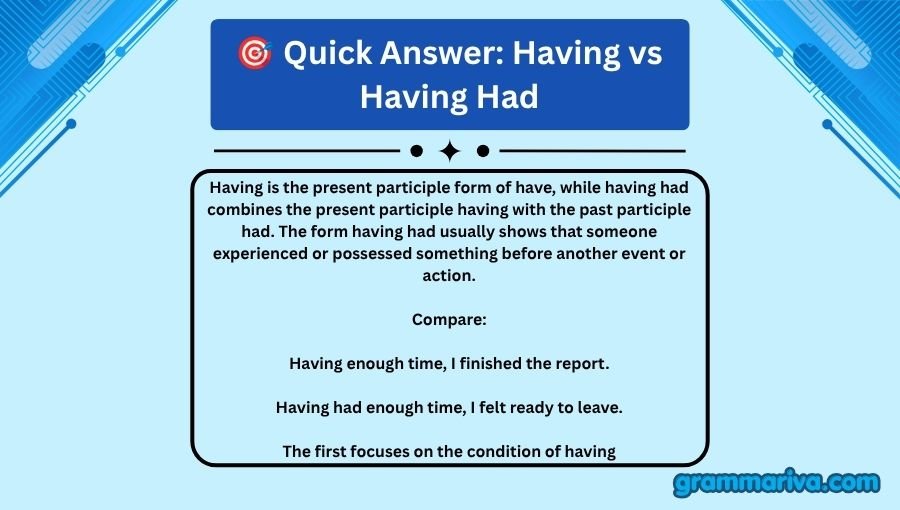
Having is the present participle form of have, while having had combines the present participle having with the past participle had. The form having had usually shows that someone experienced or possessed something before another event or action.
Compare:
- Having enough time, I finished the report.
- Having had enough time, I felt ready to leave.
The first focuses on the condition of having enough time. The second emphasizes that the experience of having enough time happened before the later feeling or action.
🔎 Is Having the Same as Having Had?
No. Having and having had are related forms, but they do different jobs.
Having can describe an action, condition, possession, or experience that is connected to the main clause. Having had places more focus on something that was already experienced or completed before another point.
Basic comparison
| Form | Type | Meaning | Example | Correct/Incorrect |
|---|---|---|---|---|
| having | Present participle | Possessing, experiencing, or doing something | Having enough money, she bought the book. | ✅ Correct |
| having had | Perfect participle | Having experienced or possessed something earlier | Having had enough money, she bought the book. | ✅ Correct |
| have had | Perfect verb form | A past experience or possession connected to the present | I have had enough time. | ✅ Correct |
| had had | Past perfect | Something possessed or experienced before another past event | She had had enough time before the meeting. | ✅ Correct |
The important point is that having had does not simply mean “having” with extra words. The word had changes the time relationship.
📚 Understanding the Basics of Having vs Having Had
The simplest way to understand these forms is to look at the action they describe.
Having usually presents something as a condition, action, or situation linked to another action.
Having had presents an earlier experience or condition. The earlier situation normally comes before the main clause.
For example:
Having breakfast, I checked my email.
The phrase having breakfast describes an action connected to checking email.
Now compare:
Having had breakfast, I checked my email.
Here, breakfast happened first. After breakfast was finished, the person checked email.
Having vs Having Had at a Glance
| Form | Main Idea | Time Relationship | Example |
|---|---|---|---|
| having | An action or state connected to another action | Usually same general time | Having lunch, I answered the call. |
| having had | An earlier action or experience | Earlier than the main action | Having had lunch, I answered the call. |
| have had | Past experience linked to now | Past to present | I have had lunch already. |
| had had | Earlier past experience | Past before past | I had had lunch before they arrived. |
This is why context matters so much.
🧩 When Should You Use Having?
Use having when you want to describe an action, condition, possession, or experience that is connected to the main action.
It often appears at the beginning of a sentence as a participial phrase.
1. Having for an ongoing or connected action
Having dinner, I heard the phone ring.
The phrase tells us what was happening when the second event occurred.
Another example:
Having a shower, she missed the delivery.
The shower was happening around the same time as the missed delivery.
2. Having for a condition
Having no car, I usually take the bus.
Here, having no car gives the reason for the main action.
3. Having for possession
Having enough money, we decided to stay another night.
The condition of having enough money supports the decision.
4. Having in a noun-like phrase
Sometimes having appears after another verb or expression.
I enjoy having coffee in the morning.
Here, having coffee acts as the object of enjoy.
Meaning summary
| Meaning | Word Type | Example Sentence |
|---|---|---|
| Action | Present participle | Having lunch, I called my friend. |
| Condition | Participial phrase | Having no ticket, he could not enter. |
| Possession | Participial phrase | Having enough savings, she felt secure. |
| Experience | Gerund/participle | I enjoy having quiet mornings. |
💡 Test Tip
Ask yourself:
Am I simply describing a condition or action connected to the main sentence?
If yes, having may be the right choice.
⏳ When Should You Use Having Had?
Use having had when you want to show that something happened or was experienced before the main action.
This form is called a perfect participle construction.
For example:
Having had breakfast, I went to work.
The natural order is:
- I had breakfast.
- Breakfast was finished.
- I went to work.
The phrase having had breakfast makes that earlier relationship clear.
Example with an experience
Having had several years of experience, Maria felt confident.
First, Maria gained experience. Then she felt confident.
Example with a problem
Having had a difficult morning, he wanted some quiet time.
The difficult morning came before the desire for quiet time.
Example with possession
Having had enough time to prepare, the team felt ready.
The team had enough preparation time before reaching the later state of feeling ready.
Example with an opportunity
Having had the chance to speak with the manager, I understood the situation better.
The conversation happened first. Understanding came afterward.
🕒 Why Does Having Had Show an Earlier Action?
The extra had carries the idea of an earlier completed experience.
Look at this sentence:
Having lunch, I answered the phone.
The two events may overlap.
Now look at:
Having had lunch, I answered the phone.
Lunch happened first. The phone call came afterward.
The difference can be shown on a simple timeline:
| Form | Earlier Event | Main Event | Relationship |
|---|---|---|---|
| having | Often overlaps | Main action | Connected or simultaneous |
| having had | Finished earlier | Main action | Earlier action |
| have had | Past event | Present situation | Past connected to present |
| had had | Earlier past event | Later past event | Past before past |
This does not mean having can never refer to an earlier event. Context can give it that meaning. The main difference is that having had specifically marks the earlier relationship more clearly.
❓ Can Having and Having Had Be Used in the Same Sentence?
Yes. Both forms can appear in the same sentence when they describe different ideas.
For example:
Having had breakfast, I spent the morning having meetings.
Here, having had breakfast refers to the earlier breakfast. Having meetings refers to an activity during the later period.
Another example:
Having had enough practice, she felt comfortable having conversations in English.
The first phrase points to earlier practice. The second refers to the activity she could now perform comfortably.
Compare these examples
| Sentence | Meaning |
|---|---|
| Having breakfast, I read the news. | Breakfast and reading may happen together. |
| Having had breakfast, I read the news. | Breakfast happened before reading. |
| Having meetings, I could not answer the call. | Meetings were taking place. |
| Having had meetings, I needed a break. | The meetings were finished before the need for a break. |
📝 Case Study: Having vs Having Had at Work
Imagine an employee named Daniel writing an email about a delayed project.
He writes:
Having reviewed the files, I found three missing documents.
This means Daniel reviewed the files and then found the missing documents. The review is presented as the reason or background for his discovery.
Now imagine he writes:
Having had enough time to review the files, I was ready for the meeting.
This says Daniel had already been given enough time. After that, he felt ready for the meeting.
The two forms are close, but they emphasize different relationships.
I once edited a work email where a writer used having had several times. The sentences were grammatically possible, but the extra had made some of them sound heavier than necessary. We changed a few sentences to having because the actions were happening in the same general time. The message became much easier to read.
Practical workplace examples
| Situation | Better Form | Example |
|---|---|---|
| Describing a current task | having | Having reviewed the report, I added my comments. |
| Showing earlier experience | having had | Having had previous experience with the system, I worked quickly. |
| Describing an ongoing meeting | having | Having a meeting, I could not answer. |
| Showing a completed meeting | having had | Having had a meeting with the client, I understood their concerns. |
📖 Grammar Rules Explanation
The main goal when choosing between having vs having had is to show the relationship between the two ideas clearly. Having is the present participle of have. It can function in participial phrases and gerund constructions.
Having had is a perfect participle construction. It combines having with the past participle had.
The main grammar difference is the relationship between the two actions.
In:
Having finished the report, she went home.
the perfect participle shows that finishing the report came before going home.
The same pattern can occur with have:
Having had enough rest, she returned to work.
The rest occurred before the later action.
The construction does not mean that having is wrong. It means that the writer has chosen a different grammatical form to show a different time relationship.
Standard English grammar references describe participles and perfect participles as distinct constructions. A general dictionary such as Merriam-Webster can also be useful when checking individual word forms, but the sentence structure determines which form works best.
Correct vs Incorrect at a Glance
| Sentence | Correct/Incorrect | Why |
|---|---|---|
| Having breakfast, I read the newspaper. | ✅ Correct | The actions are closely connected. |
| Having had breakfast, I left for work. | ✅ Correct | Breakfast happened before leaving. |
| Having had breakfast, I am eating breakfast now. | ❌ Usually incorrect | The meaning creates a confusing time relationship. |
| Having enough money, she bought the dress. | ✅ Correct | The condition supports the action. |
| Having had enough money, she bought the dress. | ✅ Correct | The earlier financial condition is emphasized. |
⚠️ Why Do People Confuse Having and Having Had?
People often confuse these forms because having and having had look almost identical.
The second form simply adds had, but that small addition can change the time relationship.
Three common causes are:
- Fast typing: Writers often choose the shorter form without checking the meaning.
- Autocorrect: Automatic suggestions can sometimes encourage a form that does not fit the sentence.
- Lack of knowledge: Learners may know that had refers to the past but may not understand how it works inside a perfect participle.
I once caught myself typing having had in a sentence where I only meant to describe a condition. Removing had made the sentence much cleaner. That small edit reminded me how easy it is to add an unnecessary verb when writing quickly.
Similar Grammar Confusions
| Confusion | Correct Choice | Basic Difference |
|---|---|---|
| its / it’s | Depends on meaning | Possession vs contraction |
| your / you’re | Depends on meaning | Possession vs “you are” |
| their / they’re | Depends on meaning | Possession vs “they are” |
| affect / effect | Depends on meaning | Verb vs noun in common uses |
| then / than | Depends on meaning | Time/order vs comparison |
| having / having had | Depends on time | Connected action vs earlier experience |
Common Wrong Forms and Uses
| Wrong Form | What’s Wrong | Correct Form |
|---|---|---|
| Having had breakfast, I am just starting breakfast. | The time relationship is confusing. | Having breakfast, I am getting ready. |
| Having had no car, I take the bus every day. | The past-perfect form may suggest an earlier condition. | Having no car, I take the bus every day. |
| Having had lunch, I am eating lunch now. | The two ideas conflict in normal context. | Having lunch, I am talking with my friend. |
| Having enough time yesterday, I finish the task. | The tense relationship is inconsistent. | Having had enough time, I finished the task. |
| Having had a meeting now, I am preparing for it. | The meeting is presented as already completed. | Having a meeting now, I cannot talk. |
🧠 How To Remember the Difference
Think of having as a situation or action connected to the main sentence. A simple time test can help you choose correctly when you are unsure about having vs having had.
Think of having had as:
“I experienced or possessed it first, then something else happened.”
A useful mental test is to replace having had with:
After having had…
For example:
Having had breakfast, I left.
You can understand it as:
After having breakfast, I left.
The phrase tells you breakfast came first.
Now try:
Having breakfast, I listened to music.
This sounds more like two activities happening around the same time.
Memory shortcut
| If you mean… | Try… |
|---|---|
| A condition | having |
| An activity happening around another action | having |
| Something completed earlier | having had |
| An earlier experience | having had |
| Possession as background information | having |
| Past possession before another event | having had |
💬 Having vs Having Had in Everyday Conversation
In casual speech, people often choose simpler structures than participial phrases.
For example, instead of:
Having had breakfast, I went shopping.
a speaker might simply say:
I had breakfast, and then I went shopping.
Both can be correct. The second version is often easier in everyday conversation.
Context comparison
| Context | Which Term to Use | Example |
|---|---|---|
| Everyday conversation | Either, depending on meaning | I had breakfast before work. |
| Professional writing | Either, depending on time | Having reviewed the file, I sent it. |
| Creative writing | Either | Having had enough of the noise, she left. |
| Social media/texting | Usually simpler forms | Had breakfast, now I’m ready! |
The key is not to force having had simply because it sounds more formal.
✍️ Having in Professional Writing
Professional writing often benefits from having when it gives a short reason or background detail.
For example:
Having reviewed your application, we would like to invite you to an interview.
This is concise and clear.
Another example:
Having considered the available options, the team selected the second proposal.
The phrase explains what happened before the decision.
Professional examples
| Sentence | Purpose |
|---|---|
| Having reviewed the report, I added my comments. | Explains the basis for an action |
| Having considered your request, we approved the change. | Explains a decision |
| Having had previous experience with this software, she completed the task quickly. | Highlights earlier experience |
| Having had several discussions with the client, we understood their needs. | Shows earlier meetings or experience |
🎨 How Creative Writing Uses Having and Having Had
Creative writers may use these forms to connect events smoothly.
For example:
Having had enough of the argument, Lena walked outside.
The phrase gives the reader a reason for Lena’s action.
Or:
Having the old photograph in her hand, Lena stared at the faded faces.
Here, having presents a condition that exists while the main action occurs.
The choice can affect the rhythm of a sentence. Having is often lighter. Having had adds a stronger sense of something already completed.
📱 Having vs Having Had in Social Media and Texting
Social media posts and texts usually favor short, natural sentences.
You might write:
Having coffee and pretending I have my life together. ☕
That is casual and clear.
For an earlier experience:
Having had three cups of coffee, I finally feel awake. 😂
The second sentence makes it clear that the coffee came before the current feeling.
You do not need a formal construction every time. Match the form to the message and the time relationship.
🔗 Common Phrases With Having
Having appears in many useful sentence patterns.
| Phrase | Meaning |
|---|---|
| having trouble | Experiencing difficulty |
| having fun | Enjoying an activity |
| having a good time | Enjoying yourself |
| having enough time | Possessing enough available time |
| having a chance | Getting an opportunity |
| having no choice | Being unable to choose another option |
Examples include:
- Having trouble with the printer?
- We’re having fun at the party.
- Having enough time makes the task easier.
- Having no choice, we accepted the offer.
These are normal and useful patterns in English.
🔄 Synonyms and Alternatives
Sometimes you can avoid both forms by rewriting the sentence.
This can make your writing clearer, especially for beginners.
| Alternative | Works When | Does Not Work When |
|---|---|---|
| after | You want to show one event came first | You need a different relationship |
| because | You want to give a reason | The phrase is not about a reason |
| after experiencing | You want to emphasize an earlier experience | You are describing an ongoing action |
| since | You want to give a reason or time connection | The intended meaning is unclear |
| once | You want to show completion before another event | The events are happening together |
For example:
Having had enough experience, she applied for the job.
can become:
After gaining enough experience, she applied for the job.
The rewritten version may be easier for some readers.
🎯 Why Getting Having vs Having Had Right Matters
Correct verb forms make your writing easier to understand.
The difference may seem small, but verb choices can tell readers when something happened. This matters in work emails, school assignments, reports, resumes, and published content.
A simple rule worth remembering is:
Clear grammar helps the reader understand the order of your ideas.
Why accuracy matters
| Situation | Why Getting It Right Matters |
|---|---|
| Resume | Shows experience and actions clearly |
| Client email | Prevents confusion about completed work |
| Published content | Makes sentences polished and readable |
| Social post | Keeps short messages easy to understand |
You do not need complicated grammar to sound professional. You need the right grammar for the meaning you want.
❓ Can Having Had Ever Be Unnecessary?
Yes. Sometimes having had is grammatically possible but unnecessarily heavy.
Consider:
Having had a meeting with John, I understood the problem.
This is correct if the meeting happened before the understanding.
But if you simply want to say:
I had a meeting with John, and we discussed the problem.
the second version may sound more natural in everyday writing.
This is a useful editing lesson: correct grammar is not always the same as the best style.
Choose the form that expresses your meaning clearly without adding extra weight.
🧪 Practice: Choose Having or Having Had
Try these examples before looking at the answers.
Example 1
_____ breakfast, I went to work.
If breakfast was completed before going to work, use:
✅ Having had breakfast, I went to work.
Example 2
_____ breakfast, I listened to music.
If breakfast and listening happened together, use:
✅ Having breakfast, I listened to music.
Example 3
_____ no money, he decided to stay home.
The condition is current or connected to the decision:
✅ Having no money, he decided to stay home.
Example 4
_____ enough time to prepare, she felt confident.
The preparation time happened before the feeling:
✅ Having had enough time to prepare, she felt confident.
Practice table
| Sentence | Best Form | Reason |
|---|---|---|
| ___ breakfast, I left for work. | Having had | Breakfast came first |
| ___ breakfast, I watched TV. | Having | Activities are connected |
| ___ no car, she takes the train. | Having | Current condition |
| ___ enough rest, he felt better. | Having had | Rest came first |
| ___ a good time, we forgot the time. | Having | Ongoing experience |
❓ Why Do People Confuse Having and Having Had?
The two forms share the word having, so they look closely related. The difference comes from the added had and the time relationship it creates.
A writer who sees had as simply “past” may add it too often. The better approach is to ask what happened first.
If one action clearly happened before the main action, having had may help show that relationship.
If the phrase simply describes a condition or action connected to the main clause, having may be enough.
❓ Does Having Had Always Mean Something Happened Long Ago?
No. Having had does not necessarily mean something happened a long time ago.
It only needs to come before the main action.
For example:
Having had lunch five minutes earlier, I wasn’t hungry.
Lunch happened only a short time before the later state.
The important idea is relative order, not distance in time.
❓ Can Having Had Describe Experience?
Yes. Having had can describe an earlier experience.
For example:
Having had experience with difficult clients, she knew how to handle the call.
Her earlier experience helped her deal with the later situation.
This pattern is especially common in professional and academic writing.
❓ Is Having Had More Formal Than Having?
Not exactly. Having had is a grammatical construction used when its meaning is needed. It may sound more formal because it often appears in carefully written sentences.
However, you should not choose it simply to sound sophisticated.
If having communicates the idea correctly, there is no reason to add had.
❓ Can Having Mean “After Having”?
Sometimes context allows having to describe an action that comes before another action, but it does not always mark that sequence as strongly as having had.
For example:
Having finished the report, I left.
Here, having finished clearly shows an earlier completed action because finished itself is perfect in this construction.
With the verb have, the distinction can be especially useful:
Having lunch, I talked to Sam.
versus:
Having had lunch, I talked to Sam.
The second sentence clearly places lunch first.
❓ Is Having Had Correct in Formal English?
Yes. Having had is completely acceptable in standard English when the sentence needs a perfect participle construction.
For example:
Having had enough time to review the proposal, the committee made its decision.
The phrase clearly explains that the review time came before the decision.
❓ What Is the Difference Between Having Had and Had Had?
Having had is a participial construction. Had had is a past perfect verb construction.
Compare:
Having had enough time, she finished the project.
and:
She had had enough time before the project ended.
In the first sentence, having had introduces a participial phrase.
In the second, had had is part of the main verb phrase.
Quick comparison
| Form | Function | Example |
|---|---|---|
| having | Present participle/gerund | Having enough time helped. |
| having had | Perfect participle | Having had enough time, she finished. |
| have had | Present perfect | I have had enough time. |
| had had | Past perfect | I had had enough time before the test. |
❓ How Can I Quickly Decide Which Form to Use?
Use this three-step test:
- Find the main action.
- Ask whether the “having” situation happened before it.
- If the earlier relationship needs to be clear, consider having had.
For example:
_____ enough sleep, I felt ready for work.
Did enough sleep happen before feeling ready?
Yes.
So:
✅ Having had enough sleep, I felt ready for work.
Now:
_____ breakfast, I checked my phone.
If breakfast and checking your phone happened together:
✅ Having breakfast, I checked my phone.
✅ Quick Recap Checklist
Use this checklist whenever you are unsure.
| Question | If Yes → Use |
|---|---|
| Am I describing a condition or activity? | having |
| Is the activity happening around the main action? | having |
| Did the experience happen before the main action? | having had |
| Am I emphasizing an earlier experience? | having had |
| Am I simply saying I possess something? | having |
| Am I describing past possession before another event? | having had |
Three final practice examples
1. _____ no car, she walks to work.
✅ Having no car, she walks to work.
2. _____ no car for several years, she became used to walking.
✅ Having had no car for several years, she became used to walking.
3. _____ coffee, I answered my emails.
✅ Having coffee, I answered my emails.
The best choice depends on the relationship between the events.
FAQs About Having vs Having Had
What is the difference between having and having had?
Having describes an action, condition, possession, or experience connected to another action. Having had usually shows that the experience or possession happened before the main action.
When should I use having?
Use having when you describe a condition or activity connected to the main clause. For example: Having enough time, we completed the project.
When should I use having had?
Use having had when you want to show that an experience, possession, or condition occurred before another action. For example: Having had enough time to prepare, she felt confident.
Is having had grammatically correct?
Yes. Having had is a standard English construction. It is useful when you need to show that one experience or condition came before another event.
Is having had the same as had had?
No. Having had is a perfect participle construction, while had had is the past perfect form of have. Their sentence structures are different.
Can I use having had in everyday English?
Yes, but everyday speech often uses simpler sentence structures. Instead of Having had lunch, I went shopping, a speaker might say, I had lunch, and then I went shopping.
Does having had always refer to the distant past?
No. It only indicates that the experience came before the main action. The earlier event could have happened minutes, hours, days, or years earlier.
Can having describe something that happened before another action?
Yes, depending on the construction and context. However, having had can make an earlier experience or possession clearer when the verb is have.
Which is better: having or having had?
Neither is always better. Choose having for a connected condition or activity. Choose having had when you need to show an earlier experience or condition.
How can I remember having vs having had?
Think of having as a connected action or condition. Think of having had as something you experienced or possessed first, followed by another action.
🏁 Conclusion
Having vs having had becomes much easier when you focus on time and meaning instead of the appearance of the words. Use having for a condition, action, possession, or experience that connects naturally with the main clause. Use having had when you want to show that an experience or condition happened before the main action.
For example, having breakfast can describe breakfast as part of an ongoing situation. Having had breakfast tells the reader that breakfast was already finished before something else happened.
When I edit sentences, I use one simple question: What happened first? If the earlier experience needs to be clear, having had may be the better choice. If the two ideas are simply connected, having may be enough.
Do not add had just because you want your sentence to sound more advanced. Choose the form that matches your meaning. That one habit will make your English cleaner, clearer, and more natural. ✨
Remember: describe the connection with “having,” and mark the earlier experience with “having had.”

Hi, I’m Madison Hayes. I’m an English learning writer at Grammariva, where I work on simple lessons and examples for people who want to improve their grammar and writing. I love turning confusing rules into easy-to-follow explanations.
[…] explains the difference, gives clear examples, and shows you an easy way to remember the rule. Having vs Having Had | Ageing or Aging | Patron vs […]
[…] memory tricks. By the end, you should feel confident using both phrases. ✨ Checkup or Check-Up | Having vs Having Had | Ageing or […]