Have you ever wanted to agree with someone in English but stopped because you were not sure whether to say so do I vs so am I? You are not alone. These two short phrases look almost the same, but they follow different grammar patterns. The good news is that the rule is much easier than it first seems. 😊
The main difference depends on the verb in the first sentence. If the first speaker uses be, you usually use so am I, so is he, or another form of be. If the first speaker uses a normal verb such as like, work, or play, you use so do I or another suitable helping verb.
I teach English grammar by looking for the verb first. That simple habit makes this choice much easier.
In this guide, I’ll show you the rules, examples, common mistakes, memory tricks, and real-life situations where these expressions appear. Understanding so do I vs so am I will help you respond more naturally in both casual conversations and formal English. Happy Holiday or Happy Holidays | Calvary vs Cavalry | In the Store or At the Store
Quick Answer: So Do I vs So Am I🎯
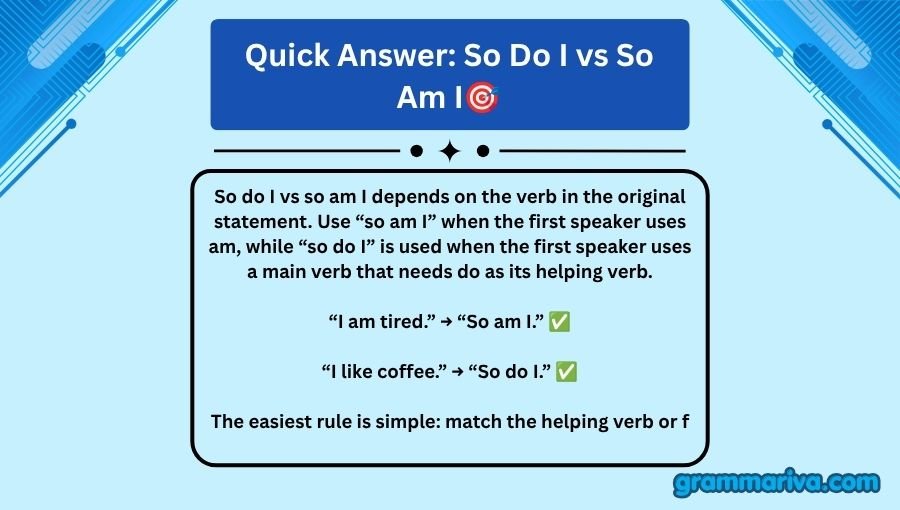
So do I vs so am I depends on the verb in the original statement. Use “so am I” when the first speaker uses am, while “so do I” is used when the first speaker uses a main verb that needs do as its helping verb.
- “I am tired.” → “So am I.” ✅
- “I like coffee.” → “So do I.” ✅
The easiest rule is simple: match the helping verb or form of the verb from the first sentence.
Is So Do I the Same as So Am I? 🤔
No, so do I and so am I are not interchangeable. They agree with different kinds of sentences.
So do I normally agrees with a sentence using a simple present verb.
“I love this song.”
“So do I.”
So am I agrees with a sentence using am, which is a form of the verb be.
“I am excited.”
“So am I.”
This is the key difference. Do not choose the phrase based only on what sounds natural. Look at the verb in the first statement.
Why Do People Confuse So Do I and So Am I? 💡
People often confuse these expressions because both phrases mean roughly “I feel the same way” or “That is true for me too.” The meaning is similar, but the grammar is different.
There is another reason. English uses several helping verbs to build these short agreement responses. The helping verb must match the original sentence.
For example:
“I can swim.” → “So can I.”
“I have finished.” → “So have I.”
“I am ready.” → “So am I.”
“I work here.” → “So do I.”
I once heard a student say, “I am like pizza. So am I!” The first sentence was actually meant to be “I like pizza.” Once we changed the verb from am like to like, the correct response became obvious: “So do I.” That small example shows why checking the verb matters.
A simple rule to remember
Ask yourself:
What verb did the first person use?
Then match it.
So Do I vs So Am I at a Glance 📊
The following table shows the basic pattern.
| Form | Type | Meaning | Example | Correct/Incorrect |
|---|---|---|---|---|
| So do I | Agreement with a simple present main verb | I do the same | “I like tea.” → “So do I.” | ✅ Correct |
| So am I | Agreement with am | I am the same | “I am tired.” → “So am I.” | ✅ Correct |
| So am I | Used after a normal present verb | I do the same | “I like tea.” → “So am I.” | ❌ Incorrect |
| So do I | Used after am | I am the same | “I am tired.” → “So do I.” | ❌ Incorrect |
The important point is that so do I and so am I do the same job but use different grammar structures.
How Does So Do I Work? 📝
So do I is used to agree with a positive statement that contains a main verb in the simple present.
Consider:
“I play tennis.”
“So do I.”
The first sentence contains the main verb play. The short agreement uses do because English needs a helping verb in this structure.
More examples include:
“I enjoy reading.”
“So do I.”
“I need more time.”
“So do I.”
“I speak English.”
“So do I.”
The subject can change, too.
“She likes jazz.”
“So does he.”
Here, does matches the third-person singular form in the original sentence.
Test Tip 💡
Remove so and ask what complete sentence the short answer represents.
“I like tea. So do I” means:
I do like tea.
That makes the use of do easier to understand. This comparison also makes so do I vs so am I easier to remember in everyday English.
When Should You Say So Am I? 🗣️
Use so am I when the original speaker uses am, usually to describe a state, feeling, identity, or condition.
Examples:
“I am hungry.”
“So am I.”
“I am nervous.”
“So am I.”
“I am ready.”
“So am I.”
“I am a teacher.”
“So am I.”
The phrase works because am is the form of be used with I.
You would not replace am with do.
“I am tired.”
“So do I.” ❌
The correct response is:
“So am I.” ✅
Meaning Summary
| Meaning | Word Type | Example Sentence |
|---|---|---|
| Agreeing with an action or habit | Main verb + do | “I read every night.” → “So do I.” |
| Agreeing with a state | Be verb | “I am tired.” → “So am I.” |
| Agreeing with an identity | Be verb | “I am a student.” → “So am I.” |
| Agreeing with a current condition | Be verb | “I am ready.” → “So am I.” |
Can You Say So Do I After “I Am”? ⚠️
Usually, no. If the first sentence uses am, the matching response should also use am.
Compare these examples:
“I am happy.”
“So am I.” ✅
“I am happy.”
“So do I.” ❌
But there is an important distinction between I am and I like.
“I am happy.” → “So am I.”
“I like happiness.” → “So do I.”
The words may look similar, but the verb controls the response.
What Are the Main Rules for So Do I and So Am I? 📚
The basic rule is to match the helping verb or verb pattern from the original positive statement.
Here is the larger pattern:
| Original Statement | Correct Agreement |
|---|---|
| I am tired. | So am I. |
| I like coffee. | So do I. |
| I work here. | So do I. |
| I can drive. | So can I. |
| I have finished. | So have I. |
| I will go. | So will I. |
| I should leave. | So should I. |
The word so comes first because this is an inverted agreement structure.
Instead of saying:
“I also am tired.”
English can say:
“So am I.”
Instead of:
“I also like coffee.”
English can say:
“So do I.”
Grammar Rules Explanation
The difference between these forms comes from English auxiliary-verb patterns.
When a sentence contains a form of be, the agreement response normally repeats the appropriate form of be.
“I am tired” becomes “So am I.”
When a sentence contains a simple present main verb without another auxiliary, English uses do, does, or sometimes did to form the short agreement.
“I like coffee” becomes “So do I.”
This same pattern appears with other auxiliary verbs.
“I can swim” becomes “So can I.”
“I have finished” becomes “So have I.”
“I will help” becomes “So will I.”
The goal is not to memorize every sentence. Instead, identify the verb structure and match it.
Standard English grammar references and major dictionaries describe do as a helping verb that can support this kind of sentence structure. The same general rule applies across formal and informal English.
Correct vs Incorrect at a Glance
| Sentence | Correct/Incorrect | Why |
|---|---|---|
| “I am busy.” → “So am I.” | ✅ Correct | Am matches am. |
| “I like music.” → “So do I.” | ✅ Correct | Do supports the simple present verb. |
| “I am hungry.” → “So do I.” | ❌ Incorrect | The original sentence uses am. |
| “I play soccer.” → “So am I.” | ❌ Incorrect | The original sentence uses play, not am. |
| “I can swim.” → “So can I.” | ✅ Correct | Can is repeated. |
What Is the Difference Between So Do I and So Am I? 🎯
The difference is the verb structure. The easiest way to understand so do I vs so am I is to compare the verbs in the two original sentences.
So do I follows a simple present main verb when no other auxiliary is present.
So am I follows a sentence that uses am.
Think of the two patterns this way:
I + main verb → So do I
I am + description → So am I
For example:
“I love dogs.” → “So do I.” ✅
“I am a dog lover.” → “So am I.” ✅
The meaning is close, but the grammar changes because the first sentence changes.
How Do You Choose the Correct Form? 🔎
Use a three-step method.
Step 1: Find the main verb
Look at what the first speaker actually said.
“I am tired.”
The verb is am.
“I like chocolate.”
The main verb is like.
Step 2: Check for a helping verb
If the sentence already has a helping verb, match it.
“I can swim.” → “So can I.”
“I have eaten.” → “So have I.”
Step 3: Use do when there is no other helping verb
For a simple present statement with an ordinary verb, use do.
“I love books.” → “So do I.”
This method works far better than trying to memorize isolated phrases.
A Real-Life Conversation Shows the Difference ☕
Imagine two coworkers are talking during a lunch break.
Maya: “I am really tired today.”
Daniel: “So am I.”
A few minutes later, Maya says:
Maya: “I need coffee.”
Daniel: “So do I.”
Notice what changed.
The first statement used am, so Daniel used am.
The second statement used need, so Daniel used do.
I once edited a short workplace email where the writer had used “So am I” after a sentence beginning with “I enjoy.” The writer was trying to sound polite, but the verb did not match. Changing it to “So do I” fixed the sentence immediately.
So Do I and So Am I in Everyday Conversation 💬
Both expressions are common in spoken English. They help you agree without repeating the whole sentence.
For example:
“I love weekends.”
“So do I.”
That sounds more natural than repeating:
“I love weekends too.”
Both are correct, but the shorter form is useful when the connection is already clear.
For be:
“I am exhausted.”
“So am I.”
The same idea works with many other verbs.
| Context | Which Term to Use | Example |
|---|---|---|
| Everyday conversation | Match the original verb | “I like pizza.” → “So do I.” |
| Professional writing | Match the auxiliary | “I am available.” → “So am I.” |
| Creative writing | Match the original structure | “I love the rain.” → “So do I.” |
| Social media/texting | Either matching form | “I’m obsessed.” → “So am I.” |
Can So Do I and So Am I Be Used in Professional English? 💼
Yes. Both forms are grammatically correct and can appear in professional communication when the tone is conversational.
For example:
“I am available for the meeting.”
“So am I.”
Or:
“I prefer the morning schedule.”
“So do I.”
In a very formal email, you may choose a fuller sentence:
“I am also available for the meeting.”
Still, so am I and so do I are not grammatically incorrect just because they are short.
Common Mistakes and Why They Happen ⚠️
These mistakes usually happen because the speaker focuses on the meaning instead of the verb pattern.
Someone thinks:
“I agree, so I need to say ‘so am I.’”
But agreement alone does not decide the form. The original verb does.
Common causes include:
- Fast typing: People write the first phrase that comes to mind.
- Autocorrect: Phones can change words or suggest familiar patterns.
- Lack of knowledge: Learners may know both phrases but not the rule.
- Sound-based learning: A phrase may feel right because it sounds familiar.
- Direct translation: Learners may transfer patterns from another language.
Similar Grammar Confusions Most mistakes with so do I vs so am I happen when learners focus on the meaning of agreement instead of the verb structure.
| Confusion | Correct Choice | Basic Rule |
|---|---|---|
| It’s / its | Depends on meaning | It’s = it is; its shows possession |
| Your / you’re | Depends on meaning | Your shows possession; you’re = you are |
| They’re / their | Depends on meaning | They’re = they are; their shows possession |
| Then / than | Depends on meaning | Then relates to time; than compares |
| So do I / so am I | Depends on verb | Match the verb structure |
Specific Wrong Forms
| Wrong Form | What’s Wrong | Correct Form |
|---|---|---|
| “I am tired.” → “So do I.” | Do does not match am. | “So am I.” |
| “I like coffee.” → “So am I.” | Am does not match like. | “So do I.” |
| “I am ready.” → “So do I.” | The original uses am. | “So am I.” |
| “I work here.” → “So am I.” | The original uses work. | “So do I.” |
| “I love music.” → “So am I.” | The main verb is love. | “So do I.” |
| “I am nervous.” → “So do I.” | The original uses am. | “So am I.” |
What Does So Do I Mean in Different Sentences? 🧠
So do I means that the speaker shares the same action, habit, opinion, or preference.
Examples:
“I drink tea every morning.”
“So do I.”
Both people drink tea.
“I enjoy documentaries.”
“So do I.”
Both people enjoy documentaries.
“I need a break.”
“So do I.”
Both people need a break.
The phrase does not mean that the speakers are literally doing the exact same action at the exact same moment. Context decides the precise meaning.
What Does So Am I Mean in Different Sentences? 🌟
So am I means that the speaker shares the same state, condition, feeling, or identity.
Examples:
“I am excited.”
“So am I.”
“I am worried.”
“So am I.”
“I am ready.”
“So am I.”
“I am a beginner.”
“So am I.”
In each case, am belongs to the verb be, so the response keeps the matching verb.
How Can You Remember the Difference? 🧩
Here is the easiest memory trick I teach:
Look at the verb. Match the helper.
If you see:
I am…
Think:
So am I.
If you see:
I like… / I work… / I need…
Think:
So do I.
You can also remember these mini-patterns:
- I am → So am I
- I do → So do I
- I can → So can I
- I have → So have I
- I will → So will I
The phrase after so is not random. It mirrors the verb structure of the first sentence.
Common Phrases With These Agreement Forms 🗨️
These forms are not really idioms. They are common agreement structures. Still, some patterns appear again and again in conversation.
| Phrase | Meaning |
|---|---|
| So do I | I share the same action, habit, or opinion |
| So am I | I share the same state or condition |
| So can I | I have the same ability |
| So have I | I have done the same thing |
| So will I | I intend to do the same thing |
| So should I | I should do the same thing |
Learning the larger pattern makes the difference between so do I vs so am I much easier.
Are There Alternatives to So Do I and So Am I? 🔄
Yes. You can often express the same idea in a longer way.
For example:
“I like coffee.”
“So do I.”
Alternative:
“I like coffee too.”
For be:
“I am tired.”
“So am I.”
Alternative:
“I am tired too.”
Both forms can be correct. The shorter agreement structure is often useful when the conversation is quick.
| Alternative | Works When | Does Not Work When |
|---|---|---|
| I do too | Agreeing with a simple present verb | The original needs am, can, have, etc. |
| I am too | Agreeing with am | The original uses a normal main verb |
| Me too | Informal agreement | A formal or highly precise sentence is needed |
| I feel the same way | Sharing a feeling or opinion | The exact action matters |
| I agree | Agreeing with an opinion | The sentence describes a state rather than an opinion |
“Me too” is especially common in casual speech. It can often replace both forms when the meaning is obvious.
Why Correct Usage Matters ✍️
Correct verb matching makes your English easier to understand. It also shows control of basic sentence structure.
This matters in several situations.
| Situation | Why Getting It Right Matters |
|---|---|
| Resume or application | Shows careful language use |
| Client email | Creates a polished impression |
| Published content | Prevents avoidable grammar errors |
| Social post | Makes short writing sound natural |
A useful rule is:
Clear grammar makes short messages easier to trust.
That does not mean every informal message must sound formal. It means your grammar should match your intended meaning.
Is There a Special Exception to the Rule? 🔍
There is no major special exception that makes so do I and so am I freely interchangeable. The normal verb-matching rule remains the safest guide.
However, English has many auxiliary verbs. That means agreement can take forms beyond these two.
For example:
“I can cook.” → “So can I.”
“I have seen that movie.” → “So have I.”
“I will join you.” → “So will I.”
This is why it is better to learn the pattern rather than memorize only two phrases.
Can You Use So Do I With Past Tense? ⏰
Yes, but the form usually changes to so did I.
For example:
“I watched the movie.”
“So did I.”
The first sentence is in the simple past, so did is used.
Compare:
“I watch movies.” → “So do I.”
“I watched a movie.” → “So did I.”
This gives you another useful clue: the helping verb must match the tense as well as the structure.
Can You Use So Am I With Other Forms of Be? 📖
Yes. The form of be changes depending on the subject and tense.
For example:
“She is tired.”
“So is he.”
“They are ready.”
“So are we.”
“I was nervous.”
“So was she.”
The general idea stays the same. Match the appropriate form of be.
| Original | Agreement |
|---|---|
| I am tired. | So am I. |
| He is tired. | So is she. |
| They are tired. | So are we. |
| I was tired. | So was he. |
| They were tired. | So were we. |
How Does So Do I Compare With Me Too? 😊
Both can show agreement, but they have different structures.
“I love pizza.”
“So do I.”
“Me too.”
All three can communicate agreement in a casual conversation.
However, so do I gives you a clearer grammatical structure. Me too is shorter and more informal.
Similarly:
“I am exhausted.”
“So am I.”
“Me too.”
This is why me too can sometimes feel easier. It avoids the need to choose a helping verb. Still, if you want to master English grammar, learning the correct agreement form is useful.
Quick Recap Checklist ✅
Use this checklist whenever you are unsure.
| Question | If Yes → Use |
|---|---|
| Does the sentence use “I am”? | So am I |
| Does it use a simple present main verb? | So do I |
| Does it use “can”? | So can I |
| Does it use “have”? | So have I |
| Does it use “will”? | So will I |
| Is it simple past? | So did I |
Practice Examples
1. “I am cold.”
→ So am I. ✅
2. “I love this book.”
→ So do I. ✅
3. “I can drive.”
→ So can I. ✅
Try finding the verb before choosing the short response.
FAQs About So Do I vs So Am I
What is the difference between so do I and so am I?
So do I agrees with a simple present sentence that uses a main verb, such as like, work, or need. So am I agrees with a sentence using am, usually to describe a state, condition, feeling, or identity.
Is “So am I” grammatically correct?
Yes. So am I is grammatically correct when the original statement uses am.
Example:
“I am tired.” → “So am I.”
Is “So do I” grammatically correct?
Yes. So do I is grammatically correct when the original statement has a simple present main verb that needs do in the agreement structure.
Example:
“I like coffee.” → “So do I.”
Can I say “So do I” after “I am”?
No, not when am is the verb being matched.
“I am happy.” → “So am I.” ✅
“I am happy.” → “So do I.” ❌
Can I say “So am I” after “I like”?
No. The correct form is normally so do I.
“I like chocolate.” → “So do I.” ✅
“I like chocolate.” → “So am I.” ❌
Is “Me too” the same as “So do I”?
They can express the same basic idea in many conversations, but they are grammatically different. Me too is a short informal agreement. So do I follows a specific verb pattern.
Which is correct: “I like it too” or “so do I”?
Both can be correct. The choice depends on the sentence and context.
“I like it too” is a complete statement.
“So do I” is a short agreement response.
How do I know when to use “so am I”?
Look for am in the original statement.
“I am ready.” → “So am I.”
If the original sentence uses another helping verb, match that instead.
Can I use “so do I” in formal writing?
Yes, when the sentence structure calls for it. The phrase is grammatically standard. In very formal writing, a complete sentence such as “I do as well” or “I also agree” may sometimes fit the tone better.
What is the easiest way to remember so do I vs so am I?
Use this rule:
I am → so am I.
I like/work/need → so do I.
Then check whether another helping verb, such as can, have, or will, needs to be repeated instead. With regular practice, so do I vs so am I will become a simple grammar choice rather than a confusing one.
Conclusion
So do I vs so am I becomes easy once you stop focusing on the meaning and start looking at the verb. Use so am I when the original sentence uses am. Use so do I when a simple present main verb needs do in the agreement response. 🌟
The same idea extends to other helping verbs. You can say so can I, so have I, so will I, and so did I when those verbs match the original sentence.
My best advice is simple: find the verb first, then choose the matching helper. That one habit will prevent most mistakes.
When you hear “I am tired,” your answer should be “So am I.” When you hear “I love coffee,” your answer should be “So do I.” Once you see the pattern, the choice becomes almost automatic. 😊
Match the verb, match the meaning, and your English will sound natural.

Hi, I’m Lucas Bennett. I’m a grammar content specialist at Grammariva. I work on articles covering everyday grammar questions, sentence usage, and writing tips that readers can apply with confidence.
[…] the end, you will know exactly when to use regardless and why irregardless is usually best avoided. So Do I vs So Am I | Happy Holiday or Happy Holidays | Calvary vs […]
[…] and how to avoid switching between them in the same piece of writing. Irregardless or Regardless | So Do I vs So Am I | Happy Holiday or Happy […]