Have you ever written a sentence and stopped because you were unsure about irregardless or regardless? You are not alone. Both forms appear in everyday speech, online posts, and even casual writing.
However, they do not have the same status in standard English. Regardless is the standard word to use when you mean “despite that,” “anyway,” or “without considering something.” Irregardless is widely used, but many editors and teachers consider it nonstandard or inappropriate in formal writing.
I teach and edit English content, and this is one of those word choices that can make a sentence look less polished even when the meaning is clear. The good news is that the rule is simple. 😊 Once you know which form belongs in standard writing, you can make the right choice quickly.
This guide explains the difference, shows real examples, covers common mistakes, and gives you an easy way to remember the rule. By the end, you will know exactly when to use regardless and why irregardless is usually best avoided. So Do I vs So Am I | Happy Holiday or Happy Holidays | Calvary vs Cavalry
🎯 Quick Answer: Irregardless or Regardless
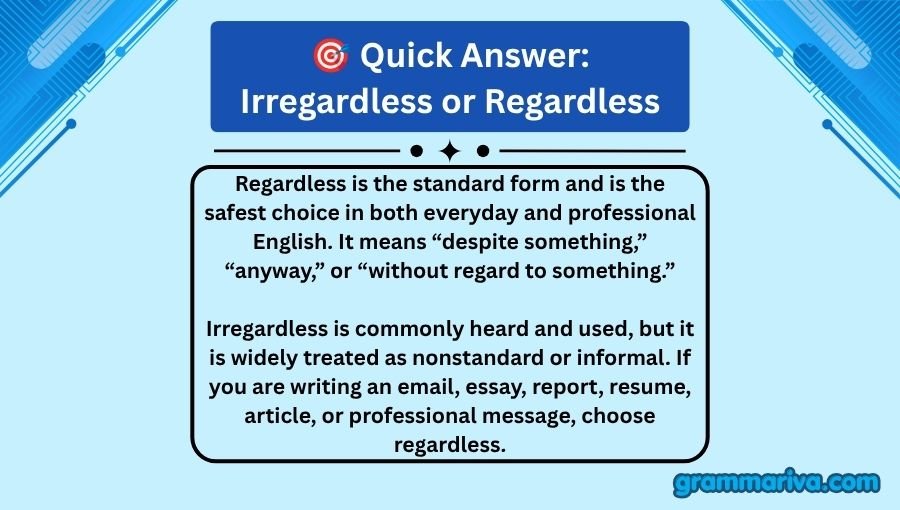
Regardless is the standard form and is the safest choice in both everyday and professional English. It means “despite something,” “anyway,” or “without regard to something.”
Irregardless is commonly heard and used, but it is widely treated as nonstandard or informal. If you are writing an email, essay, report, resume, article, or professional message, choose regardless.
Example:
✅ Regardless of the weather, we will go.
❌ Irregardless of the weather, we will go.
The first sentence is the preferred standard-English form.
Is Irregardless a Correct Word?
Irregardless is a real and widely used word, but it is generally not the best choice in standard English. It appears in speech and informal writing, yet many style guides, teachers, and editors recommend regardless instead.
This distinction matters because “a word people use” and “a word recommended for formal writing” are not always the same thing.
For example:
“He went irregardless of the warning.”
Most readers will understand the sentence immediately. The problem is not meaning. The problem is standard usage and style.
The safest revision is:
“He went regardless of the warning.”
Why does irregardless sound strange?
The word appears to combine ir- with regardless, even though regardless already expresses the intended meaning. That extra beginning can make the form sound unnecessary or awkward to many readers.
I once edited a short business report in which the writer used “irregardless” several times. The meaning was perfectly clear, but replacing it with “regardless” instantly made the report sound cleaner and more professional.
Quick comparison
| Form | Standard in formal writing? | Common in speech? | Recommended? |
|---|---|---|---|
| Regardless | Yes | Yes | Yes |
| Irregardless | Generally no | Yes | Usually no |
Regardless vs Irregardless at a Glance
The main difference is simple: regardless is the standard choice, while irregardless is generally considered nonstandard.
| Form | Type | Meaning | Example | Correct/Incorrect |
|---|---|---|---|---|
| Regardless | Adverb | Despite something; anyway | We went regardless. | ✅ Correct |
| Regardless of | Phrase | Without being affected by something | We went regardless of the rain. | ✅ Correct |
| Irregardless | Adverb | Intended to mean regardless | We went irregardless. | ❌ Avoid in standard writing |
| Irregardless of | Phrase | Intended to mean regardless of | We went irregardless of the rain. | ❌ Avoid in standard writing |
The key point is that regardless already does the job. You do not need to add the extra ir-.
What Does Regardless Mean?
Regardless means “despite something,” “anyway,” or “without allowing something to change the result.”
It can appear by itself or in the common phrase regardless of.
Regardless by itself
When used alone, regardless often means that an action will happen despite a situation.
✅ I was tired, but I went regardless.
Here, “regardless” means “even though I was tired.”
Another example:
✅ She knew the risk but continued regardless.
The word tells us that the risk did not change her decision.
Regardless of
The phrase regardless of is followed by a noun, pronoun, or noun phrase.
✅ We will help you regardless of the cost.
✅ He treats everyone fairly regardless of age.
✅ She kept working regardless of the noise.
In each sentence, something could have affected the action, but it did not.
Why Do People Confuse Irregardless and Regardless?
People confuse the two forms because irregardless has been used for a long time in spoken and informal English. Repeated exposure can make a nonstandard form feel normal.
Another reason is that English has many words beginning with ir-, such as “irregular,” “irrelevant,” and “irresponsible.” Because of this pattern, people may assume that adding ir- creates a stronger negative form.
But English does not work like a simple formula where any prefix can be added to any word.
A simple way to think about it
The word regardless already means:
“It does not matter.”
Adding ir- does not make the sentence clearer. It can make the word sound less standard instead.
I remember a student asking me whether “irregardless” was more correct because it sounded stronger. I explained that longer does not automatically mean more correct. In this case, the shorter form is the standard choice.
What causes the confusion?
| Reason | How it creates confusion |
|---|---|
| Spoken English | People hear “irregardless” in conversation |
| Repetition | Frequent exposure makes it feel familiar |
| Prefix patterns | English has many words beginning with “ir-” |
| Fast writing | Writers may use the first form that comes to mind |
| Informal communication | Texts and posts often ignore strict style rules |
When Should You Use Regardless?
Use regardless when you want to say that something does not change a decision, action, or result.
1. To mean “despite”
✅ Regardless of the delay, the meeting will begin at noon.
The delay does not change the meeting time.
2. To mean “anyway”
✅ I know it is difficult, but I will try regardless.
Here, “regardless” means “anyway.”
3. To show that a condition does not matter
✅ You can attend regardless of your experience level.
The person’s experience does not affect their ability to attend.
Meaning summary
| Meaning | Word Type | Example Sentence |
|---|---|---|
| Despite something | Adverbial use | We continued regardless of the rain. |
| Anyway | Adverb | I decided to go regardless. |
| Without considering a condition | Adverbial phrase | Everyone is welcome regardless of age. |
💡 Test Tip
When you want to use irregardless, replace it mentally with regardless.
If the sentence still makes perfect sense, use the standard form.
For example:
❌ Irregardless of the price, I want it.
Replace it:
✅ Regardless of the price, I want it.
The second version is the better choice.
Is “Regardless Of” Grammatically Correct?
Yes. Regardless of is grammatically correct and extremely common in standard English.
It introduces something that does not change the main action or result.
Consider these examples:
✅ Regardless of the outcome, we will support you.
✅ Regardless of what happens, stay calm.
✅ Regardless of how difficult it becomes, she will continue.
The structure can be:
regardless of + noun
Regardless of the weather…
or:
regardless of + pronoun
Regardless of what they say…
or:
regardless of + clause
Regardless of how much it costs…
Common structures
| Structure | Example |
|---|---|
| Regardless of + noun | Regardless of the price, I will buy it. |
| Regardless of + pronoun | Regardless of who comes, we will start. |
| Regardless of + what | Regardless of what happens, stay calm. |
| Regardless of + how | Regardless of how difficult it is, try. |
Can You Use Regardless at the End of a Sentence?
Yes. Regardless can naturally appear at the end of a sentence when it means “anyway” or “despite that.”
For example:
✅ The forecast looked bad, but we went regardless.
✅ I knew it would be difficult, but I tried regardless.
This use is common and grammatically sound.
However, do not confuse it with regardless of, which normally needs something after “of.”
Compare:
✅ We went regardless.
✅ We went regardless of the rain.
❌ We went regardless of.
The final example is incomplete because “of” needs something to follow it.
Case Study: A Workplace Email
Imagine a manager sends this message:
❌ Irregardless of the delay, we need to finish the project today.
The meaning is clear, but the word choice may look less polished in a professional email.
A cleaner version is:
✅ Regardless of the delay, we need to finish the project today.
The change is tiny. The meaning stays the same. But the second sentence follows standard usage and sounds more professional.
What if the email is casual?
Even in casual communication, regardless is usually the better choice because it is short, familiar, and widely accepted.
For example:
“Regardless of what happens, I have your back.”
That sounds natural in both a friendly message and a professional setting.
Practical workplace comparison
| Situation | Less Suitable | Better Choice |
|---|---|---|
| Client email | Irregardless of the delay… | Regardless of the delay… |
| Team message | Irregardless of the result… | Regardless of the result… |
| Formal report | Irregardless of cost… | Regardless of cost… |
| Friendly text | Irregardless, I’ll go. | Regardless, I’ll go. |
Grammar Rules Explanation
The safest grammar rule is straightforward: use regardless in standard English, especially in formal or edited writing.
The word functions as an adverb. It can stand alone or appear in the phrase regardless of.
The form irregardless is widely used in speech and informal settings, but many standard-English references and professional editors treat it as nonstandard. That means readers may recognize it without considering it the preferred form.
There is another useful point here: irregardless does not become correct simply because people understand it.
English contains many words that are common in conversation but discouraged in formal writing. Usage depends on context.
If your goal is clear, polished, standard English, choose regardless.
Correct vs Incorrect at a Glance
| Sentence | Correct/Incorrect | Why |
|---|---|---|
| Regardless of the weather, we will leave. | ✅ Correct | Uses the standard form. |
| Irregardless of the weather, we will leave. | ❌ Incorrect/Nonstandard | Use “regardless” in standard writing. |
| She continued regardless. | ✅ Correct | “Regardless” means “anyway.” |
| She continued irregardless. | ❌ Avoid | The nonstandard form is unnecessary. |
| Regardless of what happens, stay calm. | ✅ Correct | Correct standard construction. |
Common Mistakes With Regardless
Most mistakes happen because people learn words by hearing them rather than by studying their standard forms. That is completely normal. Spoken English can contain forms that are less suitable for formal writing.
Fast typing
When people type quickly, they often choose the word that sounds familiar.
Autocorrect
Autocorrect can sometimes reinforce a form that the writer has used before. It may not always distinguish between standard and nonstandard usage.
Lack of knowledge
Some writers simply have never been told that regardless is preferred.
I once caught myself typing a nonstandard form in a quick message after hearing it repeatedly in conversation. I noticed it during proofreading and changed it before sending the message. Familiar words can slip into writing surprisingly easily.
Similar grammar confusions
| Common Confusion | Correct Form | Basic Rule |
|---|---|---|
| It’s / Its | It’s / Its | “It’s” = it is; “its” shows possession. |
| Your / You’re | Your / You’re | “Your” shows possession; “you’re” = you are. |
| Their / There / They’re | Their / There / They’re | Each has a different function. |
| Affect / Effect | Affect / Effect | Meaning and grammar determine the choice. |
| Then / Than | Then / Than | “Then” relates to time; “than” is used for comparison. |
Specific mistakes with this term
| Wrong Form | What’s Wrong | Correct Form |
|---|---|---|
| Irregardless | Nonstandard in formal usage | Regardless |
| Irregardless of | Unnecessary and nonstandard | Regardless of |
| Irregardless to | Wrong construction | Regardless of |
| Irregardlessly | Unnecessary invented-looking extension | Regardless |
| Irregardlessness | Not a standard replacement for the normal expression | Regardless |
| Irregard | Not the correct substitute in this use | Regardless |
The most useful correction is usually very simple: delete ir-.
Is Irregardless Ever Used Correctly?
This question needs a careful answer. Irregardless is used by many English speakers, but that does not make it the preferred form for standard formal writing.
If you are quoting someone, studying informal speech, writing a character’s dialogue, or discussing the word itself, you may have a reason to mention or reproduce it.
For example:
The character said, “Irregardless of what happens, I am going.”
Here, the writer may be intentionally showing the character’s speech.
That is different from using the word in your own formal prose.
Context matters
| Situation | Use “Irregardless”? |
|---|---|
| Academic essay | ❌ No |
| Business report | ❌ No |
| Resume | ❌ No |
| Professional email | ❌ No |
| Formal article | ❌ No |
| Quoting a speaker | Possible |
| Discussing the word itself | Possible |
| Informal dialogue in creative writing | Possible |
Word History and How the Confusion Developed
The history of irregardless helps explain why the word can sound familiar even though many editors discourage it.
The form has been used in English for a long time, and its continued presence in speech has helped keep it alive. It appears to have developed as a blend or variation involving regardless and forms with negative-looking prefixes. The exact reason speakers created and maintained the form is less important for everyday writing than its current usage.
The important point is that widespread use does not automatically make a form the preferred choice in standard edited English.
A simple usage timeline
| Period | Form | General Note |
|---|---|---|
| Earlier English usage | Regardless | Established standard form |
| Later usage | Irregardless | Appears as a nonstandard variant |
| Modern speech | Both forms | Both may be heard |
| Modern formal writing | Regardless | Preferred standard form |
You do not need to memorize the history to use the word correctly. The practical rule remains the same: choose regardless for standard writing.
Usage in Different Contexts
The best choice is regardless in almost every normal writing context.
| Context | Which Term to Use | Example |
|---|---|---|
| Everyday conversation | Regardless | I will go regardless. |
| Professional writing | Regardless | Regardless of the cost, we need a solution. |
| Creative writing | Usually regardless | She smiled regardless of the pain. |
| Social media/texting | Regardless | I am doing it regardless 😂. |
Creative writers have more freedom than business writers. A character may use “irregardless” if that speech pattern helps show personality. But the narrator should still use standard English unless there is a clear stylistic reason not to.
Common Phrases With Regardless
There are several natural expressions that use regardless.
| Phrase | Meaning |
|---|---|
| Regardless of the outcome | The result does not change the decision |
| Regardless of the cost | The price does not affect the decision |
| Regardless of what happens | Whatever happens, the result remains the same |
| Regardless of the circumstances | The situation does not change the action |
| Regardless of the reason | The reason does not change the result |
| Regardless of who comes | The identity of the person does not matter |
These phrases are useful because they make your writing clear without sounding complicated.
Examples
✅ Regardless of the outcome, we will learn something.
✅ Regardless of what happens, I will support you.
✅ Regardless of the cost, safety comes first.
How to Remember the Difference
The easiest memory trick is:
No “ir” needed: regardless is enough.
Think of the phrase regardless of as a complete, reliable expression.
When you see a sentence like:
___ of the weather, we will play.
Choose:
Regardless of the weather, we will play.
You can also remember this three-step test:
- Do you mean “despite” or “anyway”?
- If yes, use regardless.
- If you are tempted to add “ir-,” stop and remove it.
Memory table
| If you mean… | Choose |
|---|---|
| Despite | Regardless |
| Anyway | Regardless |
| Without considering something | Regardless |
| Formal standard English | Regardless |
| A character’s nonstandard speech | Irregardless may appear intentionally |
Synonyms and Alternatives
Sometimes you can replace regardless with another phrase. The best choice depends on the sentence.
| Alternative | Works When | Does Not Work When |
|---|---|---|
| Anyway | You mean “despite that” | A noun must follow “of” |
| Nevertheless | You are contrasting two ideas | You need “regardless of + noun” |
| Despite that | You refer to a previous fact | The sentence needs a short adverb |
| No matter | You introduce a condition | You need a simple sentence ending |
| Even so | You want to show contrast | The sentence specifically requires “regardless of” |
Examples
Original:
Regardless, I decided to go.
Possible alternative:
Anyway, I decided to go.
But:
Regardless of the weather, I went.
cannot always be replaced naturally with “anyway” without changing the structure.
This is why synonyms are helpful but not always interchangeable.
Why Getting This Word Right Matters
Choosing regardless instead of irregardless is not about showing off vocabulary. It is about making your writing match the setting.
In a casual text, readers may not care. In a formal report, college paper, client email, or published article, word choice carries more weight.
Clear writing tells the reader that you have checked your language carefully.
“Good word choice removes small distractions so the reader can focus on the message.”
Why the distinction matters
| Situation | Why Getting It Right Matters |
|---|---|
| Resume | Creates a polished impression |
| Client email | Supports professional communication |
| Published content | Improves standard language use |
| Social post | Makes the message clear and natural |
A single nonstandard word will not ruin every piece of writing. Still, when there is an easy standard alternative, there is little reason to choose the less accepted one.
Does Irregardless Mean the Opposite of Regardless?
No. Irregardless is generally used with the intended meaning of regardless, not as its opposite.
This is one reason the form can confuse learners.
Someone who says:
“Irregardless of the weather, we will leave.”
usually means:
“Regardless of the weather, we will leave.”
They are not trying to say that the weather matters.
Compare the meanings
| Expression | Intended Meaning |
|---|---|
| Regardless | Despite something |
| Regardless of | Without being affected by something |
| Irregardless | Usually intended to mean “regardless” |
| Opposite of regardless | A phrase such as “because of” may express a different relationship |
So if you want to say that something does affect a decision, you need a different construction.
Can You Say “Regardless” Without “Of”?
Yes. Regardless can stand alone.
✅ I will do it regardless.
Here, the word means “anyway” or “despite that.”
You can also use it before a phrase:
✅ Regardless of the circumstances, we will continue.
The difference is structural.
| Pattern | Example |
|---|---|
| Regardless | I will go regardless. |
| Regardless of + noun | I will go regardless of the weather. |
| Regardless of + clause | I will go regardless of what happens. |
Is Regardless Formal or Informal?
Regardless is suitable for both formal and informal English. That is one of its biggest advantages.
You can use it in:
- school assignments
- academic writing
- business emails
- reports
- articles
- conversations
- text messages
- social media posts
For example:
Formal:
Regardless of the findings, further research is needed.
Casual:
I am going regardless.
The word works naturally in both.
How Should You Use These Words in Professional Writing?
In professional writing, choose regardless every time unless you are intentionally quoting or reproducing someone else’s nonstandard wording.
Here are some polished examples:
✅ Regardless of the deadline, accuracy must come first.
✅ We will review every application regardless of background.
✅ Regardless of the final decision, we appreciate your time.
Avoid:
❌ Irregardless of the deadline, accuracy must come first.
The corrected version is not only more standard. It is also simpler.
Quick Recap Checklist
Use this checklist whenever you are unsure.
| Question | If Yes → Use |
|---|---|
| Do you mean “despite”? | Regardless |
| Do you mean “anyway”? | Regardless |
| Are you writing formally? | Regardless |
| Are you using “___ of the weather”? | Regardless of |
| Are you quoting someone who said “irregardless”? | You may retain the quote |
Practice examples
1. ___ of what happens, I will be there.
✅ Regardless of what happens, I will be there.
2. The plan may be difficult, but I will continue ___.
✅ The plan may be difficult, but I will continue regardless.
3. ___ of the price, quality matters most.
✅ Regardless of the price, quality matters most.
If you can remember one rule, remember this one: when in doubt, choose regardless.
FAQs About Irregardless vs Regardless
Is irregardless a real word?
Yes, irregardless is a word that is widely used, especially in speech and informal settings. However, it is generally considered nonstandard, so regardless is the better choice for formal writing.
Is regardless or irregardless correct?
Regardless is the standard and preferred form. Use it in professional, academic, and edited writing. “Irregardless” is best avoided unless you have a specific reason to reproduce informal or nonstandard speech.
Is irregardless grammatically correct?
It is widely understood, but many editors and language teachers consider it nonstandard. For clear standard English, use regardless instead.
Can I use regardless of in a sentence?
Yes. Regardless of is a standard construction.
Example:
Regardless of the weather, we will continue the event.
What does regardless mean?
Regardless means “despite something,” “anyway,” or “without allowing something to affect the result.”
Example:
She continued regardless.
What is the difference between regardless and irregardless?
Regardless is the standard form. Irregardless is a widely used but generally nonstandard variant. Both are usually intended to express the same idea, but standard writing favors regardless.
Why do people say irregardless?
People may use it because they have heard it often in conversation. Familiarity can make the form feel natural. It may also seem to follow patterns from other English words beginning with “ir-.”
Should I use irregardless in an essay?
No. In an academic essay, choose regardless. It is the safer and more accepted standard form.
Can I use irregardless in dialogue?
Yes, if you are deliberately representing the way a character speaks. Creative writing sometimes uses nonstandard forms to show personality, background, or voice. That is different from using the word in formal narration.
Is regardless formal or informal?
Regardless works in both formal and informal English. You can use it in a business report, school paper, casual conversation, text message, or social media post.
Conclusion
Irregardless or regardless is an easy choice once you know the standard rule: use regardless for normal, polished English. It means “despite,” “anyway,” or “without being affected by something,” and it works naturally with of when you introduce a condition or noun phrase.
Irregardless is widely understood, but it is generally treated as nonstandard. That makes it a poor choice for formal writing, professional communication, academic work, and edited content. You may still encounter it in conversation, informal writing, or creative dialogue.
The good news is that you do not need to memorize a complicated grammar rule. When you mean “despite” or “anyway,” simply choose regardless. If you are writing regardless of the situation, your safest choice is clear. 😊
When one word is standard and the other is often questioned, choose the clear standard: regardless.

Hi, I’m Madison Hayes. I’m an English learning writer at Grammariva, where I work on simple lessons and examples for people who want to improve their grammar and writing. I love turning confusing rules into easy-to-follow explanations.

[…] why people confuse them, and how to avoid switching between them in the same piece of writing. Irregardless or Regardless | So Do I vs So Am I | Happy Holiday or Happy […]
[…] covers common mistakes, and gives you a simple rule you can remember. Synchronise or Synchronize | Irregardless or Regardless | So Do I vs So Am […]