Have you ever typed a holiday message and stopped to wonder, happy holiday or happy holidays? You are not alone. Both expressions can appear in English, but they do not always carry the same meaning or sound equally natural. The difference is small, yet it matters when you want your greeting to sound polished. 😊
The good news is that the basic rule is easy. “Happy Holidays” is the standard greeting when you are talking about the holiday season or more than one holiday. “Happy Holiday” can be correct when you mean one specific holiday or one particular break.
I have taught and edited plenty of everyday English, and this is one of those questions that becomes much easier once you look at the meaning behind the words. In this guide, I’ll show you the difference, explain the grammar, cover real-life examples, and give you simple ways to remember which form to choose. Calvary vs Cavalry | In the Store or At the Store | Choir vs Chorus
🎯 Quick Answer: Happy Holiday or Happy Holidays?
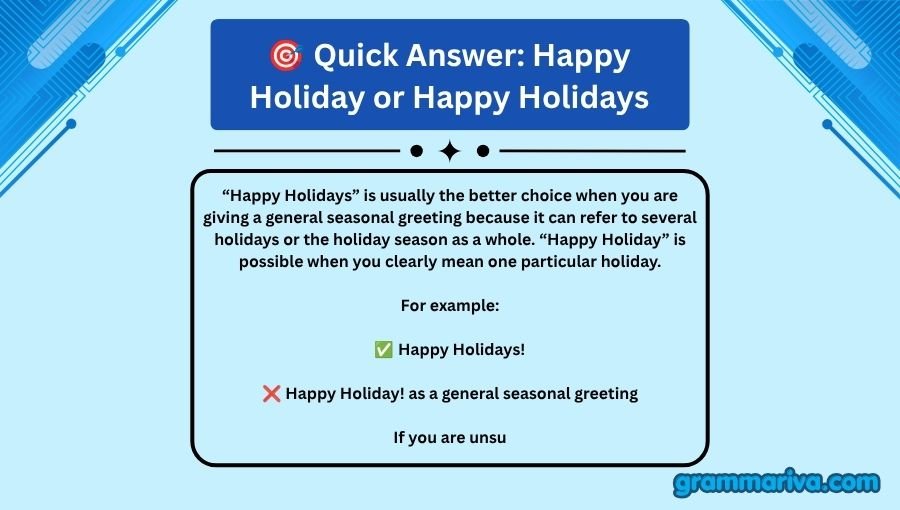
“Happy Holidays” is usually the better choice when you are giving a general seasonal greeting because it can refer to several holidays or the holiday season as a whole. “Happy Holiday” is possible when you clearly mean one particular holiday.
For example:
- ✅ Happy Holidays!
- ❌ Happy Holiday! as a general seasonal greeting
If you are unsure, “Happy Holidays” is normally the safest and most natural choice in American English.
🔍 Is “Happy Holiday” the Same as “Happy Holidays”?
No. “Happy Holiday” is singular, while “Happy Holidays” is plural. The plural form is commonly used as a broad seasonal greeting.
Think about the meaning:
- Holiday = one holiday or one holiday period
- Holidays = multiple holidays or the holiday season
For example:
- ✅ Have a happy holiday!
This can mean one specific holiday or break. - ✅ Happy Holidays!
This is a broad seasonal greeting. - ❌ Happy Holiday!
This can sound incomplete if you are using it as a general December greeting.
The difference is mainly about singular versus plural meaning.
Happy Holiday vs Happy Holidays at a Glance
| Form | Type | Meaning | Example | Correct/Incorrect |
|---|---|---|---|---|
| Happy Holiday | Singular phrase | One holiday or break | Have a happy holiday! | ✅ Correct |
| Happy Holidays | Plural phrase | Several holidays or the holiday season | Happy Holidays! | ✅ Correct |
| Happy Holiday | General seasonal greeting | Broad holiday-season greeting | Happy Holiday to everyone! | ⚠️ Less natural |
| Happy Holidays | General seasonal greeting | Broad seasonal wish | Happy Holidays to everyone! | ✅ Correct |
🎯 Why Do People Confuse “Happy Holiday” and “Happy Holidays”?
People confuse these phrases because English often uses holidays to describe a season rather than one single event. The meaning can also change depending on the country and context.
In American English, holidays often refers to the period around Thanksgiving, Christmas, Hanukkah, New Year’s, and other celebrations.
There is another reason for the confusion. A person may be thinking about one specific day while the message is actually meant for an entire season.
I once reviewed a holiday email where the writer changed “Happy Holidays” to “Happy Holiday” because they thought shorter was always better. The sentence became grammatically possible in a narrow context, but it no longer sounded like the natural seasonal greeting the writer wanted.
A Simple Meaning Test
Ask yourself:
Am I talking about one holiday?
If yes, holiday may work.
Am I talking about the holiday season or several celebrations?
If yes, holidays is usually better.
| What You Mean | Best Choice | Example |
|---|---|---|
| One specific holiday | Happy holiday | Have a happy holiday! |
| A vacation break | Happy holiday | Enjoy your holiday! |
| Several celebrations | Happy Holidays | Happy Holidays to your family! |
| General seasonal greeting | Happy Holidays | Happy Holidays from our team! |
| Holiday season | Happy Holidays | Wishing you Happy Holidays! |
📝 Understanding “Happy Holiday” and Its Correct Use
“Happy holiday” is grammatically possible because holiday is a countable singular noun. The phrase works best when the context clearly points to one holiday or one break.
For example:
Have a happy holiday with your family.
Here, the speaker can be wishing someone a pleasant holiday period.
Another example is:
I hope you have a happy holiday.
The singular form can work when the speaker sees the holiday as one particular period.
When “Happy Holiday” Works
Use the singular form when:
- You mean one specific holiday.
- You mean one vacation or break.
- The surrounding sentence clearly identifies the holiday.
Examples:
- ✅ Have a happy holiday with your family.
- ✅ I hope you have a happy holiday.
- ✅ Enjoy your holiday break.
- ✅ Have a happy holiday weekend.
The key is context.
If you simply write “Happy Holiday!” as a broad December greeting, many American readers will expect “Happy Holidays!” instead.
Meaning Summary
| Meaning | Word Type | Example Sentence |
|---|---|---|
| One holiday | Singular noun | Have a happy holiday. |
| One break | Singular noun | Enjoy your holiday break. |
| A specific holiday period | Singular noun | I hope you have a happy holiday. |
🎄 When Is “Happy Holidays” the Better Choice?
“Happy Holidays” is the standard broad greeting for the holiday season in American English. It is especially useful when you do not know which holidays another person celebrates.
This makes the phrase common in:
- Workplace emails
- Greeting cards
- Store messages
- Social media posts
- Customer messages
- School announcements
- General conversations
For example:
Happy Holidays to you and your family!
This message does not name a specific holiday. It works as a friendly seasonal greeting.
Why the Plural Form Works
The plural holidays allows the greeting to cover more than one celebration.
It can also refer to the broader holiday period.
So when you want a greeting that works for a mixed group, Happy Holidays is a very useful choice.
| Situation | Recommended Phrase |
|---|---|
| General December greeting | Happy Holidays |
| Message to customers | Happy Holidays |
| Workplace greeting | Happy Holidays |
| Greeting card | Happy Holidays |
| Several holiday celebrations | Happy Holidays |
| One specific holiday | Happy holiday / specific holiday name |
💡 How Can You Remember the Difference?
Use one simple question:
“Am I wishing someone well for one holiday or the whole holiday season?”
If it is one holiday, think holiday.
If it is the broader season, think holidays.
I use an even simpler memory trick when explaining this to students:
One = holiday. Many or general season = holidays.
This is not a rule that solves every possible sentence, but it works very well for everyday greetings.
The One-or-Many Test
| Question | Answer | Choice |
|---|---|---|
| One specific holiday? | Yes | Holiday |
| One vacation break? | Yes | Holiday |
| Several celebrations? | Yes | Holidays |
| General holiday season? | Yes | Holidays |
| Unsure about someone’s celebration? | Yes | Holidays |
🧑💼 Case Study: A Workplace Holiday Email
Imagine a manager sending an email to a team in December.
The manager writes:
Happy Holidays, everyone! Thank you for all your hard work this year.
That sounds natural because the message is for the entire holiday season.
Now imagine an employee telling a coworker:
Have a happy holiday during your time off.
That can also work because the employee is talking about the coworker’s particular break.
The context changes the choice.
Here is another real-life example. I once edited a short customer message that said, “Happy Holiday to all our customers.” I changed it to “Happy Holidays to all our customers” because the company was sending a general seasonal greeting rather than referring to one specific holiday.
Workplace Examples
| Original Message | Better Version | Reason |
|---|---|---|
| Happy Holiday, everyone! | Happy Holidays, everyone! | General seasonal greeting |
| Have a Happy Holiday during your break. | Have a happy holiday during your break. | One break |
| Happy Holidays to our customers! | Happy Holidays to our customers! | General greeting |
| Have a happy holiday weekend. | Have a happy holiday weekend. | Specific period |
📚 Grammar Rules Explanation
The grammar difference comes from the noun holiday.
Holiday is singular. Holidays is plural.
When you use holiday, you are referring to one holiday or one holiday period. When you use holidays, you are referring to more than one holiday or to the holiday season as a group.
The adjective happy does not change. The noun changes from singular to plural.
So:
happy + holiday
becomes:
happy + holidays
The choice depends on what you mean.
Standard English references and common American usage support this basic singular-plural distinction.
Correct vs Incorrect at a Glance
| Sentence | Correct/Incorrect | Why |
|---|---|---|
| Happy Holidays! | ✅ Correct | Natural general seasonal greeting |
| Have a happy holiday! | ✅ Correct | Can refer to one holiday or break |
| Happy Holiday, everyone! | ⚠️ Less natural | Plural is normally preferred for a broad greeting |
| Happy Holidays, everyone! | ✅ Correct | General greeting to a group |
| I hope you have a happy holiday. | ✅ Correct | One holiday period is meant |
⚠️ Common Mistakes With Holiday Greetings
The most common mistake is not really a grammar failure. It is a meaning problem.
People often use the singular form when they want to express a general seasonal wish.
Other mistakes happen for simple reasons:
- Fast typing
- Autocorrect
- Lack of knowledge
- Copying phrases from other people
- Not thinking about singular and plural nouns
Digital writing makes this even easier to miss. A short message may look fine even when one small word changes the meaning.
Similar Grammar Confusions
| Confusion | Correct Form | Main Difference |
|---|---|---|
| it’s / its | Depends on meaning | “It’s” = it is; “its” = possession |
| your / you’re | Depends on meaning | “Your” = possession; “you’re” = you are |
| they’re / their / there | Depends on meaning | Different functions |
| holiday / holidays | Depends on meaning | Singular vs. plural |
| advice / advise | Depends on word type | Noun vs. verb |
Common Wrong Forms
| Wrong Form or Use | What’s Wrong | Correct Form |
|---|---|---|
| Happy Holiday! to everyone | Singular sounds less natural for a broad greeting | Happy Holidays! |
| Happy holiday season! | Not necessarily wrong, but context matters | Happy holiday season! |
| Happy Holidays! for one named holiday | Too broad if one exact holiday is meant | Happy [specific holiday]! |
| Happy holiday’s! | Incorrect apostrophe | Happy Holidays! |
| Happy Holiday’s! | Apostrophe does not make a normal plural | Happy Holidays! |
The last mistake is especially common.
Holidays does not need an apostrophe when it is simply plural.
✍️ Is “Happy Holiday’s” Ever Correct?
No, not as the normal plural form of holiday.
The correct plural is:
holidays
The apostrophe in holiday’s usually signals possession or a contraction in another context. It does not simply make a noun plural.
Compare:
- ❌ Happy Holiday’s!
- ✅ Happy Holidays!
The same rule applies to many other English nouns.
You would not normally write:
- ❌ Books’s
- ❌ Friends’s
- ❌ Cars’s
A basic plural usually does not need an apostrophe.
| Form | Use |
|---|---|
| holiday | Singular |
| holidays | Plural |
| holiday’s | Possessive or contraction context |
| holidays’ | Plural possessive |
For a greeting, Happy Holidays is the correct form.
🌎 How Do the Phrases Work in Different Contexts?
The best choice can depend on the situation. Happy Holidays is especially common for broad public or professional greetings. The singular form works better when the sentence clearly points to one holiday period.
Everyday Conversation
You can say:
Have a happy holiday!
This works when someone is going away for a holiday break.
Professional Writing
Use:
Happy Holidays!
This is usually the safer choice for a general workplace or customer message.
Creative Writing
Writers have more freedom. The surrounding story can make either form appropriate.
Social Media and Texting
Both can appear, but Happy Holidays is usually the natural broad greeting.
| Context | Which Term to Use | Example |
|---|---|---|
| Everyday conversation | Either, depending on meaning | Have a happy holiday! |
| Professional writing | Happy Holidays | Happy Holidays from our team! |
| Creative writing | Depends on context | Have a happy holiday, dear. |
| Social media/texting | Happy Holidays | Happy Holidays, everyone! |
🎁 Common Phrases With “Holiday” and “Holidays”
Several common expressions can help you see the difference.
| Phrase | Meaning |
|---|---|
| Happy Holidays | General seasonal greeting |
| Have a happy holiday | Wish for one holiday or break |
| Holiday season | The broader season |
| Holiday break | A period away from work or school |
| Holiday weekend | A weekend connected to a holiday |
| Holiday spirit | The mood or feeling linked to the holiday season |
Notice that holiday and holidays both have useful roles.
The goal is not to avoid the singular form. The goal is to use the form that matches your meaning.
🔄 What Are Good Alternatives to “Happy Holidays”?
Sometimes you may want a different greeting. The best alternative depends on your audience and the specific holiday.
You could say:
- Season’s Greetings
- Warm holiday wishes
- Wishing you a joyful holiday season
- Enjoy the holiday season
- Best wishes for the holidays
These phrases can sound more formal or personal.
| Alternative | Works When | Does Not Work When |
|---|---|---|
| Season’s Greetings | You want a broad greeting | You want a casual, personal tone |
| Warm holiday wishes | Cards and emails | Very short texts |
| Wishing you a joyful holiday season | Professional messages | Very casual conversations |
| Enjoy the holiday season | Friendly messages | A specific holiday is the only focus |
| Best wishes for the holidays | Emails and cards | You want a very simple greeting |
❓ Is “Happy Holiday” Grammatically Correct?
Yes, “Happy Holiday” can be grammatically correct. The singular form works when the context refers to one holiday or one holiday period.
For example:
I hope you have a happy holiday.
However, the short greeting “Happy Holidays!” is generally more natural when you are giving a broad seasonal greeting.
So the issue is not that happy holiday is always wrong. It is about context and intended meaning.
🗣️ Why Does “Happy Holidays” Sound More Natural as a General Greeting?
The plural form sounds natural because the phrase can cover a range of celebrations and the wider holiday season.
For example:
Happy Holidays to everyone in our office!
The speaker does not need to name a particular holiday. The greeting is intentionally broad.
This is useful in mixed groups.
It also avoids assuming that everyone celebrates the same holiday.
🎯 Does “Happy Holidays” Mean More Than One Holiday?
It can. “Happy Holidays” may refer to several holidays, but in common American usage it can also refer to the holiday season more broadly.
That is why the phrase can work even when the speaker is not thinking about several specific holidays.
For example:
Happy Holidays!
The speaker may simply mean, “I hope you have a wonderful holiday season.”
The plural form gives the greeting a broad meaning.
📱 How Should You Write “Happy Holidays” in a Text or Post?
For a casual text or social media post, simply write:
Happy Holidays! 🎉
You can also personalize it:
Happy Holidays to you and your family! ❤️
Or:
Wishing everyone Happy Holidays and a wonderful New Year! ✨
In informal writing, the phrase is flexible. The main thing is to keep the plural form when you mean the general holiday season.
🏢 Which Form Is Better for Professional Emails?
For a general professional email, “Happy Holidays” is usually the better choice.
It is friendly, clear, and broad.
For example:
Happy Holidays! Thank you for your support this year. We look forward to working with you again soon.
This works well for:
- Customers
- Clients
- Coworkers
- Business partners
- Teams
- General audiences
If you know the exact holiday you are addressing, you can name it instead.
For example:
Merry Christmas!
or:
Happy Hanukkah!
The best greeting depends on your audience and purpose.
🧠 A Fast Test for Choosing the Right Form
Here is my favorite test.
Remove happy and look at the noun.
Would you say:
one holiday
or:
several holidays / the holiday season?
If you mean one, use holiday.
If you mean several or the broader season, use holidays.
| Question | If Yes → Use |
|---|---|
| Are you talking about one holiday? | Holiday |
| Are you talking about one person’s holiday break? | Holiday |
| Are you greeting a large audience generally? | Holidays |
| Are you referring to the holiday season? | Holidays |
| Are several celebrations included? | Holidays |
Practice Examples
- _____ to everyone at the office!
→ Happy Holidays! ✅ - I hope you have a _____ during your vacation.
→ happy holiday ✅ - _____ to you and your family!
→ Happy Holidays! ✅
These examples show why context matters more than memorizing one phrase.
💬 Why Does Getting This Right Matter?
Using the right form makes your message clearer. It also helps your writing sound natural.
This matters in:
- Professional emails
- Published articles
- Greeting cards
- Customer messages
- Social media posts
- School communications
A small grammar choice can affect how polished your writing feels.
Clear writing makes a simple message easier to understand.
That idea applies far beyond holiday greetings.
| Situation | Why Getting It Right Matters |
|---|---|
| Resume | Shows attention to language |
| Client email | Creates a polished impression |
| Published content | Improves accuracy |
| Social post | Makes the message sound natural |
🕰️ A Brief Note on the History of “Holiday”
The word holiday has a long history in English. It developed from the idea of a holy day, referring to a day set apart for religious observance. Over time, its use expanded.
Today, holiday can refer to a special day, a period of celebration, or a break from normal work or school, depending on the variety of English and the context.
American English also uses holiday in ways that differ somewhat from British English. For example, Americans often use vacation for a trip or extended break, while British English commonly uses holiday for that meaning.
| Period | Form | General Note |
|---|---|---|
| Earlier English | holy day | Religious day or special observance |
| Later usage | holiday | Broader everyday meaning developed |
| Modern English | holiday | Special day or break, depending on context |
| Modern American English | holidays | Often used for the holiday season |
This history helps explain why the word can have more than one everyday meaning.
🌟 Special Cases and Context Matters
There is no special grammatical exception that makes “Happy Holiday” automatically correct or incorrect.
Instead, the important edge case is context.
For example:
Have a happy holiday!
This can be perfectly natural when someone is leaving for a holiday break.
But:
Happy Holiday!
as a standalone seasonal greeting may sound less natural to many American English speakers than:
Happy Holidays!
The same words can therefore feel different depending on how they are used.
✅ Quick Recap Checklist
The easiest rule is simple: use the singular when you mean one holiday or one holiday period. Use the plural when you mean several holidays or the holiday season generally.
| Question | If Yes → Use |
|---|---|
| One specific holiday? | Holiday |
| One holiday break? | Holiday |
| General seasonal greeting? | Holidays |
| Several celebrations? | Holidays |
| Greeting a broad audience? | Holidays |
| Writing “Happy ___!” without more context? | Usually Holidays |
Remember These Three
1. ✅ Have a happy holiday!
2. ✅ Happy Holidays, everyone!
3. ❌ Happy Holiday, everyone! when you mean the broad holiday season
A tiny s can change the scope of your greeting.
❓ FAQs About Happy Holiday vs Happy Holidays
What is the difference between “Happy Holiday” and “Happy Holidays”?
“Happy Holiday” is singular and can refer to one holiday or one holiday period. “Happy Holidays” is plural and is commonly used as a broad greeting for the holiday season or several celebrations.
Is “Happy Holiday” grammatically correct?
Yes. “Happy Holiday” can be grammatically correct when the context refers to one holiday or holiday period. However, “Happy Holidays” is usually more natural as a general seasonal greeting.
Should I say “Happy Holiday” or “Happy Holidays”?
Use “Happy Holidays” when giving a general seasonal greeting. Use “happy holiday” when you clearly mean one particular holiday or someone’s individual holiday break.
Is “Happy Holidays” singular or plural?
“Holidays” is plural. The phrase can refer to several holidays or the broader holiday season.
Can I write “Happy Holiday” on a Christmas card?
You can, but “Happy Holidays” is usually the more natural broad greeting. If the card is specifically about Christmas, you can also use “Merry Christmas.”
Is “Happy Holiday’s” correct?
No. “Happy Holiday’s” is not the normal plural greeting. The correct form is “Happy Holidays.” The plural word does not need an apostrophe.
Why do Americans say “Happy Holidays”?
Americans commonly use “Happy Holidays” as a broad seasonal greeting. It can include different holidays and the wider holiday season without naming one specific celebration.
Is “Happy Holidays” professional?
Yes. “Happy Holidays” is commonly suitable for professional emails, customer messages, workplace cards, and other business communication.
Can I say “Have a happy holiday”?
Yes. “Have a happy holiday” is natural when you mean one holiday or one holiday period. For example, you might say it to someone who is leaving for a holiday break.
Which is safer when I am unsure what holiday someone celebrates?
“Happy Holidays” is usually the safer broad greeting. It does not require you to assume that everyone celebrates the same specific holiday.
🏁 Conclusion: Happy Holiday or Happy Holidays?
Happy Holidays is usually the best choice when you want a general seasonal greeting, while happy holiday works when you mean one particular holiday or holiday break.
The difference is simple once you focus on the noun. Holiday is singular. Holidays is plural. The plural form is especially common in broad American English greetings because it can cover multiple celebrations or the holiday season as a whole. 🎄
If you are writing a professional email, greeting card, social media post, or message to a group, Happy Holidays! is normally a safe and natural choice. If you are talking about one person’s break, Have a happy holiday! can be exactly right.
I always recommend using meaning as your guide instead of trying to memorize a phrase without context. Once you ask whether you mean one holiday or the broader holiday season, the answer becomes much easier. 😊
One holiday? Use “holiday.” General season or several celebrations? Use “holidays.” That one little “s” keeps your greeting clear.

Hi, I’m Ethan Brooks. I’m an English grammar writer at Grammariva, where I work on clear explanations, practical examples, and useful writing tips. I enjoy making difficult grammar topics easier to understand.
[…] I vs so am I will help you respond more naturally in both casual conversations and formal English. Happy Holiday or Happy Holidays | Calvary vs Cavalry | In the Store or At the […]
[…] exactly when to use regardless and why irregardless is usually best avoided. So Do I vs So Am I | Happy Holiday or Happy Holidays | Calvary vs […]