Have you ever stopped while writing a text and wondered whether to say in the store or at the store? You are not alone. Both phrases are common in American English, and both can be correct. The tricky part is that they do not always give the same idea. 🛒
The good news is that the difference is simple once you focus on what you want to say. In the store usually points to being inside the store. At the store usually points to being at that place or location. The second phrase is broader.
I teach English writing, and I often see this small preposition choice cause confusion. The mistake is rarely about grammar alone. It is usually about meaning. A person may be physically inside a shop but still choose at the store because they are talking about their location in a general way.
In this guide, I will explain both phrases with clear rules, examples, tables, practical situations, and easy memory tips. By the end, you will know when to use each one naturally. Choir vs Chorus | Maximal vs Maximum | Rather Than or Instead Of
🎯 Quick Answer: In the Store or At the Store
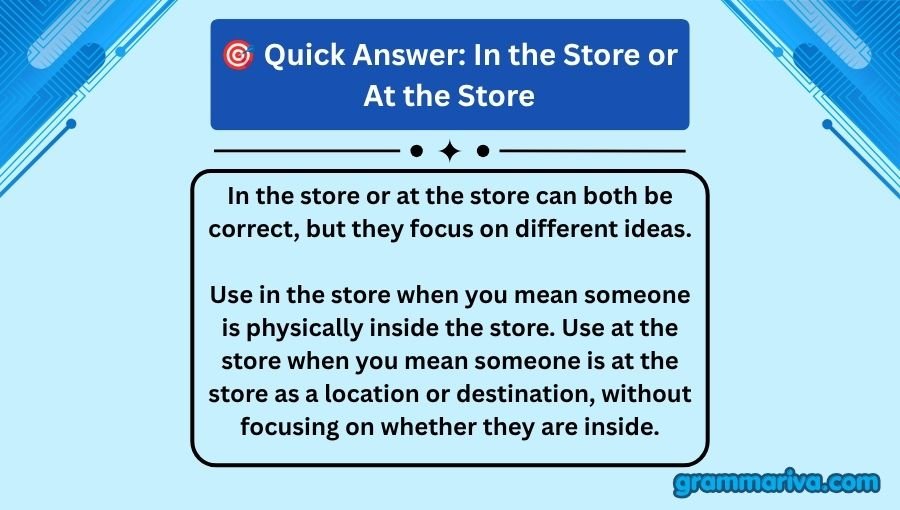
In the store or at the store can both be correct, but they focus on different ideas.
Use in the store when you mean someone is physically inside the store. Use at the store when you mean someone is at the store as a location or destination, without focusing on whether they are inside.
| Phrase | Main idea | Example |
|---|---|---|
| in the store | Inside the store | She is in the store buying shoes. |
| at the store | At the store location | She is at the store right now. |
A simple rule helps:
In = inside. At = location.
However, context matters. Someone can be at the store and also be in the store at the same time.
🏪 Is In the Store the Same as At the Store?
No. In the store and at the store are closely related, but they are not exactly the same. The first stresses the inside of the building. The second stresses the general location.
Think about this situation:
You call your friend.
“Where are you?”
“I’m at the store.”
This tells you the general location. Your friend could be inside, near the entrance, in the parking lot, or somewhere else connected with the store.
Now imagine your friend says:
“I’m in the store.”
This gives you a clearer picture. Your friend is inside the store.
A simple picture in words
Imagine a supermarket with a parking lot.
- Parking lot → at the store
- Store entrance → at the store
- Inside the building → in the store
- Shopping aisle → in the store
This does not mean at the store is wrong when someone is inside. It simply gives less detail.
| Expression | What it emphasizes | Example |
|---|---|---|
| in the store | Interior space | Tom is in the store. |
| at the store | General location | Tom is at the store. |
| in the grocery store | Inside a grocery store | We are in the grocery store. |
| at the grocery store | Grocery store as a destination | We are at the grocery store. |
📍 Why Do People Confuse In and At?
People confuse in and at because both prepositions can describe location. The difference is often small in casual conversation.
I once corrected a student’s sentence that said, “My mother is in the dentist.” The student knew that in could describe a place but had not learned that some locations naturally take at when we mean the activity or general location. That small change made the sentence sound much more natural.
The same idea applies to stores.
When you say in the store, you picture the inside.
When you say at the store, you picture the store as a point or place on a map.
The “inside test”
Ask yourself:
Am I emphasizing the inside of the building?
If yes, in is often the best choice.
✅ “I saw Lisa in the store.”
❌ “I saw Lisa at the store” if your intended meaning is specifically that you found her inside.
But remember, the second sentence is not automatically grammatically wrong. It simply gives a broader location.
The “location test”
Ask:
Am I simply saying where someone is?
If yes, at is often natural.
✅ “Dad is at the store.”
❌ “Dad is in the store” if you actually mean that you do not know whether he is inside or outside.
| Question to ask | Best choice | Reason |
|---|---|---|
| Is the person physically inside? | in the store | Focuses on the interior |
| Is the store simply the person’s location? | at the store | Focuses on the place |
| Are you describing a shopping activity? | Often at the store | Store is treated as a location |
| Are you describing something happening inside? | in the store | Interior matters |
🧭 In the Store vs At the Store at a Glance
The key difference between these phrases is focus. In the store gives a stronger sense of being inside. At the store treats the store as a general location.
| Form | Type | Meaning | Example | Correct/Incorrect |
|---|---|---|---|---|
| in the store | prepositional phrase | Inside the store | We are in the store. | ✅ Correct |
| at the store | prepositional phrase | At the store location | We are at the store. | ✅ Correct |
| in store | phrase | Available or planned, depending on context | More deals are in store. | ✅ Correct in specific uses |
| at store | incomplete phrase in standard use | Usually needs an article or determiner | I am at the store. | ❌ “at store” |
| inside the store | prepositional phrase | Clearly inside | She is inside the store. | ✅ Correct |
One useful point is that in store without the has a different use in some expressions. For example, “What surprises are in store?” does not mean something is physically inside a shop.
💡 When Should You Use In the Store?
Use in the store when the inside area matters. It is especially useful when you describe something that happens inside the building.
For example:
“I left my umbrella in the store.”
The phrase tells us where the umbrella was left. We picture the umbrella somewhere inside the shop.
Describing an action inside
Use in the store when someone is doing something inside.
- She is in the store looking for a jacket.
- I met my neighbor in the store.
- The children were playing in the store.
- We found the missing wallet in the store.
- He is waiting in the store.
Describing an object inside
The phrase also works well for objects.
- My phone is in the store.
- The package is in the store.
- Your order is in the store waiting for pickup.
The exact meaning can depend on context. For example, “Your order is in the store” might mean the order has arrived at the shop and is available there.
Test Tip 🧠
If you can naturally replace in the store with inside the store, your choice is probably right.
| Meaning | Word type | Example sentence |
|---|---|---|
| Physical interior | Location phrase | She is in the store. |
| Action inside | Location phrase | I saw him in the store. |
| Object inside | Location phrase | Your bag is in the store. |
🏬 When Should You Use At the Store?
Use at the store when the store is the general place where someone is located, visiting, working, shopping, or meeting someone.
This is extremely common in everyday American English.
For example:
“I’m at the store. Do you need anything?”
The speaker is telling you their general location. They do not need to explain exactly where they are inside the building.
Common situations
You can use at the store when:
- Someone is shopping.
- Someone works there.
- Someone has gone there.
- Someone is waiting there.
- Someone is meeting another person there.
- You are simply giving your location.
Examples:
✅ “I’m at the store. I’ll be home soon.”
❌ “I’m at store. I’ll be home soon.”
The second sentence is incorrect because standard English normally needs the before a specific store when using this phrase.
Store as a destination
“At” is also common when the store is the destination.
“I need to stop at the store.”
This means the store is one of the places the speaker plans to visit.
You could also say:
“I need to go to the store.”
That sentence focuses more directly on movement toward the store.
| Situation | Natural phrase | Example |
|---|---|---|
| General location | at the store | Mom is at the store. |
| Going there | to the store | I’m going to the store. |
| Inside the building | in the store | He is in the store. |
| Leaving it | from the store | She just came from the store. |
🚶 Is At the Store More Natural in Everyday American English?
Yes, at the store is very natural when someone is simply reporting where they are. American speakers often use at for places treated as destinations or general locations.
For example:
“Where’s Mike?”
“He’s at the store.”
That sounds natural because the question asks about Mike’s location.
If the conversation is about something that happened inside, in the store may be better:
“Where did you see Mike?”
“I saw him in the store near the bakery.”
The difference is subtle but useful.
Case Study: A Short Workplace Conversation 📝
Imagine two coworkers:
Maria: “Where is James?”
Kevin: “He’s at the store.”
Maria now knows James is at that location.
Later, Kevin explains:
“He’s in the store talking to the manager.”
Now the inside location matters.
I once edited a short workplace message where an employee wrote, “I am in the store, so I cannot answer the phone.” That sentence was perfectly clear because the writer wanted to show that they were physically inside the shop. In another message, “I’m at the store” was better because the writer was simply explaining where they were.
| Conversation goal | Better phrase | Why |
|---|---|---|
| Give a general location | at the store | Broad location |
| Explain being inside | in the store | Specific interior |
| Describe an inside event | in the store | Interior matters |
| Explain a shopping trip | at the store | Store is the destination |
📚 Grammar Rules Explanation
The difference comes from how English uses prepositions of place.
In commonly describes something within an enclosed area or space. At commonly identifies a point, place, or general location.
That is why both phrases can be grammatically correct.
There is no rule saying that a person inside a store must always be described with in. English speakers may say at the store even when the person is physically inside. The speaker is choosing to describe the store as a location rather than focusing on the interior.
This same pattern appears in many everyday expressions:
- at school
- at work
- at the office
- at the mall
- at the airport
- in the office
- in the building
- in the mall
The choice depends on the meaning you want to highlight.
Correct vs Incorrect at a Glance
| Sentence | Correct/Incorrect | Why |
|---|---|---|
| She is in the store. | ✅ Correct | It focuses on being inside. |
| She is at the store. | ✅ Correct | It gives the general location. |
| She is at store. | ❌ Incorrect | The phrase normally needs the or another determiner. |
| I found him in the store. | ✅ Correct | The person was found inside. |
| I found him at the store. | ✅ Correct | The store is given as the general location. |
A standard English dictionary can help confirm normal usage, but the most useful test here is meaning: in focuses on the inside, while at focuses on the place.
⚠️ Common Mistakes With In and At
These mistakes happen for simple reasons.
1. Fast typing
People often leave out small words while texting.
“I’m at store.”
The missing the may be a typing mistake.
2. Autocorrect
Phone keyboards can change words or remove spaces. A quick message may look strange even when the writer knows the rule.
3. Lack of knowledge
Some learners think in means every physical location and at means every general location. Real English is more flexible.
4. Translating directly
A phrase that sounds natural in another language may not use the same English preposition.
I once caught myself typing “I’ll meet you in the station” when I meant the station as a meeting point. I changed it to “I’ll meet you at the station.” The tiny preposition changed the picture in my mind.
Similar Grammar Confusions
| Confusion | Correct choice | Main difference |
|---|---|---|
| it’s / its | it’s = it is; its = possession | Apostrophe changes meaning |
| your / you’re | your = possession; you’re = you are | Different word functions |
| their / there / they’re | Three different uses | Possession, place, contraction |
| in / at | Depends on location focus | Inside vs general place |
| to / too / two | Different meanings | Direction, also, number |
Specific Wrong Forms and Uses
| Wrong Form | What’s Wrong | Correct Form |
|---|---|---|
| I am at store. | Missing article | I am at the store. |
| She is in at the store. | Two location prepositions are unnecessarily combined | She is in the store. |
| He is at inside the store. | Incorrect combination | He is inside the store. |
| We are in the store location. | Awkward when simple location is intended | We are at the store. |
| I am at the inside of the store. | Unnatural wording | I am inside the store. |
| They went in the store. | Can be unclear when movement is intended | They went into the store. |
🔄 Why Into the Store Is Sometimes Better
A common problem is confusing in with into.
In describes a location.
Into describes movement from outside to inside.
Compare:
✅ “She is in the store.”
This tells us where she is.
✅ “She walked into the store.”
This tells us that she moved from outside to inside.
The difference is easy to remember:
In = position. Into = movement toward the inside.
| Phrase | Meaning | Example |
|---|---|---|
| in the store | Already inside | We are in the store. |
| into the store | Movement inside | We walked into the store. |
| at the store | General location | We are at the store. |
| to the store | Movement toward the store | We went to the store. |
This distinction can make your writing much clearer.
🌎 In the Store or At the Store in Different Contexts
The best choice can change slightly depending on the situation. Everyday speech often favors at the store for general location. Detailed descriptions often favor in the store.
| Context | Which Term to Use | Example |
|---|---|---|
| Everyday conversation | Usually at the store for general location | “I’m at the store.” |
| Professional writing | Choose based on exact meaning | “The manager is in the store.” |
| Creative writing | in the store for scene detail | “She stood in the store by the window.” |
| Social media/texting | Either | “Guess where I am? At the store again!” |
Everyday conversation
“At the store” is very common when giving a quick update.
“Can you call me later? I’m at the store.”
Professional writing
Professional writing should be more exact.
“The technician is in the store inspecting the equipment.”
Here, the physical interior matters.
Creative writing
Writers often use in the store because it helps create a scene.
“She stood in the store, staring at rows of bright red dresses.”
Social media and texting
Casual communication allows both.
“I’m at the store again. Why do I always forget something? 😂”
💬 Common Phrases With Store
There are several natural phrases involving store. Each one has its own meaning.
| Phrase | Meaning |
|---|---|
| at the store | At the store as a general location |
| in the store | Inside the store |
| to the store | Moving toward or visiting the store |
| from the store | Coming from the store |
| go to the store | Visit or travel to the store |
| shop at the store | Buy things from that store |
Notice that these phrases use different prepositions because each one describes a different relationship with the store.
For example:
“I went to the store.”
“I shopped at the store.”
“I waited in the store.”
“I walked home from the store.”
These are all natural because each preposition adds a different meaning.
🧩 How To Remember the Difference
The easiest memory trick is to imagine a dot and a box.
Think of at as a dot on a map.
Think of in as being inside a box.
So:
AT → location point 📍
IN → inside space 📦
Imagine you are calling a friend.
If you only need to know the general place, say:
“I’m at the store.”
If you want to know exactly where the person is, say:
“I’m in the store.”
Three-question memory test
Ask:
- Am I talking about a general location?
- Use at.
- Am I talking about the inside?
- Use in.
- Am I talking about movement inside?
- Use into.
This three-step test works well beyond stores.
✍️ Synonyms and Alternatives
Sometimes you can avoid the preposition choice by using another phrase. This can be helpful when you want a different tone or more detail.
| Alternative | Works When | Does Not Work When |
|---|---|---|
| inside the store | You want to stress the interior | General location is enough |
| at the shop | Referring to the shop as a place | You need a specifically American retail term |
| inside the shop | Describing physical position | Casual location updates may sound more detailed |
| at the retail location | Formal business writing | Casual conversation |
| within the store | Formal or detailed writing | Simple everyday speech |
For most everyday American English, in the store and at the store are still the most natural choices.
🎯 Why Getting This Small Difference Right Matters
A tiny preposition can change the picture in a reader’s mind.
Clear location words help readers understand whether you mean:
- a general destination,
- a specific place,
- an interior space,
- or movement toward a place.
This matters in emails, reports, customer messages, and everyday texts.
A useful writing principle is:
“Choose the word that gives your reader the picture you mean.”
Why precision helps
| Situation | Why Getting It Right Matters |
|---|---|
| Resume or job writing | Clear location details sound professional |
| Client email | Exact wording prevents confusion |
| Published content | Correct prepositions improve readability |
| Social post | Natural wording makes the message easier to understand |
The difference may seem tiny, but good writing is often built from small choices.
🛒 Can You Say Both In the Store and At the Store?
Yes. Both phrases are standard and useful.
The important question is not “Which phrase is always correct?” The better question is “What meaning do I want?”
Consider:
“I left my keys in the store.”
This strongly suggests the keys are inside.
“I left my keys at the store.”
This gives a broader location. The keys may be somewhere at that location, depending on context.
Another example:
“Meet me at the store.”
This is natural because the store is a meeting location.
“Meet me in the store.”
This is also correct, but it tells the person to meet you inside.
| Sentence | Main focus |
|---|---|
| Meet me at the store. | Store as meeting location |
| Meet me in the store. | Inside the store |
| I am at the store. | General location |
| I am in the store. | Inside the building |
🧠 Quick Recap Checklist
Use this checklist whenever you are unsure.
| Question | If Yes → Use |
|---|---|
| Are you focusing on the inside? | in the store |
| Are you giving a general location? | at the store |
| Are you describing movement inside? | into the store |
| Are you describing movement toward the location? | to the store |
| Are you describing where someone came from? | from the store |
Practice Examples
1. Your friend calls and asks where you are.
“I’m at the store.”
Why? You are giving a general location.
2. You are describing where you found your lost wallet.
“I found it in the store.”
Why? The wallet was physically inside.
3. You are describing someone entering the building.
“She walked into the store.”
Why? The sentence describes movement from outside to inside.
❓ FAQs About In the Store vs At the Store
Is “in the store” grammatically correct?
Yes. In the store is grammatically correct when you mean that someone or something is inside the store. For example, “The children are in the store” clearly places the children inside the building.
Is “at the store” grammatically correct?
Yes. At the store is also grammatically correct. It usually describes the store as a general location or destination. For example, “I’m at the store” simply tells someone where you are.
Which is better, in the store or at the store?
Neither is always better. Use in the store when you want to stress the inside. Use at the store when you want to give the general location.
Should I say “I am in the store” or “I am at the store”?
Both are correct. Say I am in the store when being inside matters. Say I am at the store when you are simply telling someone your location.
Can “at the store” mean that I am inside?
Yes. At the store can refer to someone who is physically inside the store. The phrase focuses on the store as a location rather than specifically on the interior.
What is the difference between “in the store” and “into the store”?
In the store describes location. Into the store describes movement from outside to inside. For example, “She is in the store” describes where she is, while “She walked into the store” describes her movement.
Is “at store” correct without “the”?
Usually not when you mean a specific store in standard American English. Say at the store, at a store, or at Walmart, depending on the meaning and name of the place.
Is “go in the store” correct?
It can occur in casual speech, but go into the store is clearer when you mean movement from outside to inside. If you are describing location rather than movement, use in the store.
Is “at the store” more common in American English?
It is very common in American English for general location and shopping situations. However, in the store is also completely natural when the speaker wants to emphasize being inside.
How can I remember the difference between “in” and “at”?
Use this simple rule: in usually highlights an inside space, while at usually highlights a location. Think of in as being inside a box and at as standing at a point on a map.
📝 Final Conclusion
In the store or at the store depends on the meaning you want to express. In the store focuses on being inside the building. At the store focuses on the store as a general place or location.
The two phrases can describe the same real-world situation. If you are physically shopping inside a store, you could truthfully say, “I’m in the store.” You could also say, “I’m at the store.” The difference is the focus.
I recommend using the inside test when you are unsure. If the inside space matters, choose in. If you are simply giving a location, choose at. If you describe movement from outside to inside, choose into.
Once you start thinking about the picture behind the preposition, this choice becomes much easier. 🛍️
Remember the simple rule: in shows the inside, at shows the place, and into shows movement inside. Master that idea, and you will handle this common English question with confidence. ✨

Hi, I’m Nathan Reed. I’m a grammar and writing specialist at Grammariva. I work on practical grammar content that helps readers understand sentence structure, punctuation, vocabulary, and better writing habits.
[…] uses. By the end, you should be able to choose the right word without stopping to think twice. In the Store or At the Store | Choir vs Chorus | Maximal vs […]
[…] real-life examples, and give you simple ways to remember which form to choose. Calvary vs Cavalry | In the Store or At the Store | Choir vs […]