Have you ever typed a sentence and stopped because you were not sure whether to write seen vs scene? You are not alone. These two words sound exactly alike, but they have completely different meanings and jobs in a sentence. One is connected to seeing, while the other usually refers to a place, setting, or situation.
I teach and edit English writing, and this is one of those word pairs that can cause a surprisingly large number of small mistakes. The good news is that the difference is easy once you connect each word with a simple idea. Seen belongs to the verb see, while scene is a noun.
In this guide, I will show you how to tell them apart, when to use each one, and how to avoid common spelling mistakes. You will also see clear examples from everyday speech, work, social media, and creative writing. By the end, you should be able to choose the right word without stopping to think. 😊 Family Was or Family Were | One vs Won | Based on vs Based Off Of
🎯 Quick Answer: Seen vs Scene
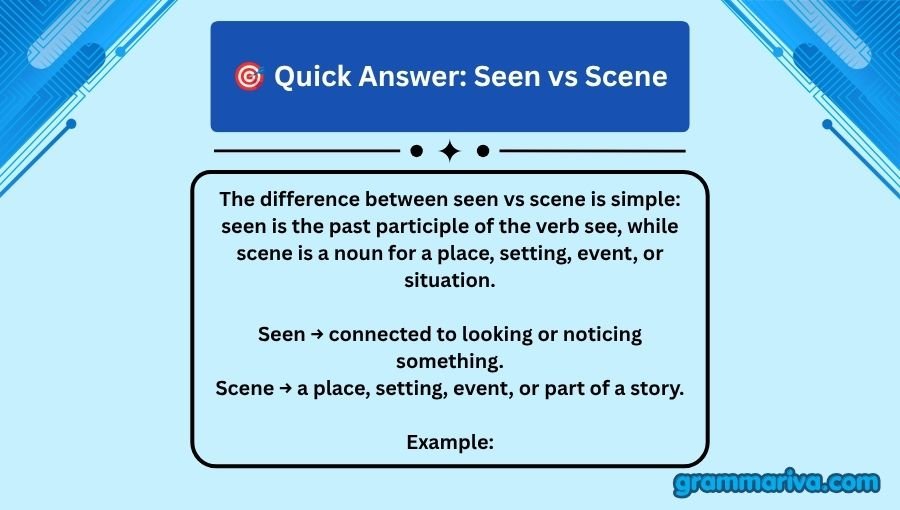
The difference between seen vs scene is simple: seen is the past participle of the verb see, while scene is a noun for a place, setting, event, or situation.
- Seen → connected to looking or noticing something.
- Scene → a place, setting, event, or part of a story.
Example:
✅ I have seen that movie before.
❌ I have scene that movie before.
Here, seen is correct because the sentence is about watching or experiencing something visually.
Another example:
✅ The movie had a beautiful beach scene.
❌ The movie had a beautiful beach seen.
Here, scene is correct because it describes a part or setting of the movie.
The easiest rule is this: if you are talking about seeing something, think “seen.” If you are talking about a setting or situation, think “scene.”
🔤 Related Word Forms of Seen
Seen has several closely related forms because it belongs to the verb see. Understanding these forms can make the difference much easier to remember.
| Form | Type | Example |
|---|---|---|
| see | Base verb | I can see the mountain. |
| sees | Present-tense verb | She sees the problem. |
| saw | Simple past | I saw him yesterday. |
| seen | Past participle | I have seen him before. |
| seeing | Present participle | I am seeing the doctor tomorrow. |
The important point is that seen normally works with an auxiliary verb such as have, has, or had.
✅ I have seen this show.
❌ I have saw this show.
By contrast, scene is normally a noun. It can also appear in plural form as scenes.
| Form | Type | Example |
|---|---|---|
| scene | Noun | The opening scene was funny. |
| scenes | Plural noun | Several scenes were filmed outside. |
| a scene | Singular noun phrase | We watched a scene from the movie. |
| the scene | Definite noun phrase | The police arrived at the scene. |
🧠 Understanding the Basics of Seen vs Scene
The core difference between seen vs scene is their part of speech and meaning. Seen is a verb form. Scene is a noun.
Think of the words as belonging to two different families:
See → saw → seen
Scene → setting → place or situation
| Form | Type | Meaning | Example | Correct/Incorrect |
|---|---|---|---|---|
| seen | Verb form | Noticed or viewed | I have seen it. | ✅ Correct |
| scene | Noun | A setting or situation | The scene was beautiful. | ✅ Correct |
| scene | Verb form in “I have scene” | Incorrect replacement for seen | I have scene it. | ❌ Incorrect |
| seen | Noun in “the seen” | Usually incorrect for the intended meaning | The seen was crowded. | ❌ Incorrect |
| scenes | Plural noun | Multiple settings or situations | The film had many scenes. | ✅ Correct |
What Does “Seen” Mean?
Seen means noticed, viewed, observed, or experienced through sight. It is the past participle of see.
It is usually used with have, has, or had.
Examples:
✅ I have seen that actor before.
❌ I have scene that actor before.
The first sentence means that I have watched or noticed the actor at some earlier time.
Another example:
✅ She has seen the message.
❌ She has scene the message.
Again, the action is connected to seeing, so seen is the right choice.
What Does “Scene” Mean?
Scene is a noun. It can describe a place where something happens, a part of a movie or play, or a situation that people can observe.
Examples:
✅ The final scene made everyone cry.
❌ The final seen made everyone cry.
Here, scene means a part of the movie.
It can also describe a real place where an event happened:
✅ The firefighters arrived at the scene.
The word can also describe a social setting:
✅ She is well known in the local music scene.
So, scene is not about the act of seeing. It is about a place, setting, event, or part of a story.
Seen vs Scene at a Glance
| Word | Main Role | Think About | Example |
|---|---|---|---|
| seen | Verb form | Seeing something | I have seen it. |
| scene | Noun | A place or setting | The scene was quiet. |
| seen | Related to “see” | Sight or observation | Have you seen this? |
| scene | Related to movies and events | Setting or situation | The next scene begins here. |
👀 Is Seen the Past Tense of See
No. Seen is not the simple past tense of see. The simple past form is saw, while seen is the past participle.
This distinction is one of the most useful grammar rules to remember.
| Verb Form | Example |
|---|---|
| see | I see the car. |
| saw | I saw the car yesterday. |
| seen | I have seen the car before. |
A common mistake is using seen without an auxiliary verb.
❌ I seen him yesterday.
✅ I saw him yesterday.
However:
✅ I have seen him before.
The word seen usually needs a helping verb in standard English when it acts as the past participle.
💡 Test Tip
Try replacing seen with saw.
If the sentence needs a simple past action, saw may be correct.
If the sentence contains have, has, or had, seen is often the form you need.
For example:
- I saw her yesterday.
- I have seen her before.
- He saw the accident.
- He had seen the accident before.
🎬 Is Scene the Same as Seen
No. Scene and seen sound alike, but they do not mean the same thing.
This is a homophone problem. The words have the same pronunciation in standard American English, but their spellings and meanings are different.
| Word | Sound | Meaning | Example |
|---|---|---|---|
| seen | Same sound as scene | Viewed or noticed | I have seen it. |
| scene | Same sound as seen | Place, setting, or situation | The scene was dramatic. |
This is why seen vs scene can be confusing in texting and casual writing. When you hear either word, you cannot know which spelling is correct until you understand the sentence.
I once reviewed a short movie review where the writer had typed “the final seen” several times. The writer knew exactly what they meant. They simply relied on the sound of the word instead of its meaning. Once we connected the word to “setting,” the spelling became easy to fix.
✍️ Key Differences Between Seen and Scene
The biggest difference is grammatical.
Seen is a verb form related to see. Scene is a noun.
That difference controls how each word behaves.
Seen in Perfect Verb Forms
Seen commonly appears after have, has, or had.
Examples:
✅ We have seen this before.
❌ We have scene this before.
✅ She has seen the new building.
❌ She has scene the new building.
Scene as a Noun
Scene can be used after articles such as a, an, and the.
Examples:
✅ We watched the scene again.
❌ We watched the seen again.
✅ It was a strange scene.
❌ It was a strange seen.
Scene in Movies and Stories
A scene can be a part of a film, television show, play, or written story.
✅ The opening scene was set in New York.
✅ That scene was the funniest part of the movie.
Scene as a Real Location
The word can also refer to a place where something happened.
✅ The police arrived at the scene.
✅ Reporters gathered at the scene.
The context tells you which meaning of scene is intended.
📝 Case Study: Seen vs Scene in Real Writing
Imagine an employee writing an email about a training video.
The employee writes:
❌ “I have scene the training video, and the last seen was very helpful.”
There are two errors.
The corrected version is:
✅ “I have seen the training video, and the last scene was very helpful.”
The first word refers to watching the video. Therefore, seen is correct.
The second word refers to a part of the video. Therefore, scene is correct.
This is a useful real-world example because both words can appear naturally in the same sentence.
I once caught a similar mistake while editing a document. The writer had used “scene” every time they meant “seen.” I did not just change the words. I explained the connection: seen belongs to see; scene belongs to setting. That simple explanation made the correction much easier to remember.
| Original Idea | Incorrect Version | Correct Version | Reason |
|---|---|---|---|
| Watched a movie | I have scene it. | I have seen it. | Verb form |
| Part of a movie | The final seen was great. | The final scene was great. | Noun |
| Noticed someone | She has scene him. | She has seen him. | Verb form |
| Place of an event | They reached the seen. | They reached the scene. | Noun |
| Watched something | Have you scene this? | Have you seen this? | Verb form |
📚 Grammar Rules Explanation
The rule behind seen vs scene is based on both meaning and grammar.
Seen is a form of the verb see. In standard English, it is the past participle form. A past participle often appears with a helping verb.
Examples:
✅ I have seen the movie.
✅ She has seen the results.
✅ They had seen the warning.
Scene, on the other hand, is a noun. It names something rather than describing the act of seeing.
Examples:
✅ The movie has a long opening scene.
✅ The accident created a chaotic scene.
✅ We arrived at the scene.
Most standard English reference sources agree on this basic distinction. The important thing is not memorizing a complicated rule. It is understanding the role each word plays.
Correct vs Incorrect at a Glance
| Sentence | Correct/Incorrect | Why |
|---|---|---|
| I have seen that movie. | ✅ Correct | “Seen” is the past participle of see. |
| I have scene that movie. | ❌ Incorrect | “Scene” is a noun. |
| The final scene was powerful. | ✅ Correct | “Scene” refers to part of the movie. |
| The final seen was powerful. | ❌ Incorrect | “Seen” is not the noun intended here. |
| We arrived at the scene. | ✅ Correct | “Scene” refers to a location or situation. |
⚠️ Why Do People Confuse Seen and Scene
People confuse these words mainly because they sound the same. Spelling becomes harder when a writer is working from sound instead of meaning.
There are several common reasons.
Fast Typing
When people type quickly, they may choose the spelling that comes to mind first.
Autocorrect
Spell-check tools can sometimes accept a real English word even when it is the wrong word for the sentence. Since both seen and scene are real words, software may not recognize the mistake.
Lack of Knowledge
A learner may hear the two words often but never learn that they have different meanings.
Sound-Based Spelling
If someone has mostly heard a word rather than read it, they may spell it based on pronunciation.
| Similar Confusion | Correct Pair | Main Problem |
|---|---|---|
| it’s / its | it’s, its | Contraction vs possession |
| your / you’re | your, you’re | Possession vs “you are” |
| they’re / their / there | three different forms | Sound and meaning |
| to / too / two | three different words | Sound and function |
| seen / scene | seen, scene | Same sound, different meaning |
Common Wrong Forms of Seen and Scene
| Wrong Form | What’s Wrong | Correct Form |
|---|---|---|
| I have scene it. | “Scene” is a noun. | I have seen it. |
| I seen it yesterday. | Simple past needs “saw.” | I saw it yesterday. |
| The movie’s last seen | Wrong noun form. | The movie’s last scene |
| Have you scene this? | “Scene” cannot replace “seen.” | Have you seen this? |
| We arrived at the seen. | The location is a “scene.” | We arrived at the scene. |
| She has scene him. | Wrong past participle. | She has seen him. |
🧩 How To Remember The Difference
The easiest memory trick is to connect each word to another word.
Seen → see
Scene → setting
When you mean looked at, noticed, watched, or observed, choose seen.
When you mean place, setting, situation, or part of a movie or story, choose scene.
Try this memory sentence:
“I have seen the scene.”
That sentence uses both words correctly.
| Memory Word | Connection | Meaning |
|---|---|---|
| seen | see | Viewed or noticed |
| scene | setting | Place or situation |
| saw | see | Simple past |
| scenes | scene | More than one setting |
A second trick is to ask: Can I put “the” before the word?
“The scene” makes sense.
“The seen” usually does not when you are talking about a movie, location, or event.
Then ask: Is this connected to the verb “see”?
If yes, seen may be the word you need.
🌎 Seen vs Scene in Different Contexts
The correct word depends on what you are trying to say.
| Context | Which Term to Use | Example |
|---|---|---|
| Everyday conversation | seen | Have you seen my phone? |
| Professional writing | seen | I have seen the updated report. |
| Creative writing | scene | The opening scene was dark and quiet. |
| Social media/texting | Either, depending on meaning | Have you seen this post? |
| Movie discussion | scene | That scene was unforgettable. |
| Reporting an event | scene | Officers arrived at the scene. |
Everyday Conversation
You will often use seen when talking about things you have watched or noticed.
✅ Have you seen my keys?
✅ I have seen that show.
You will use scene when describing a place or situation.
✅ It was a strange scene.
Professional Writing
Accuracy matters in emails, reports, and business documents.
✅ I have seen the revised proposal.
✅ The report describes the scene in detail.
Using the wrong word can make a sentence look careless.
Creative Writing
Writers often use scene when talking about parts of a story.
✅ The next scene takes place in a quiet restaurant.
They may use seen when describing what a character notices.
✅ She had seen the same car before.
Social Media and Texting
Informal writing may be quick, but the same spelling rules still apply.
✅ Have you seen this video?
❌ Have you scene this video?
🎥 Common Phrases With Scene
Scene appears in many common expressions.
| Phrase | Meaning |
|---|---|
| crime scene | Place where a crime happened |
| movie scene | Part of a movie |
| opening scene | Beginning part of a film, show, or story |
| final scene | Last part of a film, show, or story |
| scene of the accident | Place where an accident happened |
| music scene | A local or broader group of people involved in music |
Examples:
✅ The detective returned to the crime scene.
✅ The opening scene immediately grabbed my attention.
✅ She is active in the local music scene.
These expressions make scene easy to recognize because the word usually names a setting, place, or area of activity.
🔄 Synonyms and Alternatives
Sometimes you can replace scene with another word, but the best alternative depends on the context.
| Alternative | Works When | Does Not Work When |
|---|---|---|
| setting | Talking about where a story takes place | Talking about the act of seeing |
| situation | Talking about an event or condition | Referring specifically to a movie section |
| location | Talking about a physical place | Referring to a dramatic part of a story |
| moment | Talking about a specific point in a story | Referring to an entire physical setting |
| part | Talking generally about a section | When a more precise term is needed |
For seen, alternatives may include noticed, watched, or observed, depending on the sentence.
For example:
✅ I have seen the movie.
Possible alternative:
✅ I have watched the movie.
But these words are not always exact replacements. “Seen” can refer broadly to visual experience, while “watched” often suggests sustained attention.
💼 Why Getting Seen vs Scene Right Matters
Correct word choice improves clarity. It also makes your writing look more polished.
A spelling mistake between two real words can be harder to notice than an obvious misspelling. Readers may understand your meaning, but the error can still distract them.
| Situation | Why Getting It Right Matters |
|---|---|
| Resume | Shows careful writing |
| Client email | Builds a professional impression |
| Published content | Improves credibility |
| Social post | Makes the message easier to understand |
Here is a simple principle I use when editing:
Clear words make clear writing.
That applies even to tiny word pairs.
In a resume or professional email, a mistake such as “I have scene the report” can look like a basic grammar problem. In casual texting, it may not matter much. In published content, however, repeated mistakes can weaken the reader’s trust.
🧪 Practice: Can You Choose the Right Word
Try filling in each blank with seen, scene, or saw.
- I have ______ that movie twice.
- The final ______ was very emotional.
- I ______ him at the store yesterday.
- Have you ______ my new post?
- The police arrived at the ______.
- She had ______ the warning earlier.
- The opening ______ was filmed outdoors.
- We ______ a beautiful sunset yesterday.
Answers
| No. | Answer | Why |
|---|---|---|
| 1 | seen | Past participle of see |
| 2 | scene | Part of a movie |
| 3 | saw | Simple past of see |
| 4 | seen | Used after “have” |
| 5 | scene | Place or situation |
| 6 | seen | Used after “had” |
| 7 | scene | Part of a movie |
| 8 | saw | Simple past |
The key is not just memorizing the answers. Notice the grammar around each word.
🚫 Common Sentence Errors With Seen and Scene
Here are several mistakes worth watching for.
Mistake 1: Using Scene After Have
❌ I have scene that movie.
✅ I have seen that movie.
After have, you need the past participle seen.
Mistake 2: Using Seen for a Movie Section
❌ The last seen was amazing.
✅ The last scene was amazing.
A movie section is a scene.
Mistake 3: Using Seen Instead of Saw
❌ I seen him yesterday.
✅ I saw him yesterday.
The simple past form is saw.
Mistake 4: Using Scene for a Visual Action
❌ Have you scene this picture?
✅ Have you seen this picture?
The sentence asks whether someone has viewed the picture.
Mistake 5: Confusing a Location With the Act of Seeing
❌ Everyone gathered at the seen.
✅ Everyone gathered at the scene.
The word refers to a location or situation.
🧭 A Simple Decision Guide for Seen vs Scene
When you are unsure, follow these steps.
Step 1: Ask what the word means.
Does it mean viewed or noticed?
Use seen.
Does it mean place, setting, situation, or part of a movie?
Use scene.
Step 2: Check the grammar.
Does the word come after have, has, or had?
Seen is likely correct.
Step 3: Check whether you are naming a thing.
If you can naturally say the scene, a scene, or this scene, you probably need scene.
| Question | If Yes → Use |
|---|---|
| Does it mean viewed or noticed? | seen |
| Does it follow have, has, or had? | seen |
| Does it mean a movie section? | scene |
| Does it mean a place where something happened? | scene |
| Does it mean a situation or setting? | scene |
| Is the sentence about simple past seeing? | saw |
📝 Quick Recap Checklist
Use this checklist whenever you are unsure.
| Question | If Yes → Use |
|---|---|
| Am I talking about something I viewed? | seen |
| Do I have “have,” “has,” or “had” before the word? | seen |
| Am I talking about a part of a movie? | scene |
| Am I talking about a location? | scene |
| Am I talking about a situation? | scene |
| Am I describing a completed action yesterday or earlier? | saw |
Three Quick Practice Examples
- I have seen this movie before. ✅
- The final scene was beautiful. ✅
- I saw him at the store yesterday. ✅
A useful memory line is:
You have seen something, but you watch a scene.
❓ FAQs About Seen vs Scene
Is seen the same as scene?
No. Seen is a form of the verb see, while scene is a noun that can mean a setting, place, situation, or part of a movie or story.
Is “I have seen it” correct?
Yes. I have seen it is correct because seen is the past participle of see and follows the helping verb have.
Is “I have scene it” correct?
No. The correct sentence is “I have seen it.” The word scene is a noun and cannot replace the past participle seen.
What is the difference between saw and seen?
Saw is the simple past form of see, while seen is the past participle. For example, “I saw him yesterday” is correct, while “I have seen him before” is correct.
What does scene mean?
Scene is a noun that can refer to a place where something happens, a situation, or a part of a movie, play, television show, or story.
What does seen mean?
Seen means viewed, noticed, or observed. It is the past participle form of the verb see.
Why do seen and scene sound the same?
They are pronounced the same in standard American English, even though they have different spellings and meanings. This makes them easy to confuse when writing from sound.
Should I write “the scene” or “the seen”?
For a

Hi, I’m Olivia Carter. I’m an English language editor at Grammariva, and I work on making grammar lessons clear, accurate, and easy to follow. I especially enjoy writing about common grammar mistakes and everyday English.


[…] common phrases, mistakes, examples, and easy memory tricks that help you choose the right word. Seen vs Scene | Family Was or Family Were | One vs […]
[…] when you are unsure. By the end, choosing between these forms should feel natural. ✨ Set vs Sit | Seen vs Scene | Family Was or Family […]