Choosing between stint or stent can be confusing because the two words look and sound similar. Yet, they have very different meanings and are used in very different situations. One usually relates to a period of work or a limited amount of time. The other is a medical device used to help keep a passage in the body open. ✍️
I have seen this mix-up in emails, articles, and even carefully edited documents. The problem is easy to understand. When people type quickly, the brain often remembers the general sound of a word but not its exact spelling. That is where these two terms can get mixed up.
The good news is that the difference is simple once you connect each word with its meaning. Stint or stent is not a case where both spellings can be used for the same idea. Each word has its own job.
In this guide, I will explain both words with clear examples, tables, memory tips, common mistakes, and real-world situations. By the end, you should be able to choose the right word without stopping to guess. 🎯 Also Has or Has Also | Set vs Sit | Seen vs Scene
🎯 Quick Answer: Stint or Stent
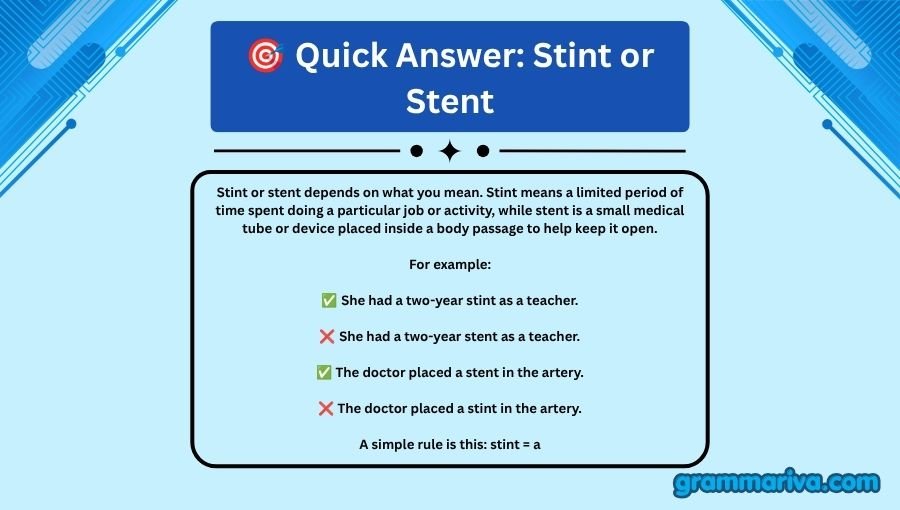
Stint or stent depends on what you mean. Stint means a limited period of time spent doing a particular job or activity, while stent is a small medical tube or device placed inside a body passage to help keep it open.
For example:
- ✅ She had a two-year stint as a teacher.
- ❌ She had a two-year stent as a teacher.
- ✅ The doctor placed a stent in the artery.
- ❌ The doctor placed a stint in the artery.
A simple rule is this: stint = a period of time; stent = a medical device.
📚 Understanding Stint or Stent at a Glance
The core difference between these words is their meaning. Stint is mainly connected with time, work, effort, or a limited amount. Stent is mainly a medical term.
| Form | Type | Meaning | Example | Correct/Incorrect |
|---|---|---|---|---|
| stint | noun | A limited period of work or activity | He completed a three-year stint overseas. | ✅ Correct |
| stint | verb | To limit or be unwilling to give enough | She did not stint on the decorations. | ✅ Correct |
| stent | noun | A medical device that helps keep a passage open | The patient received a heart stent. | ✅ Correct |
| stent | verb | To place a stent in a body passage | Doctors stented the blocked artery. | ✅ Correct |
| stent | noun | A period of work | He had a short stent at the company. | ❌ Incorrect |
Stint: Meaning and Correct Use
Stint commonly refers to a period of time spent doing a particular job, activity, or task.
You might describe someone’s time at a company as a stint. You can also use it for military service, volunteer work, travel, study, or another activity.
Examples:
- ✅ I had a short stint at a local newspaper.
- ❌ I had a short stent at a local newspaper.
Here, stint is correct because the sentence talks about a period of work.
Another meaning of stint is to limit something or avoid giving enough of it.
- ✅ The chef did not stint on the spices.
- ❌ The chef did not stent on the spices.
In this sentence, the word means the chef did not hold back or use too little.
Stent: Meaning and Correct Use
Stent is a medical word. It refers to a small tube or device that is placed inside a body passage to help keep it open.
Stents may be used in blood vessels and other parts of the body when a passage has become narrowed or blocked.
Examples:
- ✅ The doctor inserted a stent into the artery.
- ❌ The doctor inserted a stint into the artery.
Here, stent is correct because the sentence describes a medical procedure.
The Basic Difference in One Table
| Word | Main Idea | Common Setting | Example |
|---|---|---|---|
| stint | A limited period or amount | Work, study, service, effort | She had a six-month stint abroad. |
| stent | A medical device | Medicine and health care | The surgeon inserted a stent. |
The easiest distinction is time versus medicine.
🤔 Is Stint the Same as Stent?
No. Stint and stent are different words with different meanings. Although their spellings are close, they should not be substituted for one another.
Think about these two sentences:
- ✅ Mark completed a two-year stint in sales.
- ❌ Mark completed a two-year stent in sales.
The first sentence describes a period of employment.
Now compare:
- ✅ Mark needed a stent after his artery became blocked.
- ❌ Mark needed a stint after his artery became blocked.
The second example needs the medical term.
| Question | Answer |
|---|---|
| Does the sentence describe time at a job? | Use stint. |
| Does it describe a medical device? | Use stent. |
| Does it describe limiting something? | Use stint. |
| Does it describe a medical procedure involving a tube or device? | Use stent. |
A Simple Memory Trick 🧠
I use a very simple memory trick with students:
Stint = time.
Stent = treatment.
You can also remember:
A stint is something you spend time doing. A stent is something a doctor may place inside the body.
That distinction covers most everyday uses.
❓ Why Do People Confuse Stint and Stent?
People confuse these words because their spellings are almost identical. Both begin with st and contain four letters. Only the vowel changes.
The words can also appear in similar-looking sentences, especially when someone is typing quickly.
I once reviewed a short business article where the writer used stent several times when describing a manager’s period at a company. The writer clearly knew the meaning but had chosen the wrong spelling. Once I pointed out that the article was about a period of employment, every instance became stint.
Common reasons for the confusion include:
- Similar spelling
- Fast typing
- Autocorrect
- Relying on sound alone
- Limited familiarity with medical terms
- Seeing one word more often than the other
- Forgetting that the words belong to different meaning groups
The best solution is not to memorize the spelling alone. Connect each word to its meaning.
📝 Stint: The Different Ways You Can Use It
Stint has more than one useful role in English. It is most common as a noun, but it can also work as a verb.
1. Stint as a Period of Work
This is one of the most common uses.
- ✅ She began a three-month stint at the magazine.
- ❌ She began a three-month stent at the magazine.
The phrase a stint at is especially common when describing someone’s time at a workplace or organization.
2. Stint as a Period of Activity
A stint does not have to involve a paid job.
- ✅ He had a brief stint in college before changing careers.
- ✅ She spent a year-long stint volunteering overseas.
- ✅ His military stint lasted four years.
The word simply highlights a limited period devoted to something.
3. Stint as a Verb
As a verb, stint can mean to limit something or not provide enough.
- ✅ They did not stint on the decorations.
- ❌ They did not stent on the decorations.
Another example is:
- ✅ The company did not stint on employee training.
This means the company did not hold back when providing training.
Meaning Summary
| Meaning | Word Type | Example Sentence |
|---|---|---|
| A period of work | Noun | He had a short stint in retail. |
| A period of activity | Noun | Her stint abroad changed her outlook. |
| A limited amount of something | Noun | The workers were given a strict stint of time. |
| To limit or hold back | Verb | They did not stint on quality. |
🩺 Stent: The Medical Meaning
Stent is mainly used in medical contexts. A stent is a device placed inside a passage in the body to help keep it open.
For example, a person may receive a stent in an artery when the artery has become narrowed.
Examples:
- ✅ The cardiologist placed a stent in the artery.
- ❌ The cardiologist placed a stint in the artery.
You may also see the word used with verbs such as:
- insert a stent
- place a stent
- receive a stent
- have a stent
- use a stent
- implant a stent
The important point is that stent belongs to a medical vocabulary group.
💡 Test Tip: How Can You Check the Correct Word?
Here is the fastest test I recommend.
Ask yourself:
Am I talking about a period of time, work, or effort?
If yes, choose stint.
Am I talking about a medical device?
If yes, choose stent.
Try the test:
She had a two-year ___ at the company.
The sentence talks about time at a company.
Therefore:
She had a two-year stint at the company. ✅
Now try:
The doctor inserted a ___ into the artery.
This is a medical situation.
Therefore:
The doctor inserted a stent into the artery. ✅
📝 Case Study: A Workplace Email
Imagine that a manager writes this email:
“Daniel completed a three-year stent with our marketing team.”
The meaning is clear enough, but the word is wrong. The manager is describing Daniel’s period of employment.
The corrected sentence is:
“Daniel completed a three-year stint with our marketing team.”
I once caught a similar mistake in a résumé. The applicant had written that she had completed a “two-year stent” with a company. The experience itself was described perfectly. Only the word choice was wrong. Changing stent to stint made the sentence professional and accurate.
| Original Sentence | Problem | Better Version |
|---|---|---|
| He had a two-year stent at the company. | Wrong word for a work period | He had a two-year stint at the company. |
| She completed a brief stent abroad. | Wrong word for a period of activity | She completed a brief stint abroad. |
| The doctor placed a stint in the artery. | Wrong medical term | The doctor placed a stent in the artery. |
| He needed a stent after the procedure. | Correct medical use | He needed a stent after the procedure. |
📖 Grammar Rules Explanation
The difference between stint and stent is mainly a vocabulary issue rather than a complex grammar rule. They are separate words with separate meanings.
Stint can function as a noun or verb.
As a noun, it can describe a limited period of work or activity:
Her stint at the school lasted two years.
As a verb, it can describe limiting something or holding back:
They did not stint on the budget.
Stent is primarily a noun referring to a medical device. In medical writing, it may also appear as a verb when describing the act of placing a stent.
Standard English reference works treat these as distinct words. Their similar spelling does not make them interchangeable.
Correct vs. Incorrect at a Glance
| Sentence | Correct/Incorrect | Why |
|---|---|---|
| She had a short stint at the company. | ✅ Correct | It describes a period of employment. |
| She had a short stent at the company. | ❌ Incorrect | A stent is not a period of employment. |
| The surgeon inserted a stent. | ✅ Correct | It refers to a medical device. |
| The surgeon inserted a stint. | ❌ Incorrect | Stint is not the medical term. |
| He did not stint on quality. | ✅ Correct | Here, stint is a verb meaning to hold back. |
⚠️ Common Mistakes With Stint and Stent
These mistakes usually happen because the words look so similar.
Similar Word Confusions
| Confusing Words | Correct Choice | Why People Mix Them Up |
|---|---|---|
| its / it’s | Depends on meaning | Similar spelling and sound |
| your / you’re | Depends on meaning | Fast typing |
| there / their / they’re | Depends on meaning | Same general sound |
| affect / effect | Depends on context | Similar sound and usage |
| stint / stent | Depends on context | Nearly identical spelling |
The reasons are often simple:
Fast typing: Your fingers may type a familiar pattern before your brain checks the meaning.
Autocorrect: A spelling tool may not understand what you intended.
Lack of knowledge: If you have rarely seen one of the words, the difference may not feel obvious.
Sound-based spelling: If you hear the word but do not see it written, you may choose the wrong spelling.
Common Wrong Forms
| Wrong Form | What’s Wrong | Correct Form |
|---|---|---|
| a two-year stent at work | Uses a medical word for a work period | a two-year stint at work |
| a short stent abroad | Uses the medical word for a period | a short stint abroad |
| a stent in his career | Uses the medical word for career time | a stint in his career |
| a stint in his artery | Uses the time-related word for medicine | a stent in his artery |
| doctors inserted a stint | Wrong medical term | doctors inserted a stent |
| she did not stent on quality | Wrong verb form | she did not stint on quality |
🕰️ Word History and Meaning Development
The two words have different histories and developed as separate English terms. Their similar modern spellings are not a reason to treat them as variants of the same word.
Stint has long been associated with limits, fixed amounts, and periods of work or service. Its modern uses reflect those ideas.
Stent developed as a specialized medical term and is now strongly associated with medical devices used to help keep body passages open.
You do not need to memorize the full history to use either word correctly. The modern meanings are what matter most in everyday writing.
| Period | Form | General Note |
|---|---|---|
| Earlier English | stint | Connected with limits or fixed amounts |
| Later English use | stint | Became common for periods of work or service |
| Modern English | stint | Used for periods, limited amounts, and holding back |
| Modern medical English | stent | Used for a medical device and related procedures |
🌎 Usage in Different Contexts
The setting often tells you which word you need.
Everyday Conversation
Use stint when talking about a period of work, travel, service, or activity.
I did a six-month stint in Chicago.
Use stent when discussing a medical procedure or device.
My uncle had a stent placed in an artery.
Professional Writing
Stint is useful in résumés, biographies, reports, and workplace communication.
She completed a three-year stint as a project manager.
Stent belongs in medical writing and health-related communication.
The patient received a stent after the artery was found to be narrowed.
Creative Writing
Writers may use stint when describing a character’s experience.
After a short stint at sea, he returned home.
Stent would normally appear only when the story involves a medical situation.
Social Media and Texting
People may write either word online, depending on the topic.
Just finished my two-year stint at the company! 🎉
or:
Finally home after getting a stent. ❤️
| Context | Which Term to Use | Example |
|---|---|---|
| Everyday conversation | stint or stent depending on meaning | I had a short stint there. |
| Professional writing | stint for work periods | She completed a four-year stint. |
| Creative writing | stint for a period of activity | His stint abroad was unforgettable. |
| Medical communication | stent | The patient received a stent. |
❓ How Do You Use Stint in a Sentence?
Use stint as a noun when you mean a limited period of time spent doing something.
Common patterns include:
- a stint at a company
- a stint as a teacher
- a stint in the military
- a stint abroad
- a short stint
- a long stint
- a brief stint
Examples:
- ✅ She had a five-year stint as a journalist.
- ✅ His stint overseas lasted six months.
- ✅ After a short stint in retail, he started his own business.
You can also use stint as a verb:
- ✅ They did not stint on the food.
- ✅ The team did not stint on effort.
❓ How Do You Use Stent in a Sentence?
Use stent when talking about a medical device or a procedure involving one.
Examples include:
- The doctor inserted a stent.
- The patient received a stent.
- The artery was treated with a stent.
- Doctors placed a stent in the narrowed passage.
Unlike stint, the word is closely tied to medical contexts.
| Sentence Pattern | Correct Word | Example |
|---|---|---|
| ___ at a company | stint | He had a stint at the company. |
| ___ as a manager | stint | She had a stint as a manager. |
| ___ abroad | stint | I spent a stint abroad. |
| ___ in an artery | stent | The doctor placed a stent in the artery. |
| receive a ___ | stent | The patient received a stent. |
🗣️ Common Phrases With Stint
Unlike stent, stint appears in several everyday expressions and sentence patterns.
| Phrase | Meaning |
|---|---|
| a short stint | A brief period of activity |
| a long stint | A long period of activity |
| a stint at a company | A period spent working at a company |
| a stint as a teacher | A period spent working as a teacher |
| a stint abroad | A period spent in another country |
| not stint on something | Not hold back or use too little |
For example:
She had a short stint as a restaurant manager.
This means she worked as a restaurant manager for a relatively short period.
🔄 Synonyms and Alternatives for Stint
Sometimes another word can replace stint, but the best choice depends on the sentence.
| Alternative | Works When | Does Not Work When |
|---|---|---|
| period | Talking about a length of time | You want to stress a specific work experience |
| spell | Describing a period of activity, especially informal | A formal document needs a more neutral word |
| term | Describing a defined period or position | You mean a medical device |
| assignment | Describing a specific work task or posting | You mean any general period of activity |
| experience | Describing someone’s time doing something | You need to emphasize the limited period |
For example, period can sometimes replace stint:
She spent a period working abroad.
But:
She had a short stint working abroad.
sounds more natural when the focus is on a distinct period of work or activity.
None of these alternatives can replace stent when you mean the medical device.
❓ Can Stint Mean a Short Period of Work?
Yes. One of the most common meanings of stint is a limited period spent doing a particular job or activity.
For example:
He had a two-year stint as a teacher.
This tells us that he worked as a teacher for two years.
The phrase does not necessarily mean the period was unusually short. It simply presents the time as a distinct period of someone’s work or activity.
❓ Can Stent Be Used for a Period of Time?
No. Stent should not be used to describe someone’s period of employment, service, study, or travel.
Incorrect:
- ❌ She had a three-year stent at the company.
Correct:
- ✅ She had a three-year stint at the company.
This is one of the most common errors involving these two words.
❓ Is Stint a Medical Word?
Stint is not the normal word for the medical device described by stent.
When discussing a device placed inside a body passage, use stent.
For example:
The patient received a stent.
If you are talking about a period of work or activity, use stint instead.
❓ Is Stent Only Used in Medical Contexts?
In ordinary modern English, stent is strongly associated with medicine. You will most often see it in discussions of medical devices and procedures.
That makes context a powerful clue.
If the sentence contains words such as doctor, artery, patient, procedure, blood vessel, surgery, or implant, stent may be the word you need.
If it contains words such as job, company, career, service, travel, military, or years, stint is usually the better choice.
❓ What Is the Difference Between a Stint and a Stent?
A stint is generally a period of time spent doing a particular activity or job. A stent is a medical device used to help keep a body passage open.
The spelling differs by only one vowel, but the meanings are completely different.
| Word | Meaning | Example |
|---|---|---|
| stint | Period of work or activity | He had a short stint overseas. |
| stint | To hold back or limit | They did not stint on quality. |
| stent | Medical device | The doctor inserted a stent. |
❓ Which Word Should You Use in a Résumé?
Use stint when describing a period of employment or professional experience.
For example:
I completed a four-year stint as a software engineer.
You could also use simpler wording such as:
I worked as a software engineer for four years.
Never use stent to describe employment.
❓ Which Word Should You Use in Medical Writing?
Use stent when referring to the medical device or a related procedure.
For example:
The patient received a stent to help keep the narrowed passage open.
Because medical writing can involve serious information, correct terminology matters even more in that setting.
⚠️ Why Getting These Words Right Matters
Small spelling differences can create large meaning differences. A reader may understand your intended meaning from context, but the error can still make your writing look careless.
Clarity in Communication
The correct word lets readers understand your message immediately.
Professionalism
A résumé that says stent when it means stint contains a clear vocabulary error. The mistake can distract from otherwise strong writing.
Digital Communication
Emails, websites, social posts, and online articles are often read quickly. Clear word choice helps readers process information without stopping.
A useful writing principle is:
The right word makes the meaning easier to see.
| Situation | Why Getting It Right Matters |
|---|---|
| Résumé | Shows careful professional writing |
| Client email | Prevents confusion |
| Published article | Protects accuracy and credibility |
| Social post | Makes the message clear |
🧠 How to Remember the Difference
Here are three easy methods.
Method 1: Think About Time
If you see time, job, career, service, or activity, think stint.
A stint = a stretch of time.
Method 2: Think About Treatment
If you see doctor, artery, patient, surgery, or medical device, think stent.
A stent = a medical device.
Method 3: Look at the Sentence Before the Word
Do not choose the word based only on how it sounds.
Read the complete sentence and ask:
What does this word need to mean here?
That single habit prevents many spelling and vocabulary mistakes.
📝 Practice Examples
Try choosing the correct word before checking the answers.
Example 1
She had a five-year ___ with the organization.
Answer: stint ✅
Example 2
The doctor inserted a ___ into the artery.
Answer: stent ✅
Example 3
His brief ___ as a coach taught him a lot.
Answer: stint ✅
Example 4
The patient needed another ___ after the artery narrowed again.
Answer: stent ✅
Example 5
The company did not ___ on employee training.
Answer: stint ✅
These examples show the basic pattern clearly. Stint connects with periods, work, activity, or holding back. Stent connects with medical treatment.
❓ What Is the Easiest Way to Tell Stint and Stent Apart?
The easiest way is to connect each spelling with a simple idea:
STINT → time or effort
STENT → medical treatment
If you are describing someone’s time at a job, choose stint.
If you are describing a device placed inside the body, choose stent.
This mental shortcut is usually faster than trying to remember a complicated rule.
✅ Quick Recap Checklist
Use this checklist whenever you are unsure.
| Question | If Yes → Use |
|---|---|
| Am I talking about a period at a job? | stint |
| Am I talking about a period of activity? | stint |
| Am I talking about holding back or limiting something? | stint |
| Am I talking about a medical device? | stent |
| Am I talking about an artery or body passage being kept open? | stent |
Three Final Practice Examples
- She had a brief ___ at the company.
Answer: stint ✅ - The surgeon placed a ___ in the artery.
Answer: stent ✅ - They did not ___ on quality.
Answer: stint ✅
FAQs About Stint vs Stent
What is the main difference between stint and stent?
Stint usually means a period of work or activity, while stent is a medical device used to help keep a body passage open.
Is it a two-year stint or a two-year stent?
The correct phrase is a two-year stint. The word describes a period of time.
Is it a stint or stent in an artery?
The correct word is stent. A stent is a medical device that may be placed in an artery.
Can stint be a verb?
Yes. Stint can be used as a verb meaning to limit something or hold back.
For example:
They did not stint on quality.
Can stent be a verb?
Yes. In medical writing, stent can also be used as a verb for the act of placing a stent.
Why do people spell stint as stent?
The words look very similar, and people often type based on memory or sound. Fast typing and autocorrect can also contribute to the mistake.
Is “stint at a company” correct?
Yes. Stint at a company is a natural way to describe a period spent working there.
Example:
She had a five-year stint at the company.
Is “stent at a company” correct?
No. If you mean a period of employment, use stint, not stent.
Is stint used only for jobs?
No. It can describe a period spent doing many activities, including military service, travel, study, volunteer work, or other forms of activity.
How can I remember stint versus stent?
Remember stint = time or effort and stent = medical treatment. This simple contrast works in most common situations.
🎯 Conclusion
Stint or stent becomes easy to distinguish once you connect each word with its meaning. Stint describes a period of work or activity, and it can also mean to hold back or limit something. Stent refers mainly to a medical device used to help keep a body passage open.
When you are writing about someone’s career, job, service, travel, or time spent doing something, choose stint. When you are writing about an artery, medical procedure, or device placed inside the body, choose stent.
I recommend using the simple memory rule “stint means time, stent means treatment.” It is quick, practical, and easy to recall when you are writing fast. ✨
A one-letter difference can change the entire meaning of a sentence. Once you learn what each word does, you will rarely confuse them again.
Remember: stint belongs to time and effort; stent belongs to medicine. Get that distinction right, and this spelling problem is solved. ✅

Hi, I’m Madison Hayes. I’m an English learning writer at Grammariva, where I work on simple lessons and examples for people who want to improve their grammar and writing. I love turning confusing rules into easy-to-follow explanations.



[…] seems. Once you understand the basic idea, choosing the right phrase becomes almost automatic. 😊 Stint or Stent | Also Has or Has Also | Set vs […]