Have you ever wondered whether someone is on the list or in the list? 🤔 Both phrases sound natural, and both can be correct. The problem is that they do not always mean the same thing.
The choice depends on what you mean by list and how you are talking about the person, item, or information connected to it. In everyday English, on the list is usually the better choice when you mean that someone or something has been included as an item on a list. For example, you can say, “Your name is on the guest list.”
However, in the list can also be correct. We use it when we are talking about information contained inside a list, especially when we focus on the contents or details within it. For example, “There are several useful examples in the list below.”
I have seen this small preposition problem cause confusion in emails, school assignments, websites, and even professional reports. The good news is that the rule is much easier than it first seems. Once you understand the basic idea, choosing the right phrase becomes almost automatic. 😊 Stint or Stent | Also Has or Has Also | Set vs Sit
🎯 Quick Answer: On the List or In the List?
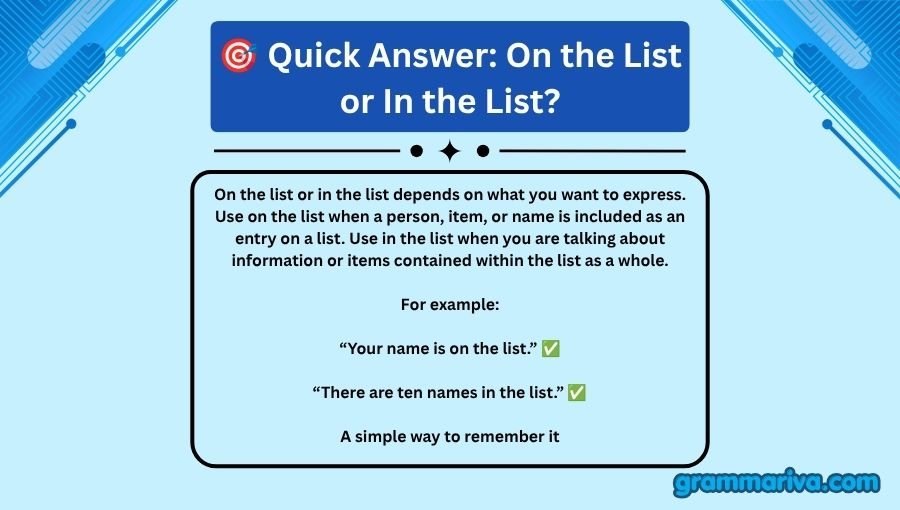
On the list or in the list depends on what you want to express. Use on the list when a person, item, or name is included as an entry on a list. Use in the list when you are talking about information or items contained within the list as a whole.
For example:
- “Your name is on the list.” ✅
- “There are ten names in the list.” ✅
A simple way to remember it is:
On = included as an entry.
In = contained within the list.
In many everyday situations, especially when talking about names, guests, tasks, events, or selected items, on the list is the natural choice.
Is “On the List” Correct?
Yes, on the list is correct and very common in standard English. It usually means that a person or thing has been written, entered, selected, or included as one of the items on a list.
Consider these examples:
- “Your name is on the list.” ✅
- “My name is in the list.” ❌
- “That restaurant is on the list of places we want to visit.” ✅
- “Her name was added on the list yesterday.” ❌
The reason is simple. English often treats a list as a surface or organized set of entries. An individual entry is therefore described as being on the list.
Basic comparison
| Form | Type | Meaning | Example | Correct/Incorrect |
|---|---|---|---|---|
| on the list | Prepositional phrase | Included as an entry | Your name is on the list. | ✅ Correct |
| in the list | Prepositional phrase | Contained within the list | The word appears in the list. | ✅ Correct |
| on list | Prepositional phrase | General phrase without article | Check on list. | ❌ Usually incorrect |
| in list | Prepositional phrase | General phrase without article | It appears in list. | ❌ Usually incorrect |
The important point is that on the list does not mean that the list is physically flat. It is simply the normal English way to describe membership in many kinds of lists.
Is “In the List” Correct?
Yes. In the list is also grammatically correct, but it is used in a different way.
We often use in the list when we focus on the contents of the list rather than the membership of one particular person or item.
For example:
- “There are several errors in the list.” ✅
- “I found your name in the list.” ⚠️ Possible, but on the list is usually more natural if you mean your name is an entry.
- “The answer is in the list below.” ✅
- “There are five products in the list.” ✅
This distinction can feel small, but it matters.
If you say:
“John is on the list.”
you are saying that John is one of the listed people.
If you say:
“There is an error in the list.”
you are talking about something contained within the list.
The difference at a glance
| Phrase | Main idea | Typical use | Example |
|---|---|---|---|
| on the list | Membership | Names, people, selected items | Maria is on the list. |
| in the list | Contents | Information, errors, details, entries | There is an error in the list. |
| on my list | Personal selection | Things you plan or want to do | Paris is on my list. |
| in the list below | Information presented inside a list | Articles, instructions, websites | See the examples in the list below. |
🧠 Why Do People Confuse “On” and “In” With Lists?
People confuse these phrases because on and in both describe location, but English uses them in different patterns.
A list can be imagined as a collection of entries. When you say that someone is on the list, you focus on the person’s status as a listed entry. When you say something is in the list, you focus more on what the list contains.
I once edited a workplace email that said, “Your department is in the approved list.” The writer clearly meant that the department had been approved and included. I changed it to “Your department is on the approved list.” The meaning became much clearer immediately.
Common reasons for the confusion
- Literal thinking
People may think that information is physically “inside” a list, so they choose in. - Influence from other phrases
English uses in with many collections, groups, and documents. - Fast typing
When people write quickly, they often choose the first preposition that sounds possible. - Autocorrect
Spell-check tools may not recognize a wrong preposition because the word itself is spelled correctly. - Different sentence patterns
Both phrases are grammatical, but they perform different jobs.
A quick test
Ask yourself:
Am I saying that someone or something is an item that has been listed?
If yes, use on the list.
If you are discussing something contained within the list, in the list may be better.
On the List vs In the List at a Glance
The easiest rule is to think about membership versus contents.
| Situation | Best Choice | Example |
|---|---|---|
| A person’s name has been included | on the list | Your name is on the list. |
| A guest has been invited | on the list | Sarah is on the guest list. |
| A task has been included | on the list | Cleaning the office is on the list. |
| An item appears among the contents | in the list | That item appears in the list. |
| An error exists within the list | in the list | There is an error in the list. |
| Instructions refer to listed information | in the list | The answer is in the list below. |
The choice is therefore not simply about grammar. It is about meaning and focus.
🎯 When Should You Use “On the List”?
Use on the list when you mean that someone or something has been included as a listed item.
Names and people
This is one of the most common uses.
- “Your name is on the list.” ✅
- “Your name is in the list.” ⚠️ Less natural in this meaning.
You can also say:
- “Is David on the list?”
- “Everyone on the list received an email.”
- “I checked, and your name is definitely on the list.”
Invitations and events
Use on when talking about guest lists or people selected for an event.
- “Are we on the list for tonight’s event?” ✅
- “She is on the guest list.” ✅
- “His name was added to the list.” ✅
Notice another useful expression here: added to the list. We normally use to when describing the action of adding something.
Plans and goals
On the list is also common when discussing things you want or plan to do.
- “Visiting Japan is on my list.”
- “That book is on my reading list.”
- “Learning Spanish is on her list of goals.”
Test Tip 💡
If you can replace the phrase with “included on the list”, on the list is probably the right choice.
| Meaning | Word Type | Example Sentence |
|---|---|---|
| Included as an entry | Phrase | His name is on the list. |
| Selected for an event | Phrase | She is on the guest list. |
| Included among plans | Phrase | Travel is on my list. |
| Included among tasks | Phrase | Call the client is on the list. |
📋 When Should You Use “In the List”?
Use in the list when you are talking about information, details, errors, or items contained within the list.
For example:
“There is a spelling mistake in the list.”
Here, you are not saying that the spelling mistake has a membership status. You are saying that the mistake exists within the contents of the list.
Other examples include:
- “There are three duplicate names in the list.” ✅
- “The information in the list is outdated.” ✅
- “I noticed a problem in the list.” ✅
- “The final item in the list is the most important.” ✅
Another useful pattern
When the phrase comes before a noun that describes the list’s contents, in is often natural:
- “the first item in the list”
- “the last name in the list”
- “the information in the list”
- “the examples in the list”
The focus is on an item within the collection.
🔍 The Meaning Changes With the Sentence
The same noun can sometimes work with both on and in, but the meaning or focus can change.
Compare:
“The name is on the list.”
“The name appears in the list.”
The first sentence emphasizes the person’s or name’s status as a listed entry. The second focuses more on the location of the name within the contents.
Both may be understandable, but on the list is usually the more natural choice when confirming membership.
Examples
| Sentence | Meaning | Naturalness |
|---|---|---|
| Your name is on the list. | You are included. | Very natural |
| Your name appears in the list. | The name occurs within the contents. | Natural |
| Your name is in the list. | Your name is contained there. | Possible, but less natural for membership |
| There is a mistake in the list. | The mistake exists within the contents. | Very natural |
| The mistake is on the list. | The mistake itself is listed as an item. | Possible in a different meaning |
This is why simply memorizing “always use on” would be wrong.
📝 Case Study: A Workplace Email
Imagine a manager sends this email:
“Please check whether your name is on the training list.”
The employee checks the document and finds the name.
The natural reply would be:
“Yes, my name is on the list.”
Now imagine the employee notices that one person’s department is spelled incorrectly.
The employee might write:
“There is a spelling error in the list.”
Notice how the prepositions change.
On describes inclusion.
In describes something contained within the document or collection.
I once caught myself making this exact distinction while reviewing a staff schedule. I first wrote, “There is a name in the schedule list,” then realized I was confirming membership. I changed it to, “Her name is on the list.” That small change made the sentence sound much more natural.
📚 Grammar Rules Explanation
The choice between on the list and in the list depends on the relationship between the noun and the list.
English commonly uses on to describe something that has been entered or included as an item in a list. This is why we say:
- “She is on the list.”
- “The item is on the shopping list.”
- “His name is on the guest list.”
English also uses in to describe something that exists within the contents of a list.
For example:
- “There is an error in the list.”
- “The final example in the list is incorrect.”
- “The information in the list is useful.”
Most standard English reference sources support the general distinction between these patterns. The important thing is to focus on what you mean rather than trying to memorize one preposition for every situation.
Correct vs Incorrect at a Glance
| Sentence | Correct/Incorrect | Why |
|---|---|---|
| Your name is on the list. | ✅ Correct | The name is included as an entry. |
| Your name is in the list. | ⚠️ Less natural for membership | On the list is normally preferred. |
| There is an error in the list. | ✅ Correct | The error is within the list’s contents. |
| She is on the guest list. | ✅ Correct | She is included among the guests. |
| The final item is in the list. | ✅ Correct | The sentence focuses on an item within the list. |
⚠️ Common Mistakes With “On” and “In”
The most common mistake is treating on and in as interchangeable.
They are not always interchangeable.
Similar preposition confusions
| Confusion | Correct Forms | Main Difference |
|---|---|---|
| on the list / in the list | Both possible | Membership vs. contents |
| on the team / in the team | Usually on the team in US English | Team membership |
| on the page / in the page | Usually on the page | Information appears on a page |
| in the document / on the document | Depends on meaning | Contents vs. surface |
| on the website / in the website | Usually on the website | Website as a platform |
| in the group / on the group | Usually in the group | Membership in a group |
Why mistakes happen
Fast typing:
People often type quickly and choose a preposition without checking the meaning.
Autocorrect:
A grammar tool may not flag the problem because both on and in are correctly spelled words.
Lack of knowledge:
Learners may translate directly from another language and choose the preposition that feels closest to the original phrase.
Overgeneralization:
Someone may learn that lists usually take on and then use it in every situation.
Common wrong forms for this topic
| Wrong Form | What’s Wrong | Correct Form |
|---|---|---|
| My name is in the guest list. | Membership is being described. | My name is on the guest list. |
| She is in the list of guests. | On is more natural for membership. | She is on the list of guests. |
| Add me on the list. | The normal verb pattern is add to. | Add me to the list. |
| Put his name in the list. | Standard phrasing for adding is usually to the list. | Put his name on the list. |
| He is in the approved list. | Membership is the focus. | He is on the approved list. |
| There is an error on the list. | This can change the intended meaning. | There is an error in the list. |
Is “Add to the List” Different From “On the List”?
Yes. Add to the list describes the action of including something, while on the list describes the result.
Compare:
“Add her name to the list.”
“Her name is on the list.”
The prepositions have different jobs.
Common patterns
| Expression | Meaning | Example |
|---|---|---|
| add to the list | Include something | Add this name to the list. |
| put on the list | Place something as an entry | Put my name on the list. |
| be on the list | Already included | My name is on the list. |
| remove from the list | Take something away | Remove his name from the list. |
| check the list | Examine it | Check the list before sending it. |
This is an especially useful pattern for workplace and everyday English.
🌎 Usage in Different Contexts
The best choice can depend on what you are discussing, but the basic meaning stays the same.
| Context | Which Term to Use | Example |
|---|---|---|
| Everyday conversation | on the list | Is my name on the list? |
| Professional writing | on the list for membership; in the list for contents | Your department is on the approved list. |
| Creative writing | Depends on meaning | His name was on the list. |
| Social media/texting | on the list for inclusion | You’re officially on the list! |
Everyday conversation
People normally say:
“Am I on the list?”
This is especially common for events, restaurants, clubs, and guest lists.
Professional writing
Professional writing requires more care because small preposition errors can make sentences sound less polished.
For example:
“Your company is on the approved vendor list.”
This clearly means the company has been approved and included.
Creative writing
Creative writers can use either phrase depending on the image or meaning they want.
“Her name was on the list.”
This suggests that the name was officially included.
“A strange symbol appeared in the list.”
This focuses on something contained within the list.
Social media and texting
Casual writing often shortens phrases:
“Yep, you’re on the list!”
That is perfectly natural in a text message.
💬 Common Phrases With “On the List”
Several common expressions use on the list.
| Phrase | Meaning |
|---|---|
| on the guest list | Included among invited guests |
| on the waiting list | Waiting for a place or opportunity |
| on the shopping list | Something you need to buy |
| on the to-do list | Something that needs to be completed |
| on the priority list | Something given special importance |
| on the short list | One of a small group being considered |
These phrases show how strongly on is associated with list membership in English.
For example:
- “She is on the waiting list.”
- “Milk is on the shopping list.”
- “Finishing the report is on my to-do list.”
- “He made it onto the short list.”
🧩 How To Remember the Difference
Use this simple mental picture:
ON = an entry
Think:
“My name is on the list.”
You are one of the entries.
IN = contents
Think:
“There is a mistake in the list.”
The mistake is inside the information presented by the list.
Memory trick
Ask:
“Am I included?”
→ on the list
“Am I talking about something contained there?”
→ in the list
This quick test works in most ordinary situations.
🔄 Synonyms and Alternatives
Sometimes you can avoid the preposition problem completely by changing the sentence.
| Alternative | Works When | Does Not Work When |
|---|---|---|
| included on the list | Confirming membership | You are discussing an error inside the list |
| listed | Saying something has been included | You need to discuss the contents |
| included | General statement of membership | You need a specific location |
| appears in the list | Talking about the appearance of information | You want to emphasize official membership |
| contained in the list | Focusing on contents | Casual conversation about guest membership |
For example:
“Your name is on the list.”
can become:
“Your name is included.”
Or:
“Your name appears in the list.”
The best alternative depends on the exact meaning.
⭐ Why Getting This Difference Right Matters
Small grammar choices can affect clarity, especially in professional communication.
If you write:
“Your name is on the list.”
the reader quickly understands that the person has been included.
If you write:
“Your name is in the list.”
the sentence may still be understood, but it can sound less natural when membership is the intended meaning.
A useful rule
“Choose the preposition that shows the relationship you actually mean.”
That rule works far beyond lists.
| Situation | Why Getting It Right Matters |
|---|---|
| Resume | Makes professional writing sound polished |
| Client email | Prevents confusion about approval or inclusion |
| Published content | Improves grammar and readability |
| Social post | Makes short messages sound natural |
Clear writing does not require complicated words. It requires the right words in the right places.
💡 Can “In the List” Ever Be More Natural?
Yes. There are many situations where in the list is the better choice.
Consider:
“There is a typo in the list.”
Here, in is clearly natural because the typo exists within the content.
Other examples include:
- “The first name in the list is incorrect.”
- “There are two repeated entries in the list.”
- “The information in the list needs to be updated.”
- “The examples in the list are useful.”
- “The final item in the list is missing.”
In each case, you are examining the list’s contents.
❓ Is “On the List” Always Better?
No. On the list is not always better.
It is usually better when you mean included as a listed entry, especially with people, names, guests, tasks, plans, and selected items.
But in the list is often better when you are describing something contained within the list.
For example:
“There are several mistakes in the list.”
It would not normally make sense to replace in with on if you mean the mistakes are errors within the list.
🧠 A Simple Decision Rule
When you are unsure, use this three-step test:
Step 1: Identify the noun
Are you talking about a person, name, task, product, or selected item?
Step 2: Ask what you mean
Are you saying that the thing has been included?
If yes, choose on the list.
Step 3: Check whether you mean contents
Are you describing an error, detail, example, item, or information found inside the list?
If yes, in the list may be more suitable.
| Question | If Yes → Use |
|---|---|
| Is someone officially included? | on the list |
| Is a name included as an entry? | on the list |
| Is a task included among planned tasks? | on the list |
| Are you discussing information contained there? | in the list |
| Are you pointing out an error within it? | in the list |
| Are you identifying an item’s position within the contents? | in the list |
📝 Practice Examples
Try these before looking at the answers.
Example 1
“Is my name ___ the guest list?”
Answer: on ✅
“Is my name on the guest list?”
Example 2
“There is a spelling mistake ___ the list.”
Answer: in ✅
“There is a spelling mistake in the list.”
Example 3
“Please add my name ___ the list.”
Answer: to ✅
“Please add my name to the list.”
Example 4
“Her name is ___ the list of finalists.”
Answer: on ✅
“Her name is on the list of finalists.”
These examples show that English uses different prepositions depending on the relationship being described.
⚠️ Common Questions About “On” and “In”
Should I say “my name is on the list”?
Yes. “My name is on the list” is the normal choice when you mean that your name has been included.
Is “my name is in the list” wrong?
It is not necessarily impossible, but it is less natural when you are simply confirming membership. “My name is on the list” is normally preferred.
Should I say “an error in the list” or “an error on the list”?
If the error exists within the contents, an error in the list is the clearer choice.
Should I say “add me on the list” or “add me to the list”?
Use add me to the list.
Is “on the guest list” correct?
Yes. On the guest list is the standard and natural expression.
Is “in the list below” correct?
Yes. In the list below is natural when you are referring to information or entries contained in a list.
🧾 Quick Recap Checklist
| Question | If Yes → Use |
|---|---|
| Is a person included among listed people? | on the list |
| Is a name officially included? | on the list |
| Is a task included among planned tasks? | on the list |
| Is something being added? | to the list |
| Is something being removed? | from the list |
| Are you discussing information contained in the list? | in the list |
| Are you pointing out an error inside it? | in the list |
| Are you referring to an item within the list? | in the list |
Three final practice sentences
- “Your name is on the list.” ✅
- “There is a mistake in the list.” ✅
- “Please add her name to the list.” ✅
If you remember only one thing, remember this:
On = inclusion. In = contents.
FAQs About On vs In
Is “on the list” grammatically correct?
Yes. On the list is grammatically correct and is the usual phrase when you mean that someone or something has been included as an entry.
Is “in the list” grammatically correct?
Yes. In the list is also grammatical. It is especially useful when talking about information, errors, examples, or other content contained within a list.
Should I say “my name is on the list” or “my name is in the list”?
Say “my name is on the list” when you mean that your name has been included. This is the more natural choice for membership or selection.
Should I say “on the guest list” or “in the guest list”?
Use “on the guest list.” For example, “Her name is on the guest list.”
Is “there is an error in the list” correct?
Yes. “There is an error in the list” is natural when the error is part of the list’s contents.
Should I say “add it on the list” or “add it to the list”?
Use “add it to the list.” The verb add normally takes to when you describe what something is being added to.
What is the difference between “on the list” and “in the list”?
On the list usually means included as an entry. In the list usually focuses on something contained within the list or appearing among its contents.
Is “in the list below” correct English?
Yes. “In the list below” is a natural expression when referring to information presented within a list that follows.
Can “on the list” and “in the list” both be correct?
Yes. Both can be correct because they can express different ideas. The right choice depends on whether you mean membership or contents.
What is the easiest way to remember the difference?
Think on = included and in = contained. If someone is included as a listed entry, use on the list. If you are discussing something contained within the list, use in the list.
Conclusion
On the list or in the list becomes much easier once you focus on meaning rather than memorizing a single preposition. Use on the list when you mean that a person, name, task, product, or other item has been included as a listed entry. Use in the list when you are talking about information, errors, examples, or other content contained within the list. 👍
Remember the simple rule: on = inclusion, in = contents.
For example, say, “My name is on the list,” when you want to confirm that you have been included. Say, “There is a mistake in the list,” when you want to point out an error inside the list.
Also remember the related pattern add to the list. We add something to a list, and once it has been added, it can be on the list.
These small preposition choices may seem minor, but they make your English sound clearer and more natural. The best writers pay attention to details like these because clear communication is built from small choices.
When in doubt, ask yourself one question: Am I talking about inclusion or contents? Once you know that, the right preposition is usually clear.

Hi, I’m Nathan Reed. I’m a grammar and writing specialist at Grammariva. I work on practical grammar content that helps readers understand sentence structure, punctuation, vocabulary, and better writing habits.


[…] memory tricks. By the end, you should be able to choose the right word quickly and confidently. On the List or In the List | Stint or Stent | Also Has or Has […]