Have you ever stopped while writing and wondered whether putted or put is correct? 🤔 This is a common question because many English verbs change their form in the past tense. For example, we say walk → walked, play → played, and work → worked. So, it may seem logical to think that put should become putted.
The good news is that the rule is simple. Put is the correct past tense of put in standard English. The word putted is not normally used as the past tense of the everyday verb put. However, there is one special situation where putted can be correct: golf.
Understanding this small difference can make your writing much clearer. It matters in school assignments, emails, reports, conversations, and everyday messages. I have seen students add -ed to put simply because they were following the usual pattern for regular verbs.
In this guide, I will explain the difference in plain English. You will learn when to use put, when putted can appear, why the confusion happens, and how to remember the rule easily. ✍️ Setup vs Set Up | Sow or Sew | On the List or In the List
🎯 Quick Answer: Putted or Put?
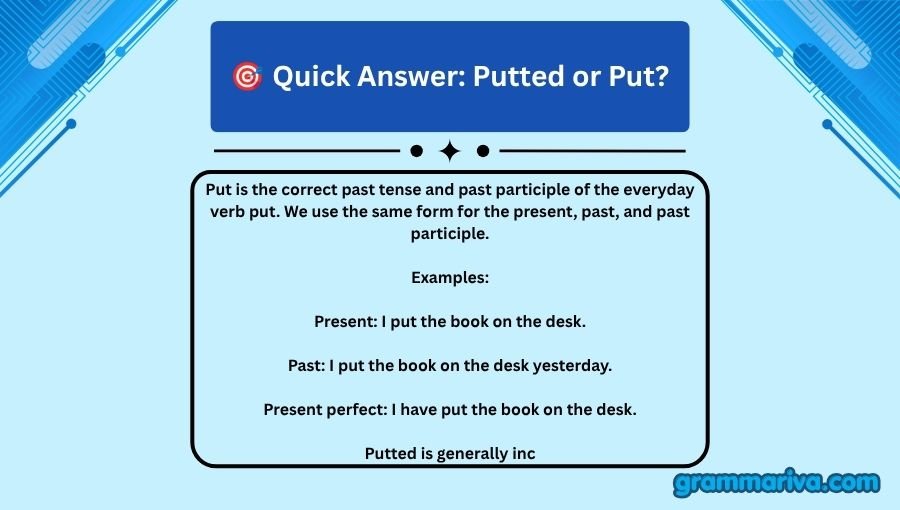
Put is the correct past tense and past participle of the everyday verb put. We use the same form for the present, past, and past participle.
Examples:
- Present: I put the book on the desk.
- Past: I put the book on the desk yesterday.
- Present perfect: I have put the book on the desk.
Putted is generally incorrect when you mean the ordinary action of placing something somewhere. However, putted is a valid past-tense form of the golf verb putt.
Is Putted or Put the Correct Past Tense?
Put is the correct past tense of the common verb put. The spelling does not change when you move from present time to past time.
This makes put an irregular verb. Unlike regular verbs, it does not form its past tense by simply adding -ed.
Compare these examples:
| Form | Type | Example |
|---|---|---|
| put | Base verb | I put my phone here. |
| put | Simple past | I put my phone here yesterday. |
| put | Past participle | I have put my phone here before. |
| putting | Present participle | I am putting my phone away. |
| puts | Third-person singular | She puts her phone on the table. |
| putted | Past tense of putt | He putted the ball into the hole. |
The key point is that putted belongs to putt, not normally to put.
What Is the Difference Between Put and Putted?
The main difference is the verb you are using.
Put means to place something somewhere. Putted is the past tense of putt, a golf term meaning to hit a golf ball gently, usually on or near the green.
| Form | Type | Meaning | Example | Correct/Incorrect |
|---|---|---|---|---|
| put | Verb | Place something somewhere | She put the keys on the table. | ✅ Correct |
| put | Past tense | Placed something somewhere | She put the keys there yesterday. | ✅ Correct |
| putted | Verb form of putt | Hit a golf ball with a putter | He putted the ball into the hole. | ✅ Correct |
| putted | Past tense of put | Placed something somewhere | She putted the keys on the table. | ❌ Incorrect |
| putting | Present participle of put | Placing something | She is putting the keys away. | ✅ Correct |
So, if you are talking about placing, use put.
If you are talking about golf, putted may be correct because the base verb is putt.
Why Does Put Stay the Same in the Past Tense?
The word put belongs to a group of irregular verbs whose forms do not change in the simple past.
Many English verbs change when they become past tense:
- walk → walked
- jump → jumped
- clean → cleaned
- call → called
But some verbs keep the same form:
- put → put
- cut → cut
- hit → hit
- hurt → hurt
- shut → shut
This means you should not automatically add -ed to put.
The Basic Rule
When put means to place something somewhere, use put for the simple past.
For example:
Present: I put my wallet on the desk.
Past: I put my wallet on the desk yesterday.
The sentence looks almost identical. The time word tells us that the action happened in the past.
📝 Putted or Put in Everyday English
In everyday English, put is the form you need when talking about placing something.
Here are some natural examples:
- I put the groceries in the kitchen. ✅
- She put her bag beside the chair. ✅
- We put the chairs outside. ✅
- He put the letter in an envelope. ✅
- They put the boxes in the garage. ✅
Now compare them with incorrect uses:
- I putted the groceries in the kitchen. ❌
- She putted her bag beside the chair. ❌
- We putted the chairs outside. ❌
- He putted the letter in an envelope. ❌
- They putted the boxes in the garage. ❌
The reason is simple: the everyday verb is put, and its past form is also put.
Can You Say “I Putted It There”?
No, not if you mean “I placed it there.”
The natural sentence is:
I put it there. ✅
The sentence “I putted it there” is incorrect in standard English when put means place. ❌
This mistake often happens because English learners know that many past-tense verbs take -ed. They may apply that rule to every verb.
I once edited a short school paragraph in which a student wrote, “I putted my homework on the teacher’s desk.” The student understood the meaning perfectly. The only problem was the verb form. I changed it to “I put my homework on the teacher’s desk,” and the sentence was fixed immediately.
A Simple Test Tip 💡
Ask yourself:
Am I talking about placing something, or am I talking about golf?
- Placing something → put
- Golf → putted
This quick question can help you avoid the mistake.
What Does Put Mean in Different Sentences?
The verb put has several uses, but the same basic past form remains put.
Put Means “Place”
This is the most common use.
I put the keys on the counter. ✅
Here, put means placed.
Put Means “Move Something Into a Position”
She put the chair near the window. ✅
Again, the past form stays put.
Put Means “Write or Enter Something”
He put his name on the form. ✅
You would not normally say putted his name.
Put Means “Express Something”
She put her feelings into words. ✅
The verb remains put.
| Meaning | Word Type | Example Sentence |
|---|---|---|
| Place | Verb | I put the cup on the table. |
| Move into position | Verb | He put the chair beside the door. |
| Write or enter | Verb | She put her address on the form. |
| Express | Verb | He put his thoughts into words. |
Is Putted Ever Correct?
Yes. Putted can be correct when it is the past tense of the golf verb putt.
A golfer uses a putter to make a short, controlled shot. The verb is putt.
For example:
Maria putted the ball into the hole. ✅
Here, putted is correct because the base verb is putt.
The difference is one letter, but the verbs have different meanings.
| Base Verb | Past Form | Meaning | Example |
|---|---|---|---|
| put | put | Place something | I put the book away. |
| putt | putted | Hit a golf ball gently | He putted the ball. |
| put | put | Place something | She put the cup down. |
| putt | putted | Make a golf putt | She putted from six feet away. |
This is the important exception to remember.
🏌️ Putted: The Golf Meaning
The word putted is perfectly normal in golf writing.
You may see sentences such as:
- He putted for the win. ✅
- She putted the ball toward the hole. ✅
- The player putted from ten feet away. ✅
- I putted twice on the final green. ✅
In each sentence, putted comes from putt, not put.
This distinction is especially useful because put and putt look and sound closely related. However, they are separate verbs.
If your sentence is about a golf ball, a golf green, a putter, or a golf shot, putted may be exactly what you need.
Why Do People Confuse Putted and Put?
People often confuse these forms because -ed is one of the most common ways to make English past tense.
For regular verbs:
- talk → talked
- open → opened
- wash → washed
- watch → watched
So learners may naturally assume:
put → putted
But English has many irregular verbs, and put is one of them.
Another reason is the existence of putt → putted. People may see or hear putted in golf-related writing and assume it is also the past tense of put.
A third reason is fast typing. When people write quickly, they often follow a familiar pattern instead of stopping to check the exact verb.
Key Differences Between Putted and Put
The difference can be summarized in one simple idea:
Put = place.
Putted = played a golf shot.
| Feature | Put | Putted |
|---|---|---|
| Base verb | put | putt |
| Main meaning | Place | Hit a golf ball |
| Common everyday use | Yes | No |
| Past tense of put | Yes | No |
| Past tense of putt | No | Yes |
| Example | I put the phone away. | He putted the ball. |
If you remember the meaning of the base verb, the correct choice becomes much easier.
How To Use Put in the Present, Past, and Perfect Tenses
One reason put can feel strange is that several forms look exactly alike.
Simple Present
I put my shoes by the door.
Simple Past
I put my shoes by the door yesterday.
Present Perfect
I have put my shoes by the door.
Past Perfect
I had put my shoes by the door before you arrived.
The verb itself stays put in all these forms.
The helping verb and the context show the tense.
| Tense | Example |
|---|---|
| Simple present | I put the book here. |
| Simple past | I put the book here yesterday. |
| Present perfect | I have put the book here. |
| Past perfect | I had put the book here. |
| Future | I will put the book here. |
| Present continuous | I am putting the book here. |
Notice that putting is different. It is the -ing form, not a past-tense form.
📝 Case Study: A Workplace Email
Imagine that an employee is writing an email to a manager.
The employee wants to explain that some documents were placed on the manager’s desk.
Incorrect:
I putted the documents on your desk this morning. ❌
Correct:
I put the documents on your desk this morning. ✅
The corrected version is short and natural.
Now imagine a golf-related email:
I putted the final ball into the hole on the last attempt. ✅
That sentence is correct because the writer is describing golf.
The context changes the answer.
Grammar Rules Explanation
The standard grammar rule is straightforward: put is an irregular verb whose simple past and past participle have the same form as its base form.
When put means “place,” its forms include put, put, and put. The form putted does not normally belong to this verb.
The verb putt, however, is different. Its past tense is putted.
The easiest way to understand the difference is to identify the base verb before changing the tense.
If the base verb is:
put → put
If the base verb is:
putt → putted
That one extra t in putt changes the verb.
Most standard English reference sources follow this distinction, and it is also the form used in normal edited English.
Correct vs Incorrect at a Glance
| Sentence | Correct/Incorrect | Why |
|---|---|---|
| I put the keys on the desk. | ✅ Correct | Put means placed. |
| I putted the keys on the desk. | ❌ Incorrect | Putted is not the normal past form of put. |
| She put the groceries away. | ✅ Correct | Put stays unchanged. |
| He putted the golf ball. | ✅ Correct | Putted is the past form of putt. |
| We putted the chairs outside. | ❌ Incorrect | The meaning is placement, so use put. |
⚠️ Common Mistakes With Putted and Put
The most common mistake is adding -ed to put.
People may think:
put + ed = putted
But English does not always work that way.
Why These Mistakes Happen
Fast typing: People often type what feels natural without checking the verb.
Autocorrect: A phone or browser may not always catch a grammatically wrong word if it is also a real English word.
Lack of knowledge: Learners may not yet know which verbs are irregular.
Pattern matching: Writers may remember rules such as “past tense takes -ed” and apply them too broadly.
| Similar Confusion | Common Mistake | Correct Form |
|---|---|---|
| it’s / its | its raining | it’s raining |
| your / you’re | your very kind | you’re very kind |
| their / there / they’re | their going home | they’re going home |
| then / than | better then me | better than me |
| put / putted | I putted it there | I put it there |
The lesson is the same: do not rely only on what looks familiar.
Common Wrong Forms for This Specific Topic
| Wrong Form or Use | What’s Wrong | Correct Form |
|---|---|---|
| I putted it there. | Putted is not the past of everyday put. | I put it there. |
| She putted the bag away. | The meaning is “placed.” | She put the bag away. |
| We putted the boxes inside. | Put is the required verb. | We put the boxes inside. |
| He putted his phone down. | The action is placement. | He put his phone down. |
| They putted the books on the shelf. | Putted would suggest golf. | They put the books on the shelf. |
| I have putted the documents there. | The past participle of put is put. | I have put the documents there. |
Is Put an Irregular Verb?
Yes. Put is an irregular verb because its past-tense form does not follow the usual -ed pattern.
For regular verbs, the past often adds -ed:
clean → cleaned
But put does not change:
put → put
This is not unusual in English. Other common verbs also keep the same form in the simple past.
| Base Verb | Past Tense | Example |
|---|---|---|
| put | put | I put it here yesterday. |
| cut | cut | She cut the paper. |
| hit | hit | He hit the ball. |
| hurt | hurt | I hurt my knee. |
| shut | shut | She shut the door. |
Learning these verbs as individual patterns is often easier than trying to force them into a regular rule.
Usage in Different Contexts
The correct choice depends heavily on context.
| Context | Which Term to Use | Example |
|---|---|---|
| Everyday conversation | put | I put my keys here. |
| Professional writing | put | I put the documents on your desk. |
| Creative writing | put | She put the letter in the drawer. |
| Social media/texting | put | I put it in my bag. |
| Golf | putted | He putted the ball into the hole. |
In all normal placement situations, put is the safe and correct choice.
In golf, putted can be correct because it comes from putt.
How To Remember the Difference
I recommend using a very short memory trick:
Put means place. Putt means golf.
Then remember:
Put → put
Putt → putted
You can also connect the extra t in putt with the golf club action.
Try these mental pairs:
- Put the book away. 📚
- Putt the ball toward the hole. 🏌️
The meanings are completely different.
Another Easy Test
Replace the verb with placed.
If the sentence still makes sense, use put.
I put the bag on the chair.
Replace put with placed:
I placed the bag on the chair.
That works.
So:
I put the bag on the chair. ✅
But:
I putted the bag on the chair. ❌
The substitution test is quick and useful.
Common Phrases With Put
Because put is such a common verb, it appears in many everyday phrases.
| Phrase | Meaning |
|---|---|
| put away | Place something where it belongs |
| put down | Place something on a surface |
| put on | Place clothing on your body |
| put off | Delay something |
| put up with | Tolerate something |
| put together | Assemble or combine things |
Examples:
- Please put away your shoes.
- I put down my phone.
- She put on her jacket.
- We put off the meeting.
- He cannot put up with the noise.
- They put together a new plan.
These expressions keep the basic verb put. You should not change it to putted simply because the action happened in the past.
Can Put Be Used After Have, Has, or Had?
Yes. The past participle of put is also put.
For example:
I have put the files on the desk. ✅
She has put the dishes away. ✅
They had put everything in the car. ✅
Do not say:
I have putted the files on the desk. ❌
This is another place where the unchanged form can feel unusual.
| Structure | Correct Example |
|---|---|
| have + put | I have put the keys away. |
| has + put | She has put the keys away. |
| had + put | He had put the keys away. |
| will + put | We will put the keys away. |
Why Getting Putted or Put Right Matters
Using the correct verb form makes your writing easier to understand and more professional.
A single incorrect word may not prevent someone from understanding you. Still, repeated grammar mistakes can make a message look careless.
| Situation | Why Getting It Right Matters |
|---|---|
| Resume | Shows attention to language |
| Client email | Creates a professional impression |
| Published content | Improves trust and readability |
| Social post | Makes the message cleaner |
A useful rule I give writers is:
Clear writing starts with choosing the right word for the action.
I once caught myself typing “putted” in a quick note about moving some files. I was typing fast and had just seen several golf-related examples earlier that day. I changed it to “put,” and the sentence immediately looked right again.
Putted or Put in Professional Writing
In professional writing, put is almost always the correct choice when you mean “place.”
For example:
I put the signed contract in the shared folder. ✅
We put the updated files in the project directory. ✅
She put the documents on the manager’s desk. ✅
Avoid:
I putted the signed contract in the shared folder. ❌
Professional writing benefits from simple, standard language. There is no advantage to using putted when the intended meaning is simply placed.
Putted or Put in Creative Writing
Creative writers also normally use put for placement.
He put the old photograph back in the drawer. ✅
She put her hand on the window. ✅
I put the letter beneath the book. ✅
The past tense does not require a spelling change.
However, a creative story about golf could naturally use putted:
On the final green, Daniel putted carefully and watched the ball disappear into the hole. ✅
The subject and context tell the reader which verb is intended.
Putted or Put in Social Media and Texting
Informal writing does not change the basic grammar rule.
You might see:
I put it in the fridge 😂
That is correct.
You may also see people type:
I putted it there.
That does not become correct simply because the message is informal.
Texting often contains shortcuts, missing punctuation, or spelling mistakes. But if you want standard English, put remains the correct form.
Are There Any Special Exceptions?
The main special case is golf.
The verb putt means to make a particular kind of golf shot, and its past tense is putted.
For example:
The golfer putted from close range. ✅
This is not an exception to the past tense of put. It is a different verb.
That distinction is worth stressing because it explains why putted exists in English at all.
Quick Recap Checklist
Use this checklist whenever you are unsure.
| Question | If Yes → Use |
|---|---|
| Do you mean “placed”? | put |
| Are you describing something that happened in the past? | put |
| Are you using “have,” “has,” or “had”? | put |
| Are you talking about a golf shot? | putted |
| Is the base verb putt? | putted |
| Is the base verb put? | put |
Practice Examples
- Yesterday, I ___ the keys on the table.
Answer: put ✅ - The golfer ___ the ball into the hole.
Answer: putted ✅ - She ___ the books back on the shelf.
Answer: put ✅
These examples show the whole rule in action.
What Is the Difference Between Put and Putted in One Sentence?
The difference is simple: put is the past form of the everyday verb put, while putted is the past form of the golf verb putt.
If you mean placed, choose put.
If you mean hit a golf ball with a putter, choose putted.
FAQs About Putted vs Put
Is “putted” the past tense of “put”?
No. Put is the past tense of the everyday verb put. Putted is the past tense of the separate verb putt, which is mainly used for a golf shot.
Is “I putted it there” correct?
No, not if you mean “I placed it there.” The correct sentence is “I put it there.”
Can “putted” ever be correct?
Yes. Putted is correct when it comes from the verb putt, especially when talking about golf.
What is the past tense of “put”?
The past tense of put is put.
Example:
I put the book on the desk yesterday.
What is the past participle of “put”?
The past participle is also put.
Example:
I have put the book on the desk.
Why is “put” not “putted”?
Put is an irregular verb. Its base form, simple past form, and past participle are all put.
Is “putting” the past tense of “put”?
No. Putting is the -ing form of put. It is used in continuous structures and other situations.
Example:
She is putting the books away.
Should I use “put” in a professional email?
Yes. When you mean “placed,” put is the standard choice.
Example:
I put the requested files in the shared folder.
Is “he putted the ball” correct?
Yes, if you are talking about golf. The base verb is putt, so its past form is putted.
How can I remember put vs putted?
Remember this simple rule:
Put = place. Putted = golf.
Conclusion
Putted or put becomes easy once you identify the verb and its meaning. If you mean placed something somewhere, use put for the present, past, and past participle. The word does not change to putted.
For example:
I put the keys on the table.
I put the keys there yesterday.
I have put the keys away.
All three sentences use put correctly.
Use putted when the base verb is putt, especially when you are talking about golf:
The golfer putted the ball into the hole.
The best memory trick is short: put means place, while putt means golf. 🏌️
Once you learn that distinction, you will not need to guess. You can simply look at the meaning, identify the base verb, and choose the correct form. ✨
When in doubt, remember: put → put, but putt → putted.

Hi, I’m Lucas Bennett. I’m a grammar content specialist at Grammariva. I work on articles covering everyday grammar questions, sentence usage, and writing tips that readers can apply with confidence.
[…] By the end, you should be able to choose the right phrase without second-guessing yourself. ✍️ Putted or Put | Setup vs Set Up | Sow or […]
[…] writing. By the end, choosing between them should feel easy. 👍 Masters Student or MS Student | Putted or Put | Setup vs Set […]