Have you ever wondered about OK vs Okay and which form you should use? You are not alone. These two forms are everywhere in texts, emails, chats, and everyday speech. The tricky part is that they usually mean the same thing, but they can create different feelings depending on the situation. 😊
When I explain ok vs okay to students and writers, I usually start with one simple point: both forms are standard English. The choice is often about style, tone, and context rather than basic meaning. OK is short and common in digital communication. Okay often feels a little more natural in ordinary writing and can look more relaxed or complete.
In this guide, I will explain the difference between OK and okay, show you when to use each form, and cover common mistakes.
You will also see examples from workplace writing, casual conversations, texting, and creative writing. By the end, choosing between them should feel easy. 👍 Masters Student or MS Student | Putted or Put | Setup vs Set Up
🎯 Quick Answer: OK vs Okay
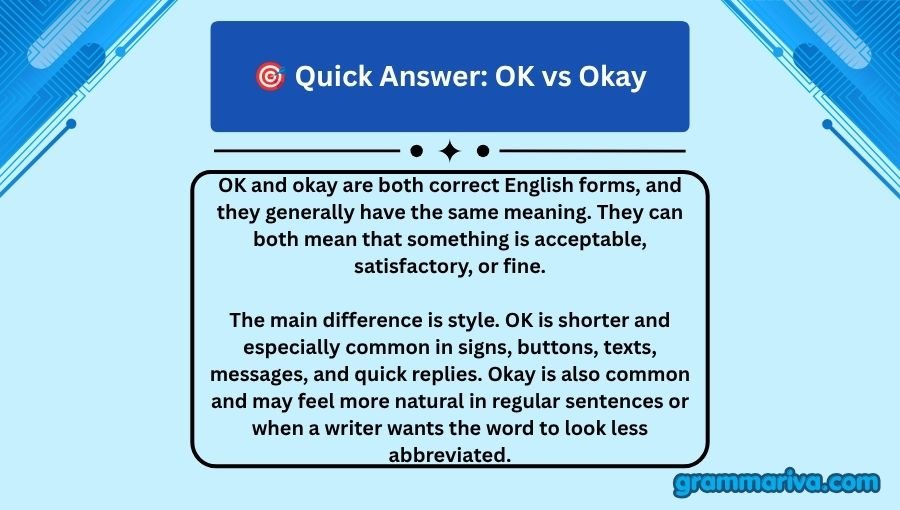
OK and okay are both correct English forms, and they generally have the same meaning. They can both mean that something is acceptable, satisfactory, or fine.
The main difference is style. OK is shorter and especially common in signs, buttons, texts, messages, and quick replies. Okay is also common and may feel more natural in regular sentences or when a writer wants the word to look less abbreviated.
| Form | Type | Meaning | Example | Correct/Incorrect |
|---|---|---|---|---|
| OK | Adjective, adverb, interjection, noun, or verb | Fine, acceptable, or agreed | “Everything is OK.” | ✅ Correct |
| Okay | Adjective, adverb, interjection, noun, or verb | Fine, acceptable, or agreed | “Everything is okay.” | ✅ Correct |
| O.K. | Older punctuation style | Same basic meaning | “Are you O.K.?” | ✅ Possible, but less common |
| Ok | Informal mixed-case form | Same basic meaning | “Ok, I understand.” | ✅ Common in informal writing |
The important point is that OK is not the “wrong” version of okay, and okay is not a correction of OK.
📚 Understanding the Basics of OK vs Okay
The core difference between OK and okay is not meaning. Both can express agreement, acceptance, health, or a satisfactory condition.
The choice usually depends on the writing situation.
| Form | Word Type | Meaning | Example | Correct/Incorrect |
|---|---|---|---|---|
| OK | Adjective | Satisfactory or fine | “The plan is OK.” | ✅ Correct |
| Okay | Adjective | Satisfactory or fine | “The plan is okay.” | ✅ Correct |
| OK | Interjection | Agreement or acknowledgment | “OK, let’s start.” | ✅ Correct |
| Okay | Interjection | Agreement or acknowledgment | “Okay, let’s start.” | ✅ Correct |
| OK | Adverb | In a satisfactory way | “She did OK on the test.” | ✅ Correct |
| Okay | Adverb | In a satisfactory way | “She did okay on the test.” | ✅ Correct |
Is OK the same as okay?
When comparing OK vs Okay, the main difference is usually style rather than meaning. Yes. In most everyday uses, OK and okay communicate the same basic idea.
For example:
“Are you OK?”
“Are you okay?”
Both ask whether someone is fine.
Likewise:
“OK, I understand.”
“Okay, I understand.”
Both show agreement or acknowledgment.
The difference is mainly one of presentation and tone.
When should you choose OK?
Choose OK when you want a short, direct form. It works especially well in:
- Text messages
- Buttons and menus
- Short instructions
- Quick workplace replies
- Signs
- Casual notes
- Informal online communication
When should you choose okay?
Choose okay when you want the full written form. It can look smoother in:
- Articles
- Essays
- Longer sentences
- Dialogue
- Friendly emails
- General prose
- Writing where you want fewer abbreviations
🔍 Is OK More Informal Than Okay?
Not necessarily. Both forms can be informal or neutral, but OK often feels shorter and more abrupt because it contains fewer letters.
For example:
“OK.”
This may feel very brief in a text message.
Compare it with:
“Okay, sounds good!”
The second version can feel warmer because the sentence contains more language.
| Message | Possible Feeling |
|---|---|
| “OK.” | Brief or neutral |
| “Okay.” | Neutral or slightly softer |
| “OK, thanks.” | Friendly and direct |
| “Okay, thanks!” | Friendly and warm |
| “OK!!!” | Excited or emphatic |
| “Okay…” | Hesitant or uncertain |
The punctuation often matters more than the spelling itself.
💬 Why Do People Confuse OK and Okay?
People confuse these forms because they perform the same basic job. There is no simple rule saying that one is correct and the other is wrong.
I once reviewed a short office message that said, “Okay, I will handle it.” The writer changed it to “OK, I will handle it” because they thought the longer form was grammatically wrong. It was not. Both versions were acceptable.
The confusion also comes from digital communication. People see OK, Ok, okay, and sometimes O.K. in different places. That can make the spelling seem inconsistent.
Another reason is tone. A person may feel that OK sounds colder while okay sounds friendlier. That can be true in certain messages, but it is not a fixed grammar rule.
Common reasons for the confusion
- Both forms have the same basic meaning.
- Different style guides may prefer different forms.
- Texting encourages short forms.
- Autocorrect can change capitalization.
- People may connect short words with informal writing.
- Punctuation can change the emotional tone.
✍️ OK vs Okay in Different Parts of Speech
Both OK and okay can work in several grammatical roles.
As an adjective
Both can describe something acceptable or satisfactory.
“The food is OK.” ✅
“The food is okay.” ✅
Here, the word describes the condition of the food.
As an interjection
Both can introduce agreement or acknowledgment.
“OK, let’s go.” ✅
“Okay, let’s go.” ✅
As an adverb
Both can describe an acceptable level of performance.
“I did OK on the exam.” ✅
“I did okay on the exam.” ✅
As a verb
In informal English, OK and okay can also be used as verbs meaning to approve something.
“The manager OK’d the request.” ✅
“The manager okayed the request.” ✅
The spelling and capitalization can vary depending on the style being used.
| Use | OK | Okay |
|---|---|---|
| Adjective | “The result is OK.” | “The result is okay.” |
| Interjection | “OK, let’s begin.” | “Okay, let’s begin.” |
| Adverb | “He did OK.” | “He did okay.” |
| Verb | “She OK’d it.” | “She okayed it.” |
💡 Test Tip: How to Choose Between OK and Okay
Here is my easiest test:
If you could replace the word with “fine,” both forms will usually work.
For example:
“The plan is OK.”
Replace OK with fine:
“The plan is fine.”
The meaning still works.
Try the same thing with okay:
“The plan is okay.”
Again:
“The plan is fine.”
So both are functioning correctly.
This test will not solve every style question, but it is useful when you are checking basic meaning.
| Sentence | Replacement | Result |
|---|---|---|
| “I am OK.” | “I am fine.” | ✅ Works |
| “I am okay.” | “I am fine.” | ✅ Works |
| “The movie was OK.” | “The movie was fine.” | ✅ Works |
| “The movie was okay.” | “The movie was fine.” | ✅ Works |
📝 Case Study: Choosing OK or Okay at Work
Imagine that a manager sends this message:
“Can you send me the revised file by 3 p.m.?”
An employee might reply:
“OK, I will send it by 3 p.m.” ✅
That is perfectly acceptable.
The employee could also write:
“Okay, I will send it by 3 p.m.” ✅
That is also correct.
In a formal business setting, however, I might choose a more complete response:
“Yes, I will send the revised file by 3 p.m.” ✅
Why? The issue is not that OK or okay is grammatically wrong. The issue is that a complete response can sound clearer and more professional.
| Workplace Reply | Grammar | Professional Effect |
|---|---|---|
| “OK.” | ✅ Correct | Very brief |
| “Okay.” | ✅ Correct | Brief and natural |
| “OK, I’ll handle it.” | ✅ Correct | Clear and direct |
| “Okay, I’ll send it shortly.” | ✅ Correct | Friendly and clear |
| “Yes, I’ll send it by 3 p.m.” | ✅ Correct | More precise |
📖 Grammar Rules Explanation
There is no general grammar rule that makes OK correct and okay incorrect. Both are established forms used in standard English.
The important rule is to match your word choice to the context and maintain consistency.
For formal writing, some editors prefer okay because it reads like a complete word rather than a short form. Other style systems and publications use OK regularly. Neither choice automatically creates a grammar error.
A standard reference such as Merriam-Webster treats these forms as recognized English usage, but writers should still consider the style expectations of their publication or workplace.
Correct vs Incorrect at a Glance
| Sentence | Correct/Incorrect | Why |
|---|---|---|
| “Everything is OK.” | ✅ Correct | OK can mean satisfactory. |
| “Everything is okay.” | ✅ Correct | Okay has the same basic meaning. |
| “Okay, I understand.” | ✅ Correct | Okay can show acknowledgment. |
| “OK, I understand.” | ✅ Correct | OK can also show acknowledgment. |
| “The project is ok.” | ⚠️ Style-dependent | Lowercase “ok” is common informally, but consistency matters. |
The key lesson is simple: do not treat OK vs okay as a normal right-versus-wrong spelling battle.
⚠️ Common Mistakes With OK and Okay
Mistakes often happen because people type quickly. They may also rely on autocorrect or copy the spelling they see in casual messages.
I once caught myself typing “ok” in a message that I was preparing for a client. The word itself was not grammatically wrong, but I changed it to “Okay” because the surrounding message was more polished. The change was about style, not grammar.
Similar Grammar Confusions
| Confusion | Correct Forms | Main Difference |
|---|---|---|
| it’s / its | Both correct | “It’s” = it is; “its” shows possession |
| your / you’re | Both correct | “Your” shows possession; “you’re” = you are |
| they’re / their / there | All correct | Different meanings and functions |
| then / than | Both correct | Time/order vs comparison |
| to / too / two | All correct | Different meanings |
| OK / okay | Both correct | Mainly style and form |
Specific Wrong Forms and Uses
| Wrong Form | What’s Wrong | Correct Form |
|---|---|---|
| “Okaay” | Extra letters are unnecessary in standard writing | “Okay” |
| “Okey” | Nonstandard spelling in ordinary English | “OK” or “okay” |
| “Okee” | Informal phonetic spelling | “OK” or “okay” |
| “Okie” | Not the normal spelling for this meaning | “OK” or “okay” |
| “O.K.K.” | Extra letter | “OK” or “okay” |
| “Okayyy” | Stretched spelling used for tone | “Okay” in standard writing |
Some stretched forms can be useful in casual texting. For example, “Okayyy!” can show excitement or disbelief. But that is a style choice, not standard spelling.
🕰️ Word Origin and History of OK and Okay
The history of OK is unusual and has been discussed for many years. The exact origin has been debated, so it is better not to present one theory as unquestionable fact.
The short form became established in English, while okay developed as a fuller spelling of the same expression. Over time, both became widely recognized.
The useful lesson for modern writers is not the exact historical debate. It is that OK and okay have developed into accepted forms with the same core meaning.
| Period | Form | General Note |
|---|---|---|
| Early English use | OK | Short written form becomes established |
| Later usage | OK | Used broadly in speech and writing |
| Modern English | OK | Common in digital and everyday communication |
| Modern English | okay | Full spelling widely used in general prose |
| Present-day usage | OK / okay | Both remain standard choices |
🌎 Usage in Different Contexts
The best choice can change depending on where you are writing.
Everyday Conversation
Both forms are natural.
“Are you okay?”
“Yeah, I’m OK.”
Professional Writing
Both can work, but a complete phrase may sometimes sound better.
“Okay, I’ll review the report.”
For a highly formal document, you might choose acceptable, approved, or another more precise word.
Creative Writing
Authors can use either spelling to reflect character voice.
“Okay,” she whispered.
A writer may use OK for a short, sharp response.
“OK. Let’s do it.”
Social Media and Texting
Both are extremely natural.
“OK, I’m coming 😂”
“Okayyy, I see what you mean!”
| Context | Which Term to Use | Example |
|---|---|---|
| Everyday conversation | OK or okay | “Are you okay?” |
| Professional writing | OK or okay, depending on style | “Okay, I’ll review it.” |
| Creative writing | Either | “OK,” he said. |
| Social media/texting | Either | “Okayyy 😂” |
📱 Does OK Sound Rude in Text Messages?
Understanding OK vs Okay in text messages can help you choose the right tone.
Sometimes OK can sound blunt in a text, but the word itself is not rude.
Tone depends on context, punctuation, relationship, and what came before the message.
Compare:
“OK.”
with:
“OK, thanks!”
The second feels warmer because it gives the reader more information.
Compare these too:
“Okay.”
“Okay! 😊”
“Okay…”
The punctuation and emoji can dramatically change the feeling.
| Message | Possible Interpretation |
|---|---|
| “OK.” | Neutral or brief |
| “Okay.” | Neutral |
| “OK, thanks!” | Friendly |
| “Okay! 😊” | Warm |
| “Okay…” | Hesitant or doubtful |
| “OK??” | Confused or frustrated |
So if someone says OK sounds rude, I would say that the context matters more than the spelling.
🔤 Capitalization: OK, Ok, or okay
Another common question about OK vs Okay is capitalization. Capitalization can create another point of confusion.
OK is widely used as an uppercase form.
okay is normally lowercase when it appears in the middle of a sentence.
Ok also appears often, especially in informal digital writing.
For example:
“OK, I understand.” ✅
“Okay, I understand.” ✅
“Ok, I understand.” ⚠️ Common informally
If you are writing professionally, choose the form your style guide or organization prefers and use it consistently.
| Form | Common Use | Recommendation |
|---|---|---|
| OK | General and digital writing | Safe choice |
| okay | General prose | Safe choice |
| Ok | Informal messages | Acceptable in casual settings |
| O.K. | Older style | Less common today |
🧠 How to Remember the Difference
The easiest way to remember OK vs Okay is to focus on context and style. The easiest way to remember OK vs okay is to stop thinking of them as different meanings.
Think:
OK = short form
okay = full spelling
That simple idea will help in most situations.
If you are sending a quick text, OK is fine.
If you are writing a sentence and prefer the full form, okay is fine.
If your workplace has a specific style preference, follow that preference.
| Question | Best Choice |
|---|---|
| Need a short reply? | OK |
| Writing ordinary prose? | OK or okay |
| Want the full spelling? | okay |
| Writing a text? | OK or okay |
| Following a house style? | Use its preferred form |
| Trying to avoid ambiguity? | Use a more precise word |
🗣️ Common Phrases With OK and Okay
Neither form has a large set of special idioms that require only one spelling. However, several common expressions use these words naturally.
| Phrase | Meaning |
|---|---|
| “Are you OK?” | Asking whether someone is fine |
| “It’s OK.” | Saying something is acceptable or forgiving |
| “OK, let’s go.” | Showing agreement before an action |
| “That’s okay.” | Saying something is acceptable |
| “Okay with me” | Expressing agreement |
| “All okay” | Saying everything is fine |
The spelling can often change without changing the meaning.
🔄 Synonyms and Alternatives
Sometimes OK or okay is not the best choice because another word can give a clearer message.
For example, if you mean that you formally approve something, approved may be stronger than okay.
| Alternative | Works When | Does Not Work When |
|---|---|---|
| Fine | You mean satisfactory | You need formal approval |
| Acceptable | You mean meeting a standard | You want a warm casual tone |
| Approved | You officially agree | You only mean “I understand” |
| Sure | You agree to a request | Something is being judged for quality |
| All right | You mean fine or acceptable | You need a very specific meaning |
For example:
“The proposal is approved.”
is more precise than:
“The proposal is okay.”
if the proposal has officially received approval.
❓ Is Okay Better Than OK in Formal Writing?
Neither form is automatically better in every formal setting. The best choice depends on the style rules of the document.
In polished writing, however, you may sometimes choose a more exact word instead of either form.
For example:
“The results are acceptable.”
is more precise than:
“The results are okay.”
Likewise:
“The request has been approved.”
is clearer than:
“The request is OK.”
The important lesson is to consider what you actually mean.
🏢 Should You Use OK or Okay in a Business Email?
Both can work in a business email, especially in internal communication. However, a complete and specific sentence often sounds more professional.
Compare:
“OK.”
with:
“Okay, I’ll review the document this afternoon.”
The second version gives the reader useful information.
For external clients, you might go one step further:
“Yes, I’ll review the document and send my feedback this afternoon.”
That response is clearer than either OK or okay by itself.
| Business Situation | Better Choice |
|---|---|
| Quick internal acknowledgment | OK / okay |
| Confirming an action | Complete sentence |
| Client communication | Specific response |
| Formal approval | “Approved” |
| Casual team chat | OK / okay |
⚠️ Why Context Matters More Than Spelling
A single word can carry different emotional meanings depending on the situation.
Consider:
“Okay, I understand.”
This sounds normal.
Now consider:
“Okay…”
That may suggest doubt.
Now:
“OK!!!”
That may show excitement.
So when deciding between OK and okay, do not focus only on spelling. Look at the entire sentence.
| Version | Possible Tone |
|---|---|
| OK | Brief |
| Okay | Natural |
| OK! | Positive |
| Okay! | Warm or enthusiastic |
| OK… | Uncertain |
| Okay… | Hesitant |
🎯 Key Differences Between OK and Okay
The biggest difference is form and style, not meaning.
OK is compact and especially useful when space is limited or the message is quick.
Okay is a fuller spelling that fits naturally into ordinary prose.
Neither one should be treated as a universal replacement for more precise words such as approved, acceptable, fine, or agreed.
| Feature | OK | Okay |
|---|---|---|
| Basic meaning | Fine/acceptable | Fine/acceptable |
| Standard English | Yes | Yes |
| Casual use | Very common | Very common |
| Texting | Very common | Very common |
| Formal prose | Possible | Possible |
| Can show agreement | Yes | Yes |
| Can describe condition | Yes | Yes |
| Can be a verb | Yes | Yes |
🚫 Common Errors to Avoid
Here are some practical errors I recommend watching for.
1. Treating okay as a correction of OK
“OK is wrong. It should always be okay.” ❌
That is not correct.
Both forms are established English.
2. Treating OK as the only correct form
“Okay is incorrect.” ❌
That is also wrong.
Okay is a standard form.
3. Using stretched spellings in formal writing
“Okayyyy, I will check it.” ❌
The stretched spelling can be playful in texting, but it does not belong in polished professional writing.
4. Using vague wording when precision is needed
“The request is okay.” ⚠️
If the request has received official approval, this is better:
“The request has been approved.” ✅
📊 OK vs Okay in Real-Life Situations
These examples show how OK vs Okay works in real-life communication.
| Situation | Recommended Example |
|---|---|
| Friend asks if you are fine | “I’m okay.” |
| Quick text reply | “OK.” |
| Team chat | “OK, I’ll do it.” |
| Formal report | “The results are acceptable.” |
| Client approval | “The proposal has been approved.” |
| Character dialogue | “Okay, let’s go.” |
| Social media | “OK, that was funny 😂” |
| Short interface button | “OK” |
🧩 Does Punctuation Change the Meaning?
Punctuation does not normally change the dictionary meaning of OK or okay, but it can change how readers understand the tone.
A period can make a one-word reply feel final.
An exclamation mark can make it enthusiastic.
An ellipsis can make it sound uncertain.
| Example | Likely Tone |
|---|---|
| “OK.” | Short or final |
| “OK!” | Enthusiastic |
| “OK?” | Questioning |
| “Okay…” | Hesitant |
| “Okay!” | Positive |
| “Okay?” | Checking or seeking agreement |
This is especially important in texting because readers cannot hear your voice.
📝 A Simple Editing Rule for Writers
When I edit a document, I use a practical rule:
Choose the form that matches the document’s style, then stay consistent.
If a company prefers OK, use OK.
If its style uses okay, use okay.
If neither style is required, choose whichever looks natural in the sentence.
Do not waste time changing every OK to okay just because one version looks more formal to you. First ask whether the word itself is correct. In most cases, it is.
📋 Quick Recap Checklist
Use this checklist whenever you are unsure.
| Question | If Yes → Use |
|---|---|
| Do you need a short, quick form? | OK |
| Do you prefer the full spelling? | okay |
| Are you writing a casual message? | Either |
| Are you writing normal prose? | Either |
| Does your company have a style guide? | Follow the style guide |
| Do you mean official approval? | Consider “approved” |
| Do you mean meeting a standard? | Consider “acceptable” |
Practice Examples
- “Are you OK?” ✅
- “Are you okay?” ✅
- “Okay, I’ll call you later.” ✅
- “OK, I’ll call you later.” ✅
- “The report has been approved.” ✅
The first four are correct because OK and okay can serve the same basic purpose. The fifth is better when you specifically mean formal approval.
🔎 Is OK the Same as Okay in American English?
Yes. In American English, OK and okay are both commonly understood as meaning fine, acceptable, or agreed.
The main difference is usually style, length, and context rather than meaning.
OK is especially convenient for short replies and digital communication. Okay often looks more natural in continuous prose.
💬 Should I Write OK or Okay in a Text?
Either is correct. OK is shorter and can work well for a quick acknowledgment. Okay can feel slightly fuller or warmer, but punctuation and context often matter more.
For example:
“OK, see you soon!”
and
“Okay, see you soon!”
Both are natural.
✍️ Which Is Better for Formal Writing, OK or Okay?
Both can be acceptable, but the best choice depends on the style guide you are following.
If the document is highly formal, consider whether a more precise word would communicate your meaning better.
Instead of:
“The plan is okay.”
you might write:
“The plan is acceptable.”
That gives the reader a clearer idea of what you mean.
📱 Is OK Too Informal for Professional Messages?
No. OK is not automatically too informal for professional communication. It is widely used in workplace messages.
Still, a one-word “OK.” can sometimes sound abrupt.
A fuller response is often better:
“OK, I’ll take care of that.”
This makes your meaning clear and reduces the chance of sounding dismissive.
🧠 Can Okay Be Used as a Verb?
Yes. Okay can be used as a verb meaning to approve something.
For example:
“The supervisor okayed the request.” ✅
You may also see:
“The supervisor OK’d the request.” ✅
The exact spelling of the verb form can vary by style, so consistency is useful.
🔤 Is “Ok” Correct or Should It Be “OK”?
OK is a widely accepted form, while Ok is also common in informal digital writing.
If you want a clean, consistent standard form, OK is a strong choice.
For example:
“OK, I understand.” ✅
In a casual text, however:
“Ok, got it.”
is also commonly seen.
❓ FAQs About OK vs Okay
Is OK or okay correct?
Both OK and okay are correct. They normally have the same basic meaning and can often be substituted for each other.
Is OK more informal than okay?
Not automatically. OK is shorter and may feel more abrupt in some messages, while okay can feel fuller. Context and punctuation strongly affect tone.
Is okay more professional than OK?
Not always. Both can appear in professional writing. The style guide, audience, and sentence matter more than the spelling alone.
Can I use OK in a formal email?
Yes. OK can be used in professional emails, especially for quick internal communication. For clients or formal situations, a complete and specific sentence may be a better choice.
Can I use okay instead of OK?
Yes. Okay is a standard form and can replace OK in most ordinary uses.
Does OK mean the same thing as okay?
Yes. In most common uses, they mean the same thing: fine, acceptable, satisfactory, or agreed.
Is “Ok” grammatically correct?
Ok is common in informal digital writing.The choice between OK vs Okay usually depends on tone and writing style. For consistent standard presentation, OK or okay is usually a better choice.
Is “Okey” the correct spelling?
No. Okey is not the standard spelling for the ordinary English word. Use OK or okay instead.
Which is better in texting, OK or okay?
Both are fine. OK is shorter, while okay can feel slightly fuller. Choose based on the tone you want.
Should I use OK or okay in an essay?
Either can be correct, but okay may fit more naturally into continuous prose. In a formal essay, consider whether a more precise word such as acceptable or satisfactory would be better.
🎯 Final Takeaway: OK vs Okay
When deciding between OK vs Okay in formal writing, always consider your audience and the style of the document.
OK vs okay is not a simple case of one spelling being correct and the other being wrong. Both forms are accepted in English, and both usually mean fine, acceptable, satisfactory, or agreed.
Use OK when you want a short and familiar form. It works especially well in quick replies, digital communication, labels, and everyday messages. Use okay when you prefer the fuller spelling or want it to flow naturally in ordinary prose.
The biggest lesson is to think about context and tone, not just spelling. A one-word “OK.” may feel abrupt, while “Okay, thanks!” can feel warm. But those differences come mostly from the surrounding message and punctuation.
When precision matters, consider replacing either word with something more exact. Approved, acceptable, satisfactory, and agreed can communicate more than a simple “OK” or “okay.”
So, when someone asks you which one is right, the answer is easy: both are right. Choose the form that fits your audience, your style, and your meaning. ✨
When in doubt, remember: OK is short, okay is full, and both are perfectly okay.

Hi, I’m Nathan Reed. I’m a grammar and writing specialist at Grammariva. I work on practical grammar content that helps readers understand sentence structure, punctuation, vocabulary, and better writing habits.
[…] writing. By the end, you should be able to choose the right word quickly and confidently. ✍️ OK vs Okay | Masters Student or MS Student | Putted or […]
[…] By the end, you should be able to choose the correct form with confidence. Further or Furthermore | OK vs Okay | Masters Student or MS […]