Choosing between is vs are seems easy until a sentence gets longer. You may know that “he is” sounds right and “they are” sounds right, yet phrases with and, or, there, and tricky subjects can make the choice confusing.
The good news is that the basic rule is simple: is usually goes with a singular subject, while are usually goes with a plural subject. Once you learn how to find the real subject of a sentence, the choice becomes much easier. 😊
I teach grammar by looking at the structure of a sentence instead of relying only on what “sounds right.” That method is especially useful when extra words come between the subject and the verb.
This guide explains is vs are with clear rules, examples, tables, common mistakes, practical situations, and quick tests. By the end, you should be able to choose the correct form with confidence. Further or Furthermore | OK vs Okay | Masters Student or MS Student
🎯 Quick Answer: Is vs Are
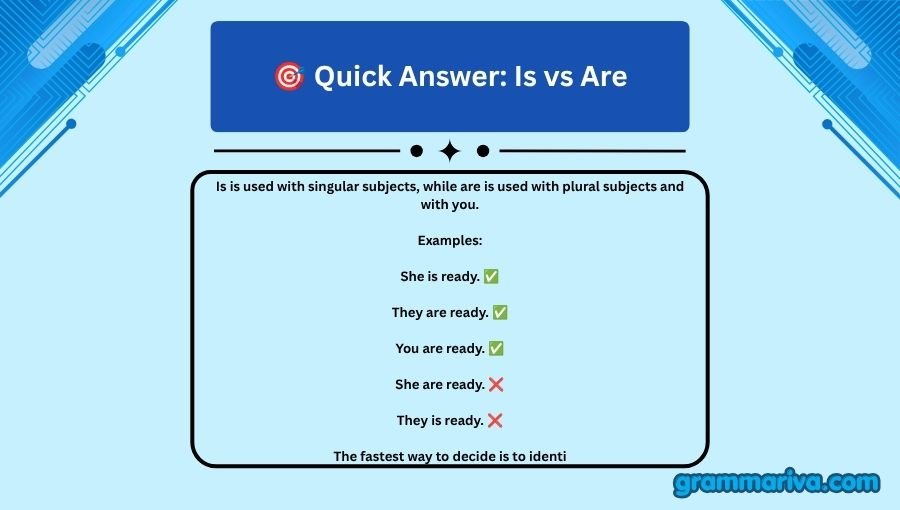
Is is used with singular subjects, while are is used with plural subjects and with you.
Examples:
- She is ready. ✅
- They are ready. ✅
- You are ready. ✅
- She are ready. ❌
- They is ready. ❌
The fastest way to decide is to identify the subject first. If the subject is singular, use is in the present tense. If it is plural, use are.
Is vs Are: The Basic Difference
The main difference between is and are is subject-verb agreement. The verb must match the subject in number.
Is is the present-tense form of be used mainly with singular third-person subjects. Are is used with plural subjects and with the pronouns you and we.
| Form | Type | Meaning | Example | Correct/Incorrect |
|---|---|---|---|---|
| is | Present form of be | Used with a singular subject | The dog is hungry. | ✅ Correct |
| are | Present form of be | Used with a plural subject | The dogs are hungry. | ✅ Correct |
| is | Present form of be | Used with a plural subject | The dogs is hungry. | ❌ Incorrect |
| are | Present form of be | Used with a singular subject | The dog are hungry. | ❌ Incorrect |
| are | Present form of be | Used with you | You are helpful. | ✅ Correct |
Singular subjects usually take “is”
A singular subject refers to one person, place, thing, or idea.
- The teacher is here. ✅
- My brother is tired. ✅
- The computer is slow. ✅
- This book is useful. ✅
Plural subjects usually take “are”
A plural subject refers to more than one person, place, thing, or idea.
- The teachers are here. ✅
- My brothers are tired. ✅
- The computers are slow. ✅
- These books are useful. ✅
The key word is subject. Do not let another noun later in the sentence distract you.
Why Do People Confuse Is and Are?
People often confuse these forms because English sentences can contain extra words between the subject and the verb.
Consider this sentence:
The box of old photographs is under the bed.
The word photographs is plural, but it is not the subject. The subject is box, which is singular.
I once edited a student’s essay in which nearly every long sentence had this problem. The student was matching the verb with the nearest noun instead of the actual subject. Once we circled the subject in each sentence, the errors almost disappeared.
This is one of the most useful grammar habits you can develop: find the subject before choosing the verb.
Watch out for phrases beginning with “of”
Words such as of, with, along with, and together with can place extra nouns near the verb.
- The group of students is ready. ✅
- The group of students are ready. ❌
The subject is group, not students.
Another example:
- The list of names is on my desk. ✅
- The list of names are on my desk. ❌
The subject is list.
A simple subject test
Remove the extra phrase:
The group of students is ready.
Remove “of students”:
The group is ready.
Now the correct verb is much easier to see.
Is “Is” Always Singular?
In standard present-tense grammar, is normally agrees with a singular third-person subject. It can also appear in certain special structures where the grammatical subject is not immediately obvious.
Examples:
- He is happy. ✅
- She is working. ✅
- The car is outside. ✅
- The answer is simple. ✅
However, is does not normally go with plural subjects.
- They is ready. ❌
- The students is waiting. ❌
- These shoes is new. ❌
The exception worth remembering is that “is” can occur after a singular subject even when a plural noun appears nearby.
For example:
The box of toys is heavy.
The plural noun toys does not control the verb.
Is “Are” Always Plural?
No. Are is strongly associated with plural subjects, but it also follows you, whether you refers to one person or several people.
Examples:
- You are my friend. ✅
- You are my friends. ✅
- We are ready. ✅
- They are outside. ✅
This is why it would be incorrect to say that are means “more than one” in every sentence.
Compare:
| Subject | Correct Verb | Example |
|---|---|---|
| I | am | I am ready. |
| He | is | He is ready. |
| She | is | She is ready. |
| It | is | It is ready. |
| You | are | You are ready. |
| We | are | We are ready. |
| They | are | They are ready. |
This small chart is worth memorizing because it covers the most common present-tense forms of be.
How Do You Choose Between Is and Are With Nouns?
Look at whether the noun is singular or plural.
A singular noun takes is:
- The student is studying. ✅
- The house is beautiful. ✅
- The problem is serious. ✅
A plural noun takes are:
- The students are studying. ✅
- The houses are beautiful. ✅
- The problems are serious. ✅
Singular and plural nouns
| Subject | Number | Correct Form | Example |
|---|---|---|---|
| cat | Singular | is | The cat is asleep. |
| cats | Plural | are | The cats are asleep. |
| child | Singular | is | The child is happy. |
| children | Plural | are | The children are happy. |
| idea | Singular | is | The idea is interesting. |
| ideas | Plural | are | The ideas are interesting. |
Do not assume that every noun ending in s is plural. Some singular nouns end in s, such as news.
- The news is surprising. ✅
- The news are surprising. ❌
Is vs Are With Compound Subjects
When two subjects are joined by and, the subject is normally plural, so use are.
- Tom and Sarah are friends. ✅
- The dog and cat are outside. ✅
- Coffee and tea are available. ✅
The two subjects together create a plural subject.
Compare:
- Tom is here. ✅
- Sarah is here. ✅
- Tom and Sarah are here. ✅
What happens with “and”?
| Sentence | Subject | Verb | Result |
|---|---|---|---|
| The boy is ready. | boy | is | ✅ |
| The girl is ready. | girl | is | ✅ |
| The boy and girl are ready. | boy and girl | are | ✅ |
| The boy and girl is ready. | boy and girl | is | ❌ |
A useful exception
Sometimes two words joined by and describe one person, thing, or combined idea.
For example:
Peanut butter and jelly is my favorite sandwich combination.
Here, the phrase can be treated as one combined item or concept. Context matters.
Is vs Are With “Or” and “Nor”
Subjects joined by or or nor require more care.
When the subjects are singular, is is normally used:
Either the manager or the assistant is available.
When both subjects are plural, are is appropriate:
Either the managers or the assistants are available.
When one subject is singular and the other is plural, the verb often follows the subject closer to it.
- Either the teacher or the students are responsible. ✅
- Either the students or the teacher is responsible. ✅
This structure can sound awkward, so writers sometimes rewrite it:
The teacher or the students must take responsibility.
Rewriting is often the clearest choice.
Are There Cases Where “Is” Appears Near a Plural Noun?
Yes. This is one of the most common traps.
Consider:
The collection of paintings is valuable.
The noun paintings is plural, but collection is singular.
Now compare:
The paintings are valuable.
The actual subject is now paintings, so the verb changes.
| Sentence | Real Subject | Correct Verb |
|---|---|---|
| The collection of paintings ___ valuable. | collection | is |
| The paintings ___ valuable. | paintings | are |
| The group of workers ___ ready. | group | is |
| The workers ___ ready. | workers | are |
| The set of keys ___ missing. | set | is |
| The keys ___ missing. | keys | are |
💡 Test Tip
When you see a sentence with of + noun, temporarily cross out the phrase beginning with of.
If the sentence still makes sense, you can usually identify the true subject more easily.
Is vs Are With There and Here
Sentences beginning with there can make subject-verb agreement harder because the subject comes after the verb.
For example:
There is a problem.
The subject is problem, which is singular.
But:
There are several problems.
The subject is problems, which is plural.
| Sentence | Subject | Correct Form |
|---|---|---|
| There is a reason. | reason | is |
| There are two reasons. | reasons | are |
| There is one student outside. | student | is |
| There are three students outside. | students | are |
| There is a mistake here. | mistake | is |
| There are several mistakes here. | mistakes | are |
A common mistake is choosing the verb based on there. But there is not the subject in these sentences.
Is vs Are in Questions
The same agreement rule applies when you ask a question.
Use is with a singular subject:
- Is the store open? ✅
- Is your brother home? ✅
- Is the answer correct? ✅
Use are with plural subjects and you:
- Are the stores open? ✅
- Are your brothers home? ✅
- Are the answers correct? ✅
- Are you ready? ✅
The word order changes in a question, but the agreement rule does not.
Is vs Are With Adjectives
Both forms can connect a subject to an adjective.
The choice depends on the subject.
- The room is clean. ✅
- The rooms are clean. ✅
- The child is quiet. ✅
- The children are quiet. ✅
The adjective does not control the verb.
For example:
The students are tired.
The word tired does not determine the verb. Students does.
Is vs Are With Present Continuous Verbs
Both forms are also used to build the present continuous tense.
Use is with a singular third-person subject:
- She is reading. ✅
- He is sleeping. ✅
- The baby is crying. ✅
Use are with plural subjects and you:
- They are reading. ✅
- The children are sleeping. ✅
- You are learning. ✅
- We are waiting. ✅
The pattern is:
singular subject + is + verb-ing
plural subject + are + verb-ing
📝 Case Study: Is vs Are in a Workplace Email
Imagine that a team leader writes:
“The list of required documents are attached.”
At first glance, documents may make are feel natural. But the subject is list, which is singular.
The corrected sentence is:
“The list of required documents is attached.” ✅
Now imagine the sentence is:
“The required documents are attached.” ✅
This time, documents is the subject, so are is correct.
I once caught a similar error while reviewing a workplace notice. The writer had typed “The schedule of events are attached.” We changed are to is because schedule was the subject. It was a tiny change, but it made the notice look much more polished.
Workplace comparison
| Original Sentence | Corrected Sentence | Reason |
|---|---|---|
| The list of tasks are attached. | The list of tasks is attached. | “List” is singular. |
| The tasks are attached. | The tasks are attached. | “Tasks” is plural. |
| The schedule of meetings are ready. | The schedule of meetings is ready. | “Schedule” is singular. |
| The meetings are ready. | The meetings are ready. | “Meetings” is plural. |
📚 Grammar Rules Explanation
The core rule is subject-verb agreement. In the present tense of be, the form of the verb changes according to the subject.
The basic pattern is:
- I am
- You are
- He is
- She is
- It is
- We are
- They are
For nouns, a singular subject normally takes is, while a plural subject normally takes are.
The important point is that the verb agrees with the grammatical subject, not necessarily with the noun closest to it.
Correct vs Incorrect at a Glance
| Sentence | Correct/Incorrect | Why |
|---|---|---|
| The dog is outside. | ✅ Correct | “Dog” is singular. |
| The dogs are outside. | ✅ Correct | “Dogs” is plural. |
| The box of toys is heavy. | ✅ Correct | “Box” is the subject. |
| The box of toys are heavy. | ❌ Incorrect | “Toys” does not control the verb. |
| The teachers are meeting today. | ✅ Correct | “Teachers” is plural. |
Standard grammar references agree on the basic subject-verb agreement rule, but real sentences can become more complex because of phrases, compound subjects, and special structures.
⚠️ Common Mistakes With Is and Are
Most mistakes happen for practical reasons.
Fast typing
When people type quickly, they often choose the form that sounds closest to the noun before the verb.
The list of names are ready. ❌
The correct form is:
The list of names is ready. ✅
Autocorrect
Autocorrect can sometimes change a word or encourage a writer to accept a sentence without checking its structure. Grammar tools can help, but they should not replace understanding.
Lack of subject awareness
Some writers look at the nearest noun instead of identifying the subject.
That creates errors such as:
The group of players are waiting. ❌
Better:
The group of players is waiting. ✅
Similar Grammar Confusions
| Confusion | Correct Forms | Main Difference |
|---|---|---|
| its / it’s | its, it’s | Possession vs. “it is” |
| your / you’re | your, you’re | Possession vs. “you are” |
| their / they’re | their, they’re | Possession vs. “they are” |
| then / than | then, than | Time/order vs. comparison |
| there / their / they’re | three different forms | Place, possession, “they are” |
Common Wrong Forms for This Topic
| Wrong Form | What’s Wrong | Correct Form |
|---|---|---|
| They is | Plural subject takes the wrong verb | They are |
| She are | Singular subject takes the wrong verb | She is |
| The students is | Plural noun takes the wrong verb | The students are |
| The group are ready | Singular collective noun in standard American usage | The group is ready |
| You is | “You” takes are | You are |
| There is two problems | Plural subject follows the verb | There are two problems |
The best fix is not simply memorizing examples. Learn to locate the subject.
How To Remember the Difference
I recommend using a three-step check.
Step 1: Find the subject
Ask:
Who or what is the sentence about?
Step 2: Decide whether it is singular or plural
One person or thing usually means singular.
More than one usually means plural.
Step 3: Choose the form
- Singular → is
- Plural → are
- You → are
- We → are
For example:
The basket of apples ___ on the table.
Find the subject:
basket
Is it singular?
Yes.
So:
The basket of apples is on the table. ✅
This simple process works much better than guessing based on sound.
Usage in Different Contexts
The basic rule stays the same whether you are talking with a friend or writing a formal report.
| Context | Which Term to Use | Example |
|---|---|---|
| Everyday conversation | is / are based on subject | The kids are outside. |
| Professional writing | is / are based on subject | The report is attached. |
| Creative writing | is / are based on subject | The stars are bright tonight. |
| Social media/texting | is / are based on subject | These pictures are amazing! |
Informal writing may contain deliberate grammar shortcuts, but standard English still follows subject-verb agreement.
Is vs Are in Everyday Conversation
In casual speech, people often use short forms:
- He is → He’s
- She is → She’s
- It is → It’s
- They are → They’re
- We are → We’re
- You are → You’re
These contractions are normal in conversation.
Examples:
- She’s ready. ✅
- They’re outside. ✅
- We’re late. ✅
- You’re right. ✅
Remember that it’s means it is or it has, while its shows possession.
Is vs Are in Professional Writing
Professional writing requires extra care because small grammar mistakes can affect how polished your message appears.
Consider:
The results of the survey are available.
Here, results is plural.
Now compare:
The outcome of the survey is available.
Here, outcome is singular.
Professional examples
- The report is attached. ✅
- The reports are attached. ✅
- The list of candidates is complete. ✅
- The candidates are available for interviews. ✅
The same grammar rule works in emails, resumes, reports, proposals, and business documents.
Is vs Are in Creative Writing
Creative writing gives you more freedom in style, but standard agreement still matters.
For example:
The trees are moving in the wind.
The subject trees is plural, so are is correct.
A writer might use unusual sentence structures for effect, but unusual style should not be confused with a grammar mistake.
Clear grammar gives creative choices a stronger foundation.
Is vs Are in Social Media and Texting
Social media posts and text messages often use informal language. People may intentionally shorten words or ignore some grammar rules.
Still, if you want polished writing, use the standard forms.
- This is so cute! ✅
- These are so cute! ✅
- The photos are amazing! ✅
- This photo is amazing! ✅
The choice depends on whether the subject is singular or plural.
Common Phrases With Is and Are
There are many everyday expressions containing these forms.
| Phrase | Meaning |
|---|---|
| It is what it is | Accepting a situation as it stands |
| There is no doubt | Something is certain |
| There are many ways | Multiple methods or choices exist |
| Here is the answer | Introducing one answer |
| Here are the results | Introducing multiple results |
| What is going on? | Asking what is happening |
These phrases are useful because they show how agreement works in natural English.
Alternatives to Is and Are
Sometimes you can rewrite a sentence and avoid is or are. This can make writing more active or concise.
| Alternative | Works When | Does Not Work When |
|---|---|---|
| exists | You mean something exists | You need a linking verb |
| remains | Something continues in a state | The meaning is simply identity |
| appears | Something seems to be a certain way | You know the fact is definite |
| consists of | You describe what something contains | You only need “is” |
| contains | You describe contents | You are describing a quality |
For example:
The box is full of books.
Could become:
The box contains books.
But these alternatives do not always have exactly the same meaning. Do not replace is or are just to avoid using them.
Why Is vs Are Correctness Important?
Correct subject-verb agreement improves clarity.
When the verb matches the subject, readers can understand your sentence quickly. When it does not, the sentence may sound awkward or confusing.
Clarity in communication
Correct agreement makes the relationship between the subject and verb clear.
Professionalism
A clean sentence creates a stronger impression in school and workplace writing.
Digital communication
Emails, websites, social posts, and messages are often read quickly. Clear grammar helps readers understand your meaning without stopping to decode the sentence.
A useful rule to remember is:
Clear writing makes the reader’s job easier.
Why getting it right matters
| Situation | Why Getting It Right Matters |
|---|---|
| Resume | Shows careful writing |
| Client email | Builds a professional impression |
| Published content | Improves readability |
| Social post | Makes the message look polished |
Is vs Are in Long Sentences
Long sentences create some of the hardest agreement problems.
Consider:
The collection of old photographs from several family trips is stored in the attic.
There are several nouns:
- collection
- photographs
- trips
- attic
But only one controls the verb: collection.
Now simplify:
The collection is stored in the attic.
The answer becomes obvious.
A useful editing trick
When a sentence feels confusing, shorten it temporarily.
Original:
The collection of rare books from several private libraries is being displayed.
Shortened:
The collection is being displayed.
Now restore the extra information.
This trick is especially helpful when editing articles or professional documents.
Is vs Are With Collective Nouns
Collective nouns refer to groups, such as:
- team
- family
- group
- class
- committee
- company
- audience
In standard American English, a collective noun is generally treated as singular when the group acts as one unit.
- The team is ready. ✅
- The family is traveling. ✅
- The committee is meeting today. ✅
If you focus on individual members, you may need a plural construction that makes the meaning clear.
For example:
The team members are arguing about the plan.
Here, team members is clearly plural.
Is vs Are With “Each” and “Every”
Words such as each and every usually take singular nouns and singular verbs.
- Each student is ready. ✅
- Every student is ready. ✅
- Each of the students is ready. ✅
Notice this sentence:
Each of the students is ready.
The noun students is plural, but each is the controlling word.
This is another example of why the nearest noun does not always determine the verb.
Is vs Are With Indefinite Pronouns
Some pronouns are normally singular and take is.
Examples include:
- everyone
- everybody
- someone
- somebody
- anyone
- anybody
- nobody
- everything
- something
- nothing
Examples:
- Everyone is welcome. ✅
- Someone is calling. ✅
- Everything is ready. ✅
- Nobody is perfect. ✅
Even though everyone refers to many people, it is grammatically singular in standard English.
📝 A Second Real-Life Example
A friend once sent me a message that said:
“Everyone are invited.”
The meaning was clear, but the grammar was not standard. The correct sentence is:
Everyone is invited. ✅
Why? Because everyone is treated as singular for subject-verb agreement.
This is a good reminder that meaning and grammar are not always identical. A word can refer to many people while still taking a singular verb.
Quick Recap Checklist
Use this checklist whenever you are unsure.
| Question | If Yes → Use |
|---|---|
| Is the subject singular? | is |
| Is the subject plural? | are |
| Is the subject “you”? | are |
| Is the subject “we”? | are |
| Does the subject contain “each”? | is |
| Does “everyone” or “someone” act as the subject? | is |
| Are two subjects joined by “and”? | are, in most cases |
| Is a plural noun only inside an “of” phrase? | Check the main noun |
Practice Examples
1. The group of students ___ waiting outside.
Answer: is ✅
The subject is group, not students.
2. The students ___ waiting outside.
Answer: are ✅
The subject is students.
3. You ___ responsible for the final decision.
Answer: are ✅
You always takes are in the present tense of be.
Is vs Are: A Fast Editing Method
When editing your own writing, use this four-second check:
- Circle the verb.
- Underline the subject.
- Ignore extra phrases.
- Check whether the subject is singular or plural.
Example:
The collection of essays are impressive.
Underline collection.
Ignore of essays.
Now ask:
Is “collection” singular?
Yes.
Correct:
The collection of essays is impressive. ✅
This method is simple, but it catches a large number of agreement errors.
FAQs About Is vs Are
When should I use “is”?
Use is with a singular subject in the present tense, such as he, she, it, or a singular noun.
Example: The car is new.
When should I use “are”?
Use are with plural subjects, you, and we.
Examples: The cars are new. and You are ready.
Is “you is” ever correct?
No. In standard English, you takes are, whether you are speaking to one person or several people.
Correct: You are kind. ✅
Is “everyone is” or “everyone are” correct?
Everyone is is correct in standard English.
Example: Everyone is invited. ✅
Is “there is” or “there are” correct?
Both can be correct. Use there is with a singular subject and there are with a plural subject.
- There is one problem. ✅
- There are three problems. ✅
Is “the group is” or “the group are” correct?
In standard American English, the group is is normally preferred when the group is treated as one unit.
Example: The group is ready. ✅
Is “a number of people is” or “are” correct?
The phrase a number of + plural noun normally takes are.
Example:
A number of people are waiting. ✅
Compare:
The number of people is increasing. ✅
Here, number is the subject.
Why is “the list of items is” correct?
Because list is the main subject and is singular.
Correct:
The list of items is complete. ✅
The plural word items does not control the verb.
Can “is” and “are” be used in the same sentence?
Yes. A sentence can contain several subjects with different verbs.
Example:
The manager is ready, and the employees are waiting.
Each verb agrees with its own subject.
What is the easiest way to remember is vs are?
Remember this basic pattern:
He/She/It is.
You/We/They are.
Then identify the subject before choosing the verb.
Conclusion: Is vs Are Made Simple
Is vs are becomes much easier when you stop guessing and start looking for the subject. Use is with singular subjects such as he, she, it, and singular nouns. Use are with plural subjects, you, and we. When a sentence contains extra words, do not let a nearby plural noun trick you into choosing are.
For example, the box of toys is heavy because box is the

Hi, I’m Ethan Brooks. I’m an English grammar writer at Grammariva, where I work on clear explanations, practical examples, and useful writing tips. I enjoy making difficult grammar topics easier to understand.
[…] been” was the better choice. 😊So, which one should you use? Let’s make the answer clear. Is vs Are | Further or Furthermore | OK vs […]