Choosing between all was or all were can feel surprisingly tricky. You may know that was usually goes with singular subjects and were usually goes with plural subjects, but the word all does not always make the answer obvious. The correct choice depends on what all refers to in the sentence. ✍️
For example, you might say, “All was quiet,” but you would say, “All were invited.” Why? In the first sentence, all refers to a general situation or everything as one whole. In the second, it refers to several people. That small difference changes the verb.
I have seen this confusion in student essays, emails, and even polished business writing. The good news is that the rule becomes much easier once you identify what all means before choosing the verb. 😊
This guide explains all was or all were in simple US English. You will learn the main rule, common exceptions, real examples, common mistakes, and an easy test you can use whenever you are unsure. Authentication or Authentification | More Proud or Prouder | Is vs Are
🎯 Quick Answer: All Was or All Were?
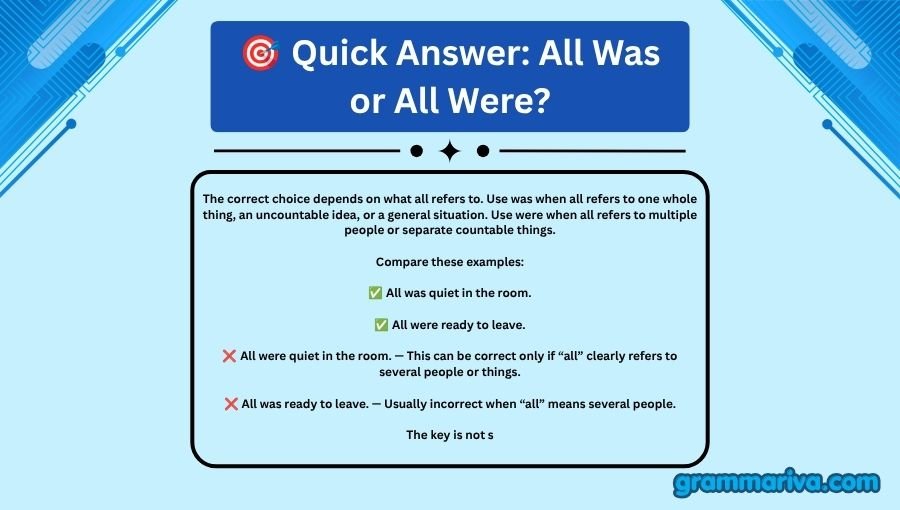
The correct choice depends on what all refers to. Use was when all refers to one whole thing, an uncountable idea, or a general situation. Use were when all refers to multiple people or separate countable things.
Compare these examples:
- ✅ All was quiet in the room.
- ✅ All were ready to leave.
- ❌ All were quiet in the room. — This can be correct only if “all” clearly refers to several people or things.
- ❌ All was ready to leave. — Usually incorrect when “all” means several people.
The key is not simply to look at the word all. Ask yourself what all stands for.
| Form | Basic Use | Example |
|---|---|---|
| all was | All refers to one whole or uncountable idea | All was peaceful. |
| all were | All refers to several people or countable things | All were prepared. |
| all is | Present form for one whole or uncountable idea | All is well. |
| all are | Present form for several people or things | All are welcome. |
📚 Understanding the Basics of All Was or All Were
The basic difference is about number and meaning. The word all can refer to a group of separate items, or it can refer to something as one complete whole.
When all refers to several individual people or things, use were.
When all refers to one whole situation or an uncountable noun, use was.
This is why both forms can be grammatically correct.
All Was
Use all was when all refers to something treated as a whole.
For example:
✅ All was silent after the announcement.
Here, all refers to the overall situation. We are not talking about several separate people or objects.
Another example:
✅ All was lost after the storm.
The word all represents everything as one complete idea.
All Were
Use all were when all refers to several individual people or things.
For example:
✅ All were excited about the trip.
Here, all refers to several people. Each person was excited.
Another example:
✅ All were placed on the table.
Here, all refers to multiple objects.
The Main Difference
| Form | Type | Meaning | Example | Correct/Incorrect |
|---|---|---|---|---|
| All was | Singular/whole idea | Everything as one whole | All was quiet. | ✅ Correct |
| All were | Plural | Several people or things | All were quiet. | ✅ Correct when referring to several people/things |
| All was | Plural reference | Several separate people/things | All was invited. | ❌ Incorrect |
| All were | Whole/uncountable idea | One general situation | All were peaceful. | ❌ Usually incorrect |
| All was | Uncountable reference | One mass or idea | All was confusion. | ✅ Correct |
The word after all can also help you.
- All of the money was spent. ✅
- All of the students were present. ✅
- All the furniture was moved. ✅
- All the chairs were moved. ✅
The noun tells you whether the verb should be singular or plural.
❓ Is All Was or All Were Always Determined by the Word All?
No. All itself does not automatically require either was or were. The noun or idea that follows it determines the correct verb.
Consider these examples:
✅ All of the water was gone.
“Water” is uncountable, so was is correct.
Now compare:
✅ All of the bottles were gone.
“Bottles” is plural and countable, so were is correct.
This is one of the most useful rules to remember.
| Expression | What “all” refers to | Correct Verb |
|---|---|---|
| All of the water | Uncountable substance | Was |
| All of the money | Uncountable amount | Was |
| All of the information | Uncountable idea | Was |
| All of the students | Multiple people | Were |
| All of the books | Multiple objects | Were |
| All of the cars | Multiple objects | Were |
A Simple Question to Ask
Whenever you see all, ask:
“Am I talking about one whole thing or several separate things?”
If it is one whole thing, was may be correct.
If it is several separate things or people, were is usually correct.
❓ Why Do People Confuse All Was and All Were?
People confuse these forms because all can have more than one grammatical meaning. The word looks plural because it suggests “everything,” but “everything” can be treated as one whole idea.
For example:
✅ All was calm.
The speaker means the entire situation was calm.
But:
✅ All were calm.
The speaker means several people or things were calm.
I once reviewed a short workplace report where the writer changed every sentence containing all to were. The writer thought “all” always meant plural. Once we replaced the verbs based on the nouns being described, several sentences changed back to was.
That is the important lesson: do not choose the verb from “all” alone.
🔍 All Was vs All Were at a Glance
The easiest way to understand the difference is to compare complete sentences.
| Sentence | Correct/Incorrect | Why |
|---|---|---|
| All was quiet. | ✅ Correct | “All” describes the whole situation. |
| All were invited. | ✅ Correct | “All” refers to several people. |
| All of the food was eaten. | ✅ Correct | “Food” is uncountable. |
| All of the guests were seated. | ✅ Correct | “Guests” is plural. |
| All was invited to the meeting. | ❌ Incorrect | People are meant, so use “were.” |
The sentence itself gives you the clue.
🧩 When Should You Use All Was?
Use all was when the word all refers to an entire situation, condition, amount, or uncountable idea.
All Was With General Situations
This is common in descriptive writing.
✅ All was quiet after midnight.
The sentence describes the entire setting.
✅ All was peaceful before the storm arrived.
Again, all represents the overall situation.
All Was With Uncountable Nouns
You can also use was after all of when the noun is uncountable.
✅ All of the money was missing.
✅ All of the information was useful.
✅ All of the furniture was damaged.
✅ All of the equipment was ready.
You would not normally use were in these examples because the nouns are treated as singular, uncountable masses.
Sentence Breakdown
Take this sentence:
All of the information was correct.
- All = the complete amount
- information = uncountable noun
- was = singular verb
Now compare:
All of the facts were correct.
- All = every fact
- facts = plural countable noun
- were = plural verb
Test Tip 💡
Replace all with the noun it represents.
If you can say:
“The information was correct.”
then all of the information was correct works.
If you can say:
“The facts were correct.”
then all of the facts were correct works.
This replacement test is one of the fastest ways to choose correctly.
🧑🤝🧑 When Should You Use All Were?
Use all were when all refers to several individual people or things.
For example:
✅ All were ready for the meeting.
The sentence means everyone in the group was ready.
You can also use it with several objects:
✅ All were damaged in the accident.
Here, all refers to multiple objects.
All Were With People
This is especially common with groups of people.
✅ All were invited to dinner.
✅ All were happy with the decision.
✅ All were waiting outside.
✅ All were asked to sign the form.
In each case, all means several people.
All Were With Countable Nouns
You can also use:
All of the employees were present.
All of the houses were painted.
All of the tickets were sold.
The plural nouns make were natural.
Quick Comparison Table
| Meaning | Example |
|---|---|
| Entire situation | All was quiet. |
| Entire amount of something uncountable | All of the water was gone. |
| Several people | All were waiting. |
| Several countable things | All of the boxes were open. |
| Several animals | All were sleeping. |
📝 Case Study: Choosing the Verb in a Workplace Email
Imagine that a manager writes:
“I checked the reports this morning. All were accurate.”
This is correct because all refers to multiple reports.
Now imagine the manager writes:
“I checked the data this morning. All was accurate.”
This can also be correct because data is being treated here as one body of information.
In everyday professional writing, clarity matters more than trying to make every sentence follow a simple “all equals plural” rule.
A useful rewrite can make the meaning even clearer:
All of the reports were accurate.
or
All of the information was accurate.
I once caught myself typing “all were included” in an editing note before realizing I meant a single block of information. I changed it to “all was included” because the context clearly treated the material as one whole. That small edit made the sentence much clearer.
⚙️ Grammar Rules Explanation
The grammar rule is based on subject-verb agreement.
A singular subject normally takes a singular past-tense verb such as was.
A plural subject normally takes the plural past-tense verb were.
The word all can work with either type of meaning.
When all represents a singular or uncountable whole, was is appropriate.
When all represents several separate people or countable things, were is appropriate.
Consider:
All of the milk was gone.
“Milk” is uncountable. We treat it as one mass.
Now:
All of the glasses were gone.
“Glasses” refers to several separate objects.
The important point is that all does not control the verb by itself. The noun or implied meaning does.
Correct vs Incorrect at a Glance
| Sentence | Correct/Incorrect | Why |
|---|---|---|
| All was quiet in the house. | ✅ Correct | “All” refers to the whole situation. |
| All were waiting for the bus. | ✅ Correct | “All” refers to several people. |
| All of the money were spent. | ❌ Incorrect | “Money” is uncountable; use “was.” |
| All of the students was ready. | ❌ Incorrect | “Students” is plural; use “were.” |
| All of the equipment was tested. | ✅ Correct | “Equipment” is uncountable. |
Standard English grammar references agree on the broader principle of matching the verb with the number of the subject or noun being represented. The same principle explains why all was and all were can both be correct in different sentences.
❓ Can All of the Be Followed by Was or Were?
Yes. Both are possible. The noun after all of the decides the form.
Use was with an uncountable noun:
✅ All of the water was clean.
Use were with a plural countable noun:
✅ All of the bottles were clean.
This pattern is extremely useful because it removes much of the confusion.
| All of the + Noun | Verb | Example |
|---|---|---|
| Water | Was | All of the water was used. |
| Money | Was | All of the money was spent. |
| Advice | Was | All of the advice was helpful. |
| Books | Were | All of the books were useful. |
| Children | Were | All of the children were asleep. |
| Cars | Were | All of the cars were washed. |
⚠️ Common Mistakes With All Was and All Were
These mistakes usually happen because writers focus on all instead of the noun or meaning behind it.
Mistake 1: Assuming All Always Means Were
❌ All of the money were spent.
Correct:
✅ All of the money was spent.
Money is treated as an uncountable noun.
Mistake 2: Using Was for People
❌ All of the employees was present.
Correct:
✅ All of the employees were present.
Employees are separate people.
Mistake 3: Forgetting the Implied Meaning
❌ All was invited to the party.
If “all” means several people, use:
✅ All were invited to the party.
Similar Grammar Confusions
| Confusion | Correct Form | Main Reason |
|---|---|---|
| It’s / its | It’s raining. | “It’s” means “it is.” |
| Your / you’re | You’re ready. | “You’re” means “you are.” |
| They’re / their | They’re here. | “They’re” means “they are.” |
| There / their | Their house | Different meanings and roles |
| Was / were | They were ready. | Verb must match the subject |
Why These Errors Happen
Common causes include:
- Fast typing: Writers choose the first verb that sounds familiar.
- Autocorrect: Software can change words without making the sentence grammatically correct.
- Lack of knowledge: Some writers were never taught how collective or quantity words work.
- Speaking habits: In casual speech, small agreement errors may go unnoticed.
- Visual confusion: The word “all” looks plural even when it represents one whole idea.
Specific Wrong Forms
| Wrong Form | What’s Wrong | Correct Form |
|---|---|---|
| All was invited. | Refers to several people | All were invited. |
| All were quiet. | Wrong only when “all” means one whole situation | All was quiet. |
| All of the money were spent. | Uncountable noun | All of the money was spent. |
| All of the students was ready. | Plural noun | All of the students were ready. |
| All of the equipment were tested. | Uncountable noun | All of the equipment was tested. |
| All of the machines was tested. | Plural noun | All of the machines were tested. |
🧠 How To Remember the Difference
A simple memory trick can save you from most mistakes.
Think:
One whole → was.
Several separate items → were.
For example:
All was quiet.
One whole situation.
All were quiet.
Several people or things.
Another useful trick is to remove all of temporarily.
All of the water was cold.
Think:
The water was cold.
Now:
All of the swimmers were cold.
Think:
The swimmers were cold.
The Replacement Test
| Sentence | Replace the Subject With | Result |
|---|---|---|
| All of the water was cold. | The water was cold. | Was |
| All of the swimmers were cold. | The swimmers were cold. | Were |
| All of the furniture was moved. | The furniture was moved. | Was |
| All of the chairs were moved. | The chairs were moved. | Were |
This test is fast and reliable.
🌎 Usage in Different Contexts
The same grammar rule applies across different types of writing. What changes is the situation and the noun being described.
Everyday Conversation
In conversation, you may hear:
All were ready to go.
This usually means everyone in a group was ready.
You may also hear:
All was quiet when I arrived.
This describes the whole situation.
Professional Writing
Professional writing benefits from clear nouns:
All of the team members were informed.
All of the information was verified.
This style reduces ambiguity.
Creative Writing
Creative writing often uses all was to describe an entire scene:
The lights faded, and all was silent.
This is a natural descriptive structure.
Social Media and Texting
Informal writing may be shorter:
All were invited! 🎉
or
All was good until the rain started.
Even in casual writing, the underlying grammar remains the same.
| Context | Which Term to Use | Example |
|---|---|---|
| Everyday conversation | Was or were, depending on meaning | All were ready. |
| Professional writing | Was or were, based on the noun | All of the files were checked. |
| Creative writing | Often “all was” for a whole scene | All was silent. |
| Social media/texting | Either, depending on meaning | All were welcome! |
❓ Does All Was Mean the Same Thing as All Were?
No. The two forms can express different meanings.
All was generally treats the subject as one whole or uncountable idea.
All were normally refers to multiple people or separate countable things.
Compare:
All was dark.
This describes the whole setting.
All were dressed in black.
This describes several people or things.
The difference is small in form but important in meaning.
❓ Is “All Was Well” Grammatically Correct?
Yes. “All was well” is grammatically correct when all means the overall situation or state of things.
The sentence treats the situation as one whole.
✅ After the inspection, all was well.
You should not automatically change this to “all were well.”
However, if you are talking about several people or things, were may be correct:
✅ All were well after the treatment.
Here, all refers to multiple people or individuals.
Context controls the meaning.
❓ Is “All Were Well” Ever Correct?
Yes, but the meaning must clearly involve several individuals or things.
For example:
✅ The children were checked, and all were well.
Here, all means all of the children.
By contrast:
✅ After the repairs, all was well.
Here, all means the overall situation.
This is a useful example because the same word can take either verb depending on what it represents.
💬 Common Phrases With All
There are several familiar expressions where all naturally appears with a singular verb or plural verb.
| Phrase | Meaning |
|---|---|
| All was well | The overall situation was fine |
| All was quiet | Everything was quiet |
| All were welcome | Every person in the group could attend |
| All were invited | Every person in a group received an invitation |
| All is well | Everything is fine now |
| All are welcome | Everyone is welcome |
These phrases show why context matters so much.
🔄 Synonyms and Alternatives
Sometimes you can avoid uncertainty by replacing all with a clearer expression.
For example, instead of:
All were invited.
you could write:
Everyone was invited.
Instead of:
All was quiet.
you could write:
Everything was quiet.
Be careful, though. Everyone refers to people, while everything refers to things or situations.
| Alternative | Works When | Does Not Work When |
|---|---|---|
| Everyone | Referring to people | Referring to objects |
| Everything | Referring to things or a whole situation | Referring only to people |
| The entire group | Referring to a group of people/things | When no group exists |
| The whole situation | Referring to one situation | Referring to separate individuals |
| Every person | Referring to individual people | Referring to objects |
These alternatives can make your writing clearer when the original sentence feels confusing.
❓ Can “All” Refer to One Thing?
Yes. All can refer to one whole thing or one uncountable amount.
For example:
All of the water was gone.
There may be millions of drops of water, but grammatically, water is treated as an uncountable mass.
Similarly:
All of the information was useful.
Information is treated as one uncountable concept.
This is why was is correct.
❓ Can “All” Refer to Multiple People?
Yes. When all means several people, were is normally required in the past tense.
Examples:
✅ All were invited.
✅ All were excited.
✅ All were asked to wait.
You can make the reference clearer:
All of the guests were invited.
All of the employees were asked to wait.
The plural noun makes the agreement obvious.
❓ What Is the Fastest Way to Choose Was or Were?
Use the noun test.
First, find what all refers to.
Then ask whether that noun is:
- A single whole or uncountable idea → was
- Several separate people or countable things → were
For example:
All of the advice ___ helpful.
“Advice” is uncountable.
Answer:
All of the advice was helpful.
Now:
All of the suggestions ___ helpful.
“Suggestions” is plural.
Answer:
All of the suggestions were helpful.
🎯 Why It Matters: Clarity and Professionalism
Correct verb agreement helps readers understand your meaning quickly. It also makes your writing look careful and professional.
A grammar mistake may not completely change your meaning, but it can make the reader stop and reread the sentence.
Clarity in Communication
Compare:
All was ready.
and
All were ready.
The first suggests one whole situation or amount. The second suggests multiple subjects.
The verb provides useful information.
Professionalism
Correct grammar matters in:
- Resumes
- Client emails
- Reports
- Business proposals
- Published articles
- Academic work
Digital Communication
Even social media posts benefit from clean grammar when the goal is to look polished.
A sentence such as:
All of the details were confirmed.
looks clearer and more professional than:
All of the details was confirmed.
A Simple Quote to Remember
“Choose the verb by meaning, not by appearance.”
That is the simplest way I know to remember this rule.
| Situation | Why Getting It Right Matters |
|---|---|
| Resume | Shows attention to detail |
| Client email | Builds trust and clarity |
| Published content | Improves readability |
| Social post | Makes the message look polished |
🧪 Practice Examples
Try choosing was or were before checking the answers.
Example 1
All of the furniture ___ moved upstairs.
Answer:
was ✅
Furniture is uncountable.
Example 2
All of the chairs ___ moved upstairs.
Answer:
were ✅
Chairs are plural and countable.
Example 3
All ___ quiet after the speech.
Answer:
was ✅
The sentence describes the whole situation.
Example 4
All ___ asked to leave.
Answer:
were ✅
The implied meaning is several people.
✅ Quick Recap Checklist
Use this checklist whenever you are unsure about all was or all were.
| Question | If Yes → Use |
|---|---|
| Does “all” describe one whole situation? | Was |
| Does “all” refer to an uncountable noun? | Was |
| Does “all” refer to several people? | Were |
| Does “all” refer to several countable objects? | Were |
| Does “all of the” come before a plural noun? | Were |
| Does “all of the” come before an uncountable noun? | Was |
Practice
- All of the information ___ correct.
→ was ✅ - All of the students ___ correct.
→ were ✅ - All ___ quiet after the meeting.
→ was ✅
The fastest rule is:
One whole = was. Several separate subjects = were.
FAQs About All Was vs All Were
❓ Is “all was” grammatically correct?
Yes. All was is correct when all refers to one whole situation, state, or uncountable idea. For example, “All was quiet” describes the entire situation as quiet.
❓ Is “all were” grammatically correct?
Yes. All were is correct when all refers to several people or separate countable things. For example, “All were invited” normally means several people were invited.
❓ Should I say “all was” or “all were”?
It depends on what all refers to. Use was for one whole or an uncountable idea. Use were for several people or countable things.
❓ Is “all of the money was” correct?
Yes. All of the money was is correct because money is an uncountable noun. For example, “All of the money was spent.”
❓ Is “all of the people were” correct?
Yes. All of the people were is correct because people is plural. For example, “All of the people were invited.”
❓ Is “all was well” correct English?
Yes. All was well is a standard grammatical expression when all refers to the overall situation. It means that everything was fine.
❓ Is “all were well” correct?
It can be correct when all refers to several people or individual things. For example, “The patients were checked, and all were well.”
❓ Does “all” always take a plural verb?
No. All can take either a singular or plural verb depending on what it represents. “All of the water was gone” uses a singular verb, while “All of the bottles were gone” uses a plural verb.
❓ What is an easy trick for choosing between “was” and “were”?
Look at the noun represented by all. If it is one whole or uncountable, choose was. If it represents several separate people or countable things, choose were.
❓ Which is correct: “all was quiet” or “all were quiet”?
Both can be correct, but they can have different meanings. All was quiet describes the whole situation. All were quiet normally refers to several people or things that were each quiet.
🏁 Conclusion
All was or all were becomes much easier once you stop treating all as automatically singular or plural. The real question is what all represents. If it refers to one whole situation, state, or uncountable noun, use was. If it refers to several people or separate countable things, use were.
Remember these two examples:
All was quiet. ✅
All were ready. ✅
The first treats “all” as one overall situation. The second refers to several individuals.
When you see all of the, simply look at the noun that follows it. All of the water was correct. All of the students were ready. That simple check will solve most cases.
Good grammar is often less about memorizing long rules and more about seeing what a sentence actually means. Once you identify the subject, the right verb usually becomes clear. 🌟
When in doubt, remember: one whole takes “was,” while several separate subjects take “were.”

Hi, I’m Nathan Reed. I’m a grammar and writing specialist at Grammariva. I work on practical grammar content that helps readers understand sentence structure, punctuation, vocabulary, and better writing habits.

[…] By the end, you should be able to choose the right word without stopping to think twice. 😊 All Was or All Were | Authentication or Authentification | More Proud or […]