Have you ever written a sentence like “I am more proud of you” and then wondered if “I am prouder of you” sounds better? If so, you are not alone. The question of more proud or prouder comes up often because both forms can sound natural in English. The good news is that the choice is usually simple once you understand how comparative adjectives work.
Both more proud and prouder can be used when comparing a feeling of pride. However, prouder is the standard one-word comparative form of proud, while more proud is also possible in certain sentences and can sometimes sound more deliberate or emphatic.
As an editor, I often see writers hesitate over this choice. I once edited a short note from a teacher to a student that said, “I could not be more proud of you.”
The sentence was completely natural. In another sentence, “She was prouder than she had ever been” was the better choice. 😊So, which one should you use? Let’s make the answer clear. Is vs Are | Further or Furthermore | OK vs Okay
🎯 Quick Answer: More Proud or Prouder?
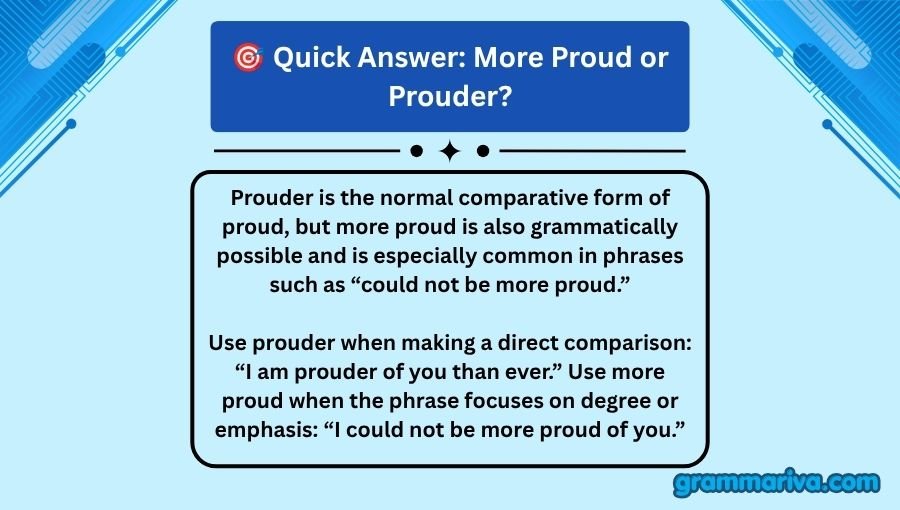
Prouder is the normal comparative form of proud, but more proud is also grammatically possible and is especially common in phrases such as “could not be more proud.”
Use prouder when making a direct comparison: “I am prouder of you than ever.” Use more proud when the phrase focuses on degree or emphasis: “I could not be more proud of you.”
Quick comparison
| Form | Correct? | Common Use | Example |
|---|---|---|---|
| prouder | Yes | Direct comparison | I am prouder of you today. |
| more proud | Yes | Degree or emphasis | I could not be more proud. |
| more prouder | No | Double comparative | ❌ I am more prouder of you. |
| proudest | Yes | Superlative | This is my proudest moment. |
The key point is that more proud or prouder is not always an either-or question. The best form depends on the sentence.
Is More Proud or Prouder the Correct Form?
Both forms are correct, but they do not always serve exactly the same purpose. Prouder is the regular comparative form, while more proud often emphasizes the amount or degree of pride.
For example:
- “I am prouder of you than I was last year.” ✅
- “I could not be more proud of you.” ✅
The first sentence compares two levels of pride. The second expresses an extremely high level of pride.
More proud vs prouder at a glance
| Form | Type | Meaning | Example | Correct/Incorrect |
|---|---|---|---|---|
| proud | Adjective | Feeling pride | I am proud of you. | Correct |
| prouder | Comparative adjective | Having more pride | I am prouder today. | Correct |
| more proud | Comparative phrase | Having a greater degree of pride | I feel more proud today. | Correct |
| proudest | Superlative adjective | Highest degree of pride | This is my proudest moment. | Correct |
| more prouder | Double comparative | Incorrect combination | I feel more prouder. | Incorrect |
In normal comparison, prouder is usually the cleaner choice.
💡 Why Do People Confuse More Proud and Prouder?
People confuse these forms because English allows both a suffix-based comparative and a comparative phrase with more in some situations.
Short adjectives often take -er:
- tall → taller
- fast → faster
- kind → kinder
- proud → prouder
But English also uses more with many adjectives:
- careful → more careful
- useful → more useful
- important → more important
Because speakers know both patterns, they may wonder whether proud should follow one pattern or the other.
I once caught myself typing “more prouder” in a quick email draft. I knew the rule, but I had combined more and -er without thinking. I deleted more before sending it.
That mistake shows why this issue can happen even to experienced writers.
The basic pattern
| Original adjective | Comparative form | Example |
|---|---|---|
| proud | prouder | She is prouder now. |
| kind | kinder | He became kinder. |
| strong | stronger | They are stronger now. |
| careful | more careful | Be more careful. |
| useful | more useful | This guide is more useful. |
The important lesson is simple: do not automatically put more before an adjective that already has -er.
What Does Prouder Mean?
Prouder means having a greater feeling of pride than someone or something else, or having a greater degree of pride than before.
It is the comparative form of proud.
Consider this sentence:
“I am prouder of my work this year.”
Here, prouder compares the speaker’s current feeling with an earlier feeling.
Another example:
“She looked prouder after hearing the news.”
This means her feeling of pride became stronger.
Common uses of prouder
1. Comparing two moments
I am prouder today than I was yesterday. ✅
2. Comparing two achievements
He was prouder of his first book than his second. ✅
3. Comparing people
She seemed prouder of her team’s success than anyone else. ✅
4. Showing increased emotion
His parents were prouder than ever. ✅
Test Tip 💡
Try adding than after the phrase.
If you are directly comparing two levels of pride, prouder will often fit naturally.
I am prouder than before. ✅
She feels prouder than ever. ✅
This is not an absolute rule, but it is a useful test.
When Should You Use More Proud?
More proud is correct when you are describing a greater degree of pride without necessarily making a simple direct comparison.
One of its most natural uses appears in expressions of strong emotion.
“I could not be more proud of you.”
This means the speaker feels an extremely high level of pride.
The sentence does not need to name a second person, moment, or achievement. It presents the speaker’s pride as being at its highest possible practical level.
Examples of more proud
I could not be more proud of my daughter. ✅
We have never been more proud of our team. ✅
I feel more proud of the project now that it is finished. ✅
The last example compares the speaker’s current feeling with an earlier feeling, but more proud works naturally because the sentence focuses on a change in degree.
More proud or prouder in emotional statements
| Sentence | Best Choice | Reason |
|---|---|---|
| I could not be ___ of you. | more proud | Fixed-style degree expression |
| I am ___ than ever. | prouder | Direct comparison |
| I feel ___ about my work now. | more proud | Focus on increased degree |
| She is ___ than her sister. | prouder | Direct comparison |
| We have never been ___ of you. | more proud | Strong degree expression |
Are More Proud and Prouder Interchangeable?
They can overlap, but they are not always equally natural. Prouder usually sounds more direct when the sentence clearly compares one level of pride with another. More proud can sound more emphatic or can highlight the degree of the feeling.
Compare:
I am prouder of you than ever. ✅
I am more proud of you than ever. ✅
Both can work. The first uses the standard comparative adjective. The second puts more focus on the degree of pride.
However, some structures strongly favor more proud:
I could not be more proud of you. ✅
Using prouder there would change the meaning and make the sentence sound unnatural:
I could not be prouder of you.
This sentence is actually possible in English and means roughly the same thing, but I could not be more proud of you is a very common way to express maximum pride.
Practical comparison
| Situation | Preferred Form | Example |
|---|---|---|
| Direct comparison | prouder | She is prouder than before. |
| Comparison with than | prouder | I am prouder than I was. |
| Strong emotional statement | more proud | I could not be more proud. |
| Increased degree | more proud | I feel more proud now. |
| Simple comparative adjective | prouder | He looks prouder today. |
📝 Case Study: More Proud or Prouder in Real Life
Imagine a manager writing an email after an employee completes a difficult project.
The manager could write:
“I am prouder of your work than I was at the start of the project.” ✅
This is a clear comparison. The manager compares two points in time.
The manager could also write:
“I could not be more proud of what you accomplished.” ✅
This sentence does not compare two named moments. It expresses a very strong feeling.
A third option is:
“I feel more proud of the team now that we have finished.” ✅
This focuses on a change in emotional degree.
Here is how the three sentences work:
| Sentence | Main Purpose | Natural? |
|---|---|---|
| I am prouder than before. | Direct comparison | Yes |
| I could not be more proud. | Maximum degree of pride | Yes |
| I feel more proud now. | Increased feeling | Yes |
| I am more prouder than before. | Double comparative | No |
The context determines which form sounds best.
📚 Grammar Rules Explanation: More Proud vs Prouder
The basic grammar rule is that proud is an adjective, and its standard comparative form is prouder.
A comparative adjective describes a higher or lower degree when two things, people, moments, or states are compared.
For many short adjectives, English adds -er:
- proud → prouder
- cold → colder
- bright → brighter
- small → smaller
The word more can also form comparative phrases. With proud, both patterns can occur, but they are used differently depending on sentence structure and emphasis.
The form more prouder is not standard because it combines two comparative markers. In most normal sentences, you should choose either prouder or more proud, not both.
Most major English dictionaries and standard grammar references recognize prouder as the comparative form of proud. The phrase more proud is also established English, especially in constructions that emphasize degree.
Correct vs Incorrect at a Glance
| Sentence | Correct/Incorrect | Why |
|---|---|---|
| I am prouder of you than ever. | Correct | Standard comparative form |
| I could not be more proud of you. | Correct | Natural degree expression |
| She feels more proud of her work now. | Correct | Describes an increased degree |
| He is more prouder than his brother. | Incorrect | Uses two comparative markers |
| They were prouder after the victory. | Correct | Standard comparative adjective |
The easiest rule to remember is:
Use “prouder” for a straightforward comparison. Use “more proud” when the sentence naturally focuses on degree or emphasis. Never use “more prouder.”
⚠️ Common Mistakes With More Proud and Prouder
Most mistakes come from trying to make a sentence sound stronger. Writers sometimes think adding more before prouder makes the comparison stronger. It does not.
The result is a double comparative.
Why these mistakes happen
Fast typing: People often write without stopping to check the sentence.
Autocorrect: Software may not catch a grammar problem if every individual word is spelled correctly.
Lack of knowledge: Some writers do not know that prouder already contains the comparative ending.
Speech patterns: Informal spoken English can make unusual combinations sound less noticeable.
Similar grammar confusions
| Common Confusion | Correct Form | Example |
|---|---|---|
| it’s / its | depends on meaning | It’s cold. / The dog wagged its tail. |
| your / you’re | depends on meaning | Your phone / You’re right |
| their / there / they’re | depends on meaning | Their house / Go there / They’re ready |
| then / than | than for comparison | She is taller than me. |
| more better / better | better | This option is better. |
These errors are similar because the writer may understand the words individually but combine them incorrectly.
Specific mistakes with this term
| Wrong Form | What’s Wrong | Correct Form |
|---|---|---|
| more prouder | Double comparative | prouder |
| most prouder | Double superlative/comparative pattern | proudest |
| more proudest | Incorrect combination | proudest |
| prouderer | Double comparative ending | prouder |
| most proudest | Double superlative | proudest |
| more proud than ever before than | Awkward repeated comparison | more proud than ever |
One especially important mistake is more prouder. Avoid it in standard writing.
Is “More Prouder” Ever Correct?
No. More prouder is not the standard form.
The problem is that both more and -er mark comparison. Putting them together creates a double comparative.
For example:
I am more prouder of my work now. ❌
Write:
I am prouder of my work now. ✅
Or:
I am more proud of my work now. ✅
The choice between the last two depends on style and context.
Quick correction table
| Incorrect | Correct |
|---|---|
| more prouder | prouder |
| more prouder than | prouder than |
| most prouder | proudest |
| more proudest | proudest |
How Do You Use Prouder in a Sentence?
Use prouder when you want to compare levels of pride.
Common patterns include:
Prouder + than
I am prouder than I was last year. ✅
Prouder + of
She is prouder of her progress now. ✅
Prouder + than ever
He is prouder than ever. ✅
Prouder + today/now
I feel prouder today. ✅
Sentence breakdown
Take this example:
“My parents are prouder of me now than they were before.”
- My parents = subject
- are = linking verb
- prouder = comparative adjective
- of me = phrase showing the object of pride
- now than they were before = comparison
The sentence clearly shows a change in the level of pride.
How Do You Use More Proud in a Sentence?
Use more proud when you want to show an increased degree of pride or create a strong emotional statement.
Examples include:
I feel more proud of myself now. ✅
She became more proud of her achievement. ✅
We could not be more proud of the students. ✅
I have never felt more proud. ✅
The phrase can be especially effective when the writer wants to emphasize emotion.
More proud sentence patterns
| Pattern | Example |
|---|---|
| feel more proud | I feel more proud now. |
| become more proud | He became more proud of his work. |
| could not be more proud | We could not be more proud. |
| never been more proud | I have never been more proud. |
| more proud than before | She is more proud than before. |
More Proud or Prouder in Different Contexts
The best choice can depend on the setting. Both forms appear in everyday speech and writing, but prouder is especially useful for direct comparisons.
| Context | Which Term to Use | Example |
|---|---|---|
| Everyday conversation | Either | I am prouder than ever. |
| Professional writing | Usually prouder | We are prouder of the results this year. |
| Creative writing | Either | His heart felt more proud after the victory. |
| Social media/texting | Either | Could not be more proud! |
| Formal comparison | Prouder | The team is prouder than before. |
In professional writing, clarity matters more than trying to make a sentence sound complicated.
Why Is Prouder Usually the Better Comparative?
Prouder is usually the better choice when you are making a simple comparison because it is the standard comparative form of proud.
For example:
She is prouder than her brother. ✅
This is direct and easy to understand.
You do not need:
She is more proud than her brother.
That version can also work, but prouder is more concise.
Shorter wording often makes a sentence easier to read.
Comparison of style
| Sentence | Style |
|---|---|
| She is prouder than before. | Direct and concise |
| She is more proud than before. | Natural but slightly more deliberate |
| She is more prouder than before. | Incorrect |
| She is the proudest of all. | Superlative |
Common Phrases With Proud, Prouder, and More Proud
Some expressions appear very often in natural English.
| Phrase | Meaning |
|---|---|
| proud of you | Feeling pride because of someone’s actions |
| prouder than ever | Feeling more pride than at any previous point |
| could not be more proud | Feeling an extremely high level of pride |
| proud moment | A moment that creates strong pride |
| proud achievement | An achievement that creates pride |
| take pride in | Feel satisfaction or pride about something |
These phrases are useful because they show how proud behaves in real sentences.
For example:
“I am prouder than ever of this team.” ✅
And:
“I could not be more proud of this team.” ✅
Both express strong positive emotion.
How Does Proudest Fit Into the Comparison?
Proudest is the superlative form of proud. It is used when you are talking about the highest level of pride within a group, range of experiences, or set of situations.
Compare:
- proud = basic form
- prouder = comparative form
- proudest = superlative form
The three forms
| Degree | Form | Example |
|---|---|---|
| Positive | proud | I am proud of you. |
| Comparative | prouder | I am prouder than before. |
| Superlative | proudest | This is my proudest achievement. |
Do not say more proudest or most prouder in standard English.
What Alternatives Can You Use Instead?
Sometimes you may want to avoid repeating proud. Several alternatives can express a similar idea, although their meanings are not identical.
| Alternative | Works When | Does Not Work When |
|---|---|---|
| delighted | You feel very happy about something | You specifically mean pride |
| pleased | You are satisfied with a result | You need strong emotional pride |
| satisfied | You feel content with an outcome | You are praising someone’s achievement |
| honored | You feel privileged or grateful | You simply mean personal pride |
| thrilled | You are extremely excited | The emotion is specifically pride |
For example:
I am thrilled with your progress.
This is positive, but it does not have exactly the same meaning as:
I am proud of your progress.
Choosing the right word helps keep the emotional meaning clear.
🎯 How To Remember the Difference
A simple memory trick can help.
Think of prouder as the normal comparison form:
proud → prouder → proudest
Then remember that more proud can be used when the sentence focuses strongly on degree.
The biggest rule to remember is:
Never combine more with prouder.
So:
prouder ✅
more proud ✅
more prouder ❌
Another useful trick is to ask yourself:
Am I directly comparing?
If yes, prouder is usually the best choice.
Am I emphasizing how much pride I feel?
If yes, more proud may sound more natural.
💡 Test Tip: A Simple Three-Step Check
When you are unsure, use this quick test.
Step 1: Look for a direct comparison
If you see than, before, now, or another clear comparison, try prouder first.
I am prouder than before. ✅
Step 2: Look for strong degree language
Expressions such as could not be, never been, and ever often work naturally with more proud.
I could not be more proud. ✅
Step 3: Check for double comparison
If you have more + prouder, remove one.
more prouder ❌
Choose:
more proud ✅
or:
prouder ✅
This three-step check solves most cases.
Why It Matters in Professional Writing
Grammar choices affect how polished your writing sounds. A sentence with more prouder may distract the reader because it uses an incorrect double comparative.
That can matter in:
- workplace emails
- resumes
- school assignments
- published articles
- business websites
- social media posts
A small grammar error can make an otherwise strong sentence look rushed.
Why getting it right matters
| Situation | Why Getting It Right Matters |
|---|---|
| Resume | Shows attention to language |
| Client email | Creates a professional impression |
| Published content | Improves reader trust |
| Social post | Makes the message cleaner |
A useful writing principle is:
Clear writing makes the intended meaning easier to trust.
You do not need complicated grammar to sound professional. You need accurate grammar used naturally.
Is More Proud or Prouder Better for Social Media?
Both can work well on social media. Social posts often use emotional phrases such as “could not be more proud” because they sound warm and enthusiastic.
For example:
Could not be more proud of this team! 🎉
That sounds natural.
You could also write:
Prouder than ever of this team! ❤️
That works too.
Social media allows more flexibility, but standard grammar still helps your message look polished.
Social media examples
| Caption | Correct? |
|---|---|
| Could not be more proud! | Yes |
| Prouder than ever! | Yes |
| So proud of this moment! | Yes |
| More prouder than ever! | No |
| Most prouder moment! | No |
Can You Say “I Could Not Be Prouder”?
Yes. I could not be prouder is grammatically possible and expresses the same general idea as I could not be more proud.
Both communicate an extremely high level of pride.
Compare:
I could not be prouder of you. ✅
I could not be more proud of you. ✅
The second version is especially common in everyday English, while the first uses the comparative form directly.
This is a useful reminder that English sometimes offers more than one natural way to express the same idea.
What Is the Most Natural Choice in Everyday English?
For a straightforward comparison, prouder is usually the most natural choice.
For strong emotional statements, more proud is very natural.
A quick decision table
| If you want to say… | Use |
|---|---|
| “I have more pride now than before.” | prouder |
| “I feel an extremely high level of pride.” | more proud |
| “I am comparing two people.” | prouder |
| “I am using a strong emotional expression.” | more proud |
| “This is my highest level of pride.” | proudest |
The context matters more than memorizing a single answer.
Quick Recap Checklist
Use this checklist whenever you are unsure.
| Question | If Yes → Use |
|---|---|
| Am I making a direct comparison? | prouder |
| Does the sentence contain “than”? | Usually prouder |
| Am I emphasizing an extreme degree? | more proud |
| Am I using “could not be ___”? | Usually more proud |
| Does my sentence say “more prouder”? | Remove one comparative marker |
| Am I talking about the highest level? | proudest |
Practice examples
1. I am ___ of you than I was last year.
Answer: prouder ✅
2. I could not be ___ of you.
Answer: more proud ✅
3. This is the ___ moment of my life.
Answer: proudest ✅
These three patterns cover many everyday situations.
FAQs About More Proud vs Prouder
Is “prouder” grammatically correct?
Yes. Prouder is the standard comparative form of proud. Use it when comparing one level of pride with another.
Is “more proud” grammatically correct?
Yes. More proud is also correct in natural English, especially when the sentence emphasizes degree or appears in expressions such as “could not be more proud.”
Is “more prouder” correct?
No. More prouder is not standard English because it combines two comparative markers. Use prouder or more proud, depending on the sentence.
Should I say “more proud” or “prouder”?
Use prouder for a straightforward comparison. Use more proud when emphasizing the degree of pride or in natural expressions such as “I could not be more proud.”
Is “I am prouder of you” correct?
Yes. “I am prouder of you” is grammatically correct. It usually suggests a comparison with an earlier feeling or another situation.
Is “I could not be more proud of you” correct?
Yes. It is a natural way to express an extremely strong feeling of pride.
Is “I could not be prouder of you” correct?
Yes. This is also grammatically correct and expresses a very high level of pride.
What is the comparative form of proud?
The standard comparative form is prouder. More proud can also be used as a comparative phrase in suitable contexts.
What is the superlative form of proud?
The superlative form is proudest. For example, “That was my proudest achievement.”
What is the easiest way to remember prouder and more proud?
Remember this pattern: proud → prouder → proudest. Also remember that more proud can be natural when you are emphasizing degree. Never use more prouder in standard English.
Conclusion
More proud or prouder is a question with a simple answer once you understand the difference between a standard comparative form and a comparative phrase. Prouder is the regular comparative form of proud, so it is usually the best choice for a direct comparison. More proud is also correct and works especially well when you want to emphasize the degree of pride or use an expression such as “I could not be more proud.”
The one form you should avoid is more prouder. It combines two comparative markers and is not standard English.
When in doubt, ask what your sentence is doing. If you are comparing two levels of pride, choose prouder. If you are stressing an extremely high degree of pride, more proud may be the better fit. If you are talking about the highest level among several experiences, use proudest. 😊
The easiest rule to remember is this: proud, prouder, proudest — and never more prouder. Get that pattern right, and this common grammar question becomes much easier.

Hi, I’m Lucas Bennett. I’m a grammar content specialist at Grammariva. I work on articles covering everyday grammar questions, sentence usage, and writing tips that readers can apply with confidence.
[…] in school, work, technology, and everyday writing. Let’s make this spelling choice simple. 😊 More Proud or Prouder | Is vs Are | Further or […]
[…] and an easy test you can use whenever you are unsure. Authentication or Authentification | More Proud or Prouder | Is vs […]