Have you ever typed one vs won and wondered which word belongs in your sentence? You are not alone. These two words sound the same in many forms of everyday English, but they have very different meanings and jobs in a sentence. One is usually connected with the number 1, a single person or thing, or a general person or thing. Won, on the other hand, is the past tense and past participle of the verb win.
This small spelling difference can cause big confusion. A sentence like “She one the game” looks almost right when you read it quickly, but it is incorrect. The correct sentence is “She won the game.” 📝
I often see this mix-up in student writing, text messages, and online posts. The good news is that the rule is simple once you connect each spelling to its meaning.
In this guide, I will explain one vs won with clear examples, easy tests, common mistakes, tables, and practical tips. By the end, you should be able to choose the right word without stopping to think twice. 😊 Based on vs Based Off Of | Entitled vs Titled | Crumby or Crummy
🎯 Quick Answer: One vs Won
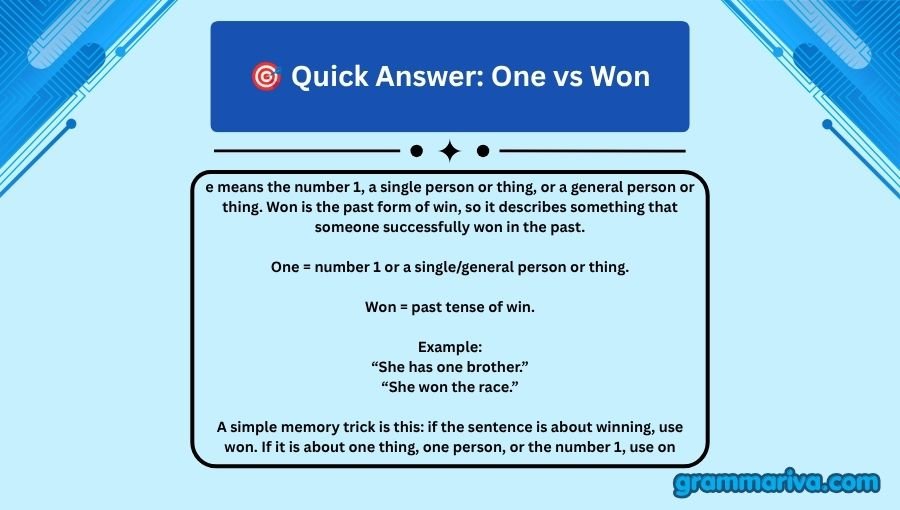
One means the number 1, a single person or thing, or a general person or thing. Won is the past form of win, so it describes something that someone successfully won in the past.
- One = number 1 or a single/general person or thing.
- Won = past tense of win.
Example:
“She has one brother.”
“She won the race.”
A simple memory trick is this: if the sentence is about winning, use won. If it is about one thing, one person, or the number 1, use one.
🔤 Related Word Forms of One and Won
The two words have different word families. One is connected to the number and pronoun uses of one, while won belongs to the verb family of win.
| Form | Type | Example |
|---|---|---|
| one | Number/determiner/pronoun | I have one question. |
| ones | Plural pronoun | I prefer the red ones. |
| one’s | Possessive form | One’s choices matter. |
| win | Base verb | I hope we win. |
| wins | Present-tense verb | She wins often. |
| won | Past tense/past participle | She won yesterday. |
| winning | Present participle/gerund | They are winning. |
Notice that won does not mean “one.” It belongs to win, even though the two words often sound alike.
📚 Understanding One vs Won
The easiest way to understand the difference is to look at what each word does.
One usually refers to a number, a single item, or an unspecified person or thing. Won describes success in a contest, game, competition, election, argument, or similar situation.
| Form | Type | Meaning | Example | Correct/Incorrect |
|---|---|---|---|---|
| one | Number | The number 1 | I need one ticket. | ✅ Correct |
| one | Pronoun | A single person or thing | One was missing. | ✅ Correct |
| one | Determiner | A single item | She bought one book. | ✅ Correct |
| won | Verb | Past form of win | He won the match. | ✅ Correct |
| won | Verb | Past success | They won the prize. | ✅ Correct |
| one | Verb | Not the past form of win | She one the game. | ❌ Incorrect |
| won | Number | Not the spelling of 1 | I have won brother. | ❌ Incorrect |
The key is meaning. Do not choose the word only because it sounds right.
🔢 What Does One Mean?
One has several common uses, but they all connect to the idea of a single person, thing, amount, or unit.
One as a Number
The most basic use of one is the number 1.
Examples:
- I have one sister. ✅
- There is one chair in the room. ✅
- He bought one sandwich. ✅
In these sentences, one tells us how many.
One as a Pronoun
One can also replace a noun when the exact person or thing is already understood.
For example:
I like the blue shirt, but I prefer the black one.
Here, one means “black shirt.”
Another example:
These cookies are good, but the chocolate ones are better.
The word ones replaces “chocolate cookies.”
One for a General Person
In formal English, one can refer to people in general.
For example:
One should always check important information before sharing it.
Here, one means “a person” or “people in general.”
One in Common Expressions
You will also see one in expressions such as:
- one day
- one time
- one more
- one by one
- one of them
- one another
- one at a time
These uses have nothing to do with the verb win.
| Meaning | Word Type | Example Sentence |
|---|---|---|
| Number 1 | Number/determiner | I need one pen. |
| Single item | Determiner | She chose one option. |
| Replacement noun | Pronoun | I like the green one. |
| General person | Pronoun | One should be careful. |
| Part of an expression | Various | We solved them one by one. |
💡 Test Tip
Ask yourself:
“Am I talking about the number 1 or a single person or thing?”
If yes, one is probably the correct choice.
🏆 What Does Won Mean?
Won is the past tense and past participle of win.
It means that someone succeeded in a competition, contest, game, battle, election, award situation, or another situation where success is possible.
Examples:
- Our team won the game. ✅
- Maya won the award. ✅
- They won the competition. ✅
- He won the election. ✅
You can usually replace won with a past form such as “was successful” and still keep the basic idea.
For example:
She won the race.
This means:
She was successful in the race.
The word won is always connected to the verb win.
Won With Games and Competitions
Use won when someone succeeded in a game or competition.
The Tigers won the final. ✅
Not:
The Tigers one the final. ❌
Won With Prizes and Awards
You can also use won with awards and prizes.
Daniel won first prize. ✅
Maria won a scholarship. ✅
Won in Other Situations
The word can also describe success outside sports.
The candidate won the election. ✅
She won the argument. ✅
The company won the contract. ✅
| Meaning | Word Type | Example |
|---|---|---|
| Succeeded in a game | Verb | We won the game. |
| Succeeded in a race | Verb | She won the race. |
| Received an award through success | Verb | He won the award. |
| Succeeded in an election | Verb | They won the election. |
| Succeeded in a contest | Verb | I won the contest. |
❓ Is One the Same as Won?
No. One and won are different words with different meanings and grammatical functions. They may sound alike in many accents, but spelling and meaning determine which one belongs in a sentence.
Compare:
I have one dollar. ✅
This sentence is about the number 1.
I won one dollar. ✅
This sentence is about winning money.
The two words can even appear in the same sentence:
I won one dollar.
That sentence uses both words correctly because each performs a different job.
❓ Why Do People Confuse One and Won?
People often confuse one and won because they are commonly pronounced the same in standard English. When we hear a word rather than see it, the sound does not always tell us which spelling to choose.
This is called a homophone relationship: different words can share the same pronunciation while having different meanings and spellings.
I once reviewed a short student story in which the writer repeatedly used “one” when describing a sports victory. The student knew exactly what the sentence meant. The problem was that they were writing from sound rather than meaning. Once we connected won with win, the mistake disappeared.
Other reasons include:
- fast typing
- autocorrect
- speech-to-text errors
- weak spelling habits
- confusion between sound and spelling
- not knowing the verb forms of win
| Confusion | Correct Form | Main Reason |
|---|---|---|
| one/won | one or won | Same or similar sound |
| two/to/too | Depends on meaning | Same sound |
| there/their/they’re | Depends on meaning | Similar sound |
| your/you’re | Depends on grammar | Similar sound |
| hear/here | Depends on meaning | Same sound |
The best solution is not to memorize spelling alone. Learn what each word means.
📝 Case Study: A Simple Workplace Example
Imagine that a manager sends an email after a sales competition.
An employee writes:
“Our team one the monthly sales challenge.”
The manager understands the message, but the spelling is wrong.
The corrected version is:
“Our team won the monthly sales challenge.” ✅
Why?
Because the team won something. The sentence uses the past form of win.
Now compare it with:
“Only one team received the award.” ✅
Here, one tells us the number of teams.
I once caught a similar mistake while editing a short announcement. The writer had typed “one” because they had heard the sentence many times and were working quickly. Changing the word was easy because the meaning made the correct choice obvious.
📖 One vs Won Grammar Rules Explanation
The grammar rule is straightforward.
One can function as a number, determiner, or pronoun. It identifies a single person, object, amount, or general person.
Won is a verb form. It is the past tense and past participle of win.
That means you should ask what grammatical job the word is doing.
If you need a word that means 1, use one.
If you need a past-tense verb meaning was successful, use won.
Standard English references and major dictionaries agree on this basic distinction.
Correct vs Incorrect at a Glance
| Sentence | Correct/Incorrect | Why |
|---|---|---|
| She has one brother. | ✅ Correct | One means the number 1. |
| She won the race. | ✅ Correct | Won is the past form of win. |
| He one the contest. | ❌ Incorrect | The past verb is won. |
| I need won ticket. | ❌ Incorrect | The number is one. |
| They won one prize. | ✅ Correct | Both words have separate meanings. |
The most useful rule is simple:
Number or single item = one.
Past success = won.
❓ How Can You Tell Whether to Use One or Won?
Look at the word’s meaning before looking at its sound.
Use one when you mean:
- the number 1
- a single person
- a single thing
- a replacement for a noun
- a general person
Use won when you mean:
- succeeded in a game
- succeeded in a competition
- received a prize through success
- succeeded in an election
- defeated an opponent
| If You Mean… | Use | Example |
|---|---|---|
| Number 1 | one | I have one question. |
| A single item | one | Choose one option. |
| A replacement noun | one | I want the blue one. |
| Past success | won | We won the game. |
| A past victory | won | She won the prize. |
⚠️ Common Mistakes With One and Won
Most mistakes happen because the words sound alike.
Mistake 1: Using One as the Past of Win
Incorrect:
Our team one the match. ❌
Correct:
Our team won the match. ✅
Mistake 2: Using Won for the Number 1
Incorrect:
I need won ticket. ❌
Correct:
I need one ticket. ✅
Mistake 3: Relying Only on Sound
When you hear:
“I won.”
You cannot know the spelling from the sound alone. You need to understand the meaning.
Mistake 4: Autocorrect
Autocorrect may sometimes select the wrong homophone, especially when you type quickly.
Mistake 5: Speech-to-Text
Voice typing can also create errors because it hears pronunciation but may not understand the intended meaning.
| Mistake | Why It Happens | Better Habit |
|---|---|---|
| Typing one for won | Sound-based spelling | Connect won with win |
| Typing won for one | Same pronunciation | Check the meaning |
| Fast typing | No proofreading | Read the sentence again |
| Autocorrect | Wrong automatic choice | Check important messages |
| Speech-to-text | Sound ambiguity | Proofread after dictation |
Common Wrong Forms for This Specific Confusion
| Wrong Form | What’s Wrong | Correct Form |
|---|---|---|
| one the game | One is not the past of win. | won the game |
| won ticket | Won is not the number 1. | one ticket |
| one the prize | Wrong verb form. | won the prize |
| won brother | Wrong number word. | one brother |
| one first place | Wrong past-tense verb. | won first place |
| won of the answers | Wrong pronoun/number form. | one of the answers |
❓ What Are the Most Common One vs Won Errors?
The most common errors happen when writers choose the spelling from pronunciation instead of meaning.
For example:
“She one the championship.” ❌
The sentence describes a victory, so it needs won.
Now look at:
“She has one championship trophy.” ✅
Here, one describes the number of trophies.
The surrounding words often provide a strong clue.
Words such as game, race, prize, contest, election, competition, championship, and award often appear with won when describing past success.
Words such as ticket, person, book, dollar, answer, question, brother, and choice can often appear with one when the word means a single item or person.
🕰️ Word Origin and History
The histories of one and won are separate because they belong to different word families.
One developed as the English number word for 1 and later gained several related uses as a pronoun and determiner.
Won developed as the past form of win. The spelling reflects its relationship to the verb win, even though its pronunciation does not look like the base form.
The important point for modern writers is not the historical detail. It is the connection between win and won.
| Stage | Form | Note |
|---|---|---|
| Modern English | one | Number and related pronoun/determiner uses |
| Modern English | win | Base verb for success |
| Modern English | won | Past form of win |
| Modern English | winning | Present participle of win |
You do not need to know the full history to use these words correctly.
🌎 One vs Won in Different Contexts
The basic rule stays the same across different types of writing.
| Context | Which Term to Use | Example |
|---|---|---|
| Everyday conversation | Either, depending on meaning | I have one brother. |
| Professional writing | Either, depending on meaning | Our team won the contract. |
| Creative writing | Either, depending on meaning | One evening, she left home. |
| Social media/texting | Either, depending on meaning | We won! 🎉 |
| Academic writing | Either, depending on meaning | One example supports the claim. |
Everyday Conversation
In conversation, one and won are especially easy to confuse because listeners rely on context.
“I won!”
means the speaker succeeded.
“I need one.”
means the speaker needs a single item.
Professional Writing
Correct spelling matters more in emails, reports, resumes, and business documents.
“Our company won the contract.”
is professional and clear.
Creative Writing
Writers may use one in many descriptive expressions.
“One cold morning, she opened the door.”
Won is used when describing a character’s victory.
“He won the final match.”
Social Media and Texting
Informal writing may contain spelling mistakes, but the correct forms are still one and won.
💬 Common Phrases With One
The word one appears in many common expressions.
| Phrase | Meaning |
|---|---|
| one by one | Individually, in order |
| one at a time | Individually rather than together |
| one more | An additional single item |
| one of a kind | Unique |
| one way or another | By some method |
| one day | At a particular future or past time |
These expressions are unrelated to the verb win.
🏆 Common Phrases With Won
Because won is the past form of win, it commonly appears in expressions describing success.
| Phrase | Meaning |
|---|---|
| won the game | Was successful in the game |
| won the race | Finished successfully ahead of competitors |
| won the prize | Received a prize through success |
| won the award | Was selected as the successful recipient |
| won the contest | Was the successful contestant |
| won the election | Was elected through the election |
A useful trick is to replace won with was victorious or was successful. If the sentence still makes sense, won may be the word you need.
🔄 Synonyms and Alternatives for One
Sometimes another word can replace one, but the replacement depends on the sentence.
| Alternative | Works When | Does Not Work When |
|---|---|---|
| single | You want to stress one item | You need a pronoun replacement |
| a | You mean one unspecified item | You need the exact number 1 |
| individual | You mean one person or item | You are simply counting |
| someone | You mean one unspecified person | You mean the number 1 |
| an item | You mean one object | You need a general pronoun |
For example:
I need one ticket.
You could say:
I need a single ticket.
But you cannot replace one with someone because a ticket is not a person.
🔄 Synonyms and Alternatives for Won
Won can sometimes be replaced by phrases that describe success.
| Alternative | Works When | Does Not Work When |
|---|---|---|
| succeeded | Talking about successful action | You need a specific game result |
| prevailed | Formal writing | Casual conversation may sound too formal |
| was victorious | Talking about victory | Simple everyday writing may prefer won |
| defeated | Someone beat an opponent | Winning does not always involve a direct opponent |
| earned | Receiving something through effort | Not every win is an earning process |
For example:
She won the competition.
Could become:
She was victorious in the competition.
However, won is usually shorter and more natural.
❓ Can One and Won Appear in the Same Sentence?
Yes. They can appear together when the sentence needs both meanings.
For example:
She won one prize.
Here, won tells us what happened. One tells us how many prizes she received.
Another example:
Our team won one game and lost two.
The words are next to each other, but they perform different jobs.
This is a great way to remember the distinction. If a sentence needs both a number and a past victory, both words can be correct.
❓ Is “One” Ever a Verb Meaning Win?
No. In standard English, one is not the past tense of win.
The correct forms are:
- win — present/base form
- wins — third-person singular present
- won — past tense
- won — past participle
- winning — present participle
| Verb Form | Example |
|---|---|
| win | I hope we win. |
| wins | She wins often. |
| won | They won yesterday. |
| won | They have won before. |
| winning | They are winning now. |
This verb pattern is worth memorizing because win → won is irregular.
❓ Should You Write “I One” or “I Won”?
If you mean that you were successful in a competition, write “I won.”
Examples:
I won the race. ✅
I won the award. ✅
I won the game. ✅
Do not write:
I one the race. ❌
But if you are talking about the number 1, one is correct.
I have one ticket. ✅
❓ How Do You Remember the Difference Between One and Won?
Learning one vs won becomes easier when you connect each word to its meaning. Use the WIN test.
If your sentence is about winning, connect the word to WIN:
WIN → WON
If your sentence is about 1, use:
1 → ONE
You can also use this quick memory line:
One counts. Won wins.
That short phrase is enough for most everyday situations.
❓ Why Does One Sound Like Won?
In many varieties of English, one and won are pronounced alike or very similarly. This makes them easy to confuse when writing from speech.
English contains many words that sound alike but have different spellings and meanings. The solution is to focus on context.
When you hear “won,” ask:
Was someone successful?
When you hear “one,” ask:
Is this about the number 1 or a single thing?
That simple check can prevent most mistakes.
🎯 How to Remember One vs Won
Here are three easy memory tricks.
Trick 1: Number 1 = One
Think:
1 = one
If you can replace the word with the number 1, choose one.
I have one sister.
I have 1 sister.
The meaning stays the same.
Trick 2: Win = Won
Think:
Win → won
If the sentence describes a past victory, choose won.
We won the game.
Trick 3: One Counts, Won Wins
This is the fastest memory phrase:
One counts. Won wins.
⚠️ Why Getting One and Won Right Matters
A single wrong letter can change the meaning or make a sentence grammatically incorrect.
Clear spelling helps readers understand your message without stopping to decode it.
| Situation | Why Getting It Right Matters |
|---|---|
| Resume | Shows careful writing |
| Client email | Builds professionalism |
| Published content | Improves credibility |
| Social post | Prevents distracting mistakes |
A sentence such as “Our company one the contract” may be understandable, but it still looks careless.
Correct:
“Our company won the contract.” ✅
Correct spelling makes the message cleaner and more professional.
Good writing removes small distractions so the reader can focus on your message.
🧠 One vs Won: A Practical Decision Guide
This one vs won guide can help you choose the correct spelling quickly. When you are unsure, follow these steps:
- Read the complete sentence.
- Ignore the sound for a moment.
- Ask whether the word means 1 or a single person/thing.
- If yes, use one.
- Ask whether the word means was successful.
- If yes, use won.
- Check the sentence one more time.
| Question | If Yes → Use |
|---|---|
| Does it mean the number 1? | one |
| Does it mean a single thing? | one |
| Does it replace a noun? | one |
| Does it describe past success? | won |
| Is it the past of win? | won |
| Can you replace it with “was successful”? | won |
✍️ Practice Examples
Try these before looking at the answers.
Example 1
She has ___ brother.
Answer: one ✅
The word tells us the number of brothers.
Example 2
She ___ the race.
Answer: won ✅
The sentence describes a past victory.
Example 3
I want the blue ___.
Answer: one ✅
The word replaces a noun such as “shirt” or “car.”
Example 4
They ___ the championship.
Answer: won ✅
The sentence describes success in a competition.
Example 5
He bought ___ ticket.
Answer: one ✅
The word means the number 1.
📝 More Correct and Incorrect Examples
| Sentence | Correct/Incorrect | Explanation |
|---|---|---|
| I won the contest. | ✅ Correct | Won is the past of win. |
| I one the contest. | ❌ Incorrect | One is not a verb form of win. |
| She has one child. | ✅ Correct | One means the number 1. |
| She has won child. | ❌ Incorrect | Won cannot show the number 1. |
| We won the award. | ✅ Correct | The sentence describes success. |
| We have one award. | ✅ Correct | One gives the number of awards. |
| He won one prize. | ✅ Correct | Both words have different jobs. |
| He one won prize. | ❌ Incorrect | One is incorrectly used as the verb. |
🔍 A Simple Comparison of One and Won
| Feature | One | Won |
|---|---|---|
| Main meaning | Number 1 or a single person/thing | Past success |
| Related word | Number | Win |
| Main grammar role | Number, determiner, pronoun | Verb |
| Talks about victory? | No | Yes |
| Can mean 1? | Yes | No |
| Example | One book | Won the game |
| Common confusion | Sounds like won | Sounds like one |
❓ What Is the Easiest Rule for One vs Won?
The easiest rule is:
Use one for the number 1 or a single person or thing. Use won for the past tense of win.
You do not need a complicated grammar rule.
Compare:
I have one chance. ✅
I won the chance. ✅
The first sentence counts. The second describes a successful result.
❓ Can “Won” Be Used With “Have”?
Yes. Won is also the past participle of win, so it can appear after have, has, or had.
Examples:
I have won before. ✅
She has won three awards. ✅
They had won the game before we arrived. ✅
This is another reason it helps to remember that won belongs to the verb win.
By contrast, one cannot function as the past form of that verb.
❓ Is “One” Always a Number?
No. One can be more than a number.
It can work as a pronoun:
I like this one.
It can refer to people generally:
One should be careful with personal information.
It can replace a repeated noun:
I need a new pen. This one is broken.
It can also appear in fixed expressions:
one by one
one another
one of them
So although the number meaning is the easiest to remember, one has several grammatical uses.
❓ Is “Won” Always About a Competition?
Not always. Won is commonly used for competitions and games, but it can describe many kinds of success.
Examples include:
- won an argument
- won an election
- won a contract
- won support
- won someone’s trust
- won an award
- won a case
For example:
The proposal won support from the board.
This does not describe a sports competition. It still describes achieving a successful result.
❓ What Should I Use in “One of the Winners”?
Use one.
She is one of the winners. ✅
Here, one means a single person from a larger group.
You would not write:
She is won of the winners. ❌
The word won describes an action or result. It cannot replace the number or pronoun one.
❓ What Should I Use in “The Team Won One Game”?
Use both.
The team won one game. ✅
Won describes the team’s success.
One tells us the number of games.
This sentence is a perfect reminder that the two words are not interchangeable. They can sit next to each other because they perform different grammatical jobs. Keep these rules in mind whenever you are unsure about one vs won.
✅ Quick Recap Checklist
Use this checklist whenever you are unsure.
| Question | If Yes → Use |
|---|---|
| Does the word mean 1? | one |
| Does it mean a single person or thing? | one |
| Does it replace a noun? | one |
| Is the sentence about past success? | won |
| Is it the past form of win? | won |
| Did someone succeed in a game or contest? | won |
| Can you replace it with “was successful”? | won |
Practice
- I have ___ question. → one ✅
- Our team ___ the final. → won ✅
- She bought ___ new laptop. → one ✅
- He ___ the scholarship. → won ✅
- I chose the smaller ___. → one ✅
❓ How Can You Avoid One and Won Mistakes When Typing?
The best method is to proofread for meaning rather than sound. These simple checks make one vs won mistakes much easier to avoid.
When you see one, ask:
“Does this mean 1 or a single thing?”
When you see won, ask:
“Is this the past form of win?”
You can also search for nearby clues. Words such as game, race, prize, award, and contest often point toward won when the sentence describes a past event.
Words such as ticket, book, question, answer, brother, and choice often work naturally with one when counting or identifying a single item.
❓ What Is the Best Way to Teach One and Won?
The best approach is to teach the meaning before the spelling.
A learner can memorize:
one = 1
and:
won = past of win
Then practice complete sentences.
Instead of memorizing isolated spellings, compare pairs:
I have one trophy.
I won the trophy.
The first sentence counts the trophy. The second explains how the person got it.
This method makes the difference easier to remember because the learner sees the grammar in context.
FAQs About One vs Won
What is the difference between one and won?
One means the number 1 or a single person or thing. Won is the past tense and past participle of win and describes past success.
Is “I one the game” correct?
No. The correct sentence is “I won the game.” The word won is the past form of win.
Is “one” the past tense of win?
No. The past tense of win is won.
When should I use one?
Use one when you mean the number 1, a single person or thing, or when one replaces a noun.
Example:
I chose the red one.
When should I use won?
Use won when someone was successful in a game, competition, election, contest, argument, or another situation involving success.
Example:
She won the competition.
Are one and won homophones?
In many varieties of English, one and won are pronounced the same or very similarly. Their spellings and meanings are different.
Can one and won be used together?
Yes. For example:
We won one game.
Won describes success, while one gives the number of games.
Is “one prize” correct?
Yes. One prize means a single prize.
Is “won prize” correct?
Not when you mean a single prize. You would normally say “won a prize” or “won one prize,” depending on the intended meaning.
How can I remember one vs won?
Remember:
One counts. Won wins.
If the word means 1, use one. If it describes past success, use won.
🎯 Final Takeaway
One vs won becomes easy once you connect each spelling to its meaning. Use one when you mean the number 1, a single person or thing, or a pronoun that replaces a noun. Use won when you mean the past form of win and are talking about success.
The best memory trick is short: one counts, won wins. If you can replace the word with 1, choose one. If you can connect it to the verb win, choose won.
I recommend reading the complete sentence instead of relying only on how the word sounds. That small habit will help you avoid this common spelling mistake in emails, schoolwork, professional writing, social media, and everyday messages. ✨
Once you remember that one is about a single thing and won is about winning, the difference is no longer confusing. Keep the two meanings separate, and your spelling will stay clear and accurate.

Hi, I’m Madison Hayes. I’m an English learning writer at Grammariva, where I work on simple lessons and examples for people who want to improve their grammar and writing. I love turning confusing rules into easy-to-follow explanations.
[…] the end, you will know which form to choose and how to avoid this common grammar mistake. ✍️ One vs Won | Based on vs Based Off Of | Entitled vs […]
[…] should be able to choose the right word without stopping to think. 😊 Family Was or Family Were | One vs Won | Based on vs Based Off […]