When you talk about your family, should you say “my family was” or “my family were”? The answer can feel confusing because a family contains several people. Yet the word family is usually treated as one unit in American English. So, in most cases, family was or family were depends on whether you are viewing the family as one group or as separate individuals.
I have seen this question cause trouble in emails, school assignments, and everyday conversations. The good news is that the basic rule is simple once you understand how collective nouns work. 👨👩👧👦
In this guide, I will explain when to use family was and when family were may appear in English. I will focus on standard US English, while also explaining why you may sometimes see the plural form in British English.
By the end, you will know which form to choose and how to avoid this common grammar mistake. ✍️ One vs Won | Based on vs Based Off Of | Entitled vs Titled
🎯 Quick Answer: Family Was or Family Were
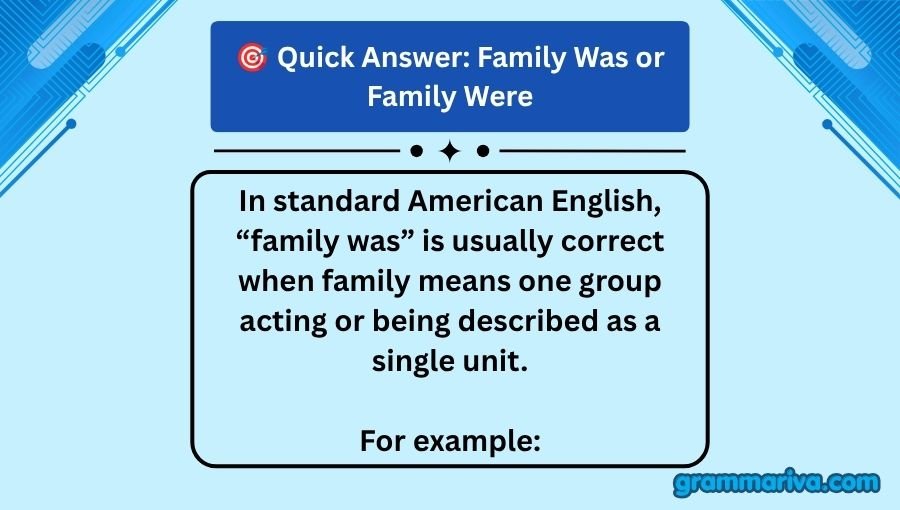
In standard American English, “family was” is usually correct when family means one group acting or being described as a single unit.
For example:
- ✅ My family was happy to hear the news.
- ❌ My family were happy to hear the news.
However, family were can appear when the members of the family are being treated as separate individuals, especially in British English.
The safest rule for US English is simple: Use “family was” when the family acts as one unit.
📚 Related Word Forms of Family
The word family has several useful forms. Knowing them can make sentence building easier.
| Form | Type | Example |
|---|---|---|
| family | Singular noun | My family was excited. |
| families | Plural noun | Several families were invited. |
| family’s | Singular possessive | My family’s house is nearby. |
| families’ | Plural possessive | The families’ homes were close. |
| familial | Adjective | They have a strong familial bond. |
The key point is that family is grammatically singular in standard American English. Its plural form is families.
🔎 Understanding Family Was or Family Were
The main difference comes from how you view the word family.
When family means one group, use the singular verb was. When the members are being discussed as individuals, some varieties of English may use were.
| Form | Type | Meaning | Example | Correct/Incorrect |
|---|---|---|---|---|
| family was | Singular collective noun | One group | My family was tired. | ✅ Correct |
| family were | Plural-style collective use | Individual members | My family were arguing among themselves. | ⚠️ Depends on dialect |
| families were | Plural noun | More than one family | The families were waiting. | ✅ Correct |
| family are | Plural-style use | Individual members | The family are divided. | ⚠️ Mostly British English |
| family is | Singular verb | One group in present tense | My family is large. | ✅ Correct |
For American readers and writers, family was is generally the best choice when the family is treated as one group.
❓ Is Family a Singular or Plural Noun
Family is normally a singular collective noun in American English. It refers to a group of related people, but the group itself is grammatically singular.
Consider this sentence:
My family was at the restaurant.
The family is being viewed as one group. Therefore, was agrees with the singular noun family.
Compare it with:
My family members were at the restaurant.
Now the subject is family members, which is plural. Therefore, were is correct.
| Subject | Verb | Example |
|---|---|---|
| My family | was | My family was there. |
| My family members | were | My family members were there. |
| My families | were | The families were there. |
| My parents | were | My parents were there. |
This is one of the easiest ways to solve the problem. If the subject is family, think singular. If the subject is family members, think plural.
🧠 Why Do People Confuse Family Was and Family Were
People often choose were because they know that a family contains multiple people.
That reasoning makes sense at first. But grammar does not always work from the number of people inside a group. It works from the grammatical number of the noun being used.
A family can contain five people, but family is still a singular noun.
I once edited a short workplace message that said, “My family were planning to visit next month.” The writer was thinking about several people. The meaning was clear, but in standard American English, “My family was planning to visit” was the cleaner choice.
The confusion often comes from collective nouns such as:
- family
- team
- company
- committee
- class
- audience
- group
These words describe groups but can still be grammatically singular.
💡 Test Tip
Try replacing family with it.
My family was visiting us.
Can you say:
It was visiting us.
Yes.
That tells you the group is being treated as one unit.
Now consider:
My family members were visiting us.
You cannot replace family members with it. The plural subject needs they:
They were visiting us.
That simple substitution test can help you choose the correct verb.
🏠 Family Was: Meaning and Correct Use
Family was is the standard choice when the family is treated as one group.
Family acting as one unit
Use was when the whole family shares one action, feeling, condition, or experience.
- ✅ My family was excited about the trip.
- ❌ My family were excited about the trip.
Here, the family shares one feeling.
Family in a past situation
Use was when describing where the family was or what condition it experienced.
- ✅ My family was at home.
- ✅ My family was tired after the journey.
- ✅ My family was ready for dinner.
In each sentence, the group is considered one unit.
Family with a singular description
You also use was when the family is described as having one shared quality.
- ✅ My family was very supportive.
- ✅ Her family was wealthy.
- ✅ His family was known for its kindness.
| Meaning | Word Type | Example Sentence |
|---|---|---|
| One group | Collective noun | My family was together. |
| Shared feeling | Collective noun | My family was happy. |
| Shared condition | Collective noun | My family was tired. |
| Shared location | Collective noun | My family was at home. |
❓ When Can Family Were Be Used
Family were is possible in some varieties of English, especially British English, when the individual members of the family are emphasized.
For example:
The family were arguing among themselves.
The writer is focusing on the separate people rather than the family as one unit.
Another example is:
The family were all wearing different colors.
The focus is on the individual members and what each person was wearing.
This usage is less natural in standard American English. An American writer would often say:
The family members were arguing among themselves.
or:
Everyone in the family was arguing.
These alternatives remove the ambiguity.
| Sentence | Main Focus | US English Preference |
|---|---|---|
| The family was eating dinner. | One group | Preferred |
| The family was happy. | Shared feeling | Preferred |
| The family members were eating. | Individual people | Preferred |
| The family were arguing. | Individual members | Less common in US English |
| Everyone in the family was arguing. | Individual people | Clear |
🇺🇸 Family Was in American English
In American English, family was is generally the natural choice when family is the subject.
For example:
- ✅ My family was proud of me.
- ✅ Her family was waiting outside.
- ✅ Their family was living in Texas.
- ✅ The family was sitting together.
- ✅ My whole family was invited.
American English usually treats collective nouns as singular when the group is acting as one unit.
This does not mean Americans can never describe individual members. Instead, American English often changes the noun phrase to make the meaning clear.
Instead of:
The family were disagreeing.
an American writer might say:
The family members were disagreeing.
That version makes the plural meaning obvious.
🇬🇧 Why British English May Use Family Were
British English sometimes treats collective nouns as either singular or plural, depending on the intended meaning.
That means you may encounter sentences such as:
The family were getting ready.
The writer may be thinking about the separate family members.
This difference explains why learners sometimes find conflicting examples online. Both forms can appear in English, but they are not equally natural in every variety of English.
| Variety | One Group | Individual Members |
|---|---|---|
| American English | family was | family members were |
| British English | family was | family were may occur |
| Formal US writing | family was | members of the family were |
| Informal US speech | family was | family members were |
If your audience is American, family was is normally the safest choice.
📝 Case Study: Choosing the Right Form at Work
Imagine that you are writing an email to your manager after a family emergency.
You might write:
My family was dealing with a difficult situation, so I needed to leave early.
That sentence sounds natural in American English.
Now imagine you want to explain that several people were involved in different ways:
My parents and siblings were handling different parts of the situation.
The second sentence uses were because parents and siblings is plural.
The difference is not about the number of people. It is about the grammatical subject.
| Sentence | Subject | Verb |
|---|---|---|
| My family was dealing with it. | family | was |
| My parents were dealing with it. | parents | were |
| My siblings were helping. | siblings | were |
| Everyone in my family was helping. | everyone | was |
This is a useful lesson for emails, reports, school work, and professional writing.
📖 Grammar Rules Explanation: Why Family Was Is Usually Correct
The basic rule is subject-verb agreement.
A singular subject normally takes a singular verb in the past tense. The singular past form of be is was.
The noun family is normally singular in American English.
Therefore:
The family was happy.
is standard.
The plural form families takes were:
The families were happy.
The important idea is that the grammatical number of family does not change simply because the family contains multiple people.
A collective noun names a group as a single entity. Examples include team, committee, company, and family.
However, English varieties differ in how they handle collective nouns. British English may use a plural verb when the writer wants to stress the individuals within the group.
Most standard grammar references agree on the main American English pattern: treat family as singular when it represents one unit.
Correct vs Incorrect at a Glance
| Sentence | Correct/Incorrect | Why |
|---|---|---|
| My family was happy. | ✅ Correct | Family is one group. |
| My family were happy. | ❌ Usually incorrect in US English | Plural treatment is not normally used here. |
| My family members were happy. | ✅ Correct | Members is plural. |
| The families were happy. | ✅ Correct | Families is plural. |
| Everyone in my family was happy. | ✅ Correct | Everyone is singular. |
⚠️ Common Mistakes With Family Was or Family Were
Several things can cause this mistake.
Fast typing
When people type quickly, they often choose the verb based on meaning rather than grammar.
They think:
Family = several people = were.
But that shortcut is not reliable.
Autocorrect
Autocorrect may not always understand the exact meaning of a sentence. It can also train writers to accept suggestions without checking subject-verb agreement.
Lack of grammar knowledge
If you have never studied collective nouns, the choice can seem strange.
The word family looks like a group of people, so were can feel logical.
Influence from British English
Readers who regularly consume British books, shows, websites, or news may see collective nouns used with plural verbs. This can influence their writing.
| Similar Confusion | Common Error | Correct Form |
|---|---|---|
| family was/were | My family were happy. | My family was happy. |
| team is/are | The team are ready. | The team is ready. |
| company was/were | The company were successful. | The company was successful. |
| group was/were | The group were waiting. | The group was waiting. |
| committee was/were | The committee were divided. | The committee was divided. |
Common Wrong Forms for This Topic
| Wrong Form | What’s Wrong | Correct Form |
|---|---|---|
| My family were happy. | Plural verb in standard US usage | My family was happy. |
| My family are happy. | Present plural treatment | My family is happy. |
| My families was happy. | Plural noun with singular verb | My families were happy. |
| My family was all arguing. | Can sound unclear if individuals are meant | My family members were arguing. |
| My family were planning it. | Usually not preferred in US English | My family was planning it. |
I once caught myself typing a similar collective-noun sentence in a draft. I stopped because the meaning involved the whole group, not separate members. Changing the sentence to singular made it much cleaner.
🕰️ Word Origin and History of Family
The word family has a long history in English, but its historical development is not necessary to decide whether to use was or were.
What matters for modern grammar is how the noun functions in the sentence.
English developed many nouns that describe groups. These nouns are called collective nouns. Their grammar can vary across English-speaking regions.
The modern US pattern generally treats family as singular when the group is viewed as one unit.
| Period | Form | General Note |
|---|---|---|
| Earlier English use | family | Developed as a group-related noun |
| Later English | family | Used for a household or related group |
| Modern American English | family | Usually singular |
| Modern British English | family | Can be singular or plural depending on meaning |
| Modern global English | family | Usage varies by region |
The historical details are less useful than the modern rule: choose the verb based on how the noun functions in your sentence and the variety of English you are writing.
🌎 Usage in Different Contexts
The choice becomes easier when you consider the setting.
Everyday Conversation
In everyday American conversation, family was is very common for past situations.
My family was at the beach yesterday.
Professional Writing
Professional American writing should usually use family was or a clearer plural phrase such as family members were.
My family was unable to attend the event.
Creative Writing
Creative writers have more flexibility. A British-style character, for example, may naturally use family were.
Social Media and Texting
Informal posts often ignore strict grammar, but family was is still the standard American choice.
| Context | Which Term to Use | Example |
|---|---|---|
| Everyday conversation | family was | My family was there. |
| Professional writing | family was | My family was unavailable. |
| Creative writing | family was/were depending on dialect | The family were arguing. |
| Social media/texting | family was | My family was so excited! |
💬 Common Phrases With Family
Some everyday expressions naturally use family as a singular noun.
| Phrase | Meaning |
|---|---|
| My family was there | The whole family was present |
| My family was happy | The group shared happiness |
| My family was together | The group was united or present |
| My family was at home | The group was at home |
| My family was invited | The group received an invitation |
| My family was proud | The family shared a feeling of pride |
These phrases are useful because they show how naturally family was works in American English.
🔄 Synonyms and Alternatives to Family
Sometimes you can avoid the grammar issue by choosing a different phrase.
| Alternative | Works When | Does Not Work When |
|---|---|---|
| family members | You mean individual relatives | You mean the group as one unit |
| relatives | You mean related people generally | You specifically mean your household |
| household | You mean people living together | The family lives in different homes |
| everyone in my family | You want maximum clarity | You need a short phrase |
| my loved ones | You mean people close to you | You need a formal family reference |
For example:
My family was waiting.
could become:
My family members were waiting.
The second sentence clearly focuses on individual people.
Another option is:
Everyone in my family was waiting.
This is especially useful when you want to stress that every person was involved.
💡 How to Remember the Difference
The easiest memory trick is:
Family = one group → was.
Family members = several people → were.
Think of these pairs:
- My family was there.
- My family members were there.
- My family was excited.
- My parents were excited.
- My family was together.
- My brothers were together.
A Simple Substitution Test
Replace family with it.
My family was happy.
becomes:
It was happy.
That works because family is singular here.
If you are talking about individual members, use they with a plural noun:
My family members were happy.
becomes:
They were happy.
This test is quick and reliable.
❓ Is Family Was Correct in a Sentence
Yes. Family was is correct when family is treated as one singular group in American English.
Examples include:
- My family was visiting.
- Her family was supportive.
- His family was nearby.
- Our family was excited.
- The family was waiting outside.
The important point is that family is grammatically singular even though it describes more than one person.
❓ Is Family Were Ever Correct
Yes, but the context matters.
Family were can be correct in varieties of English that allow plural agreement with collective nouns. It is especially associated with British English when the members are being viewed separately.
For standard American English, however, it is usually better to write:
The family members were arguing.
rather than:
The family were arguing.
This makes the intended meaning clear.
❓ Should I Say My Family Was or My Family Were
If you are writing standard American English, say:
My family was.
For example:
My family was excited about the vacation.
Use my family members were when you want to emphasize separate people.
❓ Is My Family Was Happy Correct
Yes.
My family was happy.
is grammatically correct in standard American English.
The sentence treats the family as one group with one shared emotional state.
❓ Is My Family Were Happy Correct
In standard American English, my family were happy is generally not the preferred form.
You may see this construction in British English or other varieties where collective nouns can take plural verbs.
For US writing, use:
My family was happy.
❓ Why Does Family Take Was Instead of Were
Because family is normally a singular collective noun in American English.
The fact that a family contains several people does not make the noun itself plural.
Compare:
The family was eating.
with:
The families were eating.
The first has one family. The second has more than one family.
❓ Should I Use Family Was in Formal Writing
Yes. Family was is appropriate in formal American writing when the family is treated as one group.
For example:
My family was unable to attend the ceremony.
This is clear, natural, and grammatically standard.
If the individual people matter, use:
My family members were unable to attend the ceremony.
❓ What Is the Difference Between Family Was and Family Were
The main difference is singular versus plural treatment of the collective noun.
In American English:
Family was = one group.
In varieties that allow plural collective nouns:
Family were = individual members within the group.
The safest American English choice is family was.
❓ Can Family Be Used With Were in British English
Yes. British English often allows collective nouns to take either singular or plural verbs depending on whether the group is viewed as one unit or as separate members.
For example:
The family was celebrating.
focuses on the family as one unit.
The family were arguing.
focuses more on the individual people.
This difference is one reason English learners may see both forms.
❓ What Is the Plural of Family
The plural of family is families.
For example:
One family was invited.
but:
Three families were invited.
The spelling changes from family to families, and the verb changes from was to were.
❓ Should I Say Family Was or Family Were in an Essay
For a US English essay, use family was when family means one group.
For example:
My family was deeply affected by the decision.
If you mean individual members, use a plural noun:
My family members were deeply affected by the decision.
This approach is clear and safe for academic writing.
❓ What About Everyone in the Family Was
Everyone in the family was is correct.
The word everyone is grammatically singular.
For example:
Everyone in my family was invited.
Even though everyone refers to multiple people, it takes a singular verb.
| Subject | Correct Verb | Example |
|---|---|---|
| family | was | My family was there. |
| everyone | was | Everyone was there. |
| family members | were | My family members were there. |
| parents | were | My parents were there. |
| families | were | The families were there. |
⚠️ Why Getting Family Was or Family Were Right Matters
Grammar is not only about passing tests. Clear grammar helps readers understand exactly what you mean.
A small verb choice can also reveal whether you are talking about a group or separate individuals.
| Situation | Why Getting It Right Matters |
|---|---|
| Resume or application | Shows careful writing |
| Client email | Creates a professional impression |
| Published content | Improves clarity and consistency |
| Social post | Makes your message easier to read |
A useful rule I teach is:
Clear grammar makes the intended meaning easier to see.
You do not need complicated grammar to write well. You need the right structure for the meaning you want.
🧩 Special Exception: Family as Individual Members
The main exception is not really an error. It is a difference in how collective nouns can work.
If you deliberately focus on the individual members, plural agreement may appear in British English.
For example:
The family were each given a separate room.
The word each strongly focuses on individuals.
For American English, you could make the same meaning clearer by writing:
The family members were each given a separate room.
This version avoids regional variation and works well for an international audience.
📋 Quick Recap Checklist
Use this checklist whenever you are unsure.
| Question | If Yes → Use |
|---|---|
| Does family mean one group? | family was |
| Are you writing standard US English? | family was |
| Are you talking about individual relatives? | family members were |
| Are you talking about more than one family? | families were |
| Are you using British English and focusing on individuals? | family were may work |
| Is the subject everyone? | everyone was |
Practice Examples
- My family ___ excited about the trip.
Answer: was ✅ - My family members ___ waiting outside.
Answer: were ✅ - Three families ___ invited to dinner.
Answer: were ✅ - Everyone in the family ___ ready.
Answer: was ✅ - The family ___ together at the table.
Answer: was in standard American English ✅
📊 Family Was or Family Were at a Glance
Here is the entire rule in one table.
| Sentence Pattern | Standard US Choice | Reason |
|---|---|---|
| My family was happy. | ✅ Yes | Family is one group |
| My family were happy. | ❌ Usually no | Plural treatment is not standard US usage |
| My family members were happy. | ✅ Yes | Members is plural |
| My families were happy. | ✅ Yes | Families is plural |
| Everyone in my family was happy. | ✅ Yes | Everyone is singular |
| The family was divided. | ✅ Yes | Family is treated as one group |
| The family members were divided. | ✅ Yes | Members are plural |
📝 Final Practical Examples
Here are some natural examples you can use as models.
Talking about a shared experience
- ✅ My family was on vacation last week.
- ❌ My family were on vacation last week.
Talking about individual relatives
- ✅ My family members were staying in different hotels.
- ❌ My family members was staying in different hotels.
Talking about multiple families
- ✅ The families were invited to the event.
- ❌ The families was invited to the event.
Talking about everyone
- ✅ Everyone in my family was excited.
- ❌ Everyone in my family were excited.
Talking about a group decision
- ✅ My family was planning to move.
- ❌ My family were planning to move.
These examples show the central rule again: family is normally singular in American English.
🔁 Family Was or Family Were: The Easy Rule
If you only remember one thing from this article, remember this:
In standard American English, use “family was” when family is treated as one group.
If you mean the individual people, change the subject to a clearly plural phrase:
family members were
or:
my parents were
or:
my siblings were
This is usually better than trying to force a plural verb onto family.
❓ FAQs About Family Was vs Family Were
Is “family was” grammatically correct?
Yes. Family was is grammatically correct in standard American English when family is treated as one group.
Is “family were” grammatically correct?
It can be correct in some varieties of English, especially British English, when the individual family members are emphasized. In standard US English, family was is usually preferred.
Should I say “my family was” or “my family were”?
For American English, say my family was.
Example:
My family was happy with the decision.
Why is “family” singular if it contains several people?
Because family is a collective noun. It names the group as one grammatical unit. The number of people inside the group does not automatically make the noun plural.
Is “my family was happy” correct?
Yes. It is a standard American English sentence.
Is “my family were happy” wrong?
In American English, it is generally not the preferred form. In British English, it may be acceptable depending on whether the writer views the family as separate individuals.
What is the plural of family?
The plural is families.
Example:
One family was there.
Several families were there.
Should I use “family members were”?
Yes, especially when you want to emphasize individual people.
Example:
My family members were discussing the problem.
Is “everyone in my family was” correct?
Yes. Everyone is grammatically singular.
Example:
Everyone in my family was excited.
Which is better for American English: “family was” or “family were”?
Family was is the standard and safest choice for American English when the family is treated as one unit.
🎯 Conclusion
Family was or family were becomes much easier once you remember how collective nouns work. In standard American English, use family was when you are talking about the family as one group. For example, “My family was excited about the trip” is the normal choice.
When you want to focus on individual people, use a clearly plural phrase such as family members were, parents were, or siblings were. This makes your meaning clear and avoids regional differences.
British English may sometimes use family were when the members of the family are viewed separately. That does not mean the American form is wrong. It simply reflects a different approach to collective nouns.
The best habit is to look at your subject before choosing the verb. If the subject is family, singular agreement is usually right in US English. If the subject is family members, use a plural verb.
Once you learn that simple pattern, this common grammar question becomes much easier.
When the family is one unit, remember: family was. ✨

Hi, I’m Nathan Reed. I’m a grammar and writing specialist at Grammariva. I work on practical grammar content that helps readers understand sentence structure, punctuation, vocabulary, and better writing habits.


[…] writing. By the end, you should be able to choose the right word without stopping to think. 😊 Family Was or Family Were | One vs Won | Based on vs Based Off […]