Have you ever typed piece of mine or peace of mind and stopped because you were not sure which phrase was right? You are not alone. These phrases sound similar when spoken quickly, but they have very different meanings. One can describe something that belongs to you. The other describes a calm and worry-free feeling. 😊
This small spelling difference can change the meaning of an entire sentence. That matters in emails, school assignments, social media posts, and everyday conversations. I have seen this mix-up many times while reviewing writing. It is easy to make, especially when typing fast.
The good news is that the rule is simple once you connect each phrase with its meaning. Piece of mine refers to something that belongs to me or comes from me. Peace of mind refers to a feeling of calm, safety, or freedom from worry.
In this guide, I will explain the difference in plain US English. You will learn when to use each phrase, why people confuse them, how to remember the difference, and how to avoid common mistakes. Roofs vs Rooves | Dieing vs Dying | For Who or For Whom
🎯 Quick Answer: Piece of Mine or Peace of Mind
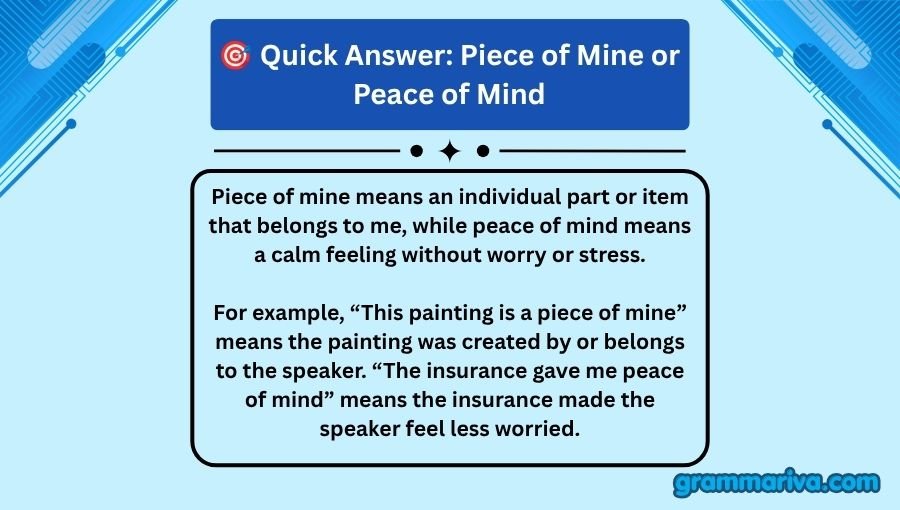
Piece of mine means an individual part or item that belongs to me, while peace of mind means a calm feeling without worry or stress.
For example, “This painting is a piece of mine” means the painting was created by or belongs to the speaker. “The insurance gave me peace of mind” means the insurance made the speaker feel less worried.
| Phrase | Meaning | Example |
|---|---|---|
| Piece of mine | Something that belongs to me or was created by me | This poem is a piece of mine. |
| Peace of mind | A feeling of calm or freedom from worry | The backup gave me peace of mind. |
The easiest clue is peace = calm. If you mean calm or relief from worry, use peace of mind.
🔎 Is Piece of Mine the Same as Peace of Mind?
No. Piece of mine and peace of mind are not the same phrase. They contain different words and express different ideas.
The confusion comes from sound. In casual speech, piece and peace sound exactly alike. However, their meanings and spellings are different.
Piece of mine
The word piece is a noun. It means a part, item, work, or portion of something.
The word mine is a possessive pronoun. It means something belongs to me.
Together, piece of mine can mean something that belongs to me or something I made.
Example:
“This short story is a piece of mine.”
Breakdown:
- piece = an item or work
- of = connects the item to the speaker
- mine = belonging to me
Peace of mind
The word peace is a noun connected with calm, quiet, or freedom from worry.
The word mind refers to a person’s thoughts and mental state.
Together, peace of mind describes a calm and secure feeling.
Example:
“Knowing that my family arrived safely gave me peace of mind.”
Breakdown:
- peace = calm
- of = connects the idea
- mind = thoughts or mental state
Comparison at a glance
| Form | Type | Meaning | Example | Correct/Incorrect |
|---|---|---|---|---|
| Piece of mine | Noun phrase | Something belonging to me | This song is a piece of mine. | ✅ Correct |
| Peace of mind | Noun phrase | Calm or freedom from worry | The plan gave me peace of mind. | ✅ Correct |
| Peace of mine | Mixed phrase | Usually not the intended expression | This song is a peace of mine. | ❌ Incorrect |
| Piece of mind | Misspelled phrase | Intended to mean calm | It gave me a piece of mind. | ❌ Incorrect |
The key difference is simple: piece is about an item or part. Peace is about calm.
💡 Why Do People Confuse Piece of Mine and Peace of Mind?
People confuse these phrases because piece and peace are homophones. Homophones are words that sound alike but have different spellings and meanings.
When we speak, the difference disappears. When we write, the difference becomes visible.
I once edited a short personal essay where a student wrote, “Finishing the project gave me a piece of mind.” The student clearly meant that finishing the project made them feel calm. Changing piece to peace fixed the sentence immediately.
There are three common reasons for this mix-up:
- Fast typing: People type the word that comes to mind first.
- Autocorrect: A phone may not understand the intended meaning.
- Lack of knowledge: Writers may know how the phrase sounds but not how it is spelled.
| Confusing Pair | Correct Use | Meaning |
|---|---|---|
| piece / peace | piece | an item or part |
| piece / peace | peace | calm or absence of conflict |
| mine / mind | mine | belonging to me |
| mine / mind | mind | thoughts or mental awareness |
| your / you’re | your | belonging to you |
| your / you’re | you’re | you are |
| its / it’s | its | belonging to it |
| its / it’s | it’s | it is or it has |
The important thing is not to memorize spelling alone. Connect each spelling to an idea.
🧩 Piece of Mine: Meaning and Correct Use
Piece of mine is used when you want to describe something as belonging to you or being one of your works.
The phrase often appears when people talk about art, writing, music, collections, or personal belongings.
Something you created
You can call your own creative work a piece of mine.
Example:
“This painting is a piece of mine.”
Here, piece means a work of art, while mine shows ownership.
Something that belongs to you
The phrase can also describe an object that belongs to you.
Example:
“That old guitar is a piece of mine that I have kept for years.”
The exact meaning depends on context. The main idea is ownership or personal connection.
Something that comes from you
A person may use piece of mine when discussing writing, music, artwork, or another contribution.
Example:
“The editor chose a piece of mine for the magazine.”
The speaker means one of their own works.
| Meaning | Word Type | Example Sentence |
|---|---|---|
| Personal work | Noun phrase | The article is a piece of mine. |
| Personal item | Noun phrase | This old watch is a piece of mine. |
| Personal contribution | Noun phrase | They published a piece of mine. |
💡 Test Tip
Ask yourself:
“Am I talking about an item, part, work, or something that belongs to me?”
If the answer is yes, piece of mine may be the phrase you need.
🕊️ Peace of Mind: Meaning and Correct Use
Peace of mind means a feeling of calm, safety, confidence, or freedom from worry.
It is a common fixed phrase in English. It often appears when something removes fear or uncertainty.
Feeling less worried
Example:
“Having a backup plan gives me peace of mind.”
The speaker feels calmer because there is a backup plan.
Feeling safe or secure
Example:
“Installing a security system gave them peace of mind.”
The security system does not create literal silence. It creates a sense of safety.
Feeling confident about a decision
Example:
“The doctor’s explanation gave her peace of mind.”
The explanation helped her feel less worried.
| Meaning | Word Type | Example Sentence |
|---|---|---|
| Calm | Noun phrase | The quiet room gave me peace of mind. |
| Freedom from worry | Noun phrase | Insurance can provide peace of mind. |
| Sense of security | Noun phrase | The lock gives us peace of mind. |
The phrase is usually about an emotional or mental state, not a physical object.
✍️ Piece of Mine vs Peace of Mind at a Glance
The fastest way to understand piece of mine or peace of mind is to compare the ideas behind the words.
| Phrase | Main Idea | Typical Context | Example |
|---|---|---|---|
| Piece of mine | Ownership or personal work | Art, writing, belongings | This is a piece of mine. |
| Peace of mind | Calm or security | Safety, decisions, worry | This gives me peace of mind. |
| Piece | Part or item | Objects and works | I bought a piece of furniture. |
| Peace | Calm or harmony | Feelings and situations | I finally felt peace. |
| Mine | Belonging to me | Ownership | That notebook is mine. |
| Mind | Thoughts or mental state | Feelings and thinking | Put your mind at ease. |
A useful trick is to focus on mine versus mind too. If something belongs to you, think mine. If you are talking about thoughts or worry, think mind.
🏢 How Is the Difference Used in Professional Writing?
Professional writing needs the correct phrase because a spelling error can change your meaning.
If you are describing your work, piece of mine can be appropriate.
Example:
“I have attached a recent piece of mine for your review.”
If you are describing reassurance or confidence, use peace of mind.
Example:
“The updated security process gives our clients peace of mind.”
Correct vs incorrect examples
✅ The editor accepted a piece of mine.
❌ The editor accepted a peace of mine.
The first sentence refers to the writer’s work.
✅ The new backup system gives customers peace of mind.
❌ The new backup system gives customers piece of mind.
The second sentence refers to a feeling of security.
| Professional Situation | Correct Phrase | Example |
|---|---|---|
| Submitting an article | Piece of mine | I attached a piece of mine. |
| Describing customer confidence | Peace of mind | The service offers peace of mind. |
| Discussing artwork | Piece of mine | This is a piece of mine. |
| Describing security | Peace of mind | The system provides peace of mind. |
📝 Case Study: A Simple Workplace Example
Imagine that Maya works as a freelance writer. She sends an email to a magazine editor.
She wants to say that she has attached one of her articles.
Her first draft says:
❌ “I have attached a peace of mine for your review.”
The editor may understand what she means from context, but the phrase is wrong.
The corrected sentence is:
✅ “I have attached a piece of mine for your review.”
Now imagine Maya is writing about a secure file system.
She writes:
❌ “The automatic backup gives me a piece of mind.”
That is also incorrect.
The correct sentence is:
✅ “The automatic backup gives me peace of mind.”
I once caught a similar mistake in my own notes after typing quickly. I had written piece of mind when I meant peace of mind. Reading the sentence aloud did not help because the words sound the same. Checking the meaning did.
That is the real lesson: sound cannot always tell you which spelling to use. Meaning can.
📚 Grammar Rules Behind Piece of Mine and Peace of Mind
The two phrases are grammatically valid in the right contexts, but they do different jobs.
Piece of mine is a noun phrase built around piece. The word mine shows possession.
Peace of mind is a noun phrase built around peace. It refers to a mental or emotional state of calm.
The grammar itself is not the main problem. The spelling and meaning are.
Standard English reference sources and major dictionaries recognize piece and peace as separate words with separate meanings. The same basic distinction applies whether you are writing a formal email or a casual text.
Why “piece of mind” is usually wrong
If you write:
❌ “The insurance gives me a piece of mind.”
you are using piece to describe something that should mean calm or relief from worry.
That does not fit the intended meaning.
The correct form is:
✅ “The insurance gives me peace of mind.”
Here, peace expresses calm.
Why “peace of mine” is usually wrong
If you write:
❌ “This painting is a peace of mine.”
you are using peace where you need piece.
A painting can be a piece of yours. It is not normally a peace of yours.
Correct vs Incorrect at a Glance
| Sentence | Correct/Incorrect | Why |
|---|---|---|
| This article is a piece of mine. | ✅ Correct | It is the speaker’s work. |
| This article is a peace of mine. | ❌ Incorrect | “Peace” does not mean a work or item here. |
| The warranty gives me peace of mind. | ✅ Correct | The warranty reduces worry. |
| The warranty gives me piece of mind. | ❌ Incorrect | The intended phrase is “peace of mind.” |
| I submitted a piece of mine. | ✅ Correct | “Piece” refers to the speaker’s work. |
⚠️ Common Mistakes With These Phrases
The most common mistake is writing piece of mind instead of peace of mind.
Another mistake is writing peace of mine when talking about personal work.
These errors are easy to make because English contains many words that sound alike.
I once reviewed a business message that used “piece of mind” twice. The writer knew exactly what they wanted to say. They simply had never connected the spelling peace with the idea of calm.
Common causes
Fast typing: You may type what you hear rather than what you mean.
Autocorrect: A device can sometimes keep the wrong word because both words are valid English words.
Lack of knowledge: You may have learned the phrase by hearing it instead of seeing it in writing.
Relying on sound: Since piece and peace sound the same, pronunciation cannot solve this problem.
| Mistake Type | Wrong Example | Correct Example |
|---|---|---|
| Homophone confusion | piece of mind | peace of mind |
| Possession confusion | peace of mine | piece of mine |
| Missing article | piece of mine work | a piece of mine |
| Wrong meaning | a peace of writing | a piece of writing |
| Wrong mental phrase | piece of mind | peace of mind |
Specific wrong forms
| Wrong Form | What’s Wrong | Correct Form |
|---|---|---|
| Piece of mind | “Piece” does not mean calm here | Peace of mind |
| Peace of mine | “Peace” does not mean an owned item | Piece of mine |
| Piece of mine mind | Extra word changes the phrase | Piece of mine |
| Peace of my | Incomplete possessive phrase | Peace of mind |
| A peace of mine | Wrong word for a personal work | A piece of mine |
| A piece of mind | Wrong word for calm | Peace of mind |
🧠 How To Remember the Difference
The best memory trick is to connect each word with another word that explains it.
Think:
Piece = part or item.
Peace = calm.
Mine = belongs to me.
Mind = thoughts.
Now combine them:
Piece of mine = an item or work that belongs to me.
Peace of mind = calm in my thoughts.
Try this quick memory test
If you could replace the phrase with “something I made”, think piece of mine.
If you could replace it with “calm” or “freedom from worry,” think peace of mind.
| If You Mean… | Use |
|---|---|
| My artwork | Piece of mine |
| My article | Piece of mine |
| My song | Piece of mine |
| Calm | Peace of mind |
| Security | Peace of mind |
| Relief from worry | Peace of mind |
This simple test works in most everyday situations.
🌎 Usage in Different Contexts
The right phrase depends on what you are trying to say. Piece of mine works best when discussing ownership or personal work. Peace of mind works when discussing calm, safety, or reassurance.
| Context | Which Term to Use | Example |
|---|---|---|
| Everyday conversation | Either, depending on meaning | This poem is a piece of mine. |
| Professional writing | Either, depending on meaning | The service provides peace of mind. |
| Creative writing | Either, depending on meaning | She shared a piece of mine. |
| Social media/texting | Either, depending on meaning | This gives me peace of mind. |
Everyday conversation
People often use piece of mine when talking about something they created.
“That song is a piece of mine.”
They may use peace of mind when describing relief.
“Knowing the kids are home gives me peace of mind.”
Professional writing
Both phrases can appear in professional writing, but the meaning must be clear.
Piece of mine:
“I am pleased to share a recent piece of mine.”
Peace of mind:
“Our secure payment system gives customers peace of mind.”
Creative writing
Creative writers may use both phrases in personal and artistic contexts.
“The painting is a small piece of mine.”
“The quiet forest gave him peace of mind.”
Social media and texting
Casual writing often contains homophone errors. Even though social media is informal, correct spelling still makes a post easier to understand.
💬 Common Phrases With Peace of Mind
Peace of mind appears in several common expressions. These phrases are worth learning as complete units.
| Phrase | Meaning |
|---|---|
| Peace of mind | A calm or worry-free feeling |
| Give someone peace of mind | Make someone feel calmer or safer |
| Have peace of mind | Feel calm or secure |
| For peace of mind | To reduce worry |
| Provide peace of mind | Offer reassurance or security |
| Some peace of mind | A certain amount of calm or relief |
Examples:
- “The backup gives me peace of mind.”
- “I checked the door again for peace of mind.”
- “The warranty provides peace of mind.”
- “I just want some peace of mind before the trip.”
These are natural examples of the fixed phrase.
🔄 Synonyms and Alternatives
Sometimes you can replace peace of mind with another expression. The best choice depends on the sentence.
| Alternative | Works When | Does Not Work When |
|---|---|---|
| Calm | You mean a peaceful feeling | You need a more specific phrase |
| Reassurance | Something reduces doubt or worry | You mean physical peace |
| Sense of security | Safety is the main idea | You mean artistic work |
| Relief | Worry has already decreased | You mean long-term confidence |
| Comfort | Something makes you feel better | You need the exact fixed phrase |
For example:
“The insurance gives me peace of mind.”
could become:
“The insurance gives me reassurance.”
But the two phrases are not always identical. Peace of mind often suggests an ongoing feeling of calm or security.
For piece of mine, alternatives include:
- my work
- one of my works
- something I created
- one of my pieces
- my contribution
These alternatives are useful when repeating the same phrase would sound awkward.
❤️ Why Getting the Difference Right Matters
Correct word choice improves clarity. A reader should not have to guess whether you mean an object or a feeling.
Professionalism also matters. A spelling mistake in a casual text may not cause trouble. The same mistake in a resume, client email, article, or published page can make the writer seem less careful.
Digital communication makes this especially important because people often type quickly and rely on sound.
| Situation | Why Getting It Right Matters |
|---|---|
| Resume | Shows attention to language |
| Client email | Builds trust and professionalism |
| Published content | Protects clarity and credibility |
| Social post | Prevents confusing readers |
A useful writing principle is:
Choose words by meaning, not just by sound.
That rule works far beyond these two phrases. English has many homophones, so learning their meanings is more useful than learning their sounds alone.
❓ Is Piece of Mine or Peace of Mind Correct?
Both phrases are correct, but they are correct in different situations.
Use piece of mine for something that belongs to you or is one of your works. Use peace of mind for calm, reassurance, or freedom from worry.
“This story is a piece of mine.” ✅
“The story gave me peace of mind.” ✅
The surrounding meaning tells you which phrase belongs in the sentence.
🗣️ Can Piece of Mine Refer to Writing or Art?
Yes. Piece of mine can refer to a work created by the speaker.
For example:
“The magazine published a piece of mine.”
Here, piece can mean a written work, while mine means it belongs to the speaker.
The phrase can also be used for music, artwork, photography, or another personal creation.
🕊️ Does Peace of Mind Mean Calm?
Yes. Peace of mind means a calm or worry-free mental state.
For example:
“Knowing that everything is ready gives me peace of mind.”
The phrase often suggests that something has reduced uncertainty, fear, or stress.
✏️ Is “Piece of Mind” Ever Correct?
In standard everyday English, piece of mind is usually an incorrect spelling when you mean calm or freedom from worry.
The standard phrase for that meaning is peace of mind.
There may be unusual contexts where someone intentionally uses piece and mind as separate literal words, but that does not create the fixed expression peace of mind.
🎯 What Is the Easiest Way to Remember Peace of Mind?
Remember this pair:
Peace = calm.
Piece = part.
Then remember:
Mine = belongs to me.
Mind = thoughts.
So:
Piece of mine = my part or my work.
Peace of mind = calm in my thoughts.
This four-word association is often enough to prevent the mistake.
📱 Why Do Autocorrect and Phones Cause This Error?
Both piece and peace are real English words. Spell-check tools may not flag the wrong one if the word is spelled correctly but used incorrectly.
For example, “piece of mind” contains correctly spelled words. The problem is meaning, not basic spelling.
That is why proofreading should include a meaning check. Do not only look for red underlines.
Ask:
“Does this word express the idea I want?”
That extra question can catch many homophone errors.
🧾 Quick Recap Checklist
Use this checklist before you submit your writing.
| Question | If Yes → Use |
|---|---|
| Am I talking about an item or part? | Piece |
| Am I talking about something I created? | Piece of mine |
| Am I talking about something that belongs to me? | Piece of mine |
| Am I talking about calm? | Peace of mind |
| Am I talking about relief from worry? | Peace of mind |
| Am I talking about safety or reassurance? | Peace of mind |
Practice Examples
- “This painting is a ___ of mine.”
Answer: piece ✅ - “The safety system gives us ___ of mind.”
Answer: peace ✅ - “The writer submitted a ___ of mine.”
Answer: piece ✅
Try to solve each one by meaning instead of sound.
🔍 Key Differences Between Piece of Mine and Peace of Mind
Here is the whole rule in one place.
| Feature | Piece of Mine | Peace of Mind |
|---|---|---|
| Main word | Piece | Peace |
| Main meaning | Item, part, or work belonging to me | Calm or freedom from worry |
| Possessive word | Mine | None |
| Mental state | No | Yes |
| Creative work | Yes | No |
| Security or reassurance | No | Yes |
| Common mistake | Peace of mine | Piece of mind |
If you remember only one thing, remember this:
A piece is something you can describe as an item or work. Peace of mind is a feeling.
❔ FAQs About Piece of Mine vs Peace of Mind
What is the difference between piece of mine and peace of mind?
Piece of mine refers to something that belongs to you or something you created. Peace of mind refers to calm, reassurance, or freedom from worry. The two phrases sound similar but have different meanings and spellings.
Is it piece of mind or peace of mind?
When you mean calm or freedom from worry, the correct phrase is peace of mind.
Example:
“Having insurance gives me peace of mind.”
Piece of mind is normally a spelling error when used with this meaning.
Is it peace of mine or piece of mine?
When you mean something that belongs to you or something you created, use piece of mine.
Example:
“This article is a piece of mine.”
Peace of mine is not the normal phrase for ownership.
Can I say “a piece of mine” about an article?
Yes. A piece of mine can refer to an article, story, poem, essay, artwork, song, or another work created by you.
Example:
“The newspaper published a piece of mine last week.”
Does peace of mind mean happiness?
Not exactly. Peace of mind mainly means a calm feeling or freedom from worry. A person can have peace of mind without feeling extremely happy.
For example, knowing that your important documents are safely stored can give you peace of mind.
Why do piece and peace get confused?
They are homophones. They sound the same in normal speech but have different meanings and spellings. Writers can therefore choose the wrong spelling when they rely on sound instead of meaning.
What is an easy trick for remembering peace of mind?
Connect peace with calm and mind with thoughts. Then remember that peace of mind means calm in your thoughts or freedom from worry.
Connect piece with part or item.
Can “piece of mine” mean something I made?
Yes. It can describe one of your creative works or contributions.
Example:
“This poem is a piece of mine.”
The word mine shows that the work belongs to the speaker.
Is “piece of mind” always wrong?
It is wrong when you are trying to write the fixed phrase meaning calm or freedom from worry. In that situation, use peace of mind.
A literal combination of the words “piece” and “mind” could occur in a different sentence, but that does not make piece of mind the standard phrase.
Which phrase should I use in a business email?
Use the phrase that matches your meaning. If you are referring to your work, use piece of mine. If you are describing reassurance or security, use peace of mind.
For example:
“I have attached a piece of mine for consideration.”
or
“Our service is designed to give customers peace of mind.”
✅ Final Conclusion
Piece of mine or peace of mind becomes easy once you focus on meaning instead of sound. Piece of mine refers to an item, part, creative work, or contribution that belongs to you. Peace of mind refers to calm, reassurance, safety, or freedom from worry.
When you see piece, think part or item. When you see peace, think calm. Then remember that mine shows ownership, while mind connects to thoughts.
This small trick can help you avoid one of the most common homophone mistakes in everyday English. It also helps your writing look cleaner and more professional. ✨
I recommend reading the full sentence before choosing the spelling. Ask yourself what you really mean. Are you talking about something you made? Choose piece of mine. Are you talking about feeling calm or less worried? Choose peace of mind.
Once you connect each phrase with its meaning, the spelling becomes much easier to remember. Keep this rule in mind, and you will rarely confuse these two phrases again. 🌟

Hi, I’m Madison Hayes. I’m an English learning writer at Grammariva, where I work on simple lessons and examples for people who want to improve their grammar and writing. I love turning confusing rules into easy-to-follow explanations.
[…] the end, you should feel confident whenever you face the it is must vs it is a must question. ✨Piece of Mine or Peace of Mind | Roofs vs Rooves | Dieing vs […]
[…] end, you should be able to choose the right word with confidence. 😊 It Is Must vs It Is a Must| Piece of Mine or Peace of Mind | Roofs vs […]