Have you ever typed a word that looked right, only to wonder later if you had used the wrong spelling? Resister vs resistor is a good example. These words look almost the same, but they do not mean the same thing. One refers to a person or thing that resists. The other is a specific electrical component. ⚡
I have seen this mix-up in school notes, technical writing, emails, and online posts. The confusion is easy to understand. Both words come from the idea of “resist,” and only one letter changes. Yet that small difference can change the meaning of an entire sentence.
If you are writing about electronics, resistor is usually the word you need. If you are describing someone who opposes or fights against something, resister may be correct.
In this guide, I will explain the difference in simple US English. We will look at meanings, examples, grammar rules, common mistakes, word forms, contexts, and memory tricks. By the end, you should be able to choose the right word with confidence. 😊 It Is Must vs It Is a Must| Piece of Mine or Peace of Mind | Roofs vs Rooves
🎯 Quick Answer: Resister vs Resistor
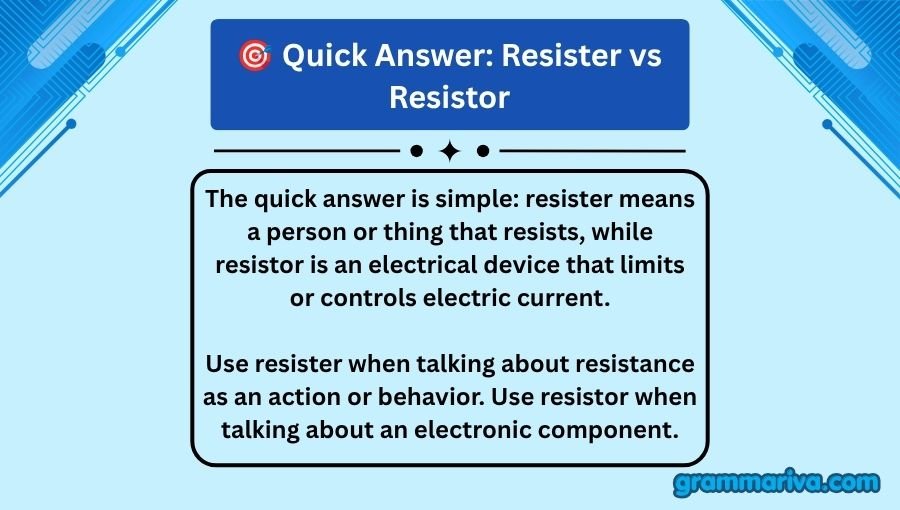
The quick answer is simple: resister means a person or thing that resists, while resistor is an electrical device that limits or controls electric current.
Use resister when talking about resistance as an action or behavior. Use resistor when talking about an electronic component.
| Word | Basic Meaning | Common Context |
|---|---|---|
| resister | Someone or something that resists | People, groups, actions |
| resistor | An electrical component that resists current | Electronics and engineering |
| resisting | Taking action against something | General writing |
| resistance | The act or quality of resisting | General and technical writing |
For example:
- Resister: The resister refused to follow the order.
- Resistor: The technician replaced the damaged resistor.
The spelling difference is small, but the meanings are very different.
🔎 What Does Resister Mean?
A resister is someone or something that resists. In simple terms, it is a person, group, or object that pushes back against something.
The word is formed from the verb resist with the ending -er. The ending often creates a noun for a person or thing that performs an action.
Consider these examples:
- A person who teaches is a teacher.
- A person who drives is a driver.
- A person who runs is a runner.
- A person who resists can be called a resister.
Resister as a Person
The most natural use of resister is for a person who opposes something.
Example:
“The resister refused to accept the new rule.”
Here, “resister” identifies the person doing the resisting.
Resister as a General Noun
The word can also describe someone who resists pressure, control, change, or authority.
Example:
“She was known as a strong resister of unfair policies.”
The exact meaning depends on the sentence.
| Meaning | Word Type | Example Sentence |
|---|---|---|
| Person who resists | Noun | The resister stood firm. |
| Person who opposes something | Noun | He became a resister of the new policy. |
| Something that resists | Noun | The material acts as a resister of heat. |
The key idea is always resistance.
⚡ What Does Resistor Mean?
A resistor is an electrical component designed to resist the flow of electric current.
This is a technical noun used mainly in electronics and electrical engineering. A resistor is commonly used in circuits to control current or create a desired voltage drop.
For example:
“The circuit needs a 100-ohm resistor.”
The word “resistor” refers to the physical electronic part. It does not normally refer to a person who disagrees with something.
A basic resistor may look like a tiny cylinder with colored bands, or it may have another design depending on the type of circuit.
| Term | Meaning | Example |
|---|---|---|
| Resistor | Electrical component | The resistor limits current. |
| Resistance | Opposition to current flow | The circuit has high resistance. |
| Current | Flow of electric charge | Current passes through the circuit. |
| Circuit | Connected electrical path | The resistor is part of the circuit. |
A useful rule is this:
If the sentence is about electricity, circuits, voltage, or current, “resistor” is probably the correct word.
🆚 Resister vs Resistor at a Glance
The main difference between resister and resistor is their meaning and context. A resister is related to the act of resisting. A resistor is an electronic component.
| Form | Type | Meaning | Example | Correct/Incorrect |
|---|---|---|---|---|
| Resister | Noun | Person or thing that resists | The resister rejected the demand. | ✅ Correct |
| Resistor | Noun | Electrical component | The resistor controls current. | ✅ Correct |
| Resister | Noun | Electrical component | Install the resister in the circuit. | ❌ Incorrect |
| Resistor | Noun | Person who opposes something | The resistor refused the order. | ❌ Usually incorrect |
| Resisting | Verb/adjective form | Opposing or pushing back | She is resisting the change. | ✅ Correct |
The important clue is the ending.
-er in “resister” connects directly to the action of resisting.
-or in “resistor” is the standard spelling for the electronic component.
🧠 Why Do People Confuse Resister and Resistor?
People confuse these words because both are built around the word resist. They also sound similar and differ by only one letter.
I once reviewed a student’s electronics report where almost every use of “resistor” had been written as “resister.” The student clearly understood the circuit. The problem was simply the spelling. Once I explained that a resistor is the physical component, the mistake disappeared.
Several factors cause this confusion:
- The words look almost identical.
- Both relate to the idea of resistance.
- People often hear the words before seeing them in writing.
- Autocorrect may not catch the error.
- Technical vocabulary can be unfamiliar.
- Fast typing makes one-letter mistakes easy.
A Simple Mental Picture
When you see resistor, picture a small electronic component sitting on a circuit board.
When you see resister, picture a person saying, “No, I will not!”
That mental contrast can make the difference much easier to remember.
❓ Is Resister the Same as Resistor?
No, resister and resistor are not normally interchangeable. Resister refers to someone or something that resists, while resistor refers specifically to an electrical component.
Compare these sentences:
✅ The resistor reduced the current in the circuit.
❌ The resister reduced the current in the circuit.
The second sentence sounds wrong because the writer is talking about an electronic part.
Now consider:
✅ The resister refused to cooperate.
❌ The resistor refused to cooperate.
The first sentence describes a person who resists. The second sentence makes “resistor” sound like an electronic part.
| Sentence | Correct/Incorrect | Why |
|---|---|---|
| The resistor limits current. | ✅ Correct | It describes an electrical component. |
| The resister limits current. | ❌ Incorrect | “Resister” is not the standard technical term here. |
| The resister opposed the plan. | ✅ Correct | It describes someone who resists. |
| The resistor opposed the plan. | ❌ Usually incorrect | “Resistor” normally means the electronic component. |
| Replace the broken resistor. | ✅ Correct | The sentence concerns electronics. |
✍️ Resister vs Resistor: Correct Meanings and Uses
Understanding the meaning is the easiest way to choose between the two words.
Resister for Someone Who Resists
Use resister when the noun describes someone who opposes or refuses something.
Example:
“The resister would not give up.”
Sentence breakdown:
- The = article
- resister = person who resists
- would not give up = action
The word describes a person.
Resistor for an Electronic Part
Use resistor when you mean the component found in an electrical circuit.
Example:
“The resistor became hot.”
Sentence breakdown:
- The = article
- resistor = electronic component
- became hot = what happened to it
Here, “resistor” is the subject of the sentence.
Resister vs Resistor Meaning Table
| Word | Main Meaning | Example |
|---|---|---|
| Resister | A person or thing that resists | The resister refused the demand. |
| Resistor | An electronic component | The resistor became damaged. |
| Resist | To oppose or withstand | They resisted the change. |
| Resistance | Opposition or electrical opposition | The circuit has resistance. |
💡 Test Tip
Ask yourself:
“Am I talking about a person or an electronic component?”
If you mean a person who resists, choose resister.
If you mean an electronic component, choose resistor.
This one question solves most cases.
📝 Case Study: A Mistake in a Technical Email
Imagine a technician sends this email:
“The resister on the control board needs to be replaced.”
The reader may understand what the writer means. Still, resistor is the correct technical term.
A clearer version would be:
“The resistor on the control board needs to be replaced.”
I once caught a similar error while checking a short technical document. The writer had used the word “resister” several times. The context made the intended meaning obvious, but the spelling reduced the professional quality of the document.
This matters because technical writing depends on exact terms.
Workplace Example
Suppose an engineer writes:
“Please check the resistor near the power connector.”
That sentence is clear. The reader knows the writer means an electronic component.
Now compare:
“Please check the resister near the power connector.”
The reader may still understand the message, but the terminology is not standard.
| Situation | Better Word | Example |
|---|---|---|
| Circuit repair | Resistor | Replace the faulty resistor. |
| Electronics report | Resistor | The resistor has overheated. |
| Describing an opponent | Resister | The resister rejected the demand. |
| General resistance | Resister | He became a resister of the policy. |
📚 Grammar Rules Explanation
The difference between these words comes from how English forms nouns and how technical vocabulary develops.
Resister is a noun connected to the verb resist. It identifies a person or thing that resists.
Resistor is the established technical noun for an electrical component that provides resistance in a circuit.
Neither word is simply a different spelling of the other. They have separate uses.
In standard English, context determines which noun fits.
Do not choose based only on sound. Look at the meaning first.
The basic rule is:
Person or thing that resists → resister.
Electrical component → resistor.
A standard English dictionary can also help confirm spelling when you are unsure, but meaning and context usually make the choice clear.
Correct vs Incorrect at a Glance
| Sentence | Correct/Incorrect | Why |
|---|---|---|
| The resistor controls the current. | ✅ Correct | It is an electronic component. |
| The resister controls the current. | ❌ Incorrect | The standard technical term is “resistor.” |
| The resister opposed the decision. | ✅ Correct | The noun describes someone who resists. |
| The resistor opposed the decision. | ❌ Usually incorrect | “Resistor” normally refers to electronics. |
| We need to replace this resistor. | ✅ Correct | The sentence refers to a circuit part. |
⚠️ Common Mistakes With Resister and Resistor
Most mistakes happen because writers focus on spelling instead of meaning.
A person may know that both words come from “resist” but not know which ending belongs to the technical term.
Other mistakes happen because of:
- Fast typing
- Autocorrect
- Lack of knowledge
- Poor proofreading
- Hearing the word instead of seeing it
- Unfamiliarity with electronics vocabulary
Similar Word Confusions
English has many pairs where a tiny spelling difference changes meaning.
| Confusion | Correct Choice | Difference |
|---|---|---|
| Its / It’s | Depends on meaning | Possession vs “it is” |
| Your / You’re | Depends on meaning | Possession vs “you are” |
| Their / They’re | Depends on meaning | Possession vs “they are” |
| Affect / Effect | Depends on context | Verb/noun meanings vary |
| Resister / Resistor | Depends on context | Person who resists vs electronic part |
I once caught myself typing “resister” while writing a note about a circuit. I knew the right word, but my fingers followed the familiar “-er” pattern. A quick reread fixed it.
❌ Specific Wrong Forms to Avoid
| Wrong Form or Use | What’s Wrong | Correct Form |
|---|---|---|
| The resister controls voltage. | Wrong technical noun | The resistor controls voltage. |
| Replace the resister. | Refers to an electronic component | Replace the resistor. |
| The resistor refused to cooperate. | Wrong noun for a person | The resister refused to cooperate. |
| Circuit resister | Not the standard component name | Circuit resistor |
| Electrical resister | Nonstandard technical wording | Electrical resistor |
| A broken resister | Wrong spelling for the component | A broken resistor |
🕰️ What Is the History Behind Resister and Resistor?
The history of these words is closely connected to the English verb resist and to the later development of electrical technology.
The general word resist has been used in English for a long time. The noun resister follows the common English pattern of forming a noun for someone who performs an action.
The technical word resistor developed as electrical engineering created a need for names for circuit components.
Because the two words share the same base, their spellings remain easy to confuse.
| Period | Form | General Note |
|---|---|---|
| Earlier English | Resist | Used for the idea of opposing or withstanding. |
| Later general use | Resister | Used for a person or thing that resists. |
| Growth of electrical technology | Resistor | Became the standard technical term for the circuit component. |
| Modern English | Both forms | The words have different meanings and contexts. |
The useful lesson is not the exact historical date. It is the modern distinction: resister relates to resisting, while resistor belongs strongly to electronics.
🌎 How Are Resister and Resistor Used in Different Contexts?
Understanding resister vs resistor in different contexts makes it easier to choose the correct word.
Context makes the choice much easier. In everyday writing, resister can describe a person who opposes something. In technical writing about circuits, resistor is the normal choice.
| Context | Which Term to Use | Example |
|---|---|---|
| Everyday conversation | Resister | He is a resister of unfair rules. |
| Professional writing | Depends on meaning | The resistor needs replacement. |
| Creative writing | Resister | The young resister refused to surrender. |
| Social media/texting | Depends on meaning | That resistor is overheating. |
Everyday Conversation
If you are talking about human behavior, resister may work.
“She is a strong resister of pressure.”
However, everyday speakers may often choose more natural phrases such as someone who resists or someone who opposes.
Professional Writing
Technical writing strongly favors resistor when discussing electronics.
“The resistor must be connected correctly.”
Precision matters more in reports, manuals, and engineering documents.
Creative Writing
Creative writing may use resister to describe a character.
“He was the last resister in the village.”
The word helps identify the character’s role.
Social Media and Texting
Casual writing depends on the topic.
For electronics:
“This tiny resistor saved my whole circuit! ⚡”
For human behavior:
“She has always been a resister. 💪”
💬 Common Phrases With Resistor
Unlike some everyday words, resistor does not have many fixed idioms. However, it appears in common technical phrases.
| Phrase | Meaning |
|---|---|
| Fixed resistor | A resistor with a set resistance value |
| Variable resistor | A resistor whose resistance can be adjusted |
| Resistor network | A group of connected resistors |
| Resistor value | The resistance value assigned to a resistor |
| Resistor circuit | A circuit containing one or more resistors |
| Power resistor | A resistor designed to handle significant power |
These phrases are useful when reading electronics manuals, circuit diagrams, repair guides, and technical instructions.
🔄 Synonyms and Alternatives for Resister and Resistor
Sometimes another word is clearer than either term. This is especially true when writing for a general audience.
| Alternative | Works When | Does Not Work When |
|---|---|---|
| Opponent | Describing someone who opposes something | Referring to an electronic part |
| Dissenter | Describing someone who disagrees | Talking about a circuit |
| Protester | Describing someone protesting | Describing electrical resistance |
| Electrical component | Explaining a resistor to beginners | When the exact technical name is needed |
| Circuit component | General electronics writing | When “resistor” is more precise |
For example, instead of saying:
“He was a resister of the proposal.”
You could write:
“He was an opponent of the proposal.”
That may sound more natural in some situations.
For electronics, however, replacing resistor with a broad phrase can make the sentence less precise.
🎯 How Can You Remember Resister vs Resistor?
The easiest memory trick is to connect each ending with its meaning.
Remember “Resister” With “Person”
Think:
resist + er = resister
A teacher teaches.
A runner runs.
A resister resists.
Remember “Resistor” With “Electronics”
Think of the o in resistor as the “o” in ohms, a unit used to measure electrical resistance.
This is only a memory trick. It is not a spelling rule.
You can also use this quick test:
Person pushing back? Resister.
Circuit component? Resistor.
| Question | Answer | Word |
|---|---|---|
| Is it a person who resists? | Yes | Resister |
| Is it an electronic component? | Yes | Resistor |
| Is the sentence about current? | Usually yes | Resistor |
| Is the sentence about opposition? | Usually yes | Resister |
| Is the word part of an electronics diagram? | Usually yes | Resistor |
❓ Why Does the Ending Change From -er to -or?
The spelling differs because these are separate established nouns with different uses. English does not always create related words with one perfectly predictable ending.
Resister follows a familiar pattern for naming someone who performs an action.
Resistor is the established technical name for a component used in electrical circuits.
That means you should not assume that one word is simply a misspelled version of the other.
Compare:
- The resister opposed the plan. ✅
- The resistor reduced the current. ✅
The endings help signal different meanings.
📱 Is Resister Correct in Everyday English?
Yes, resister can be correct when you mean a person or thing that resists. However, it may sound less common than phrases such as “someone who resists,” “opponent,” or “dissenter,” depending on the sentence.
For example:
“He became a resister of the new policy.”
This can be grammatically valid.
But:
“He opposed the new policy.”
may sound more natural in ordinary conversation.
So the question is not only whether resister is possible. You should also ask whether it is the clearest choice for your audience.
❓ When Should You Always Use Resistor?
Use resistor when you mean the standard electronic component that resists electrical current.
This includes writing about:
- Circuits
- Current
- Voltage
- Ohms
- Circuit boards
- Electronics
- Electrical repairs
- Engineering
- Components
- Circuit diagrams
For example:
“The resistor is connected between the two points.”
That is the normal technical use.
A good rule is:
If you could point to the part on a circuit board, call it a resistor.
📖 Resister vs Resistor in Professional Writing
Professional writing requires extra care because readers expect standard terminology.
A spelling mistake in a casual text may not matter much. In an engineering report, product manual, school assignment, or repair instruction, the wrong word can make the writer look less careful.
| Professional Situation | Better Choice | Example |
|---|---|---|
| Engineering report | Resistor | The resistor failed during testing. |
| Electronics manual | Resistor | Connect the resistor as shown. |
| Resume mentioning electronics | Resistor | Repaired circuits and replaced resistors. |
| School science report | Resistor | The resistor limited current. |
If you work with technical subjects, proofreading these small details can make your writing much stronger.
💡 How To Check Your Sentence Before Publishing
Use a three-step check.
Step 1: Find the Word
Locate resister or resistor in your sentence.
Step 2: Ask What It Means
Are you talking about a person or thing that resists?
Or are you talking about an electrical component?
Step 3: Replace It Mentally
Try replacing the word with a simple phrase.
If “person who resists” works, resister may be right.
If “electrical component” works, use resistor.
| Your Intended Meaning | Replacement Test | Correct Word |
|---|---|---|
| Person who resists | “person who resists” | Resister |
| Electronic component | “electrical component” | Resistor |
| Someone who opposes | “opponent” | Often resister |
| Circuit part | “electrical component” | Resistor |
❓ Can Resister and Resistor Be Used Interchangeably?
No. They should not normally be treated as interchangeable.
Although both words are linked to the idea of resistance, their standard uses are different.
Resister focuses on the person or thing doing the resisting.
Resistor names a specific electrical component.
This distinction is especially important in technical writing. Using resister instead of resistor in an electronics document may create an incorrect or nonstandard term.
❓ Which Is Correct: Electrical Resister or Electrical Resistor?
Electrical resistor is the correct standard term for the component.
For example:
✅ The electrical resistor became too hot.
❌ The electrical resister became too hot.
The component is called a resistor.
You may describe its resistance, but the part itself is a resistor.
❓ Is “Resistor” a Person Who Resists?
No, not in standard modern usage. Resistor normally refers to the electrical component.
If you want to describe a person who resists, resister is the closer noun.
For example:
✅ “The resister refused to cooperate.”
❌ “The resistor refused to cooperate.”
The second sentence creates an odd image because it makes an electronic component sound like a person.
❓ What Is the Plural of Resistor?
The plural of resistor is resistors.
For example:
“The technician replaced three resistors.”
The plural of resister is resisters.
For example:
“Several resisters rejected the proposal.”
| Singular | Plural | Example |
|---|---|---|
| Resistor | Resistors | The circuit has two resistors. |
| Resister | Resisters | The group included several resisters. |
Both plural forms are grammatically regular.
❓ What Is the Difference Between Resistance and Resistor?
Resistance describes the opposition to electric current or, more generally, the act or quality of resisting. A resistor is the physical electrical component used in a circuit.
For example:
“The resistor has a resistance of 100 ohms.”
Here, the resistor is the component. Resistance is the property being measured.
This is a useful distinction:
Resistor = thing
Resistance = property
❓ Is “Resister” a Common Technical Term in Electronics?
No. In standard electronics writing, resistor is the normal term for the component.
You will commonly see phrases such as:
- resistor
- resistor value
- resistor network
- variable resistor
- fixed resistor
- power resistor
If you are writing an electronics assignment or manual, use resistor for the component.
❓ How Do You Use Resister in a Sentence?
Use resister as a noun for someone or something that resists.
Examples include:
- “The resister refused to obey.”
- “She became a vocal resister of the plan.”
- “The group was made up of determined resisters.”
In many ordinary situations, though, a phrase such as person who resists or opponent may sound more natural.
❓ How Do You Use Resistor in a Sentence?
Use resistor as a noun when referring to an electronic component.
Examples include:
- “The resistor limits current.”
- “The technician replaced the resistor.”
- “This circuit contains four resistors.”
- “Check the resistor before testing the board.”
The word belongs mainly to electronics and electrical engineering.
❓ What Is the Easiest Way to Remember Resister and Resistor?
Use the person versus part trick.
Resister = person or thing that resists.
Resistor = electrical part.
Picture a person standing with crossed arms for resister.
Then picture a tiny circuit component for resistor.
That visual difference can help you remember the spelling without memorizing a complicated rule.
❓ Can Autocorrect Fix Resister vs Resistor?
Not always. Both spellings are real English words, so a spell checker may accept either one.
That is why meaning matters.
If you type resister while discussing a circuit, your software may not flag it because “resister” is a valid word.
Always proofread technical writing for meaning, not just spelling.
❓ Which Word Should I Use in an Electronics Assignment?
Use resistor when referring to the electronic component.
For example:
“A resistor is used to control current in a circuit.”
Do not replace it with resister just because both words contain “resist.”
For school work, using the standard technical term makes your explanation clearer and more accurate.
❓ Is “Resister vs Resistor” a Grammar or Spelling Issue?
It is mainly a word-choice and spelling distinction rather than a simple grammar rule.
Both words can function as nouns. The problem is choosing the noun that matches your intended meaning.
If you are discussing an electronic part, use resistor.
If you are describing someone who resists, resister may be appropriate.
The sentence’s meaning tells you which word belongs there.
❓ What Should I Use in a Technical Report?
Use resistor when discussing the electrical component. Technical reports should use the standard term because precision matters.
A sentence such as:
“The resistor failed after prolonged operation.”
is clear and professional.
Using “resister” in the same context may distract readers and make the report appear less polished.
❓ Can “Resister” Describe an Object?
Yes, in a broad sense, resister can describe something that resists. However, this use is much less common than the technical word resistor when talking about electronics.
That distinction matters.
If an object is part of an electrical circuit, call it a resistor.
Do not choose resister simply because the object “resists” something.
❓ Is Resistor Always Related to Electricity?
In normal modern technical usage, resistor is strongly associated with electrical circuits and electronics.
When readers see “resistor,” they will usually think of the component used to provide electrical resistance.
That makes it a much more specific word than resister.
❓ What Is the Best One-Line Rule for Resister vs Resistor?
The best rule is:
A resister resists; a resistor regulates electrical current.
This is short enough to remember and broad enough to handle most everyday cases.
🧾 Quick Recap Checklist
Before you publish your sentence, run through this checklist.
| Question | If Yes → Use |
|---|---|
| Am I talking about a person who resists? | Resister |
| Am I talking about an electronic component? | Resistor |
| Am I writing about a circuit? | Resistor |
| Am I describing someone who opposes something? | Resister |
| Am I talking about current or voltage? | Resistor |
| Am I unsure because both words look similar? | Check the meaning |
Practice Examples
- “The technician replaced the damaged ______.”
Answer: resistor ✅ - “The ______ refused to accept the order.”
Answer: resister ✅ - “The circuit contains three ______.”
Answer: resistors ✅ - “The political ______ spoke against the proposal.”
Answer: resister ✅
The fastest way to learn this pair is to practice the meaning, not just the spelling.
📊 Final Comparison Table
| Feature | Resister | Resistor |
|---|---|---|
| Part of speech | Noun | Noun |
| Main use | Person or thing that resists | Electrical component |
| Common field | General writing | Electronics |
| Related verb | Resist | Resist |
| Plural | Resisters | Resistors |
| Example | The resister refused. | The resistor overheated. |
| Memory clue | Someone who resists | Circuit component |
✨ Why Getting Resister vs Resistor Right Matters
Correct word choice improves clarity. It also shows that you understand the subject you are writing about.
In a casual message, a small mistake may be harmless. In a school assignment, client email, technical report, or published article, the same mistake can make readers question your accuracy.
A simple principle I use when editing is:
Clear words make clear ideas easier to trust.
| Situation | Why Getting It Right Matters |
|---|---|
| Resume | Shows attention to detail |
| Client email | Keeps technical meaning clear |
| Published content | Builds reader trust |
| Social post | Prevents avoidable confusion |
Accuracy does not mean using complicated words. It means using the right simple word.
That is exactly why this pair deserves attention.
🔍 Resister vs Resistor: The Key Difference in One Minute
If you remember only one section from this guide, remember this one.
Resister describes someone or something that resists.
Resistor describes an electrical component.
Think about the subject of your sentence.
If the subject could say “I resist,” resister may be the word you need.
If the subject sits on a circuit board and controls electrical resistance, resistor is the correct choice.
Here are the two ideas side by side:
✅ The resister opposed the new rule.
✅ The resistor limited the current.
The difference is only one letter, but the meaning changes completely.
❓ FAQs About Resister vs Resistor
What is the difference between resister and resistor?
A resister is a person or thing that resists. A resistor is an electrical component that provides resistance in a circuit.
Is resister a real word?
Yes. Resister is a real noun used for someone or something that resists. However, it should not be used as the standard name for an electrical component.
Is resistor the correct word for electronics?
Yes. Resistor is the standard word for the electrical component used in circuits.
Which is correct, electrical resister or electrical resistor?
Electrical resistor is correct when you mean the circuit component.
Can resistor mean someone who resists?
Normally, no. In standard modern usage, resistor refers to the electrical component. For a person who resists, resister is the more suitable noun.
What is the plural of resistor?
The plural is resistors.
Example: “The technician checked all five resistors.”
What is the plural of resister?
The plural is resisters.
Example: “The group included several resisters.”
What is the easiest way to remember resistor?
Connect resistor with electronics. Think of a resistor sitting on a circuit board.
What is the easiest way to remember resister?
Connect resister with a person who says no or pushes back. A resister is someone who resists.
Is resister vs resistor a spelling mistake?
Not exactly. Both are legitimate words, but they have different meanings. The mistake happens when one is used in place of the other.
🎯 Conclusion: Resister vs Resistor Made Simple
Resister vs resistor becomes easy once you focus on meaning instead of appearance. A resister is someone or something that resists. A resistor is an electrical component used in a circuit.
When writing about people, opposition, refusal, or resistance as an action, resister may fit. When writing about circuits, current, voltage, or electronic components, resistor is the correct choice. ⚡
I recommend using the simple “person versus part” test whenever you hesitate. If you are describing someone who resists, think resister. If you can point to the component on a circuit board, think resistor.
The two words may look almost identical, but their jobs are different. Once you connect each spelling with its meaning, the confusion fades quickly.
Remember: a resister resists, but a resistor belongs in the circuit. Keep that one line in mind, and you will rarely mix them up again. 😊

Hi, I’m Olivia Carter. I’m an English language editor at Grammariva, and I work on making grammar lessons clear, accurate, and easy to follow. I especially enjoy writing about common grammar mistakes and everyday English.


[…] show you when each form works, and give you easy tests you can use whenever you are unsure. ✨ Resister vs Resistor | It Is Must vs It Is a Must | Piece of Mine or Peace of […]