Have you ever typed dieing vs dying and stopped because both forms looked almost right? You are not alone. This spelling problem is common because the word die changes in a way that does not match what many people expect when adding -ing. ✍️
The good news is simple: dying is the standard spelling when you mean “becoming dead” or “moving toward death.” Dieing is generally not the spelling you want when talking about death. There is, however, a separate word dyeing, which means coloring fabric, hair, or another material.
I have seen this mix-up in school papers, emails, social posts, and even polished drafts. The three spellings look very close, but their meanings are different. Once you learn the rule, the difference becomes much easier to remember.
In this guide, I’ll explain dieing vs dying with clear rules, examples, tables, memory tricks, common mistakes, and FAQs. By the end, you should know exactly which spelling to choose. 🌟 For Who or For Whom | Is It to or Too Early | Mom vs Mum
🎯 Quick Answer: Dieing vs Dying
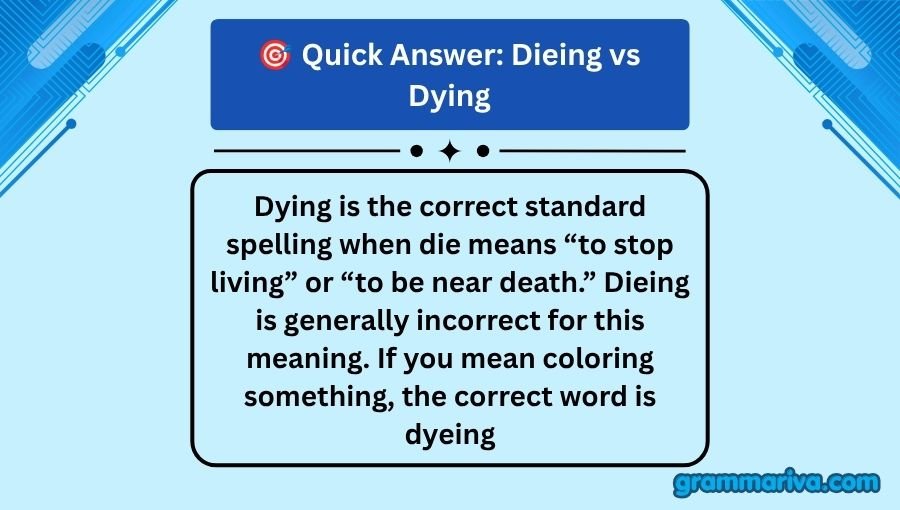
Dying is the correct standard spelling when die means “to stop living” or “to be near death.” Dieing is generally incorrect for this meaning. If you mean coloring something, the correct word is dyeing.
| Spelling | Meaning | Standard Use | Example |
|---|---|---|---|
| dying | becoming dead or nearing death | ✅ Correct | The plant is dying. |
| dieing | usually a misspelling of dying | ❌ Usually incorrect | The plant is dieing. |
| dyeing | coloring something with dye | ✅ Correct | She is dyeing her hair. |
The easiest rule is this:
Die + -ing = dying, not dieing, when you mean “becoming dead.”
📚 Dieing vs Dying: The Basic Difference
The main difference is spelling and meaning. Dying is the present participle of die. It describes the process of becoming dead, losing life, or failing gradually. Dieing is not the standard form for that meaning.
There is one spelling that causes even more confusion: dyeing. It comes from dye, not die.
Dying means losing life
Use dying when someone, something, or even a situation is moving toward an end.
Examples:
✅ The old tree is dying.
❌ The old tree is dieing.
The first sentence says that the tree is losing life. The second sentence uses a nonstandard spelling.
Dyeing means adding color
Use dyeing when you are coloring something.
Examples:
✅ She is dyeing her shirt blue.
❌ She is dying her shirt blue.
Here, dying would normally suggest that the shirt is losing life, which makes no sense in this context.
Comparison table
| Form | Type | Meaning | Example | Correct/Incorrect |
|---|---|---|---|---|
| die | verb | stop living | Animals eventually die. | ✅ Correct |
| dying | present participle | becoming dead | The bird is dying. | ✅ Correct |
| dieing | nonstandard spelling for death | Usually intended to mean dying | The bird is dieing. | ❌ Incorrect |
| dye | verb | color something | They dye fabric. | ✅ Correct |
| dyeing | present participle | coloring something | They are dyeing fabric. | ✅ Correct |
❓ Is Dieing the Same as Dying?
No. Dieing and dying are not normally interchangeable. When the verb is die, its -ing form is dying.
This happens because the final e is dropped before -ing, and the spelling changes from ie to y.
Compare:
- die → dying
- lie → lying
- tie → tying
The pattern is easier to see when you place the words side by side.
| Base Verb | -ing Form | Example |
|---|---|---|
| die | dying | The flower is dying. |
| lie | lying | The dog is lying down. |
| tie | tying | He is tying his shoes. |
| vie | vying | The teams are vying for first place. |
The spelling dying may look unusual at first. Still, it is the normal form used in standard English.
A useful test 💡
Ask yourself:
Am I talking about death or loss of life?
If the answer is yes, choose dying.
Am I talking about adding color?
If the answer is yes, choose dyeing.
If neither meaning fits, check the sentence again.
🧠 Why Do People Confuse Dieing and Dying?
People confuse these spellings because the base word die contains ie. When many learners add -ing, they expect to keep the same letters and simply attach the ending.
That would seem to produce:
die + ing = dieing
But standard English does not use that form for the normal verb die.
The accepted form is:
die → dying
I once edited a short school assignment where a student had written dieing several times. The student knew exactly what the word meant. The problem was simply applying a spelling pattern that seemed logical. Once we compared die → dying with lie → lying, the mistake made sense.
Fast typing can also make the problem worse. Your fingers may type the letters you expect before your brain catches the error.
Other common causes include:
- relying on sound instead of spelling
- typing quickly
- trusting autocorrect
- seeing the wrong spelling online
- not knowing the spelling rule
- confusing die with dye
| Cause | Why It Creates Confusion | Helpful Fix |
|---|---|---|
| Fast typing | Your fingers may add -ing automatically. | Proofread slowly. |
| Autocorrect | Some tools may not catch every spelling mistake. | Check the word yourself. |
| Lack of knowledge | The ie → y change may be unfamiliar. | Memorize die → dying. |
| Sound | Dying and dyeing can sound alike. | Focus on meaning. |
| Visual similarity | dieing, dying, and dyeing look close. | Compare the meanings. |
✍️ Dying: Meaning and Correct Use
Dying is the standard -ing form of die when the verb refers to death or the loss of life.
It can describe people, animals, plants, or things that are metaphorically coming to an end.
Physical death
This is the most direct use.
✅ The patient is dying.
❌ The patient is dieing.
The sentence means that the patient is close to death or is in the process of dying.
Plants and animals
The same spelling applies to living things.
✅ My flowers are dying because they need water.
❌ My flowers are dieing because they need water.
Figurative use
Dying can also be used in a nonliteral way.
For example:
✅ The old tradition is slowly dying.
Here, the tradition is not alive in a physical sense. The word means that the tradition is becoming less common or disappearing.
Summary of meanings
| Meaning | Word Type | Example Sentence |
|---|---|---|
| Losing life | Verb form | The animal is dying. |
| Nearing death | Verb form | The man is dying. |
| Gradually disappearing | Figurative verb form | The custom is dying out. |
| Becoming weaker or less active | Figurative verb form | Interest in the event is dying. |
❓ When Should You Use Dying?
Use dying whenever die is the verb you need in an -ing form. Understanding dieing vs dying is easier when you remember that dying is always the standard spelling when the verb refers to death or loss of life.
The sentence structure may vary, but the spelling stays the same.
Common patterns include:
- is dying
- are dying
- was dying
- were dying
- be dying
- has been dying
- slowly dying
- nearly dying
- dying out
Examples:
✅ The leaves are dying.
❌ The leaves are dieing.
✅ The fire is dying out.
❌ The fire is dieing out.
✅ The industry is slowly dying.
❌ The industry is slowly dieing.
The key is to recognize the base verb. If the base verb is die, the standard -ing form is dying.
❓ When Should You Use Dyeing?
Use dyeing when you mean coloring something with dye.
This word comes from the verb dye.
For example:
✅ She is dyeing her hair.
❌ She is dying her hair.
The first sentence means she is changing the color of her hair.
Other examples include:
✅ They are dyeing the fabric red.
❌ They are dieing the fabric red.
✅ He enjoys dyeing Easter eggs.
❌ He enjoys dying Easter eggs.
The word dyeing is especially common when talking about:
- hair
- fabric
- clothing
- yarn
- paper
- leather
- eggs
- craft materials
| Word | Base Verb | Meaning | Example |
|---|---|---|---|
| dying | die | losing life | The plant is dying. |
| dyeing | dye | adding color | She is dyeing fabric. |
| dieing | die | nonstandard spelling in normal use | ❌ Avoid it for death. |
🧪 Test Tip: Use the Meaning Test
When I teach spelling differences like this, I recommend using meaning before spelling.
Try this three-step test:
- Does the sentence involve death or loss of life?
- Use dying.
- Does the sentence involve adding color?
- Use dyeing.
- Does the sentence use neither meaning?
- Recheck the intended verb.
Try these:
✅ The grass is dying.
❌ The grass is dyeing.
Why? Grass can lose life, but it is not normally coloring something.
Now try:
✅ The artist is dyeing the cloth.
❌ The artist is dying the cloth.
Why? The artist is adding color.
| Question | If Yes | Use |
|---|---|---|
| Is something losing life? | Yes | dying |
| Is something becoming dead? | Yes | dying |
| Is something being colored? | Yes | dyeing |
| Are you writing dieing for death? | Yes | Change it to dying |
📝 Case Study: A Simple Workplace Example
Imagine an employee sends this message to a coworker:
“The flowers in the office are dieing. We should water them.”
The meaning is clear, but the spelling is not standard.
A polished version would be:
“The flowers in the office are dying. We should water them.”
Now consider a different message from someone working in a clothing shop:
“We are dying the fabric blue today.”
That spelling changes the meaning. If the worker is adding color, the correct sentence is:
“We are dyeing the fabric blue today.”
I once caught myself typing dieing in a quick note while reviewing a draft. I stopped because the sentence looked wrong. That small pause is often enough. When a word looks suspicious, compare it with its base form.
| Situation | Incorrect | Correct |
|---|---|---|
| Office plants | The plants are dieing. | The plants are dying. |
| Clothing shop | We are dying the fabric. | We are dyeing the fabric. |
| Garden | The flowers are dieing. | The flowers are dying. |
| Hair salon | She is dying her hair. | She is dyeing her hair. |
📖 Grammar Rules Explanation
The standard rule is straightforward. The verb die changes to dying when it takes the -ing form.
The spelling does not become dieing in normal standard English.
The change can be remembered as:
die → dying
This is similar to:
lie → lying
and
tie → tying
The important point is that English spelling does not always work by simply attaching letters to the end of a word. Some verbs change their spelling when endings are added.
The rule is about the word die. It should not be confused with dye, which produces dyeing.
Most standard English reference sources agree on the ordinary distinction: dying relates to die, while dyeing relates to dye.
Correct vs Incorrect at a Glance
| Sentence | Correct/Incorrect | Why |
|---|---|---|
| The tree is dying. | ✅ Correct | Dying is the -ing form of die. |
| The tree is dieing. | ❌ Incorrect | Dieing is not the standard spelling here. |
| She is dyeing her hair. | ✅ Correct | Dyeing means adding color. |
| She is dying her hair. | ❌ Incorrect | The intended meaning is coloring, not death. |
| The flowers are dying. | ✅ Correct | The flowers are losing life. |
⚠️ Common Mistakes With Dieing vs Dying
The most common mistake is writing dieing when the writer means dying. These common expressions also make dieing vs dying easier to remember because they show how naturally dying is used in everyday English.
This happens because the spelling looks logical. Writers see die and add -ing without changing anything.
Another common error is confusing dying with dyeing.
These words sound very similar. Their meanings, however, are completely different.
Similar spelling and grammar confusions
| Confusion | Correct Form | Basic Difference |
|---|---|---|
| it’s / its | both can be correct | It’s = it is; its shows possession |
| your / you’re | both can be correct | Your shows possession; you’re = you are |
| their / they’re | both can be correct | Their shows possession; they’re = they are |
| then / than | depends on meaning | Then relates to time; than compares |
| lose / loose | both can be correct | Lose means fail to keep; loose means not tight |
| dying / dyeing | both can be correct | Dying relates to death; dyeing means coloring |
Why these mistakes happen
Fast typing: You may write the first spelling that comes to mind.
Autocorrect: Spell-check tools are helpful, but they are not perfect.
Lack of knowledge: If you have never learned the spelling pattern, dieing can look reasonable.
Sound confusion: Dying and dyeing sound alike in normal speech.
Specific wrong spellings
| Wrong Form | What’s Wrong | Correct Form |
|---|---|---|
| dieing | Wrong -ing form of die | dying |
| dieing slowly | Wrong spelling | dying slowly |
| dieing out | Wrong spelling | dying out |
| dying fabric | Wrong if you mean coloring | dyeing fabric |
| dying my hair | Wrong if you mean coloring | dyeing my hair |
| dieing flowers | Wrong spelling | dying flowers |
🕰️ The History Behind Dying
The spelling of dying is tied to the established spelling pattern of the verb die when it takes the -ing ending. The form became standardized in English usage rather than following a simple “keep every letter and add -ing” pattern.
You do not need to memorize a long history lesson to use the word correctly. The useful modern pattern is simply:
die → dying
For comparison:
lie → lying
tie → tying
This helps explain why dieing feels tempting even though it is not the normal standard form.
| Stage | Form | Note |
|---|---|---|
| Base verb | die | Refers to losing life. |
| Inflected form | dying | Standard present participle. |
| Related verb | dye | Means to color something. |
| Inflected form | dyeing | Standard present participle of dye. |
🌎 Dieing vs Dying in Different Contexts
The correct choice depends on what you mean.
In everyday conversation, dying is used when someone or something is losing life. In professional writing, the same spelling applies. Creative writers may also use dying in figurative ways. Social media posts often use it casually or dramatically.
| Context | Which Term to Use | Example |
|---|---|---|
| Everyday conversation | dying | My plant is dying. |
| Professional writing | dying | The patient is dying. |
| Creative writing | dying | The dying light faded away. |
| Social media/texting | dying | I’m dying laughing! |
| Hair styling | dyeing | I’m dyeing my hair. |
| Textile work | dyeing | They are dyeing the fabric. |
Everyday conversation
You might hear:
“My phone is dying.”
This does not usually mean the phone is literally alive. It means its battery is almost empty.
Professional writing
Accuracy matters more in professional writing.
Use:
“The plant is dying due to a lack of water.”
Avoid:
“The plant is dieing due to a lack of water.”
Creative writing
Writers may use dying in vivid or figurative ways:
“The dying sunlight disappeared behind the hills.”
Social media and texting
People often use dying in exaggerated expressions:
“I’m dying laughing.”
This usually means:
“I’m laughing very hard.”
The spelling remains dying.
💬 Common Phrases With Dying
Dying appears in many common expressions. Some are literal, while others are figurative. These common expressions also make dieing vs dying easier to remember because they show how naturally dying is used in everyday English.
| Phrase | Meaning |
|---|---|
| dying out | gradually disappearing |
| dying of laughter | laughing extremely hard |
| dying to know | strongly wanting to know |
| dying to see you | strongly wanting to see someone |
| dying for something | strongly wanting something |
| dying breath | final breath before death |
Dying out
“The old tradition is dying out.”
This means fewer people are continuing the tradition.
Dying to know
“I’m dying to know what happened.”
This means the speaker is very eager to know.
Dying for something
“I’m dying for a cup of coffee.”
This is usually an exaggeration. It means the speaker really wants coffee.
🔄 Synonyms and Alternatives for Dying
Sometimes another word can replace dying, but the replacement depends on the meaning.
For physical death, words such as perishing or passing away may work in certain contexts. For plants, wilting may describe a visible condition without necessarily meaning death.
For figurative use, words such as fading, disappearing, or declining may be better.
| Alternative | Works When | Does Not Work When |
|---|---|---|
| passing away | Referring politely to a person’s death | Talking about a dying plant |
| perishing | Describing death in a formal or literary way | Casual everyday writing may sound unnatural |
| fading | Something is becoming weaker or less visible | You mean literal human death |
| declining | Something is losing strength or popularity | You specifically mean physical death |
| disappearing | Something is gradually vanishing | You mean a person is dying |
Choose the replacement based on meaning. Do not replace dying simply because you think the spelling looks unusual.
❓ Why Does Dying Not Become Dieing?
The standard spelling is dying because the verb die has an established spelling change when the -ing ending is added.
The important form to memorize is:
die → dying
Do not treat every English verb as a word that keeps all its letters before adding -ing. English spelling has many patterns where letters change or disappear.
For practical writing, you do not need to work out the entire history each time. Simply remember the standard form.
❓ Is Dieing Ever Correct?
For ordinary modern English, dieing should not be used when you mean “becoming dead.” In normal writing, choose dying.
If you encounter dieing somewhere, it may be a typo, a nonstandard spelling, or a special historical or technical use. Such rare cases do not change the standard rule for everyday English.
If your sentence means death, dying is the safe and standard choice.
❓ How Can You Remember Dying?
Use this short memory trick:
Die loses the “e” and changes to “y”: die → dying.
You can also connect it with lie → lying.
Think:
- die → dying
- lie → lying
- tie → tying
For dye, keep the e because the word has a different meaning:
- dye → dyeing
A second memory trick is even easier:
Death = dying.
Color = dyeing.
❓ Is Dying the Correct Spelling in American English?
Yes. Dying is the standard spelling in American English when die is used in its -ing form.
For example:
✅ The battery is dying.
✅ The plant is dying.
✅ The patient is dying.
The spelling does not change simply because the sentence is formal, casual, American, or conversational.
❓ What Is the Difference Between Dying and Dyeing?
Dying comes from die and relates to death, loss of life, or figurative decline.
Dyeing comes from dye and means coloring something.
Compare:
✅ The flower is dying.
This means the flower is losing life.
✅ She is dyeing the flower petals.
This means she is coloring the petals.
The difference is only a few letters, but the meanings are completely different.
❓ Should I Write Dieing in Formal Writing?
No. If you mean that someone or something is becoming dead, use dying in formal writing.
For example:
✅ The company is slowly dying out.
❌ The company is slowly dieing out.
The incorrect form can make a professional document look poorly edited.
❓ Is “Dying to Know” Grammatically Correct?
Yes. Dying to know is a common informal expression meaning that someone is very eager to know something.
For example:
“I’m dying to know the answer.”
It is usually not meant literally. The speaker is expressing strong curiosity.
The spelling is still dying, not dieing.
❓ Is “Dying My Hair” Correct?
Not if you mean changing the color of your hair.
The correct expression is:
“I’m dyeing my hair.”
The verb is dye, meaning to color something.
So:
✅ I’m dyeing my hair.
❌ I’m dying my hair.
This is one of the easiest ways to remember the difference. If color is involved, think dyeing.
❓ What Is the Difference Between Die, Dying, and Died?
Die is the base verb.
Dying is the -ing form.
Died is the past-tense and past-participle form.
Examples:
- People eventually die.
- The animal is dying.
- The animal died yesterday.
| Form | Grammar Role | Example |
|---|---|---|
| die | base verb | Some plants die without water. |
| dying | -ing form | The plant is dying. |
| died | past form | The plant died last week. |
This distinction is useful because it shows why dying has its unusual spelling.
🎯 How to Remember the Difference
The fastest way to remember the rule is to focus on the base verb and meaning.
Memory Rule 1: Death = DYING
If something is losing life, use dying.
The fish is dying.
Memory Rule 2: Color = DYEING
If you are adding color, use dyeing.
She is dyeing the fabric.
Memory Rule 3: Avoid DIEING
When die means “stop living,” do not simply attach -ing and write dieing.
Remember:
DIE → DYING
Memory chart
| Meaning | Correct Word | Memory Cue |
|---|---|---|
| Losing life | dying | Death |
| Almost dead | dying | Death |
| Disappearing | dying | Figurative death |
| Adding color | dyeing | Dye |
| Wrong standard form for death | dieing | Avoid |
⚠️ Why Getting Dieing vs Dying Right Matters
Correct spelling improves clarity. It also makes your writing look more polished.
A single spelling error may not stop someone from understanding your sentence. Still, repeated mistakes can distract readers.
This matters in:
- resumes
- school assignments
- workplace emails
- websites
- articles
- social media
- business messages
A useful writing principle is:
Clear words make clear messages.
The goal is not to sound complicated. The goal is to make your meaning easy to understand.
| Situation | Why Getting It Right Matters |
|---|---|
| Resume | Shows care and attention to detail. |
| Client email | Makes your communication look professional. |
| Published content | Protects the quality of your writing. |
| Social post | Prevents avoidable spelling errors. |
🧩 Special Exception: Rare Uses of Dieing
For ordinary English writing, dieing should not be treated as the normal spelling of dying.
There can be rare specialized or historical contexts where unusual spellings appear. Those cases do not apply to normal school, business, website, or everyday writing.
If your intended meaning is “becoming dead,” use dying.
If your intended meaning is “adding color,” use dyeing.
That simple distinction will handle almost every situation you are likely to encounter.
✅ Quick Recap Checklist
Before you submit your sentence, ask yourself what you mean.
| Question | If Yes → Use |
|---|---|
| Does something lose its life? | dying |
| Is someone near death? | dying |
| Is something gradually disappearing? | dying |
| Are you adding color? | dyeing |
| Did you write dieing for death? | Change it to dying |
Practice Examples
1. The flowers are ___ because nobody watered them.
Answer: dying ✅
2. Maria is ___ her dress a darker color.
Answer: dyeing ✅
3. The old tradition is ___ out.
Answer: dying ✅
Try to solve the examples without looking at the answers first. This makes the distinction easier to remember.
❓ FAQs About Dieing vs Dying
What is correct, dieing or dying?
Dying is the standard spelling when you mean “becoming dead” or “near death.” Dieing is generally not correct for this meaning.
Why is dying spelled with a y?
The verb die takes the standard -ing form dying. The spelling changes rather than simply becoming dieing. The same kind of spelling pattern appears in words such as lie → lying and tie → tying.
Is dieing a real word?
Dieing is not the standard everyday spelling of the -ing form of die. In ordinary writing, use dying when you mean death or loss of life.
What does dyeing mean?
Dyeing means coloring something with dye. You might use it when talking about hair, fabric, clothing, yarn, leather, or other materials.
Is “I am dying my hair” correct?
Not when you mean changing your hair color. The standard sentence is “I am dyeing my hair.” The verb dye means to color something.
Is “The plant is dying” correct?
Yes. “The plant is dying” is correct because the sentence describes a living plant losing life.
Is “dying out” correct?
Yes. Dying out is a common expression that means something is gradually disappearing or becoming less common.
For example:
“The old custom is dying out.”
Is “dying to know” correct?
Yes. Dying to know is a common informal expression. It means being very eager or curious to know something.
Example:
“I’m dying to know what happened.”
How do I remember dying vs dyeing?
Use the meaning test:
Death = dying.
Color = dyeing.
If neither meaning applies, check the base verb before choosing the spelling.
Which spelling should I use in formal writing?
Use dying when the meaning comes from die. Use dyeing when the meaning comes from dye. Avoid dieing in standard formal writing when you mean death.
🌟 Conclusion
Dieing vs dying becomes much easier once you connect each spelling to its meaning. When you mean losing life, becoming dead, or gradually disappearing, use dying. When you mean adding color to hair, fabric, clothing, or another material, use dyeing. The spelling dieing is generally not the standard form you want in everyday English.
The key pattern is simple:
die → dying
dye → dyeing
I recommend memorizing those two pairs instead of trying to guess the spelling each time. If you remember death = dying and color = dyeing, you can solve most cases in seconds. 🧠
Good spelling does not need to be hard. Sometimes one small rule is all you need to turn a confusing pair into an easy choice. Keep dying for die, keep dyeing for dye, and leave dieing out of your normal writing. ✨
When the meaning is clear, the spelling becomes clear too.

Hi, I’m Madison Hayes. I’m an English learning writer at Grammariva, where I work on simple lessons and examples for people who want to improve their grammar and writing. I love turning confusing rules into easy-to-follow explanations.

[…] you simple tests you can use whenever you are unsure. By the end, the choice should feel easy. 🏡 Dieing vs Dying | Is It to or Too Early | Mom vs […]
[…] confuse them, how to remember the difference, and how to avoid common mistakes. Roofs vs Rooves | Dieing vs Dying | For Who or For […]