Have you ever written a sentence and stopped because you were unsure whether for who or for whom was correct? You are not alone. This is one of those small grammar choices that can make even confident writers pause. The confusion comes from the fact that both who and whom can sound natural in casual speech. However, they play different roles in a sentence.
I teach grammar with one simple goal: make rules easy enough to remember and practical enough to use. In this guide, I will show you how for who or for whom works, why one form is usually correct in standard English, and when casual speech may sound different. You will also get simple tests, examples, tables, common mistakes, and practice tips. 😊
By the end, you should be able to choose the right form without second-guessing every sentence. Is It to or Too Early | Mom vs Mum | Spectre or Specter
🎯 Quick Answer: For Who or For Whom?
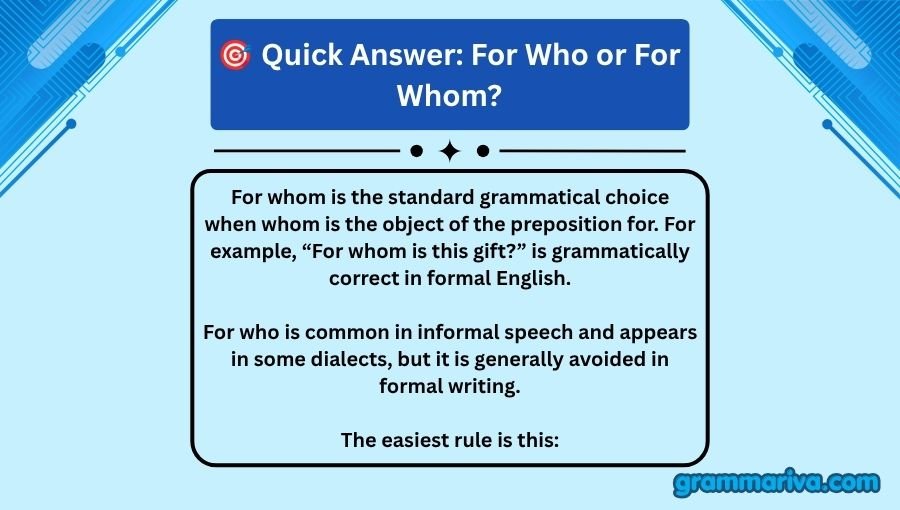
For whom is the standard grammatical choice when whom is the object of the preposition for. For example, “For whom is this gift?” is grammatically correct in formal English.
For who is common in informal speech and appears in some dialects, but it is generally avoided in formal writing.
The easiest rule is this:
If for is followed by the person who receives the action or benefit, use whom in formal English.
🔍 Is For Whom Grammatically Correct?
Yes. For whom is grammatically correct because whom is the object form of who.
The word for is a preposition. In standard formal English, a pronoun that follows a preposition should normally be in the object form.
Compare:
- Who is coming?
- You invited whom?
- This gift is for whom?
The same basic idea appears with other prepositions:
- with whom
- to whom
- from whom
- about whom
- by whom
- for whom
A Simple Example
Consider:
For whom did you buy the flowers?
The flowers were bought for someone. That person receives the benefit of the action. Therefore, whom works as the object of for.
✅ For whom did you buy the flowers?
❌ For who did you buy the flowers?
The second version is common in everyday speech, but it does not follow the traditional formal grammar rule.
📚 Who vs Whom at a Glance
The difference between who and whom becomes much easier when you focus on their jobs in a sentence.
| Form | Type | Meaning | Example | Correct/Incorrect |
|---|---|---|---|---|
| who | Subject pronoun | The person doing the action | Who called you? | ✅ Correct |
| whom | Object pronoun | The person receiving the action | Whom did you call? | ✅ Correct |
| for whom | Prepositional phrase | The person something is intended for | For whom is this letter? | ✅ Correct |
| for who | Informal/nonstandard in formal writing | Person following “for” | For who is this gift? | ❌ Usually incorrect in formal writing |
A useful shortcut is to think of who as similar to he/she and whom as similar to him/her.
For example:
- Who called? → She called.
- You called whom? → You called her.
- The gift is for whom? → The gift is for her.
That last test is especially useful.
💡 Why Do People Confuse For Who and For Whom?
People confuse these forms because everyday English does not always follow the traditional who-versus-whom pattern.
In normal conversation, many native speakers use who in places where traditional grammar would expect whom. This is especially common when the word appears at the beginning of a question.
For example, someone might naturally say:
Who is this gift for?
That sentence sounds completely normal. In fact, many speakers prefer it to the more formal:
For whom is this gift?
Both sentences communicate the same basic idea. The difference is mainly one of grammatical form and style.
I once edited a business letter where the writer had changed almost every whom to who because they thought “whom sounds old.” The funny part was that the rest of the letter was very formal. We kept the formal style and used whom where it fit naturally.
Why This Happens
There are several reasons:
- Who is much more common in everyday speech.
- Many speakers rarely use whom.
- Questions can sound stiff when a preposition is placed at the beginning.
- People often remember “who” but forget the object form “whom.”
- Modern English often allows prepositions to move to the end.
Compare:
Formal:
For whom are you writing this report?
Natural conversation:
Who are you writing this report for?
Both are understandable. The second is often more natural in casual English.
✏️ For Who or For Whom in Questions
When a question contains for, you have two main choices.
You can place for before whom:
For whom is this package?
Or you can move for to the end:
Who is this package for?
The first version is more formal. The second version is much more common in ordinary conversation.
Compare the Two Structures
| Structure | Example | Style |
|---|---|---|
| For + whom | For whom is this package? | Formal |
| Who + … + for | Who is this package for? | Natural/casual |
| For + who | For who is this package? | Usually avoided in formal English |
| Whom + … + for | Whom is this package for? | Less natural and often avoided |
Notice something important: “Who is this package for?” is not the same grammatical structure as “For who is this package?”
The first uses who because the question word has moved away from the preposition. The second places who directly after for, where traditional grammar expects whom.
🧠 How Can You Test Who vs Whom?
The easiest test is to replace the word with he/she or him/her.
If he or she works, choose who.
If him or her works, choose whom.
Example 1
Who called the office?
Test it:
She called the office.
“She” works, so who is correct.
Example 2
For whom did you buy the ticket?
Test it:
I bought the ticket for her.
“Her” works, so whom is correct.
| Question Word | Test Word | Correct Choice |
|---|---|---|
| Who called? | She called. | who |
| Whom did you call? | I called him. | whom |
| For whom is this gift? | It is for her. | whom |
| Who sent the email? | He sent it. | who |
💡 Test Tip
Whenever you see for who, stop for a second and replace the phrase with for him or for her.
If the sentence sounds like:
This is for her.
then formal English calls for:
This is for whom.
This test will solve most for who or for whom questions.
📝 What Are the Correct Meanings and Uses?
The forms who and whom have different grammatical roles. Understanding those roles makes the choice much easier.
Who as the Subject
Use who when the person is doing the action.
Examples:
✅ Who opened the door?
❌ Whom opened the door?
Why? The person is performing the action of opening.
Whom as the Object
Use whom when the person receives the action.
Examples:
✅ Whom did you invite?
❌ Who did you invite? in very formal traditional grammar
However, who did you invite? is extremely common and accepted in many modern styles.
Whom After a Preposition
Use whom after a preposition in formal English.
Examples include:
- for whom
- with whom
- to whom
- from whom
- by whom
| Meaning | Word Type | Example Sentence |
|---|---|---|
| Person doing the action | Subject pronoun | Who wrote the article? |
| Person receiving the action | Object pronoun | Whom did you meet? |
| Person connected to “for” | Object after preposition | For whom is this seat? |
| Person connected to “with” | Object after preposition | With whom did you travel? |
💬 Can You Say “Who Is It For”?
Yes. Who is it for? is completely natural in everyday English.
This is one of the most useful points to remember.
You do not have to say:
For whom is it?
in every situation.
The version:
Who is it for?
is natural and widely used.
Compare These Sentences
✅ Who is this present for?
✅ For whom is this present?
❌ For who is this present?
The first sentence is conversational. The second is formal. The third is generally avoided in formal standard English.
This gives you a practical choice:
Casual: Put the preposition at the end.
Formal: Put the preposition before whom.
🎯 For Who or For Whom in Formal Writing
In formal writing, for whom is usually the safest choice when whom directly follows the preposition for.
You may see this form in:
- business letters
- academic writing
- official notices
- legal writing
- formal speeches
- professional correspondence
For example:
For whom should I prepare the documents?
This sounds formal and polished.
In a casual email, you could write:
Who should I prepare the documents for?
Both are clear. The second simply has a more conversational tone.
| Situation | Preferred Form | Example |
|---|---|---|
| Academic writing | for whom | For whom was the study conducted? |
| Formal email | for whom | For whom should I send the report? |
| Casual email | who … for | Who should I send the report to? |
| Conversation | who … for | Who is this for? |
🏢 Case Study: A Workplace Email
Imagine that a manager receives a package with no clear recipient.
An employee wants to ask:
For whom is this package?
That sentence is grammatically formal and correct.
But in a normal office conversation, the employee might say:
Who is this package for?
That version sounds more relaxed.
Now imagine the employee writes a formal message:
Could you please confirm for whom the package was intended?
Here, for whom fits the professional tone.
What I Would Recommend
If I am writing a formal document, I use whom after for when it sounds natural.
If I am writing a friendly message, I usually rewrite the sentence so that for comes at the end.
This approach keeps the grammar correct without making everyday English sound unnecessarily stiff.
⚖️ Grammar Rules Explanation
The traditional rule is based on grammatical case.
Who is the subject form. Whom is the object form. A preposition such as for normally takes an object, so the formal construction is for whom.
Consider:
For whom did you make this card?
The structure is:
for + whom
Here, whom is the object of the preposition for.
Compare:
Who made this card?
Here, who is the subject because the person performs the action.
The distinction becomes clearer with pronoun substitutions.
She made the card.
Therefore:
Who made the card?
But:
I made the card for her.
Therefore:
For whom did you make the card?
Modern English has reduced the use of whom in many everyday situations. Many speakers use who instead, especially when the preposition is moved to the end.
So:
Who did you make the card for?
is common and natural.
However:
For who did you make the card?
does not follow the traditional formal rule.
Most standard grammar references recognize the difference between subject who and object whom, while also recognizing that everyday English often uses who more broadly.
Correct vs Incorrect at a Glance
| Sentence | Correct/Incorrect | Why |
|---|---|---|
| For whom is this letter? | ✅ Correct | “Whom” follows the preposition “for.” |
| For who is this letter? | ❌ Incorrect in formal standard English | “Who” is the subject form. |
| Who is this letter for? | ✅ Correct | “Who” is used in a natural question with the preposition at the end. |
| For whom did you buy the gift? | ✅ Correct | “Whom” is the object of “for.” |
| For who did you buy the gift? | ❌ Usually incorrect in formal writing | Traditional grammar requires “whom” after “for.” |
⚠️ Common Mistakes With Who and Whom
The biggest mistake is assuming that who and whom are interchangeable in every sentence.
They are not interchangeable under traditional grammar rules.
Another mistake is thinking that every sentence must use whom if the person receives an action. Modern English is more flexible, especially in conversation.
Why Do These Mistakes Happen?
Common causes include:
- fast typing
- autocorrect
- uncertainty about grammar
- lack of knowledge
- trying to sound formal
- copying conversational patterns into formal writing
I once caught myself typing “for who” in a formal editing note because I was writing quickly. I noticed the preposition, ran the her/him test, and changed it to “for whom.” Even editors need a quick check sometimes.
Similar Grammar Confusions
| Confusion | Correct Form | Main Difference |
|---|---|---|
| it’s / its | depends on meaning | contraction vs possession |
| your / you’re | depends on meaning | possession vs “you are” |
| they’re / their / there | depends on meaning | they are vs possession vs place |
| who / whom | depends on sentence role | subject vs object |
| then / than | depends on meaning | time/order vs comparison |
Specific Mistakes With This Topic
| Wrong Form | What’s Wrong | Correct Form |
|---|---|---|
| For who is this? | “Who” follows “for” | For whom is this? |
| For who did you buy it? | Formal object form is missing | For whom did you buy it? |
| For whom is this for? | Unnecessary repeated “for” | For whom is this? |
| Whom called you? | “Whom” is not the subject | Who called you? |
| Who did you give it to? | Common in speech, but formal style may prefer “whom” | To whom did you give it? |
🕰️ Why Does “Whom” Sound So Formal?
Whom sounds formal because everyday English uses it much less often than who.
Many speakers naturally avoid whom by changing the sentence structure.
For example:
For whom are you waiting?
can become:
Who are you waiting for?
The second version feels much more natural to most speakers.
This does not mean whom is wrong or outdated. It still has a useful place in formal English. The key is knowing when it fits the tone.
🌎 How Is This Used in Different Contexts?
The best choice can depend on the setting.
Everyday Conversation
Use the natural conversational structure:
Who is this for?
You will hear this far more often than:
For whom is this?
Professional Writing
If the sentence is formal, for whom may be the better choice:
For whom should I reserve the conference room?
Creative Writing
Writers can choose either form based on the character’s voice and the tone of the scene.
Social Media and Texting
Casual forms are usually preferred:
Who’s this for? 😂
There is little reason to force formal wording into a casual message.
| Context | Which Term to Use | Example |
|---|---|---|
| Everyday conversation | who … for | Who is this for? |
| Professional writing | for whom | For whom is this report intended? |
| Creative writing | Depends on voice | Who is this gift for? |
| Social media/texting | who … for | Who’s this for? |
🧩 How Does Sentence Structure Change the Choice?
Sentence structure is one of the most important parts of this topic.
Look at these two questions:
For whom did you buy the flowers?
and:
Who did you buy the flowers for?
They express the same basic idea, but their structures differ.
In the first sentence, whom comes directly after for.
In the second, for has moved to the end. This is called leaving the preposition at the end of the sentence, and it is very common in English.
More Examples
| Formal Structure | Natural Alternative |
|---|---|
| For whom is this seat reserved? | Who is this seat reserved for? |
| For whom did she prepare dinner? | Who did she prepare dinner for? |
| For whom are you buying the flowers? | Who are you buying the flowers for? |
| For whom was the award created? | Who was the award created for? |
The natural alternative is often easier to say and easier to understand.
📝 Common Phrases With Whom
There are several common formal phrases that use whom after a preposition.
| Phrase | Meaning |
|---|---|
| for whom | the person something is intended for |
| with whom | the person someone is together with |
| to whom | the person receiving something |
| from whom | the person something comes from |
| by whom | the person who performed an action |
| about whom | the person being discussed |
Examples:
For whom was the gift purchased?
With whom did you speak?
To whom should I send the invoice?
From whom did you receive the message?
These forms are especially useful in formal writing.
🔄 Synonyms and Alternatives to Whom
Sometimes you can avoid the issue completely by changing the sentence.
This is useful when whom sounds too formal for your audience.
| Alternative | Works When | Does Not Work When |
|---|---|---|
| who … for | Casual questions | Very formal writing |
| the person who | You want maximum clarity | A short question is better |
| the recipient | Referring to a receiver | The person is not necessarily receiving something |
| the intended recipient | Talking about gifts or messages | The person is not an intended receiver |
| that person | Casual, known reference | The person’s identity is unknown |
For example:
For whom is the package intended?
could become:
Who is the package intended for?
Or:
Who is the intended recipient?
The best version depends on your audience.
🎯 How Can You Remember For Whom?
Use the him/her test.
If you can say:
for him
or:
for her
then use:
for whom
For example:
The gift is for her.
Question:
For whom is the gift?
This works because her is an object pronoun.
Here is another memory trick:
Who = he/she
Whom = him/her
So:
He called.
becomes:
Who called?
And:
I called him.
becomes:
Whom did I call?
This tiny trick can save you from a lot of grammar stress.
🚦When Should You Avoid “For Whom”?
You do not need to use for whom just to sound intelligent.
If you are chatting with a friend, who … for is usually smoother.
For example:
Who is this cake for?
sounds friendly and natural.
Compare:
For whom is this cake?
That sentence is grammatically fine, but it may sound unusually formal in a casual conversation.
Good writing is not only about following rules. It is also about choosing language that fits the situation.
💼 Why Does Getting This Right Matter?
Correct grammar helps readers understand your meaning without stopping to figure out what you meant.
It can also make formal writing look more polished.
| Situation | Why Getting It Right Matters |
|---|---|
| Resume or application | Shows careful writing |
| Client email | Creates a professional impression |
| Published content | Improves clarity and consistency |
| Social post | Helps you communicate naturally |
A simple rule I like is:
Good grammar should make your meaning easier to see, not harder to read.
That is especially true with who and whom. You should know the formal rule, but you should also know when natural sentence structure is better.
🗣️ Can “For Who” Ever Appear in Real English?
Yes, you may hear or see for who in informal speech, some dialects, song lyrics, or intentionally casual writing.
That does not make it the preferred form for formal standard English.
For example, a speaker might say:
Who is this for?
This is perfectly natural.
Another speaker might say:
For who?
That can appear in casual conversation, but formal writing would normally use:
For whom?
The key distinction is between what people may say naturally and what traditional formal grammar recommends.
🧪 Practice: Choose Who or Whom
Try these before checking the answers.
1. ___ is this gift for?
The natural conversational answer is:
✅ Who is this gift for?
2. For ___ did you prepare the report?
Formal English:
✅ For whom did you prepare the report?
3. ___ called the manager?
The person performs the action.
✅ Who called the manager?
4. For ___ should I reserve the table?
Formal English:
✅ For whom should I reserve the table?
5. ___ are you buying the flowers for?
Natural conversation:
✅ Who are you buying the flowers for?
| Question | Answer |
|---|---|
| Who called? | Who |
| For whom is it? | Whom |
| Who is it for? | Who |
| For whom did you write it? | Whom |
| Who did you write it for? | Who |
📋 Quick Recap Checklist
Use this checklist whenever you are unsure.
| Question | If Yes → Use |
|---|---|
| Is the person doing the action? | who |
| Does the word come directly after “for” in formal English? | whom |
| Can you replace it with “he” or “she”? | who |
| Can you replace it with “him” or “her”? | whom |
| Are you writing casually and can move “for” to the end? | who … for |
Practice Examples
Example 1
For ___ is this letter?
Answer: whom
Example 2
___ is this letter for?
Answer: who
Example 3
___ sent the letter?
Answer: who
The fastest rule is still the him/her test.
❓ FAQs About Who vs Whom
Is “for who” grammatically correct?
In traditional formal English, for who is generally considered incorrect. The standard formal construction is for whom because whom is the object form used after the preposition for.
Is “for whom” always correct?
For whom is grammatically correct when whom is the object of for. However, you may prefer a different sentence structure in casual English. For example, “Who is this for?” is natural and correct.
Is “who is this for” correct?
Yes. Who is this for? is a common and natural English question. It is especially appropriate in conversation and informal writing.
Should I use “for whom” in formal writing?
Yes, when whom directly follows the preposition for, it is the traditional formal choice. For example, “For whom was the award created?” is grammatically correct.
What is the easiest way to remember who and whom?
Use the he/she versus him/her test. If he or she fits, use who. If him or her fits, use whom.
Why does “whom” sound so formal?
Modern everyday English uses who much more often. Speakers also frequently move prepositions to the end of questions. This makes sentences such as “Who is it for?” more common than “For whom is it?”
Can I say “who did you buy it for”?
Yes. This is natural and widely used in everyday English. In a very formal style, you might write “For whom did you buy it?”
Is “for whom” better than “who … for”?
Neither is automatically better. For whom is more formal. Who … for is more conversational. Choose the structure that fits your audience and setting.
What is the difference between “for who” and “for whom”?
The main difference is grammatical case. Whom is the traditional object form, so it follows for in formal English. Who is the subject form, though modern English often uses it in informal questions.
How do I avoid using whom incorrectly?
Use the sentence rewrite method. Instead of forcing whom into casual writing, you can often move the preposition to the end. For example, change “For whom is this gift?” to “Who is this gift for?”
🏁 Conclusion
For who or for whom is easier once you remember one simple rule: whom is the traditional object form, so for whom is the formal construction when the pronoun directly follows for.
For example:
✅ For whom did you buy the gift?
But in everyday conversation:
✅ Who did you buy the gift for?
Both versions are clear. The difference is mainly grammar and style.
When you are unsure, use the him/her test. If you would say “for her” or “for him,” then for whom is the formal choice. If the sentence sounds too formal, rewrite it naturally by moving for to the end.
I recommend learning the formal rule first. Then learn how native speakers naturally reshape the sentence. That gives you control instead of making you memorize random exceptions. 😊
Remember: who does the action, whom receives it, and “for whom” is the formal choice after “for.”

Hi, I’m Lucas Bennett. I’m a grammar content specialist at Grammariva. I work on articles covering everyday grammar questions, sentence usage, and writing tips that readers can apply with confidence.
[…] common mistakes, and FAQs. By the end, you should know exactly which spelling to choose. 🌟 For Who or For Whom | Is It to or Too Early | Mom vs […]