Have you ever typed better than or better then and stopped to wonder which one is right? You are not alone. These two phrases sound almost the same, but they do very different jobs in a sentence. The correct choice is usually simple once you know what each word does. Better than or better then is a common grammar question because “than” and “then” differ by only one letter, yet their meanings are not alike. ✨ In this guide, I will show you the rule, explain why people mix them up, and give you plenty of real examples. You will also see how the choice works in emails, school writing, social media, and everyday speech. By the end, you should be able to choose the right word without stopping to think twice. 😊 Minuet vs Minute | Wonder vs Wander
🎯 Quick Answer: Better Than or Better Then
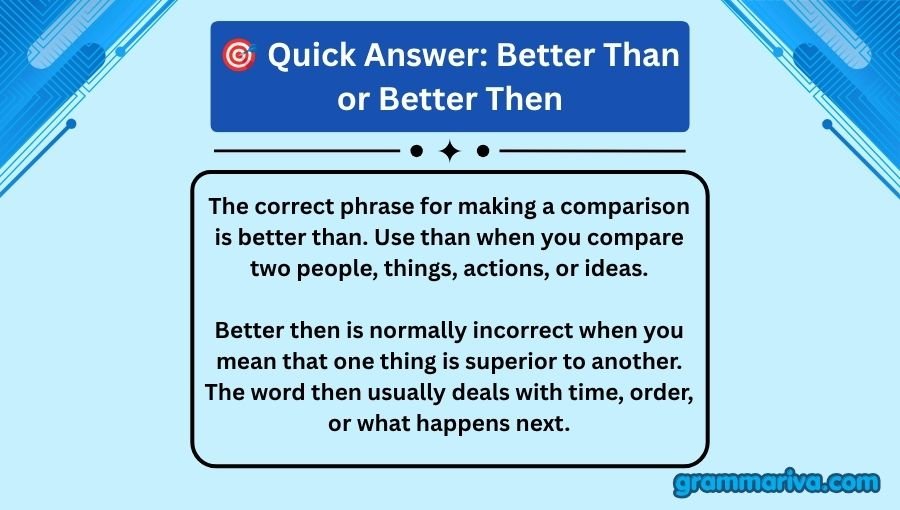
The correct phrase for making a comparison is better than. Use than when you compare two people, things, actions, or ideas.
Better then is normally incorrect when you mean that one thing is superior to another. The word then usually deals with time, order, or what happens next.
Correct: This phone is better than my old one. ✅
Incorrect: This phone is better then my old one. ❌
The easiest rule is:
Than = comparison.
Then = time or order.
🧩 Related Word Forms and Useful Variations
The main issue is not a change in the word form of “better.” The confusion comes from choosing between two different words: than and then.
| Form | Type | Example |
|---|---|---|
| better | Comparative adjective/adverb | This plan is better. |
| better than | Comparative phrase | This plan is better than the old one. |
| than | Comparison word | She runs faster than me. |
| then | Time/order adverb | Finish your work, then call me. |
| better then | Incorrect comparison phrase | ❌ This is better then that. |
The key point is simple. Better than forms a comparison. Then does not normally introduce the second side of a comparison.
📚 Understanding Better Than or Better Then
The main difference between better than or better then is the job performed by “than” and “then.” Than connects ideas in a comparison. Then usually tells us when something happens or what happens next.
Consider these two examples:
- This restaurant is better than the other one. ✅
- We ate dinner, then we went home. ✅
The first sentence compares two restaurants. The second sentence shows the order of two actions.
Better Than for Comparisons
Use than after a comparative word when you compare one thing with another.
Common comparative words include:
- better than
- faster than
- taller than
- smaller than
- easier than
- harder than
- stronger than
- cheaper than
- more useful than
- less expensive than
For example:
My new laptop is better than my old laptop. ✅
Here, “better” describes the quality of the new laptop. “Than” introduces the thing being compared.
Better Then Is Not the Normal Comparison
If you are comparing two things, then is not the correct word.
This book is better then that one. ❌
The correct version is:
This book is better than that one. ✅
“Then” would only make sense if you were talking about time or sequence.
| Form | Type | Meaning | Example | Correct/Incorrect |
|---|---|---|---|---|
| better than | Comparison phrase | One thing has greater quality | This one is better than that one. | ✅ Correct |
| better then | Incorrect comparison | Uses “then” instead of “than” | This one is better then that one. | ❌ Incorrect |
| then | Adverb | Shows time or order | Eat first, then leave. | ✅ Correct |
| than | Comparison word | Shows comparison | She is taller than me. | ✅ Correct |
🔍 Why Do People Confuse Better Than and Better Then?
People confuse these words mainly because they sound very similar in normal speech. When spoken quickly, the difference can be hard to notice.
I have seen this mistake many times in student writing. One student once wrote, “Math is better then science for me,” in an essay. The student knew exactly what they wanted to say. The problem was simply choosing the wrong word.
Typing also makes the problem worse. If you type quickly, your fingers may produce “then” automatically. Spell-check tools may not catch the mistake because then is a real English word.
The confusion usually comes from three things:
- Fast typing
- Similar pronunciation
- Uncertainty about the grammar rule
A Simple Memory Trick 🧠
Think of the word than as the comparison word.
You can remember:
Than compares. Then continues.
If you are comparing two things, choose than.
If you are showing what happens next, choose then.
| Question | Correct Word | Example |
|---|---|---|
| Are you comparing things? | than | Better than before |
| Are you showing time? | then | Then we left |
| Are you showing order? | then | First study, then rest |
| Are you showing superiority? | than | Faster than me |
| Are you connecting two actions in sequence? | then | Call me, then come over |
🎯 How Does Better Than Work in a Sentence?
Better than is used when one person, object, action, or idea is judged to be better compared with another.
The structure is often:
Subject + better + than + comparison
For example:
This solution is better than the first one.
“Better” describes the preferred solution. “Than” introduces the first solution.
Here are more examples:
My new shoes are better than my old shoes. ✅
My new shoes are better then my old shoes. ❌
She is better than me at tennis. ✅
She is better then me at tennis. ❌
This route is better than the other route. ✅
This route is better then the other route. ❌
Test Tip 💡
When you see better, ask yourself:
“Am I comparing two things?”
If the answer is yes, use than.
You can also replace “better than” with another comparison, such as “worse than,” “faster than,” or “stronger than.” If the sentence still makes sense as a comparison, than is the right choice.
| Meaning | Word Type | Example Sentence |
|---|---|---|
| Superior quality | Comparative | This option is better than that one. |
| Superior skill | Comparative | She is better than I am at drawing. |
| Improved result | Comparative | The second draft is better than the first. |
| Preferred choice | Comparative | Walking is better than driving today. |
📝 Case Study: A Real Workplace Example
Imagine that you are writing an email to your manager. You want to explain why one proposal is stronger than another.
You write:
“I think the second proposal is better then the first because it costs less.”
The meaning is clear, but the comparison contains an error.
The corrected sentence is:
“I think the second proposal is better than the first because it costs less.” ✅
I once edited a short workplace document where the writer used “then” several times after comparative words. The writer was not making a deep grammar mistake. They simply relied on how the words sounded. Once we changed each comparison to than, the document looked much more polished.
This small correction can matter in professional writing. A single word may not change your meaning, but repeated grammar errors can affect how readers judge your writing.
📖 Grammar Rules Explanation
“Than” is used to introduce the second part of a comparison. It commonly appears after comparative adjectives and adverbs.
“Then” has a different grammatical role. It is generally used as an adverb to show time, sequence, or a result.
The difference can be seen clearly:
This car is better than that car.
This sentence compares two cars.
We bought the car, then drove home.
This sentence shows two actions in sequence.
The two words are therefore not interchangeable in standard English.
Standard grammar references and major dictionaries consistently distinguish than from then by meaning and function. The spelling difference is small, but the grammatical difference is clear.
Correct vs Incorrect at a Glance
| Sentence | Correct/Incorrect | Why |
|---|---|---|
| This is better than that. | ✅ Correct | “Than” introduces a comparison. |
| This is better then that. | ❌ Incorrect | “Then” does not normally mark comparison. |
| Finish this first, then start the next task. | ✅ Correct | “Then” shows sequence. |
| She is better than her brother at chess. | ✅ Correct | “Than” introduces the comparison. |
| She is better then her brother at chess. | ❌ Incorrect | “Then” is the wrong word for comparison. |
⚠️ Common Mistakes With Than and Then
The mistake happens because both words are common and sound similar. Autocorrect can also make the problem easy to miss.
Why These Errors Happen
Fast typing: You may type the familiar word without thinking.
Autocorrect: A device may not flag “then” because it is spelled correctly. It cannot always know that you meant “than.”
Lack of knowledge: Some writers simply have not learned the difference.
Speech habits: In casual speech, the two words may sound close enough that the distinction disappears.
| Common Confusion | Correct Choice | Basic Rule |
|---|---|---|
| better than / better then | better than | Use “than” for comparison. |
| your / you’re | Depends | “Your” shows ownership; “you’re” means “you are.” |
| its / it’s | Depends | “Its” shows ownership; “it’s” means “it is” or “it has.” |
| their / they’re | Depends | “Their” shows ownership; “they’re” means “they are.” |
| affect / effect | Depends | Meaning and grammar determine the choice. |
| to / too | Depends | “Too” often means also or excessively. |
Specific Wrong Forms
| Wrong Form | What’s Wrong | Correct Form |
|---|---|---|
| better then | “Then” is not the comparison word. | better than |
| more better than | Double comparative in standard usage. | better than |
| better then before | Comparison is intended. | better than before |
| better then ever | Comparison is intended. | better than ever |
| better then anyone | “Then” is not used to mark comparison. | better than anyone |
| better then the old version | The sentence compares versions. | better than the old version |
🕰️ Is Then Ever Correct Near the Word Better?
Yes, but the meaning changes. Then can appear in a sentence with “better” when it refers to time or sequence.
For example:
I felt better then.
Here, then means “at that time.”
Another example:
If you feel better, then you can go home.
Here, “then” shows a result or next step.
So, the presence of the word “better” does not automatically mean that “than” must appear. You need to look at what the sentence means.
Compare:
I feel better than yesterday. ✅
This compares your current condition with yesterday.
I felt better then. ✅
This refers to a past time.
This is why context matters.
| Sentence | Meaning |
|---|---|
| I feel better than yesterday. | A comparison |
| I felt better then. | Refers to a past time |
| She is better than me at cooking. | A comparison |
| She finished cooking, then cleaned the kitchen. | Sequence |
| This plan is better than the first. | A comparison |
| If things get better, then we can relax. | Result or next step |
🌎 How Are Better Than and Then Used in Different Contexts?
The basic rule stays the same across different forms of writing. Use than for comparisons. Use then for time, sequence, or results.
Everyday Conversation
In normal conversation, you might say:
This one tastes better than the other one.
Or:
Let’s eat first, then go for a walk.
Professional Writing
In professional writing, the same rule applies:
The revised plan is better than the original proposal.
Creative Writing
A writer may use both words in the same paragraph:
The new road was better than the old one. They reached the town, then stopped for coffee.
Social Media and Texting
Informal writing still follows the same basic grammar:
This outfit is better than the last one. 🔥
| Context | Which Term to Use | Example |
|---|---|---|
| Everyday conversation | than for comparisons | This is better than that. |
| Professional writing | than for comparisons | The new plan is better than the old one. |
| Creative writing | Depends on meaning | The view was better than before. |
| Social media/texting | than for comparisons | This version is better than the first! |
💬 Common Phrases With Better Than
“Better than” appears in many natural English expressions. These phrases all involve comparison.
| Phrase | Meaning |
|---|---|
| better than ever | Improved compared with an earlier time |
| better than before | Improved from an earlier condition |
| better than expected | More positive than expected |
| better than nothing | Not ideal, but still useful |
| better than most | Superior to many others |
| better than average | Above the usual level |
Examples
The team is playing better than ever. ✅
This result is better than expected. ✅
A short break is better than nothing. ✅
Her latest work is better than before. ✅
Notice that each phrase involves a comparison. That is why than appears.
🔄 What Can You Use Instead of Better Than?
Sometimes you can replace better than with another comparison. The best choice depends on your sentence.
For example, instead of:
This method is better than the old method.
You could write:
This method is more effective than the old method.
Or:
This method works more efficiently than the old method.
Do not replace “better than” with an expression that changes the meaning.
| Alternative | Works When | Does Not Work When |
|---|---|---|
| superior to | Formal comparisons | You want a casual tone |
| more effective than | Comparing results or methods | You are discussing a different quality |
| stronger than | Comparing strength or impact | The comparison is about a different feature |
| more useful than | Comparing usefulness | The main idea is overall quality |
| preferable to | Showing a preferred choice | You need a very casual expression |
🧠 How To Remember the Difference
The fastest way to remember better than or better then is to connect each word with its job.
Remember “Than”
Think:
Than = compare
Examples:
- better than
- faster than
- older than
- easier than
- stronger than
Remember “Then”
Think:
Then = next or at that time
Examples:
- First eat, then leave.
- I was younger then.
- Finish this, then call me.
A useful memory sentence is:
Than compares. Then moves time forward.
You do not need a complicated grammar trick. Just ask what the sentence is doing.
❓ Is Better Than Always the Correct Phrase?
No. Better than is correct when you are making a comparison, but then can be correct in a sentence that talks about time or sequence.
For example:
This version is better than the old one. ✅
This is a comparison.
But:
I felt better then. ✅
This refers to an earlier time.
So the answer depends on the meaning of the sentence, not simply on the presence of “better.”
🎯 Key Differences Between Better Than and Better Then
The simplest distinction is that than is connected with comparison, while then is connected with time, order, or result.
| Feature | Better Than | Better Then |
|---|---|---|
| Comparison | Yes | No |
| Standard comparison phrase | Yes | No |
| Shows time | No | Yes |
| Shows sequence | No | Yes |
| Example | Better than before | I felt better then |
| Common mistake | Rare in comparison | Common as a misspelling of “than” |
✍️ When Should You Use Better Than in Formal Writing?
Use better than whenever you compare quality, performance, value, skill, results, or other features.
This applies to:
- essays
- reports
- resumes
- business emails
- articles
- academic assignments
- professional messages
For example:
The updated process is better than the previous one.
This is clear and professional.
Avoid:
The updated process is better then the previous one.
Even though the reader will probably understand the sentence, the spelling error makes the writing less polished.
📱 Does Social Media Change the Rule?
No. Informal writing may use slang, shortened words, or missing punctuation, but than and then still have different meanings.
If you write:
This pic is better than the last one. 😎
“Than” is correct because you are comparing two pictures.
If you write:
Post this first, then add the story.
“Then” is correct because you are showing the order of two actions.
Social media may be casual, but the meaning of these words does not change.
⭐ Why Getting This Small Difference Right Matters
A tiny spelling choice can affect how polished your writing looks. The reader may understand your meaning, but repeated word-choice errors can make a piece feel less careful.
I once caught myself typing “better then” in a quick message. I knew the rule, but I was typing too fast. That reminded me that even experienced writers can make simple slips when they do not slow down.
| Situation | Why Getting It Right Matters |
|---|---|
| Resume | Shows attention to detail |
| Client email | Supports a professional image |
| Published content | Improves grammar and trust |
| Social post | Makes the message cleaner |
A useful writing principle is:
Small word choices can make a big difference in clear communication.
🚫 Common Sentences to Fix
Here are several examples you may see in everyday writing.
This laptop is better then mine. ❌
This laptop is better than mine. ✅
She is better then her sister at math. ❌
She is better than her sister at math. ✅
This year’s results are better then last year’s. ❌
This year’s results are better than last year’s. ✅
The new design looks better then the old design. ❌
The new design looks better than the old design. ✅
Finish your homework, then watch TV. ✅
This sentence is correct because “then” shows what happens next.
📋 Quick Recap Checklist
Use this checklist whenever you are unsure.
| Question | If Yes → Use |
|---|---|
| Am I comparing two things? | than |
| Am I saying one thing is superior? | than |
| Am I comparing quality or performance? | than |
| Am I talking about what happens next? | then |
| Am I referring to a past time? | then |
| Am I showing the order of actions? | then |
Practice Examples
- My new job is better than my old job. ✅
- Finish your lunch, then go outside. ✅
- The second option is better than the first. ✅
If you remember only one thing, remember this:
Than = comparison. Then = time or order.
❓ FAQs About Better Than vs Better Then
What is correct, better than or better then?
Better than is correct when you compare two things. For example, “This book is better than that one.” Better then is incorrect for this meaning because “then” normally refers to time, sequence, or a result.
Is better then ever correct?
Yes, but only when “then” has its own time or sequence meaning. For example, “I felt better then” is correct when “then” means “at that time.” It is not correct as the comparison word in “This is better than that.”
Why do people write better then instead of better than?
The words “than” and “then” look and sound very similar. Fast typing, autocorrect, and uncertainty about the rule can lead writers to choose “then” by mistake.
How can I remember than vs then?
Use this simple rule: than compares, then continues. If you are comparing two things, use than. If you are talking about what happens next or what happened at a certain time, use then.
Is better than grammatically correct?
Yes. Better than is the standard phrase used for comparisons. It can compare people, objects, actions, skills, results, prices, quality, and many other things.
Should I use better than in formal writing?
Yes. Better than is completely appropriate in formal and professional writing when you need to make a comparison. It is standard English and is not limited to casual speech.
What is the difference between than and then?
Than is used mainly for comparisons. Then is used mainly for time, order, or sequence. For example, “She is taller than me” compares two people, while “Eat first, then leave” shows the order of two actions.
Is better than ever correct?
Yes. Better than ever is a common comparison phrase. It means something has improved compared with how it was before. For example, “The team is playing better than ever.”
Is better than before correct?
Yes. Better than before is correct because it compares the current state with an earlier state. For example, “The new version works better than before.”
How do I avoid writing better then?
Pause and identify the meaning. If you are comparing something, choose than. If you are talking about time or the next action, choose then. Reading the sentence aloud can also help you notice what the word is doing.
🏁 Conclusion: Better Than or Better Then Made Easy
Better than or better then becomes easy once you remember one simple rule: use than for comparisons. Use then for time, order, or sequence. So, when you want to say that one thing is superior to another, write better than.
For example, “This phone is better than my old phone” is correct. “This phone is better then my old phone” is not correct when you mean a comparison.
The good news is that you do not need to memorize a long grammar lesson. Just ask yourself what the sentence means. Are you comparing two things? Choose than. Are you explaining what happens next or referring to a past time? Choose then. 🧠
I use this quick check whenever I see the two words confused: than compares, then continues. It is short, clear, and easy to remember.
Master this small difference, and your emails, essays, articles, and everyday messages will instantly look more polished. ✨

Hi, I’m Nathan Reed. I’m a grammar and writing specialist at Grammariva. I work on practical grammar content that helps readers understand sentence structure, punctuation, vocabulary, and better writing habits.
[…] examples, covers common mistakes, and gives you simple tests you can use whenever you are unsure. Better Than or Better Then | Minuet vs Minute | Wonder vs […]