Beloved vs loved can look like a tiny word choice, but the two words can create a different feeling in a sentence. Both describe strong affection. Yet, they do not always sound the same. One may feel warm and personal. The other can sound deeper, more lasting, or more special. 💛
I often see this question when people are writing cards, social media posts, wedding messages, stories, or personal notes. They know someone is deeply cared for, but they are unsure which word fits best.
The good news is that the difference is easy to understand. Loved usually tells us that someone receives love or affection. Beloved adds a stronger sense of deep affection, high value, or special emotional importance.
In this guide, I will explain both words in plain English. We will look at meaning, grammar, examples, common mistakes, professional writing, creative writing, and everyday speech. By the end, you will know exactly when to choose each word. ✨ Unalienable vs Inalienable | Per Say or Per Se | Better Than or Better Then
🎯 Quick Answer: Beloved vs Loved
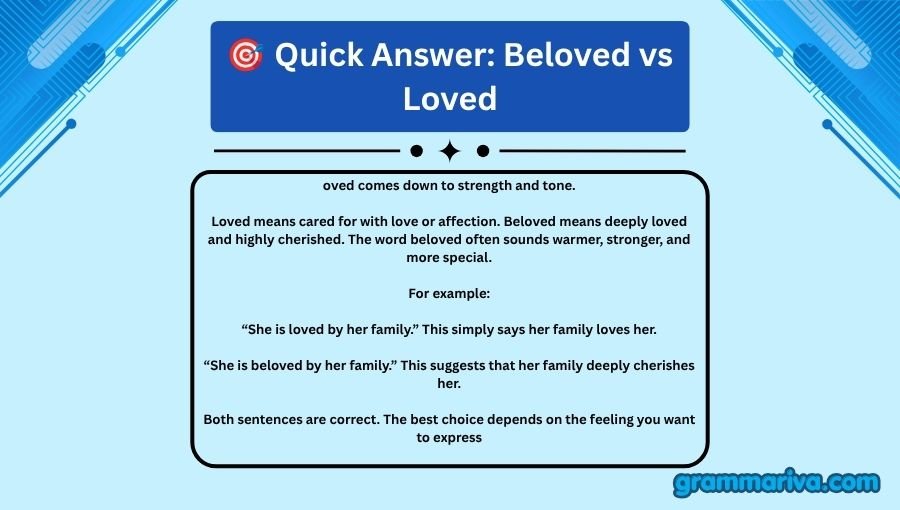
Beloved vs loved comes down to strength and tone.
Loved means cared for with love or affection. Beloved means deeply loved and highly cherished. The word beloved often sounds warmer, stronger, and more special.
For example:
- “She is loved by her family.” This simply says her family loves her.
- “She is beloved by her family.” This suggests that her family deeply cherishes her.
Both sentences are correct. The best choice depends on the feeling you want to express.
Related Word Forms
The two words come from the same basic idea of love, but they work in different ways. Understanding their forms makes sentence building much easier.
| Form | Type | Example |
|---|---|---|
| love | Noun/verb | I love my family. |
| loved | Past tense/past participle/adjective | She loved the book. |
| beloved | Adjective/noun | He was a beloved teacher. |
| loving | Adjective/participle | She gave me a loving smile. |
| lovable | Adjective | The puppy is lovable. |
| lover | Noun | He is a lover of music. |
The key point is simple: loved is a very common form of love, while beloved is often used to describe someone or something that is deeply cherished.
📚 Understanding the Basics
The core difference is emotional tone. Loved is broad and common. Beloved usually adds a stronger feeling of deep affection and special value.
| Form | Type | Meaning | Example | Correct/Incorrect |
|---|---|---|---|---|
| loved | Verb/adjective | Received love or affection | She is loved by everyone. | ✅ Correct |
| beloved | Adjective | Deeply loved or cherished | She is a beloved teacher. | ✅ Correct |
| loved | Adjective | Describes someone who receives love | He is a loved member of the team. | ✅ Correct |
| beloved | Adjective | Shows strong emotional importance | It was his beloved home. | ✅ Correct |
| belove | Standard modern form | Not normally used as a modern replacement for love | I belove my family. | ❌ Incorrect |
A useful way to think about the difference is this:
Loved = receives love.
Beloved = deeply cherished and especially valued.
The meanings can overlap, but the emotional effect is not always the same.
Is Beloved the Same as Loved? 💕
No, they are not exactly the same in tone, although they can overlap in meaning.
Loved is a normal, everyday word. Beloved often carries a stronger emotional weight. It can suggest that a person, place, object, or idea is especially cherished.
Compare these:
“My grandmother was loved by her family.” ✅
This tells us that her family cared deeply about her.
“My grandmother was beloved by her family.” ✅
This gives the sentence a warmer and more powerful feeling. It suggests she held a special place in the family’s heart.
Neither sentence is wrong. The second one simply feels more expressive.
A Simple Meaning Test
When I teach word choice, I like to ask one question:
Does the sentence only need to show love, or does it need to show deep affection and special importance?
If it only needs to show love, loved is usually enough.
If you want a more emotional or memorable tone, beloved may be better.
Test Tip 💡
Try replacing the word with “deeply cherished.”
If that meaning fits, beloved is probably a good choice.
For example:
She was a beloved coach.
You can understand it as:
She was a deeply cherished coach.
That quick test can help you choose the stronger word.
Why Do People Confuse Beloved and Loved? 🤔
People confuse these words because their meanings overlap. Both can describe someone who receives strong affection.
The main difference is not a strict grammar rule. It is often a difference in tone, strength, and style.
I once helped a student edit a short tribute to her grandfather. She had written, “He was a loved man in our town.” The sentence was understandable, but she wanted it to sound more heartfelt. We changed it to “He was a beloved man in our town.” The new version matched the emotional purpose much better.
That small change did not change the basic fact. It changed the feeling.
| Situation | Natural Choice | Why |
|---|---|---|
| Everyday statement | loved | Simple and direct |
| Emotional tribute | beloved | Stronger and warmer |
| Family relationship | loved | Very natural |
| Memorial message | beloved | Often more heartfelt |
| Formal biography | beloved | Can sound respectful |
| Casual text | loved | More conversational |
What Does Loved Mean? ❤️
Loved means that someone or something receives love, care, affection, or strong positive feelings.
It is the past participle of the verb love, and it can also work as an adjective.
Consider these examples:
- “She is loved by her children.”
- “He felt loved at home.”
- “This song is loved by millions of fans.”
- “I loved that movie.”
- “They loved their new house.”
The word is flexible. It can describe people, places, animals, ideas, activities, books, songs, and many other things.
Loved as a Verb
In a sentence such as:
I loved the movie.
Loved is the past tense of love.
It tells us what the speaker felt in the past.
Loved as an Adjective
In:
He is deeply loved.
Loved describes his condition. He receives love from others.
| Meaning | Word Type | Example Sentence |
|---|---|---|
| Had strong affection for something | Verb | I loved the book. |
| Receives affection | Adjective/passive form | She is loved by her family. |
| Was enjoyed or admired | Verb | They loved the concert. |
What Does Beloved Mean? 🌷
Beloved means deeply loved, cherished, or greatly valued.
It is often used when the speaker wants to show that someone or something has a special emotional place in people’s lives.
Examples include:
- “She was a beloved teacher.”
- “The old dog was beloved by the family.”
- “This is my beloved hometown.”
- “He returned to his beloved garden.”
- “The beloved character returned in the final chapter.”
Beloved can describe people, places, animals, objects, traditions, characters, and ideas.
It often feels more emotional than loved.
| Meaning | Word Type | Example Sentence |
|---|---|---|
| Deeply loved | Adjective | She was a beloved friend. |
| Greatly cherished | Adjective | He visited his beloved hometown. |
| A loved person | Noun, in some uses | The beloved was remembered fondly. |
How Does Loved Work in a Sentence?
Loved can appear in many sentence patterns. It can describe an action in the past or someone receiving love.
Here are common patterns:
Subject + loved + object
Maria loved the painting.
Subject + be + loved
Maria is loved.
Subject + be + deeply loved
Maria is deeply loved by her family.
The word is very common in everyday English, so it rarely sounds unusual.
Examples
I loved the restaurant. ✅
My parents loved the gift. ✅
He is loved by his friends. ✅
The little dog was loved by everyone. ✅
These sentences are natural and clear.
How Does Beloved Work in a Sentence?
Beloved is most often used as an adjective before a noun or after a linking verb.
Common patterns include:
beloved + noun
She was a beloved teacher.
be + beloved
The teacher was beloved by her students.
someone’s + beloved + noun
He returned to his beloved hometown.
Because beloved has a strong emotional tone, it often appears in tributes, stories, speeches, biographies, and heartfelt writing. Understanding beloved vs loved becomes easier when you look at how each word works in a complete sentence.
Examples
She is a beloved member of our community. ✅
The author created a beloved character. ✅
They returned to their beloved home. ✅
He was a beloved coach for many years. ✅
These examples show why beloved can feel more special than the simple word loved.
Beloved vs Loved at a Glance 🔎
The easiest way to compare them is by looking at tone and purpose.
| Feature | Loved | Beloved |
|---|---|---|
| Basic meaning | Receiving love | Deeply loved or cherished |
| Tone | Everyday | Warm and emotional |
| Strength | Strong | Often stronger |
| Common in conversation | Very common | Less common |
| Common in tributes | Yes | Very common |
| Common in creative writing | Yes | Very common |
| Describes people | Yes | Yes |
| Describes places | Yes | Yes |
| Describes objects | Yes | Yes |
| Emotional impact | Moderate to strong | Strong |
When Should You Use Loved?
Use loved when you want a simple, natural, and direct expression of affection. When comparing beloved vs loved, choose beloved when you want to highlight deep affection or special emotional value.
It is usually the better choice in casual conversations.
For example:
My kids are loved.
I felt loved when my friends came to visit.
She loved the surprise.
We loved our vacation.
These sentences sound natural because loved is part of normal everyday English.
You can also make it stronger with an adverb:
- deeply loved
- dearly loved
- truly loved
- greatly loved
- widely loved
So you do not always need beloved to express strong emotion.
When Should You Use Beloved?
Use beloved when you want to emphasize deep affection, special value, or emotional importance.
It works especially well in writing that is meant to feel warm or memorable.
Examples include:
Our beloved grandmother will always be remembered.
The town celebrated its beloved coach.
She returned to her beloved childhood home.
The book introduced readers to a beloved character.
I would choose beloved when the emotional meaning matters as much as the basic fact.
Which Word Sounds More Emotional? 💖
Beloved usually sounds more emotional than loved.
Compare:
He was loved by his students.
and:
He was beloved by his students.
The first sentence gives a clear fact. The second sentence creates a stronger emotional picture.
This does not mean loved is weak. A phrase like deeply loved can be extremely powerful.
For example:
She was deeply loved by her family.
That can sound just as heartfelt as:
She was beloved by her family.
The difference is often style rather than meaning.
Can Beloved Describe Things Besides People? 🏡
Yes. Beloved can describe many things besides people.
It can describe:
- places
- pets
- books
- songs
- traditions
- characters
- objects
- memories
- ideas
Examples:
Paris was his beloved city.
The family lost its beloved dog.
The novel became a beloved classic.
She returned to her beloved garden.
The word works well when the thing has strong emotional value.
Case Study: Choosing the Right Word at Work 📝
Imagine a company is writing a retirement message for a manager.
The first draft says:
“John was a loved manager who helped our team for 25 years.”
The sentence is understandable. But it sounds a little plain.
A stronger version is:
“John was a beloved manager who guided our team for 25 years.”
Why does the second sentence work better?
The word beloved suggests that John was not simply liked. It suggests that employees felt a deep connection with him and valued his presence.
I once edited a retirement message with almost the same issue. The writer wanted a warm tone but had used several simple words. Replacing one or two words with more expressive choices made the message feel personal without making it complicated.
| Draft Style | Example | Effect |
|---|---|---|
| Basic | He was a loved manager. | Clear but plain |
| Warm | He was a deeply loved manager. | More emotional |
| Expressive | He was a beloved manager. | Warm and memorable |
| Formal | He was a respected leader. | Professional |
| Personal | He was a beloved mentor. | Emotional and specific |
Grammar Rules Explanation
The main grammar rule is simple: both words can be correct, but they have different roles and tones.
Loved can function as a past-tense verb:
She loved the book.
It can also appear in passive structures:
She is loved by her family.
Beloved is mainly used as an adjective:
She is a beloved teacher.
He returned to his beloved hometown.
The important point is that you should not treat the two words as exact substitutes in every sentence.
For example:
I beloved this song. ❌
This is not standard modern English.
The correct sentence is:
I loved this song. ✅
On the other hand:
She is a beloved teacher. ✅
Here, beloved works naturally as an adjective.
Standard English reference works and dictionaries agree on the broad distinction: loved relates directly to the verb love, while beloved is commonly used for someone or something deeply cherished.
Correct vs Incorrect at a Glance
| Sentence | Correct/Incorrect | Why |
|---|---|---|
| I loved the movie. | ✅ Correct | Loved is the past tense of love. |
| She is beloved by her students. | ✅ Correct | Beloved describes someone deeply cherished. |
| I beloved my family. | ❌ Incorrect | Use loved as the verb. |
| He was a beloved coach. | ✅ Correct | Beloved works as an adjective. |
| They beloved the old house. | ❌ Incorrect | Use loved as the verb. |
Common Mistakes ⚠️
Most mistakes happen because the two words share the same basic idea. Fast typing can also cause errors. Autocorrect may not always catch them. Some writers also assume that beloved is simply a fancy form of loved that can replace it everywhere.
It cannot.
I once caught myself typing “beloved” when I meant “loved” in a quick personal message. I was writing too fast and wanted the sentence to sound warm. After reading it again, I realized the simple word sounded much more natural.
Common Grammar Confusions
| Confusion | Correct Form | Common Reason for Error |
|---|---|---|
| it’s / its | Depends on meaning | Apostrophe confusion |
| your / you’re | Depends on meaning | Fast typing |
| their / there / they’re | Depends on meaning | Similar sound |
| affect / effect | Depends on grammar | Similar use |
| loved / beloved | Depends on role and tone | Overlap in meaning |
Specific Wrong Forms and Uses
| Wrong Form | What’s Wrong | Correct Form |
|---|---|---|
| I beloved her. | Beloved is not the normal verb here. | I loved her. |
| They beloved the song. | The past-tense verb is loved. | They loved the song. |
| He is a loved teacher. | Grammatically possible, but often less natural when emphasizing deep affection. | He is a beloved teacher. |
| My beloved her. | Incorrect sentence structure. | My beloved friend. |
| She beloved the gift. | Incorrect verb form. | She loved the gift. |
| I am beloved this book. | Incorrect verb structure. | I love this book. |
Why Fast Typing Causes These Mistakes ⌨️
Fast typing makes people choose words based on sound or memory rather than meaning.
Autocorrect can also create trouble. If two words are related, a writing app may not know which one you intended.
There is another issue: people sometimes think longer words sound more formal or intelligent. That can lead to unnecessary use of beloved.
Good writing does not mean choosing the fancier word.
It means choosing the right word.
How To Remember the Difference 🧠
Use this simple memory trick:
Loved = love happened.
Beloved = deeply cherished.
Think about these two examples:
I loved the movie.
This describes your reaction.
It is a beloved movie.
This describes the movie’s special place in people’s hearts.
Another quick trick is to look at the sentence’s purpose.
If you are telling someone what you did or felt, loved is often the natural choice.
If you are describing a person, place, or thing that is deeply cherished, beloved may fit better.
| If You Mean… | Choose |
|---|---|
| I had strong affection | loved |
| Someone receives love | loved |
| Someone is deeply cherished | beloved |
| A place is especially precious | beloved |
| A past action involving love | loved |
| A warm description | beloved |
Usage in Different Contexts
Both words can appear in many types of writing, but their tone changes depending on the setting.
| Context | Which Term to Use | Example |
|---|---|---|
| Everyday conversation | loved | I loved the meal. |
| Professional writing | loved or beloved | She was a beloved mentor. |
| Creative writing | beloved | He returned to his beloved village. |
| Social media/texting | loved | Loved this photo! |
| Tribute | beloved | Our beloved father will be missed. |
| Reviews | loved | Readers loved the story. |
| Biography | beloved | She became a beloved public figure. |
Everyday Conversation
Use loved most often in casual speech.
I loved that movie.
We loved the trip.
She loved your idea.
Beloved can sound more formal or dramatic in casual conversation.
Professional Writing
Both can work in professional writing.
Use loved when you want a simple, direct tone.
Use beloved when the writing is about a respected person, tradition, organization, place, or community figure.
Creative Writing
Beloved can be especially useful in stories.
It helps create emotion without requiring a long explanation.
He walked through the doors of his beloved home.
The word tells readers that the home has deep emotional meaning.
Social Media and Texting
Loved is usually more natural in short posts.
Loved this! ❤️
Loved every second of it!
But beloved can work well for emotional posts.
Celebrating our beloved grandmother today. 🌷
Common Phrases With Loved and Beloved
There are several natural phrases built around these words.
| Phrase | Meaning |
|---|---|
| deeply loved | Loved very strongly |
| dearly loved | Greatly loved and valued |
| truly loved | Genuinely loved |
| much-loved | Very popular or warmly regarded |
| beloved family member | A deeply cherished member of a family |
| beloved hometown | A town that someone deeply cherishes |
The phrase much-loved is especially common in writing about people, books, places, traditions, and public figures.
For example:
She was a much-loved teacher.
This has a meaning close to beloved teacher.
Synonyms and Alternatives
Sometimes you can replace either word with another phrase. But each alternative creates a slightly different feeling.
| Alternative | Works When | Does Not Work When |
|---|---|---|
| cherished | You want to stress value and affection | You need a simple everyday verb |
| adored | You want very strong affection | The tone must be neutral |
| treasured | You want to stress personal value | You are describing a simple past action |
| dear | You want warmth or affection | You need a full replacement for loved |
| admired | You mean respect rather than love | The relationship is based mainly on affection |
For example:
She was a cherished friend.
This is close to:
She was a beloved friend.
But admired is different:
She was an admired teacher.
That means people respected her. It does not necessarily mean they loved her.
Is Beloved Stronger Than Loved? 🌟
Usually, yes, in emotional tone.
Beloved often suggests a deeper or more special kind of love. However, context matters.
Consider:
He was loved by his family.
This is already a powerful statement.
Now consider:
He was deeply loved by his family.
That is even stronger.
So the scale is not simply:
loved < beloved
A phrase such as deeply loved can be more emotional than beloved in some situations.
The best word depends on the whole sentence.
Can You Say “Much Loved” Instead of “Beloved”?
Yes. Much-loved is a natural alternative in many contexts.
For example:
She was a beloved teacher.
and:
She was a much-loved teacher.
Both suggest that many people cared about her.
The difference is mostly style.
Beloved often feels warmer and more literary.
Much-loved can feel simple, natural, and descriptive.
| Sentence | Tone |
|---|---|
| She was a loved teacher. | Plain |
| She was a much-loved teacher. | Warm |
| She was a beloved teacher. | Warm and expressive |
| She was a deeply loved teacher. | Very emotional |
Why Word Choice Matters 🎯
Small word choices can change the feeling of a sentence.
This matters in:
- personal messages
- wedding speeches
- memorials
- resumes
- company announcements
- published articles
- social media posts
- creative writing
Clear writing helps readers understand both your meaning and your tone.
A simple rule I use when editing is:
Choose the word that matches the feeling, not the word that sounds fancier.
| Situation | Why Getting It Right Matters |
|---|---|
| Resume | Shows careful word choice |
| Client email | Keeps the tone professional |
| Published content | Improves clarity and style |
| Social post | Makes emotion feel natural |
| Tribute | Helps express sincere feelings |
Beloved vs Loved in Professional Writing 💼
Professional writing needs a careful balance.
You may use beloved when writing about a person who had a strong positive connection with a team or community.
For example:
“She was a beloved member of our organization.”
That sounds warm and respectful.
But in a standard business email, a simpler word may be better:
“We are grateful for everything she did for the team.”
The lesson is not to avoid emotional words. It is to match the tone to the situation.
Beloved vs Loved in Creative Writing ✍️
Creative writers often have more freedom. The beloved vs loved choice can also affect how warm or formal your professional writing sounds.
Beloved can create a strong emotional image with only one word.
Compare:
He looked at the house he loved.
with:
He looked at his beloved house.
The second sentence feels more personal and literary.
However, using beloved too often can make writing feel overly dramatic.
Good creative writing still needs balance.
Special Exception and Edge Cases
There is one useful edge case: beloved can be used as a noun in certain formal or literary contexts.
For example:
The beloved was remembered by everyone.
This use is much less common in everyday American English.
Most modern readers will see beloved used as an adjective:
her beloved mother
a beloved character
his beloved dog
So if you are writing normal English, the adjective use is the safest and most natural choice.
Quick Recap Checklist ✅
Use these questions before choosing your word.
| Question | If Yes → Use |
|---|---|
| Am I describing a past action of loving something? | loved |
| Am I saying someone receives love? | loved |
| Am I describing someone deeply cherished? | beloved |
| Am I describing a special place or object? | beloved |
| Do I want a simple everyday tone? | loved |
| Do I want a warmer, more emotional tone? | beloved |
Practice Examples
- I ___ the concert last night.
Answer: loved ✅ - She was a ___ teacher in our town.
Answer: beloved ✅ - He is deeply ___ by his family.
Answer: loved ✅ - They returned to their ___ hometown.
Answer: beloved ✅ - A final look at beloved vs loved can help you make the right choice quickly, especially when writing emotional or personal messages.
FAQs About Beloved vs Loved
Is beloved more powerful than loved?
Usually, beloved sounds more emotionally strong. It often suggests that someone or something is deeply cherished. However, phrases such as deeply loved or dearly loved can also express very strong emotion.
Is “beloved” a correct English word?
Yes. Beloved is a standard English word. It is commonly used as an adjective to describe someone or something that is deeply loved or cherished.
Can I say “I beloved you”?
No. That is not standard modern English. The correct sentence is “I love you” or “I loved you,” depending on the intended meaning.
Is “loved” a verb or an adjective?
It can be both, depending on the sentence. In “I loved the movie,” it is a verb. In “She is loved by her family,” it appears in a passive verb structure and describes someone receiving love.
Can beloved describe a place?
Yes. Beloved can describe a place that someone deeply cherishes. For example, “He returned to his beloved hometown” shows that the hometown has strong emotional value.
Is “beloved” formal?
It can sound more formal, literary, or emotional than loved. It is common in tributes, biographies, stories, speeches, and heartfelt writing. It can also appear in normal descriptions when the writer wants to show deep affection.
Which is better for a romantic message, loved or beloved?
Both can work. Loved sounds natural and personal. Beloved sounds more poetic and deeply emotional. For a simple romantic message, “You are loved” is natural. For a more poetic message, “My beloved” can work well.
Can beloved and loved be used interchangeably?
Sometimes, but not always. Both can express affection, yet beloved usually adds a sense of deep affection or special value. Also, loved works as a verb in sentences where beloved cannot.
What is the difference between “much-loved” and “beloved”?
Both can mean deeply or warmly regarded. Much-loved is often straightforward and descriptive. Beloved can sound more emotional or literary.
Should I use beloved in everyday conversation?
You can, but loved is usually more natural in casual American English. Beloved is often better when you want to sound warm, emotional, respectful, or literary.
Conclusion
Beloved vs loved is mainly a question of meaning, strength, and tone. Loved is the everyday choice for talking about love, affection, or a past action. Beloved usually adds a stronger sense of deep affection and special value.
When you say, “I loved the movie,” you are describing your reaction. When you say, “It is a beloved movie,” you are saying that the movie holds a special place in people’s hearts.
The best choice is not always the more emotional word. Good writing uses the word that fits the situation. ❤️
If you are writing a casual message, loved will often sound natural. If you are writing a tribute, story, biography, or heartfelt description, beloved may create the exact feeling you want.
Remember the simple rule: loved tells us about love, while beloved often tells us about something deeply cherished. Keep that difference in mind, and choosing between the two becomes easy. ✨

Hi, I’m Lucas Bennett. I’m a grammar content specialist at Grammariva. I work on articles covering everyday grammar questions, sentence usage, and writing tips that readers can apply with confidence.


[…] dont is incorrect in standard English, and how to remember the rule without thinking too hard. ✨ Beloved vs Loved | Unalienable vs Inalienable | Per Say or Per […]