Have you ever typed do not vs dont and stopped because you were unsure which form was right? You are not alone. This small grammar question causes a lot of confusion, especially when people type quickly or write casual messages. 😊
The good news is that the rule is simple. Do not is a standard two-word form. Don’t is its standard contraction. The spelling dont, without an apostrophe, is not the standard English contraction.
I teach grammar and editing, and I often see this mistake in emails, schoolwork, social posts, and quick texts. The problem is usually not the grammar itself. It is the missing apostrophe.
Understanding do not vs dont can help you avoid one of the most common apostrophe mistakes in English. In this guide, I’ll explain the difference in plain English. You will learn when to use do not, when to use don’t, why dont is incorrect in standard English, and how to remember the rule without thinking too hard. ✨ Beloved vs Loved | Unalienable vs Inalienable | Per Say or Per Se
🎯 Quick Answer: Do Not vs Dont
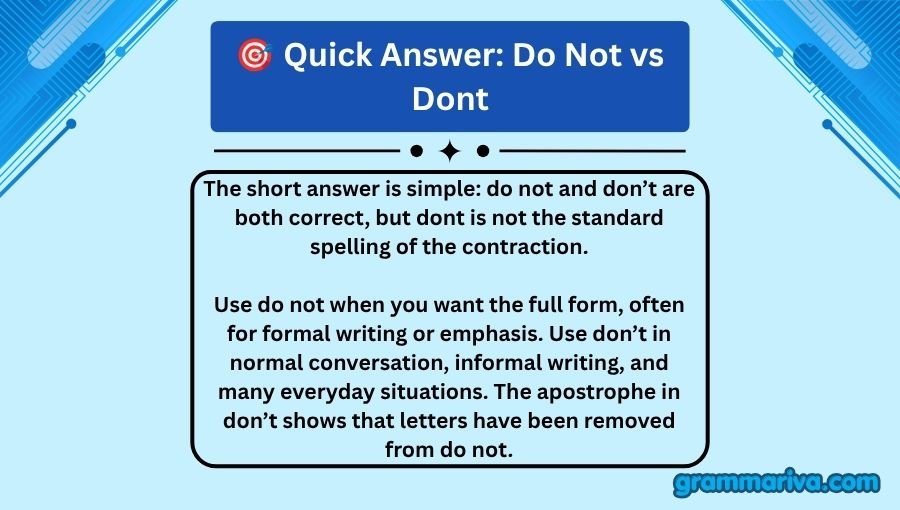
The short answer is simple: do not and don’t are both correct, but dont is not the standard spelling of the contraction.
Use do not when you want the full form, often for formal writing or emphasis. Use don’t in normal conversation, informal writing, and many everyday situations. The apostrophe in don’t shows that letters have been removed from do not.
| Form | Correct? | Use |
|---|---|---|
| do not | ✅ Yes | Full form |
| don’t | ✅ Yes | Contraction |
| dont | ❌ No | Missing apostrophe |
Is Do Not the Same as Don’t? 🤔
Yes. Do not and don’t have the same basic meaning. The main difference is formality and emphasis.
For example:
- I do not know the answer.
- I don’t know the answer.
Both sentences mean that the speaker does not know the answer.
The full form can sound more formal or stronger. The contraction sounds more natural in everyday speech.
I usually tell students to think of them as two versions of the same idea. One is open and complete. The other is shortened.
Do Not
Do not is the full form.
Example:
Please do not touch the equipment.
This sounds clear and somewhat formal.
Don’t
Don’t is the contraction of do not.
Example:
Please don’t touch the equipment.
The meaning is the same, but the sentence feels more conversational.
Dont
Dont is not the standard spelling.
Example:
❌ Please dont touch the equipment.
The problem is the missing apostrophe. Write don’t, not dont.
Do Not vs Don’t: The Core Difference 📝
The core difference is not meaning. It is form. The basic rule for do not vs dont is simple: use do not as the full form and don’t as the contraction.
Do not contains two separate words. Don’t combines them with an apostrophe.
The apostrophe matters because it marks missing letters.
| Form | Type | Meaning | Example | Correct/Incorrect |
|---|---|---|---|---|
| do not | Full form | Negative of “do” | I do not agree. | ✅ Correct |
| don’t | Contraction | Short form of “do not” | I don’t agree. | ✅ Correct |
| dont | Incorrect spelling | Intended as “do not” | I dont agree. | ❌ Incorrect |
The easiest rule is:
If you shorten “do not,” keep the apostrophe: don’t.
You should not remove the apostrophe in standard English just because the word is common.
When Should You Use Do Not? 🎯
Use do not when you want the full form of the negative expression. It is especially useful in formal writing, instructions, serious statements, and situations where you want extra emphasis.
For example:
We do not accept returns without a receipt.
This sounds professional and direct.
You can also use do not when the negative statement needs strong emphasis.
I do not want to discuss this matter again.
The full form can make the speaker sound firm.
Common uses of do not
You may use do not in:
- Formal emails
- Academic writing
- Business documents
- Official instructions
- Policies
- Strong warnings
- Formal announcements
- Situations where you want emphasis
| Meaning | Word Type | Example Sentence |
|---|---|---|
| Negative action | Verb phrase | I do not understand. |
| Negative habit | Verb phrase | They do not eat meat. |
| Negative instruction | Verb phrase | Do not enter this room. |
| Strong denial | Verb phrase | I do not agree with that decision. |
Test Tip 💡
Try replacing do not with don’t.
If the sentence still has the same meaning, you are probably dealing with the correct contraction.
I do not like coffee.
I don’t like coffee.
Both work.
But this does not make dont correct:
❌ I dont like coffee.
The apostrophe is still required.
When Should You Use Don’t? 💬
Use don’t when you want the contracted form of do not. It is common in everyday speech and informal writing.
For example:
I don’t feel well today.
That sounds natural in a conversation.
You can also use it in texts, casual emails, social media posts, personal writing, and dialogue.
Don’t forget your keys!
This is short, clear, and natural.
However, you may want to avoid contractions in some highly formal writing. That does not make contractions grammatically wrong. It simply means the full form may fit the tone better.
| Context | Preferred Form | Example |
|---|---|---|
| Casual conversation | don’t | I don’t know. |
| Text message | don’t | Don’t be late! |
| Social media | don’t | Don’t miss this! |
| Formal report | do not | We do not support this claim. |
| Strong warning | do not | Do not enter. |
Why Do People Confuse Do Not and Dont? 🤷
People often confuse these forms because contractions are usually spoken as one quick sound. When we hear don’t, we do not hear the missing letters.
Typing makes the problem worse. A person may know the correct spelling but leave out the apostrophe while moving quickly.
I once reviewed a short work message that said, “Please dont send the file yet.” The writer knew exactly what they meant. The only problem was the missing apostrophe. One tiny mark changed the spelling from standard to incorrect.
Three common reasons for the mistake
1. Fast typing
People often skip punctuation when texting or typing quickly.
2. Autocorrect habits
Phones and keyboards sometimes change text in unexpected ways. Users may also get used to typing without punctuation in casual messages.
3. Lack of knowledge
Some writers simply have not learned that the apostrophe is part of the contraction.
| Cause | What Happens | Better Habit |
|---|---|---|
| Fast typing | Apostrophe gets skipped | Slow down during final review |
| Autocorrect | Words may change | Check important messages |
| Lack of knowledge | “dont” seems logical | Learn the contraction rule |
| Casual texting | Punctuation is ignored | Use standard spelling when needed |
| Editing too quickly | Small errors survive | Proofread once before sending |
Do Not vs Don’t in Everyday Conversation 🗣️
In everyday conversation, don’t is usually the more natural choice. When learning do not vs dont, everyday conversation is a good place to notice how often contractions are used.
People commonly say:
I don’t know.
I don’t want that.
Don’t worry.
They don’t live here.
Using do not is still correct. It may sound more formal or more forceful.
Compare:
I don’t want to go.
with:
I do not want to go.
The second sentence can sound more serious. The speaker may be stressing the word not.
| Situation | Natural Choice | Example |
|---|---|---|
| Friendly chat | don’t | I don’t know. |
| Casual conversation | don’t | Don’t worry. |
| Strong refusal | do not | I do not agree. |
| Formal instruction | do not | Do not remove the cover. |
How Do Do Not and Don’t Work in Professional Writing? 💼
Both forms can appear in professional writing, but your choice should match the tone. Knowing do not vs dont also helps you choose the right tone for professional emails and documents.
Use do not when you want a formal, careful, or firm tone.
We do not recommend changing the settings.
Use don’t when the message is friendly and conversational.
Don’t forget to attach the report.
A professional email does not automatically require every contraction to be removed. Good writing depends on context.
For a formal policy:
Employees do not have access to this system.
For a friendly reminder:
Don’t forget our meeting at 10 a.m.
Both sentences are correct.
Case Study: A Small Apostrophe in a Work Email 📧
Imagine a manager sends this message:
Please dont forward this document.
The meaning is clear, but the spelling is incorrect in standard English.
A corrected version is:
Please don’t forward this document.
If the message is part of a formal policy, the full form may be better:
Please do not forward this document.
I once edited a company notice where the writer used contractions throughout a formal instruction sheet. Nothing was grammatically broken, but the full forms made the document sound much more polished and consistent.
The lesson is simple: don’t is not wrong. It is a matter of choosing the form that fits the situation.
Why Is “Dont” Incorrect? ⚠️
Dont is incorrect in standard English because it removes the apostrophe from the contraction.
The correct contraction is don’t.
The apostrophe shows that the word is a shortened form of do not.
Compare:
do not → don’t
The apostrophe takes the place of omitted letters.
This is similar to other common contractions:
cannot → can’t
will not → won’t
I am → I’m
they are → they’re
The punctuation is part of the standard spelling.
Correct vs Incorrect at a Glance
| Sentence | Correct/Incorrect | Why |
|---|---|---|
| I do not understand. | ✅ Correct | Full form is correctly written. |
| I don’t understand. | ✅ Correct | Standard contraction. |
| I dont understand. | ❌ Incorrect | Apostrophe is missing. |
| Please do not call me late. | ✅ Correct | Full form is correct. |
| Please dont call me late. | ❌ Incorrect | “Dont” is not the standard contraction. |
Do Not vs Don’t Grammar Rules Explanation
The grammar rule is straightforward. Do not is the full negative form. Don’t is the contraction.
A contraction joins words and uses an apostrophe to show that some letters have been omitted.
The important point is that don’t is not a completely different word. It is a shortened version of do not.
The form also depends on the subject in a sentence.
For example:
I don’t understand.
You don’t understand.
We don’t understand.
They don’t understand.
But with he, she, and it, standard English normally uses does not or doesn’t.
She does not understand.
She doesn’t understand.
Not:
❌ She don’t understand.
And not:
❌ She dont understand.
| Subject | Full Form | Contraction | Example |
|---|---|---|---|
| I | do not | don’t | I don’t know. |
| You | do not | don’t | You don’t know. |
| We | do not | don’t | We don’t know. |
| They | do not | don’t | They don’t know. |
| He | does not | doesn’t | He doesn’t know. |
| She | does not | doesn’t | She doesn’t know. |
| It | does not | doesn’t | It doesn’t work. |
This is an important point. Don’t is not the contraction of does not. The correct contraction of does not is doesn’t.
What Are the Most Common Mistakes? ⚠️
Most mistakes happen when writers treat contractions like ordinary words and forget that the apostrophe is part of their spelling. One of the easiest ways to fix do not vs dont mistakes is to check every contraction during proofreading.
Another common problem is using don’t with a third-person singular subject.
For example:
❌ She don’t like tea.
The correct sentence is:
✅ She doesn’t like tea.
I once caught myself typing “dont” in a quick message because I was focused on the sentence rather than the punctuation. A two-second reread fixed it. That is exactly why proofreading matters.
Similar Grammar Confusions
| Confusion | Correct Form | Common Error |
|---|---|---|
| its / it’s | It’s raining. | Its raining. |
| your / you’re | You’re ready. | Your ready. |
| they’re / their | They’re here. | Their here. |
| we’re / were | We’re ready. | Were ready. |
| who’s / whose | Who’s coming? | Whose coming? |
These errors are similar because the writer may know the words but forget how punctuation changes the form.
Specific Mistakes With Do Not and Don’t
| Wrong Form | What’s Wrong | Correct Form |
|---|---|---|
| dont | Missing apostrophe | don’t |
| Dont | Missing apostrophe | Don’t |
| DONt | Incorrect capitalization pattern | DON’T |
| dont’t | Extra letters and apostrophe | don’t |
| do’nt | Apostrophe is in the wrong place | don’t |
| Don´t | Wrong apostrophe character may appear from copied text | Don’t |
The safest standard form is don’t.
Do Not vs Don’t in Different Contexts 🌎
The correct choice depends on your audience and purpose. Both forms are useful.
| Context | Which Term to Use | Example |
|---|---|---|
| Everyday conversation | don’t | I don’t want coffee. |
| Professional writing | do not or don’t | We do not offer refunds. |
| Creative writing | Either | Don’t look back. |
| Social media/texting | don’t | Don’t miss this! |
Everyday Conversation
Choose don’t for a natural, relaxed sound.
I don’t think so.
Professional Writing
Choose do not when the tone needs to be formal, direct, or official.
Do not share your password.
Creative Writing
Both forms can work. Writers often choose based on the character’s voice.
“Don’t leave me,” she said.
A formal character might say:
“Do not leave me.”
The choice can affect tone.
Social Media and Texting
Don’t is usually more natural.
Don’t scroll past this one! 😄
Still, remember that casual writing does not make dont the standard spelling. If you want correct English, write don’t.
How Do You Remember the Difference? 🧠
Use a simple three-step memory trick.
Step 1: Start with do not.
Step 2: Shorten it.
Step 3: Keep the apostrophe.
So:
do not → don’t
Never:
do not → dont
Think of the apostrophe as a small sign saying, “Something is missing here.”
A Simple Memory Test
Ask yourself:
Am I writing the full form?
If yes:
do not
Am I writing the short form?
If yes:
don’t
If you wrote:
dont
Stop and add the apostrophe.
Common Phrases With Do Not and Don’t 💬
There are many everyday expressions that use don’t.
| Phrase | Meaning |
|---|---|
| Don’t worry | Tells someone not to feel worried |
| Don’t forget | Reminds someone to remember something |
| Don’t give up | Encourages someone to continue |
| Don’t get me wrong | Clarifies that you are not criticizing the person in the way they may think |
| Don’t be afraid | Tells someone not to feel fear |
| Don’t get involved | Advises someone to stay out of a situation |
These phrases are extremely common in speech and informal writing.
The full forms are also grammatically possible:
Do not worry.
Do not forget.
Do not give up.
The tone simply changes.
What Alternatives Can You Use? 🔄
Sometimes you can rewrite a sentence to avoid either form. This can be useful when you want a different tone.
For example:
I don’t agree.
can become:
I disagree.
Both express a similar idea.
However, alternatives are not always exact replacements.
| Alternative | Works When | Does Not Work When |
|---|---|---|
| disagree | You want to express a different opinion | You need to describe another negative action |
| avoid | You mean staying away from something | You simply mean “do not” |
| refuse | Someone actively rejects something | The sentence is only a simple negative |
| lack | You mean something is absent | You are giving a direct instruction |
For example:
I don’t agree.
works naturally as:
I disagree.
But:
Don’t touch the button.
cannot simply become:
I disagree.
The meaning changes completely.
Why Does Correct Usage Matter? 🎯
Correct spelling helps readers understand your writing without distractions.
A missing apostrophe may seem tiny, but repeated small errors can make a document look careless.
This matters most when you are writing something other people will judge.
| Situation | Why Getting It Right Matters |
|---|---|
| Resume | Shows attention to detail |
| Client email | Creates a professional impression |
| Published content | Builds reader trust |
| Social post | Makes your writing look polished |
A useful rule is:
Small punctuation marks can make a big difference in clear writing.
That does not mean every informal text must sound formal. It means you should know the standard form and choose your style on purpose.
Is “Dont” Ever Acceptable? 🔍
In standard English writing, dont without an apostrophe is not the normal spelling of the contraction.
You may see it in usernames, brand names, stylized text, or online writing where punctuation is intentionally removed. Those are special cases of styling, not evidence that dont is the standard grammatical form.
For normal writing, use:
do not
or
don’t
Do not use dont when you are trying to write standard English.
Do Not vs Don’t: Quick Recap Checklist ✅
The rule can be remembered in seconds.
| Question | If Yes → Use |
|---|---|
| Do you want the full form? | do not |
| Do you want the contraction? | don’t |
| Are you writing a formal instruction? | Usually do not |
| Are you writing casual dialogue? | Usually don’t |
| Did you write “dont”? | Add the apostrophe |
| Is the subject he, she, or it? | Use does not/doesn’t |
Practice Examples
Example 1
I ___ like spicy food.
Answer:
I don’t like spicy food. ✅
Example 2
___ enter this area.
Answer:
Do not enter this area. ✅
Example 3
She ___ understand the question.
Answer:
She doesn’t understand the question. ✅
Notice that the third example uses doesn’t, not don’t. Once you understand do not vs dont, the difference becomes much easier to spot in everyday writing.
FAQs About Do Not vs Dont
Is “dont” grammatically correct?
No. Dont without an apostrophe is not the standard spelling. The correct contraction of do not is don’t.
Is “do not” or “don’t” better?
Both are correct. Do not is the full form and often sounds more formal or emphatic. Don’t is the contraction and is common in everyday speech and informal writing.
Why does “don’t” have an apostrophe?
The apostrophe shows that the word is a contraction. Letters have been removed when do not becomes don’t.
Can I use “don’t” in formal writing?
Yes, but the choice depends on the style. Some formal documents prefer full forms such as do not. Other professional writing uses contractions naturally.
What is the difference between “do not” and “don’t”?
There is usually no difference in basic meaning. Do not is the full form, while don’t is the shortened form.
Is “dont” the same as “don’t”?
They may be intended to mean the same thing, but they are not the same standard spelling. Don’t is correct. Dont is missing the apostrophe.
When should I use “do not” instead of “don’t”?
Use do not when you want a formal, serious, official, or strongly emphasized tone. It is also common in rules and instructions.
When should I use “don’t” instead of “do not”?
Use don’t when you want a natural conversational tone. It works well in everyday speech, casual writing, dialogue, texts, and social media.
Is “she don’t” correct?
No, not in standard English. With she, use she does not or she doesn’t.
Correct:
She doesn’t like coffee. ✅
Incorrect:
She don’t like coffee. ❌
Is “do not” a contraction?
No. Do not is the full two-word form. Don’t is the contraction. Keep the main do not vs dont rule in mind whenever you are unsure about the apostrophe.
Conclusion
Do not vs dont is easier than it first appears. Do not is the full form, while don’t is the correct contraction. Dont, without the apostrophe, is not the standard spelling.
When you need a formal or firm tone, do not is often the better choice. When you want a natural and conversational tone, don’t usually sounds better. 😊
The key rule is worth remembering:
Do not → don’t
The apostrophe is not optional in standard English. It shows that the word is a shortened form.
Also remember that does not → doesn’t, so sentences with he, she, or it usually need doesn’t, not don’t.
I recommend one final proofreading trick: whenever you see dont, pause for a second. Ask whether you meant do not or don’t. Then choose the correct form.
Master that tiny apostrophe, and this common grammar problem becomes one less thing to worry about. ✨

Hi, I’m Madison Hayes. I’m an English learning writer at Grammariva, where I work on simple lessons and examples for people who want to improve their grammar and writing. I love turning confusing rules into easy-to-follow explanations.
[…] the end, you should be able to choose the right word without stopping to think twice. Do Not vs Dont | Beloved vs Loved | Unalienable vs […]