Have you ever typed a sentence and stopped because you were unsure about wonder vs wander? You are not alone. These two words look and sound close, but they have very different meanings. One is about thinking, asking, or feeling curious. The other is about moving around without a clear path or purpose. A single letter can change the whole meaning of your sentence. 😊
I have taught and edited English for years, and this is one of those word pairs that becomes easy once you connect each word with a simple idea. Wonder is about your mind. Wander is about movement. Once you remember that basic link, choosing the right word becomes much easier.
In this guide, I will explain the difference in plain English. You will see clear examples, common mistakes, memory tricks, usage rules, and practice questions. By the end, you should feel confident using both words in everyday writing, schoolwork, emails, and social posts. ✨ Minuet vs Minute
🎯 Quick Answer: What Is the Difference Between Wonder and Wander?
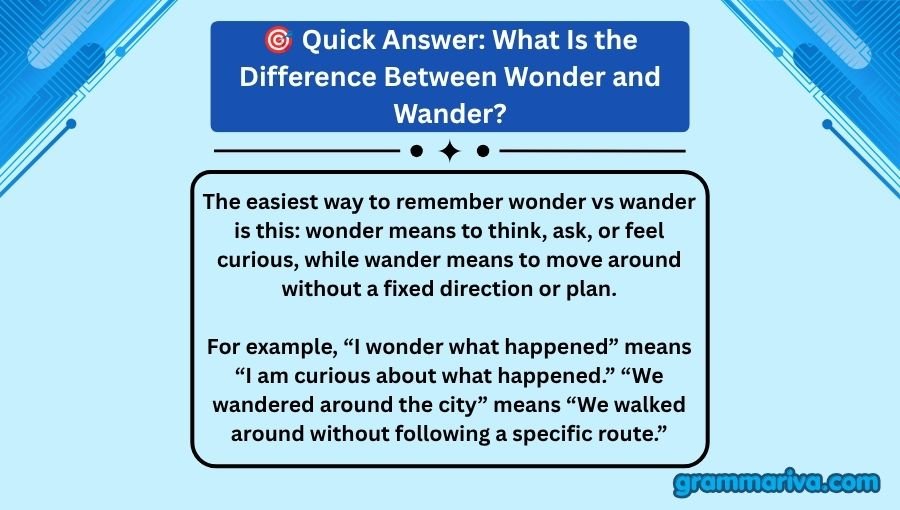
The easiest way to remember wonder vs wander is this: wonder means to think, ask, or feel curious, while wander means to move around without a fixed direction or plan.
For example, “I wonder what happened” means “I am curious about what happened.” “We wandered around the city” means “We walked around without following a specific route.”
| Word | Main Meaning | Example |
|---|---|---|
| Wonder | To think about something or feel curious | I wonder where she went. |
| Wander | To move without a clear direction | We wandered through the park. |
| Wonder | A feeling of surprise or amazement | The child looked at the stars in wonder. |
| Wander | To move away from a place, path, or topic | My mind began to wander. |
🧠 Is Wonder the Same as Wander?
No, wonder and wander are not the same. Wonder usually describes curiosity, thought, surprise, or amazement. Wander usually describes movement without a set direction.
Think about these two sentences:
- ✅ I wonder where my keys are.
- ❌ I wander where my keys are.
The first sentence is correct because the speaker is thinking about where the keys might be.
Now look at this pair:
- ✅ We wandered around the old town.
- ❌ We wondered around the old town.
The first sentence is correct because the people walked around without a specific route.
A Simple Mental Picture
When you wonder, picture a question mark inside your head.
When you wander, picture your feet moving from place to place.
That small mental picture can help you make the right choice quickly.
| Word | What Is Happening? | Main Idea |
|---|---|---|
| Wonder | Thinking or feeling | Curiosity |
| Wander | Moving | No fixed direction |
| Wonder | Looking at something with amazement | Surprise |
| Wander | Leaving the planned route | Roaming |
📚 Wonder: Meaning and Correct Use
Wonder can work as both a verb and a noun. As a verb, it often means to think about something because you are curious. As a noun, it can describe a feeling of amazement or something remarkable.
Wonder as a Verb
When wonder is a verb, it often introduces a question or thought.
Examples:
- ✅ I wonder why Jake left early.
- ❌ I wander why Jake left early.
Here, the speaker is curious. No physical movement is involved.
Another example:
- ✅ She wondered whether the store was still open.
- ❌ She wandered whether the store was still open.
Again, the person is thinking about something.
Wonder as a Noun
Wonder can also describe amazement.
- ✅ The children stared at the fireworks in wonder.
- ❌ The children stared at the fireworks in wander.
It can also describe something amazing or remarkable.
- The natural wonder attracted thousands of visitors.
- The young scientist spoke with a sense of wonder.
Common Uses of Wonder
You will often see wonder in phrases such as:
- I wonder why…
- I wonder if…
- I wonder whether…
- I wonder what…
- in wonder
- a sense of wonder
| Meaning | Word Type | Example Sentence |
|---|---|---|
| Feel curious | Verb | I wonder what she meant. |
| Think about something | Verb | He wondered about the result. |
| Feel amazement | Noun | She watched in wonder. |
| Something amazing | Noun | The waterfall was a natural wonder. |
💡 Test Tip
Ask yourself: “Am I thinking about something?”
If the answer is yes, you probably need wonder.
🚶 Wander: Meaning and Correct Use
Wander is mainly a verb that means to move around without a clear destination, route, or purpose. It can describe physical movement, but it can also describe thoughts that lose focus.
Physical Movement
This is the most common use.
- ✅ We wandered through the market.
- ❌ We wondered through the market.
The people are moving around the market without following a fixed path.
Another example:
- ✅ He wandered around the neighborhood after dinner.
- ❌ He wondered around the neighborhood after dinner.
Wandering Away
Wander can also mean moving away from a place or path.
- The child wandered away from the group.
- The dog wandered out of the yard.
- She wandered off before anyone noticed.
Wandering Thoughts
The word can also describe a mind that loses focus.
- My mind started to wander during the long meeting.
- His thoughts wandered while he was reading.
This use can confuse learners because it involves thinking. Still, the idea is different from wonder. Your thoughts are moving from one idea to another.
| Use | Meaning | Example |
|---|---|---|
| Wander physically | Move without a fixed route | We wandered around town. |
| Wander away | Move away from a place | The puppy wandered away. |
| Wander off | Leave without a clear plan | She wandered off alone. |
| Wander mentally | Lose focus | My mind began to wander. |
🔍 Wonder vs Wander at a Glance
The core difference is simple: wonder relates to curiosity or amazement, while wander relates to movement or a lack of focus.
| Form | Type | Meaning | Example | Correct/Incorrect |
|---|---|---|---|---|
| Wonder | Verb | Feel curious | I wonder what he wants. | ✅ Correct |
| Wonder | Noun | Amazement | She looked at it in wonder. | ✅ Correct |
| Wander | Verb | Move without direction | We wandered through the woods. | ✅ Correct |
| Wander | Verb | Lose mental focus | My mind began to wander. | ✅ Correct |
| Wonder | Verb | Physical roaming | We wonder through the park. | ❌ Incorrect |
❓ Why Do People Confuse Wonder and Wander?
People confuse these words because they look and sound very similar. Both begin with w and contain similar letters. The main difference is the vowel sound and, more importantly, the meaning.
I once reviewed a student’s short travel story that said, “We wondered through the streets until sunset.” The student meant that the group walked around with no set route. Changing wondered to wandered fixed the sentence immediately.
The confusion also happens because wander can describe the mind. For example, “My thoughts wandered.” That may make learners connect it with thinking and accidentally choose wonder in movement sentences. Understanding wonder vs wander becomes much easier when you focus on what the person is doing rather than how the words look.
The Core Memory Trick
Use this:
Wonder = mind.
Wander = movement.
This is not a rule for every possible sentence, but it is an excellent starting point.
| If You Mean… | Choose | Example |
|---|---|---|
| Ask yourself something | Wonder | I wonder why she called. |
| Feel curious | Wonder | I wonder what happened. |
| Feel amazement | Wonder | He watched in wonder. |
| Walk without a plan | Wander | We wandered around town. |
| Move away | Wander | The child wandered off. |
| Lose focus | Wander | My mind wandered. |
📝 A Real-Life Case Study: A Travel Email
Imagine that you are writing an email about a vacation.
You write:
“After lunch, we wondered around the old streets for two hours.”
The reader may understand your meaning, but the word choice is wrong.
The corrected sentence is:
“After lunch, we wandered around the old streets for two hours.”
Why?
Because the group physically moved around the streets. They were not asking themselves a question.
Now consider this sentence:
“I wonder what the old building was used for.”
That sentence is correct because the writer is curious.
Before and After
| Original Sentence | Problem | Better Sentence |
|---|---|---|
| We wondered around the city. | Wrong verb for movement | We wandered around the city. |
| I wander why she left. | Wrong verb for curiosity | I wonder why she left. |
| My mind wondered during class. | Wrong word for losing focus | My mind wandered during class. |
| She wondered about the museum. | Correct | She wondered about the museum. |
📖 Grammar Rules Explanation
Wonder and wander are different words with different grammatical meanings. The correct choice depends on what the sentence says the subject is doing.
Wonder is commonly used as a verb when someone is curious, asks themselves a question, or thinks about something they do not know. It can also function as a noun for amazement or something remarkable.
Wander is commonly used as a verb for moving without a fixed direction. It can also describe thoughts that drift away from the main subject.
Neither word is simply a different spelling of the other. Replacing one with the other changes the meaning.
Most standard English dictionaries make the same basic distinction between the two words.
Correct vs Incorrect at a Glance
| Sentence | Correct/Incorrect | Why |
|---|---|---|
| I wonder what time it is. | ✅ Correct | The speaker is curious. |
| We wandered through the garden. | ✅ Correct | The people moved around freely. |
| I wander what she meant. | ❌ Incorrect | Curiosity requires wonder. |
| They wondered through the forest. | ❌ Incorrect | Physical movement requires wandered. |
| My mind wandered during the lecture. | ✅ Correct | The thoughts lost focus. |
A Useful Grammar Pattern
For curiosity, you will often see:
wonder + question word
Examples:
- I wonder why he left.
- She wonders where they went.
- We wondered what happened.
- He wonders when the meeting starts.
You can also use:
wonder + if/whether
- I wonder if she is coming.
- He wondered whether the plan would work.
For movement, wander often appears with location words:
- wander around
- wander through
- wander into
- wander away
- wander off
These patterns make the difference easier to spot. The easiest way to master wonder vs wander is to connect each word with its basic meaning before choosing it.
⚠️ Common Mistakes With Wonder and Wander
The most common mistake is choosing the word that looks right instead of the word that matches the meaning.
I once caught myself typing “I wander if…” in a quick message. I was moving fast and my fingers followed the familiar spelling. I noticed the mistake before sending it. That small slip shows how easily speed can beat careful word choice.
Why These Mistakes Happen
Fast typing: Your brain may focus on the sound instead of the meaning.
Autocorrect: Your device may change a word based on context.
Lack of knowledge: If you have never learned the difference, the words can seem interchangeable.
Similar spelling: Only one letter separates them.
Similar Grammar Confusions
| Confusing Pair | Correct Difference |
|---|---|
| its / it’s | Possession vs. “it is” or “it has” |
| your / you’re | Possession vs. “you are” |
| their / there / they’re | Possession, place, and “they are” |
| then / than | Time/order vs. comparison |
| affect / effect | Usually verb vs. noun |
| wonder / wander | Curiosity vs. movement |
Specific Wrong Forms and Uses
| Wrong Form | What’s Wrong | Correct Form |
|---|---|---|
| I wander why | Wander does not mean “be curious” | I wonder why |
| We wondered around | Wondered does not mean “walked around” | We wandered around |
| My mind wondered | The intended meaning is drifting or losing focus | My mind wandered |
| They wandered what happened | The intended meaning is curiosity | They wondered what happened |
| She wonder through town | The verb needs the correct form for movement | She wandered through town |
🕰️ Wonder and Wander: A Brief Word History
The two words have separate histories and developed with different meanings. Their modern spellings are similar, but they are not simply two forms of one word.
Wonder developed around ideas of amazement, curiosity, and thought.
Wander developed around the idea of moving from place to place without a fixed course.
Because English contains many words with similar sounds and spellings, it is possible for two unrelated words to look quite close.
| Stage | Form | General Note |
|---|---|---|
| Earlier English | Forms related to wonder | Connected with amazement or curiosity |
| Earlier English | Forms related to wander | Connected with roaming or moving |
| Middle English | Similar-looking forms continued | Meanings remained distinct |
| Modern English | wonder | Curiosity or amazement |
| Modern English | wander | Unplanned movement or drifting focus |
The key point is simple: their modern meanings are different, so their spelling should not be treated as interchangeable.
🌎 How Wonder and Wander Work in Different Contexts
The right word stays the same even when the setting changes. What matters is the meaning of the sentence.
Everyday Conversation
Use wonder when you are curious.
“I wonder where Sam is.”
Use wander when someone moves without a clear route.
“We wandered around the mall.”
Professional Writing
In a workplace email, wonder can make a question sound polite.
“I was wondering if you could send the report.”
Wander is useful when describing movement or a loss of focus.
“The discussion wandered away from the main topic.”
Creative Writing
Writers often use both words to create different effects.
“She wondered what waited beyond the hill.”
“He wandered through the quiet village.”
Social Media and Texting
Both words are common in casual posts.
“Wonder what tomorrow will bring. ✨”
“Wandering through the city with no plan. 📸”
| Context | Which Term to Use | Example |
|---|---|---|
| Everyday conversation | Wonder for curiosity | I wonder where he is. |
| Everyday conversation | Wander for movement | We wandered around downtown. |
| Professional writing | Wonder for polite questions | I was wondering if you could help. |
| Professional writing | Wander for drifting topics | The meeting wandered off topic. |
| Creative writing | Either, based on meaning | She wondered about the future. |
| Social media | Either, based on meaning | Wandering through new places. |
💬 Common Phrases With Wonder
Wonder appears in many natural English phrases. These expressions usually involve curiosity, amazement, or something remarkable.
| Phrase | Meaning |
|---|---|
| I wonder | I am curious |
| I wonder if | I am unsure and curious about something |
| I wonder why | I am curious about a reason |
| in wonder | With amazement |
| a sense of wonder | A feeling of amazement or curiosity |
| no wonder | It is not surprising |
Examples:
- I wonder if she will call.
- No wonder he was tired.
- The children looked at the stars in wonder.
🚶 Common Phrases With Wander
Wander also appears in several common expressions, especially those describing movement or drifting attention.
| Phrase | Meaning |
|---|---|
| Wander around | Move around without a set route |
| Wander through | Move slowly or freely through a place |
| Wander off | Leave a place or group |
| Wander away | Move away from something |
| Wander into | Enter a place without a clear plan |
| Mind wanders | Attention moves away from the main subject |
Examples:
- We wandered around the village.
- She wandered into the bookstore.
- My mind tends to wander during long meetings.
🔄 Synonyms and Alternatives
You can sometimes replace wonder or wander with another word. However, the replacement must match the exact meaning.
For example, wonder can sometimes become ask yourself or be curious about. Wander can sometimes become roam, stroll, or drift.
| Alternative | Works When | Does Not Work When |
|---|---|---|
| Be curious | You mean wonder | You mean physical movement |
| Ask yourself | You are thinking about a question | Someone is walking around |
| Roam | Someone moves freely | Someone is asking a question |
| Stroll | Someone walks casually | Someone feels curious |
| Drift | Thoughts lose focus | You need to express curiosity |
Be careful with synonyms. Stroll usually suggests relaxed walking. Wander focuses more on the lack of a clear route or destination.
❓ Can Wonder and Wander Be Used in the Same Sentence?
Yes. You can use both words in one sentence when you are talking about curiosity and movement at the same time.
For example:
- I wondered why he wandered away from the group.
Here, wondered means “was curious,” while wandered means “moved away without a clear purpose.”
Another example:
- She wondered where her brother had wandered.
The first word describes her thought. The second describes his movement.
| Sentence | Wonder Meaning | Wander Meaning |
|---|---|---|
| I wonder where they wandered. | Feel curious | Move without a clear route |
| She wondered why he wandered off. | Ask herself | Move away |
| We wondered where the dog had wandered. | Feel curious | Roam away |
This is one of the best ways to see that the words have separate jobs.
🧩 How to Remember the Difference Easily
A strong memory trick can save you from spelling mistakes.
Think: Wonder = Why?
The word wonder often appears when you are asking yourself a question.
I wonder why.
That connection is easy to remember.
Think: Wander = Walk
Both wander and walk relate to movement.
You can imagine:
Wander = Walk without a plan.
This is not a perfect synonym, but it is a useful memory shortcut. This simple trick makes wonder vs wander easier to remember when you are writing quickly.
The One-Line Rule
Wonder happens in your thoughts. Wander happens in your path.
There are exceptions in the sense that wander can describe your thoughts too, but the central distinction remains useful.
❓ Is “I Wonder” Correct English?
Yes. “I wonder” is completely correct when you want to express curiosity, uncertainty, or a question you are thinking about.
Examples:
- I wonder where she lives.
- I wonder what happened.
- I wonder if they are coming.
- I wonder why he left.
You do not need to use a question mark after every sentence beginning with “I wonder.” If the sentence itself is a statement about your curiosity, a period is often correct.
For example:
I wonder where she went.
This is a statement about your thought, not a direct question.
❓ Is “Wander Around” Correct?
Yes. Wander around is a common and correct phrase. It means to move around without following a fixed route or having a clear destination.
Examples:
- We wandered around the museum.
- I like to wander around old neighborhoods.
- They wandered around the park for an hour.
Do not replace wander with wonder when you mean physical movement.
- ✅ We wandered around the city.
- ❌ We wondered around the city.
❓ Can Your Mind Wander?
Yes. Your mind can wander when your attention moves away from what you are supposed to be thinking about.
Examples:
- My mind wandered during the lecture.
- Her mind began to wander while she was reading.
- I noticed that my thoughts were wandering.
This is an important exception to the simple “wander equals physical movement” memory trick. Wander can describe mental drifting too.
The key idea is still movement. Your thoughts are moving from one subject to another.
❓ Is “I Wander Why” Correct?
No. “I wander why” is incorrect when you mean that you are curious about a reason.
The correct phrase is:
I wonder why.
For example:
- ❌ I wander why he did that.
- ✅ I wonder why he did that.
The phrase “I wonder why” is one of the most common places where people make this spelling mistake.
❓ Is “We Wondered Around” Correct?
No, not when you mean that you walked around without a clear plan.
Use:
We wandered around.
For example:
- ❌ We wondered around the park.
- ✅ We wandered around the park.
The word wandered is the past tense of wander.
❓ What Is the Difference Between “Wondered” and “Wandered”?
Wondered is the past tense of wonder. It describes past curiosity or thought.
Wandered is the past tense of wander. It describes past movement or drifting.
Compare:
- I wondered what she meant.
- I wandered through the market.
The endings look similar, but the meanings are completely different.
| Past Form | Meaning | Example |
|---|---|---|
| Wondered | Was curious | I wondered why he left. |
| Wondered | Thought about something | She wondered about the result. |
| Wandered | Moved without direction | We wandered through town. |
| Wandered | Drifted mentally | His mind wandered. |
❓ Which Word Should I Use in a Professional Email?
Use wonder when you want to express curiosity or make a polite request. Use wander only when you are describing movement or a discussion that moves away from its main subject.
For example:
I was wondering if you could send the updated file.
This is a polite workplace request.
You might use wander in a different type of sentence:
The conversation wandered away from the original topic.
The first sentence is about a polite thought. The second is about a discussion drifting away from its main subject.
❓ What Is the Easiest Way to Remember Wonder vs Wander?
Remember these two short ideas:
Wonder = curiosity.
Wander = movement.
If you are asking yourself why, where, what, when, or if, wonder is often the correct choice.
If someone is walking, roaming, drifting, or moving without a clear route, wander is usually correct.
⚡ Quick Recap Checklist
Use this checklist before choosing the word.
| Question | If Yes → Use |
|---|---|
| Am I curious about something? | Wonder |
| Am I asking myself a question? | Wonder |
| Am I describing amazement? | Wonder |
| Is someone moving without a fixed route? | Wander |
| Is someone moving away without a plan? | Wander |
| Are thoughts losing focus? | Wander |
Practice Examples
- I ___ why she canceled the meeting.
→ wonder - We ___ through the quiet streets.
→ wandered - My mind began to ___ during the long speech.
→ wander
Try saying the full sentences aloud. Hearing the meaning can help you choose the correct word.
🧪 Three Quick Practice Questions
1. Which sentence is correct?
A. I wander why he is late.
B. I wonder why he is late.
Answer: B. The sentence expresses curiosity.
2. Which sentence is correct?
A. We wandered through the forest.
B. We wondered through the forest.
Answer: A. The sentence describes physical movement.
3. Which sentence is correct?
A. Her mind wandered during class.
B. Her mind wondered during class.
Answer: A. The sentence describes attention drifting away. A little practice with wonder vs wander can help you avoid these common spelling and meaning mistakes.
❓ FAQs About Wonder vs Wander
What is the main difference between wonder and wander?
Wonder means to feel curious, think about something, or feel amazement. Wander means to move without a clear direction or to drift away from a subject or thought.
Is “I wonder why” correct?
Yes. “I wonder why” is correct when you are curious about a reason. For example, “I wonder why she left early.”
Is “I wander why” correct?
No. When you mean curiosity, the correct spelling is wonder. “I wander why” is a common spelling mistake.
Is “wander around” correct?
Yes. Wander around means to move around without a fixed route or destination. For example, “We wandered around the city all afternoon.”
What does “my mind wandered” mean?
“My mind wandered” means that your attention moved away from the subject you were supposed to be thinking about. For example, your mind may wander during a long lecture.
Can wonder and wander appear in the same sentence?
Yes. For example, “I wondered where the dog had wandered.” Wondered describes curiosity, while wandered describes movement.
Is wondered the past tense of wonder?
Yes. Wondered is the past tense of wonder. It can mean that someone was curious or thought about something.
Is wandered the past tense of wander?
Yes. Wandered is the past tense of wander. It describes past movement without a fixed route or mental drifting.
How can I remember wonder vs wander?
Use the simple memory trick: wonder = curiosity and wander = movement. Think of a question mark for wonder and moving feet for wander.
Which word should I use when talking about curiosity?
Use wonder. For example, “I wonder what happened.” When talking about roaming or moving without a fixed path, use wander. Reviewing wonder vs wander one more time can help you remember the difference and avoid future spelling mistakes.
🎯 Final Takeaway: Wonder vs Wander Made Simple
Wonder vs wander becomes much easier once you focus on meaning instead of spelling. Wonder is connected to curiosity, questions, thought, and amazement. Wander is connected to movement, roaming, drifting, and losing focus. 😊
When you say, “I wonder why,” you are thinking. When you say, “We wandered through the park,” you are moving. When you say, “My mind wandered,” your thoughts are drifting from one idea to another.
I recommend using the simple memory pair: wonder = curiosity, wander = movement. It works well for everyday writing, school assignments, professional emails, and casual messages.
The next time you hesitate, stop for one second and ask yourself what the sentence means. Are you thinking or asking? Choose wonder. Are you roaming or drifting? Choose wander.
Remember: Wonder asks “why?” while wander asks “where next?” ✨

Hi, I’m Lucas Bennett. I’m a grammar content specialist at Grammariva. I work on articles covering everyday grammar questions, sentence usage, and writing tips that readers can apply with confidence.


[…] In this guide, I will explain the difference in simple English. You will see clear examples, common mistakes, memory tricks, grammar rules, tables, and practice sentences. By the end, you should feel confident choosing the right word every time. ✨ Wonder vs Wander […]