Have you ever typed a quick message and stopped at alright vs allright? 🤔 You are not alone. These spellings look almost identical, but only one is accepted as a standard word. The confusion gets worse because another form, all right, is also correct and has been used for a long time.
The good news is that the rule is easy once you see it. Alright is a recognized spelling used to mean satisfactory, acceptable, or in agreement. Allright, written as one word with two l’s before the r, is not the standard spelling. All right, written as two words, is also correct and is often preferred in formal writing.
As an editor, I see this kind of spelling mix-up often. It usually happens when people type quickly or remember the sound instead of the spelling. In this guide, I will show you the difference, explain when each form works, and give you simple examples you can use right away. ✍️ Worn or Warn | Where Are You Headed or Where Are You Heading | There Has Been or There Have Been
🎯 Quick Answer: Alright vs Allright
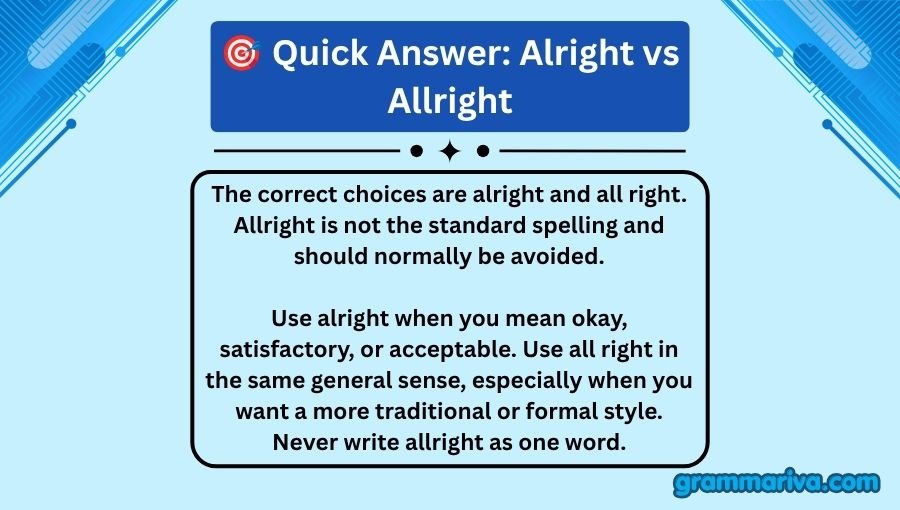
The correct choices are alright and all right. Allright is not the standard spelling and should normally be avoided.
Use alright when you mean okay, satisfactory, or acceptable. Use all right in the same general sense, especially when you want a more traditional or formal style. Never write allright as one word.
| Form | Correct? | Basic Use | Example |
|---|---|---|---|
| alright | ✅ Yes | Means okay or satisfactory | I am alright now. |
| all right | ✅ Yes | Means okay or satisfactory | Everything is all right. |
| allright | ❌ No | Nonstandard spelling | Please do not use this form. |
The simplest answer to alright vs allright is this: alright is correct, while allright is not standard English.
❓ Is Alright the Same as Allright?
No. Alright is a recognized English spelling, while allright is generally treated as a misspelling. The bigger comparison is actually between alright and all right.
This matters because writers sometimes think that adding another “l” makes the spelling follow the pattern of all right. It does not.
Alright
Alright is one word. It can mean:
- okay
- satisfactory
- acceptable
- safe or well
- in agreement
For example:
Are you alright?
Here, the speaker is asking whether the person is okay.
Allright
Allright is not the standard form in edited English. If you see it, it is usually a spelling mistake.
For example:
❌ I hope you are allright.
The corrected version is:
✅ I hope you are alright.
Or:
✅ I hope you are all right.
Comparison at a Glance
| Form | Number of Words | Standard Use | Example |
|---|---|---|---|
| alright | 1 | Yes | The patient feels alright. |
| all right | 2 | Yes | The patient feels all right. |
| allright | 1 | No | The patient feels allright. |
So, when comparing alright vs allright, remember that the extra “l” does not make a valid spelling.
📝 Alright vs All Right: The Real Comparison
The real spelling choice is alright vs all right, not alright vs allright. Both alright and all right can express the idea of being okay or satisfactory.
The difference is mainly one of style and spelling tradition.
All right is the older and more traditional form. It is a safe choice in formal writing.
Alright is widely used in modern English. It is common in everyday writing, conversation, journalism, fiction, and online communication.
| Form | Meaning | Style | Example |
|---|---|---|---|
| alright | Okay or satisfactory | Modern, common | Are you alright? |
| all right | Okay or satisfactory | Traditional, often preferred formally | Are you all right? |
| allright | Intended to mean okay | Nonstandard | ❌ Are you allright? |
If you are writing a formal paper and want the least controversial option, all right is a strong choice.
If you are writing casual English, alright is widely understood and commonly used.
❓ Why Do People Confuse Alright and Allright?
People confuse these forms because alright and all right sound nearly the same. The spelling becomes harder to remember when people type quickly.
I once caught myself typing “allright” in a short message. I knew what I wanted to write, but my fingers combined the two-word form into one incorrect spelling. That tiny mistake is exactly why this confusion happens.
Here are the main reasons:
1. Fast typing
When people type quickly, they often join words together.
all + right → allright
That feels logical for a second, but English spelling does not always work by simply combining familiar words.
2. Autocorrect
Autocorrect can make things confusing. A phone may change a word without making the correction obvious.
3. Sound
When you hear all right, you hear one smooth phrase. You do not always hear the space between the words.
4. Lack of knowledge
Some writers know all right but assume allright is the one-word version. It is not.
5. Modern spelling habits
Because alright exists as a one-word form, writers may assume any version with “all” and “right” can be joined.
That creates three possible forms in a writer’s mind:
- all right
- alright
- allright
Only the first two are standard choices.
💡 How Do You Use Alright Correctly?
Use alright when you want to say that something is okay, satisfactory, or acceptable. It can also appear in questions about someone’s condition.
Asking about someone
Are you alright?
This asks whether the person is okay.
Saying that something is acceptable
The movie was alright.
This means the movie was acceptable, though perhaps not excellent.
Showing agreement
Alright, I will help you.
Here, alright works as an informal way to show agreement or acceptance.
Talking about a situation
Everything will be alright.
This means everything will be okay.
Correct vs Incorrect Examples
| Sentence | Status | Reason |
|---|---|---|
| Are you alright? | ✅ Correct | Alright is a standard spelling. |
| Are you allright? | ❌ Incorrect | Allright is not standard. |
| The food was alright. | ✅ Correct | It means acceptable or okay. |
| The food was allright. | ❌ Incorrect | The spelling is wrong. |
| Alright, let’s begin. | ✅ Correct | Common informal use. |
🔎 Test Tip
When you are tempted to write allright, stop and ask:
“Am I trying to write alright or all right?”
If the answer is yes, delete one “l” if you want the one-word form:
allright ❌ → alright ✅
Or separate the words:
allright ❌ → all right ✅
❓ When Should You Use All Right Instead?
Use all right when you want the traditional two-word form. It works in formal and informal English and is especially useful when you want to avoid any debate about the one-word spelling.
For example:
Everything is all right.
This sentence is clear and standard.
You can also use all right in questions:
Are you all right?
It can express agreement:
All right, I understand.
It can also describe something as acceptable:
The plan is all right with me.
Meaning Summary
| Meaning | Word Type | Example |
|---|---|---|
| Okay or well | Adjective | She is all right now. |
| Acceptable | Adjective | The result is all right. |
| Agreement | Interjection | All right, I will go. |
| Permission or acceptance | Expression | All right, you can start. |
If you are unsure about alright vs allright, choosing all right is often the safest formal option.
❓ Can Alright Mean Okay?
Yes. Alright can mean okay, fine, acceptable, or well, depending on context.
For example:
I’m alright.
This can mean “I’m okay” or “I’m doing fine.”
Is everything alright?
This asks whether everything is okay.
The meal was alright.
This means the meal was acceptable but may not have been especially good.
The exact meaning comes from context.
| Sentence | Meaning of Alright |
|---|---|
| Are you alright? | Are you okay? |
| I’m alright. | I’m okay. |
| The movie was alright. | The movie was acceptable. |
| Alright, let’s go. | Okay, let’s go. |
| Everything will be alright. | Everything will be okay. |
One useful point is that alright does not always mean something is excellent. When someone says, “The food was alright,” they may mean it was simply okay.
❓ Is Allright Ever Correct?
In standard modern English, allright is generally not considered correct. It is best treated as a spelling error.
You should not use it in:
- school assignments
- resumes
- business emails
- reports
- articles
- professional documents
- formal letters
Instead, choose alright or all right.
| Incorrect Form | Better Choice |
|---|---|
| allright | alright |
| allright | all right |
| Allright, let’s go. | Alright, let’s go. |
| Everything is allright. | Everything is alright. |
| Are you allright? | Are you all right? |
There is no need to invent a third spelling. English already gives you two useful standard choices.
📚 Grammar Rules Explanation
The main grammar rule is simple: alright is an accepted one-word form, while all right is the traditional two-word form. Allright is not the standard spelling.
The difference is not about changing the meaning of the sentence. It is mainly about choosing a recognized spelling.
Why is allright wrong?
The phrase all right contains two words. English does not normally allow you to combine them as allright simply because they are often pronounced together.
Compare:
- all right ✅
- alright ✅
- allright ❌
The one-word form developed as alright, not allright.
Most standard English reference sources recognize alright as a word, although some formal style preferences still favor all right.
Correct vs Incorrect at a Glance
| Sentence | Correct/Incorrect | Why |
|---|---|---|
| I am alright now. | ✅ Correct | Alright is a recognized word. |
| I am all right now. | ✅ Correct | All right is the traditional form. |
| I am allright now. | ❌ Incorrect | Allright is not standard. |
| Alright, I’ll call you later. | ✅ Correct | Common modern usage. |
| Allright, I’ll call you later. | ❌ Incorrect | The spelling is nonstandard. |
The safest rule is simple:
Never use “allright.” Choose “alright” or “all right.”
⚠️ Common Mistakes With Alright and Allright
The biggest mistake is joining all right into allright. This often happens during fast typing.
Other mistakes happen because writers are unsure whether they should use the one-word or two-word form.
| Common Confusion | Correct Form | Simple Rule |
|---|---|---|
| its / it’s | its / it’s | Its shows possession; it’s means it is. |
| your / you’re | your / you’re | Your shows possession; you’re means you are. |
| there / their / they’re | there / their / they’re | Learn each meaning. |
| than / then | than / then | Than compares; then relates to time or order. |
| allright / alright | alright | Never use allright. |
| alot / a lot | a lot | Use two words. |
Specific Spelling Mistakes
| Wrong Form | What’s Wrong | Correct Form |
|---|---|---|
| allright | Extra “l” | alright |
| Allright | Same spelling problem | Alright |
| all rite | Informal sound-based spelling | all right / alright |
| alrite | Text-style spelling | alright |
| alrighht | Extra letter | alright |
| alrightt | Extra letter | alright |
These errors may appear in casual texts, but they should not appear in polished writing.
🧑💼 Case Study: A Workplace Email
Imagine that an employee needs to send this email:
Hi Maria,
I checked the report. Everything looks allright.
Thanks.
The message is understandable, but allright is a spelling error.
A polished version would be:
Hi Maria,
I checked the report. Everything looks alright.
Thanks.
Or, for a more traditional professional style:
Hi Maria,
I checked the report. Everything looks all right.
Thanks.
Both corrected versions work.
I once edited a short workplace notice where “allright” appeared several times. The writer had used it because they thought all right became allright when written as one word. Once the difference was explained, the correction was easy.
| Workplace Situation | Best Choice | Example |
|---|---|---|
| Casual team message | alright | The file looks alright. |
| Formal email | all right | Everything is all right. |
| Report | all right | The results are all right. |
| Informal note | alright | Alright, I’ll check it. |
| Any polished writing | Never allright | ❌ |
❓ Does Alright Work in Formal Writing?
Yes, alright can appear in formal writing, but all right is often the safer choice when you want a traditional formal style.
Different editors and style guides may have different preferences. Some accept alright without concern. Others prefer all right, especially in formal work.
If you are writing for:
- a school assignment
- an academic paper
- a formal report
- a professional document
then all right is a simple choice.
For casual writing, alright is natural.
| Writing Type | Recommended Choice |
|---|---|
| Text message | alright |
| Casual email | alright |
| Conversation | alright / all right |
| Formal email | all right |
| Academic writing | all right |
| Business report | all right |
| Social media | alright |
| Creative dialogue | alright / all right |
The key point is that allright does not become acceptable just because the writing is casual.
❓ How Does Alright Work in Everyday Conversation?
Alright is very common in everyday conversation and informal writing. It can show agreement, acceptance, or a person’s condition.
Consider these examples:
Alright, let’s go.
The speaker agrees to move forward.
Are you alright?
The speaker asks if someone is okay.
That’s alright with me.
The speaker accepts the situation.
The weather is alright today.
The weather is acceptable.
Context Guide
| Context | Which Term to Use | Example |
|---|---|---|
| Everyday conversation | alright / all right | Are you alright? |
| Professional writing | all right | Everything is all right. |
| Creative writing | alright / all right | “Alright, I’ll stay.” |
| Social media | alright | Alright, who’s coming? |
In dialogue, writers often choose alright because it can sound natural and relaxed.
✍️ Alright vs Allright in Creative Writing
Creative writers have more freedom with style, but spelling still matters. Alright can be useful in dialogue because it feels natural and conversational.
For example:
“Alright, I’ll meet you at seven.”
That sentence sounds casual.
You could also write:
“All right, I’ll meet you at seven.”
That version is equally understandable and more traditional.
What you should not write is:
“Allright, I’ll meet you at seven.”
The problem is not the casual tone. The problem is the spelling.
| Creative Use | Good Example |
|---|---|
| Casual dialogue | “Alright, I’m ready.” |
| Traditional dialogue | “All right, I’m ready.” |
| Character agreement | “Alright, you win.” |
| Reassurance | “Everything will be alright.” |
| Incorrect spelling | ❌ “Everything will be allright.” |
❓ What Are Common Phrases With Alright?
There are several common expressions using alright. These phrases usually communicate agreement, reassurance, or a state of being okay.
| Phrase | Meaning |
|---|---|
| Are you alright? | Are you okay? |
| I’m alright. | I’m okay. |
| That’s alright. | That’s okay or acceptable. |
| Everything is alright. | Everything is okay. |
| Alright, let’s go. | Okay, let’s go. |
| It’ll be alright. | It will be okay. |
The same ideas can often be written with all right.
For example:
Everything will be alright.
and
Everything will be all right.
Both are standard choices.
🔄 Synonyms and Alternatives for Alright
Sometimes you can replace alright with another word. The best choice depends on the meaning.
| Alternative | Works When | Does Not Work When |
|---|---|---|
| okay | You mean acceptable or fine | You need a more formal tone in some contexts |
| fine | You mean satisfactory or well | “Fine” changes the exact tone |
| acceptable | You mean good enough | You mean emotional well-being |
| satisfactory | You mean meeting a basic standard | You are asking if someone is safe |
| well | You mean healthy or in good condition | You mean simple agreement |
For example:
Are you alright?
can become:
Are you okay?
But:
Alright, let’s begin.
does not always become:
Satisfactory, let’s begin.
That would sound unnatural.
Always choose the replacement based on the sentence’s meaning.
❓ Why Does Getting the Spelling Right Matter?
Spelling matters because small errors can affect how readers judge a piece of writing. A single misspelled word rarely destroys communication, but repeated mistakes can make writing look rushed.
The difference between alright and allright is especially easy to fix.
| Situation | Why Getting It Right Matters |
|---|---|
| Resume | Shows care and attention to detail |
| Client email | Supports a professional image |
| Published article | Improves trust and readability |
| Social post | Makes the message look polished |
A useful rule I tell writers is:
Clear writing makes your message easier to trust.
You do not need complicated words to sound professional. Correct spelling, clean sentences, and clear ideas do a lot of the work.
🧠 How To Remember the Difference
The easiest memory trick is this:
One word: alright.
Two words: all right.
Never: allright.
Think of the three forms like this:
| Form | Memory Rule |
|---|---|
| alright | ✅ One word |
| all right | ✅ Two words |
| allright | ❌ Never use it |
A Quick Mental Test
If you write allright, look at the middle.
You have:
all + right = allright
Instead, choose one of these:
alright
or
all right
That simple check can prevent the mistake.
Another trick is to remember that alright does not keep the double “l” from all.
❓ Is Alright or All Right Better for School Writing?
For school and academic writing, all right is usually the safer choice because it is the traditional form and is unlikely to attract a style objection.
For example:
The experiment went all right.
is a safe formal sentence.
You can also write:
The experiment was satisfactory.
if you want a more formal alternative.
Although alright is widely recognized and used, teachers, editors, or institutions may have their own style preferences.
| School Writing Situation | Safe Choice |
|---|---|
| Essay | all right |
| Research paper | all right |
| Formal assignment | all right |
| Personal reflection | alright / all right |
| Dialogue in a story | alright / all right |
| allright | ❌ Never |
If your teacher has given you a specific style guide, follow that guide.
❓ Is Alright Acceptable in Text Messages and Social Media?
Yes. Alright works well in casual digital communication. It is short, clear, and commonly understood.
Examples include:
Alright, see you soon! 😊
Everything is alright now.
Alright, who’s ready?
But even in casual messages, allright is still a spelling error.
| Digital Message | Correct? |
|---|---|
| Alright, I’m coming. | ✅ |
| All right, I’m coming. | ✅ |
| Allright, I’m coming. | ❌ |
| Are you alright? | ✅ |
| Are you allright? | ❌ |
Texting may encourage shortcuts, but if you want standard English, stick with alright or all right.
📖 Word History and Spelling Development
The spelling issue becomes easier to understand when you remember that all right began as two separate words. Over time, alright developed as a one-word form.
The spelling allright did not become the standard one-word form.
A simple timeline looks like this:
| Period | Form | General Note |
|---|---|---|
| Earlier English use | all right | Traditional two-word expression |
| Later usage | alright | One-word spelling develops |
| Modern English | all right | Still widely used |
| Modern English | alright | Widely used, especially in informal styles |
| Modern English | allright | Not standard |
The exact style preference can vary by editor or publication. That is why you may see alright in some polished writing and all right in other polished writing.
The important spelling lesson is that allright is not the standard one-word version.
❓ Can Alright Be Used at the Beginning of a Sentence?
Yes. Alright can begin a sentence when it is used to show agreement or to move a conversation forward.
For example:
Alright, let’s start the meeting.
It can also appear after a quotation mark in dialogue:
“Alright, I’ll give it a try.”
However, the choice between alright and all right can depend on the desired style.
| Sentence | Status |
|---|---|
| Alright, let’s begin. | ✅ Correct |
| All right, let’s begin. | ✅ Correct |
| Allright, let’s begin. | ❌ Incorrect |
| Alright! I understand. | ✅ Correct |
❓ Can Alright Describe a Person?
Yes. Alright can describe someone’s condition when it means okay or well.
For example:
She is alright now.
This means she is okay now.
You can also ask:
Is your brother alright?
This asks about his condition.
However, if you want to be more precise, you may choose okay, well, or another word.
| Sentence | Meaning |
|---|---|
| She is alright. | She is okay. |
| She is well. | She is healthy or doing well. |
| She is okay. | She is fine or safe. |
| She is allright. | ❌ Incorrect spelling |
Context tells readers what alright means.
❓ What Is the Fastest Way To Check Alright vs Allright?
The fastest check is to remember one rule:
“Allright” is never the standard choice.
If you want one word, write alright.
If you want two words, write all right.
| Your Intended Form | Correct Result |
|---|---|
| One word | alright |
| Two words | all right |
| One word with two l’s | ❌ allright |
This works for almost every normal situation.
🧪 Practice Examples
Try correcting these sentences before looking at the answers.
Example 1
❌ Are you allright after the game?
✅ Are you alright after the game?
Example 2
❌ Allright, I’ll send the file tonight.
✅ Alright, I’ll send the file tonight.
Example 3
❌ Everything should be allright soon.
✅ Everything should be alright soon.
Example 4
❌ The project is allright for now.
✅ The project is all right for now.
Example 5
❌ I think we’re allright.
✅ I think we’re alright.
The pattern is always the same. Replace allright with alright or all right.
⚡ Quick Recap Checklist
Use this checklist whenever you are unsure.
| Question | If Yes → Use |
|---|---|
| Do I want the one-word form meaning okay? | alright |
| Do I want the traditional two-word form? | all right |
| Did I write allright? | ❌ Change it |
| Am I writing formally? | all right is a safe choice |
| Am I writing casually? | alright works well |
| Am I writing a text or social post? | alright is natural |
Practice
1. I hope you are ___ now.
Answer: alright / all right
2. ___, let’s finish this work.
Answer: Alright / All right
3. I hope everything is ___.
Answer: alright / all right
The only spelling you should remove from your choices is allright.
❓ Why Is Allright Incorrect?
Allright is incorrect because it is not the standard spelling of the expression. Standard English uses alright as the recognized one-word form or all right as the traditional two-word form.
The extra “l” creates a spelling that looks logical but is not standard.
A simple comparison shows the rule:
| Form | Standard? | Use |
|---|---|---|
| alright | ✅ | Modern one-word form |
| all right | ✅ | Traditional two-word form |
| allright | ❌ | Avoid |
So, if your eyes catch allright while proofreading, fix it.
❓ FAQs About Alright vs Allright
Is alright a correct English word?
Yes. Alright is a recognized English word. It commonly means okay, satisfactory, or well. It can also be used to show agreement, especially in informal writing.
Is allright correct spelling?
No. Allright is not the standard spelling. Use alright if you want one word, or all right if you want the traditional two-word form.
Which is correct, alright or allright?
Alright is correct, while allright is not standard. You can also use all right, which is the traditional two-word form.
Is alright or all right better?
Both are standard choices, but all right is often preferred when a traditional or formal style is desired. Alright is very common in modern and informal English.
Can I use alright in formal writing?
Yes, alright is widely used and recognized. However, some editors and style guides prefer all right in formal writing. If you want the safest traditional choice, use all right.
Why do people spell alright as allright?
The mistake usually comes from combining all and right directly. People may also type quickly or rely on sound instead of spelling. The correct one-word form is alright, not allright.
Is all right the same as alright?
They can have the same meaning in many sentences. Both can mean okay, acceptable, or well. The main difference is that all right has two words, while alright has one.
Can alright mean okay?
Yes. For example, “Are you alright?” can mean “Are you okay?” The meaning depends on the context.
Can I use alright in a text message?
Yes. Alright is natural in casual messages, chats, and social media posts. For example, “Alright, see you tomorrow!” is standard.
What should I remember about alright vs allright?
Remember three forms: alright is correct, all right is also correct, and allright is incorrect. If you see the third form, change it.
🎯 Final Takeaway: Alright vs Allright
Alright vs allright becomes easy once you remember one simple rule: alright is a correct one-word form, all right is a correct two-word form, and allright is not standard English.
Use alright when you want a modern, natural one-word spelling. Use all right when you prefer the traditional form or want a safe choice for formal writing. Both can mean okay, acceptable, or well.
Never let the extra “l” fool you. Allright may look like a logical combination of “all” and “right,” but standard English does not use it.
When I proofread writing, this is one of those errors I fix instantly because the solution is so simple. You only have two choices to remember:
alright ✅
all right ✅
allright ❌
Once that pattern becomes familiar, you will spot the mistake immediately. Keep your spelling clean, choose the form that fits your tone, and remember: if you write it as one word, write “alright,” not “allright.” ✨

Hi, I’m Lucas Bennett. I’m a grammar content specialist at Grammariva. I work on articles covering everyday grammar questions, sentence usage, and writing tips that readers can apply with confidence.

[…] the end, you should know exactly when to use each word. ✨ Alright vs Allright | Worn or Warn | Where Are You Headed or Where Are You […]
[…] phrases, and FAQs so you can use the word with confidence. ✍️ Indolence vs Insolence | Alright vs Allright | Worn or […]