Have you ever seen two words that look almost the same but mean very different things? Indolence vs insolence is a perfect example. Both words begin with “in” and contain similar letters, but they describe two completely different problems. One is about laziness or avoiding work, while the other is about rude or disrespectful behavior.
This mix-up is easy to make, especially when typing quickly or reading a word without much context. I have seen students confuse these words because they sound somewhat alike. I have also caught similar mistakes while editing workplace writing. A small spelling mistake can change the meaning of an entire sentence. 😄
The good news is that the difference is simple once you connect each word with its meaning. In this guide, I’ll explain indolence vs insolence with clear definitions, examples, grammar rules, common mistakes, memory tricks, tables, and practice sentences.
By the end, you should know exactly when to use each word. ✨ Alright vs Allright | Worn or Warn | Where Are You Headed or Where Are You Heading
🎯 Quick Answer: What Is the Difference Between Indolence and Insolence?
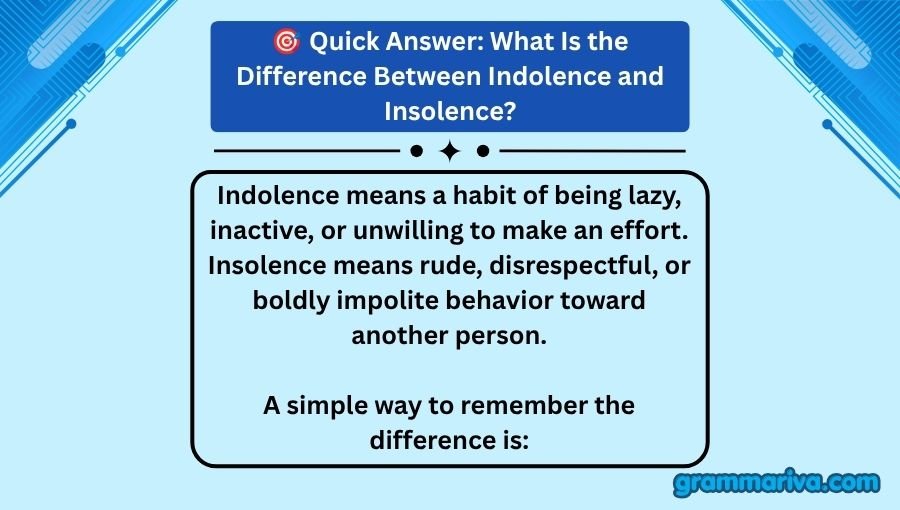
Indolence means a habit of being lazy, inactive, or unwilling to make an effort. Insolence means rude, disrespectful, or boldly impolite behavior toward another person.
A simple way to remember the difference is:
- Indolence = laziness
- Insolence = disrespect
For example:
His indolence kept him from finishing the project.
The sentence says he was lazy or unwilling to work.
His insolence offended the manager.
The sentence says he behaved in a rude or disrespectful way.
So, when comparing indolence vs insolence, think effort versus attitude.
📚 Related Word Forms and Common Variations
Both words have related forms that can appear in everyday and professional writing. Learning these forms can make the distinction easier.
| Form | Type | Example |
|---|---|---|
| indolence | noun | His indolence delayed the work. |
| indolent | adjective | The indolent employee avoided extra tasks. |
| insolence | noun | Her insolence shocked the teacher. |
| insolent | adjective | His insolent reply caused tension. |
| indolently | adverb | He worked indolently all afternoon. |
| insolently | adverb | She answered insolently. |
The main pattern is easy:
indolence → indolent → indolently
insolence → insolent → insolently
The noun forms describe the behavior itself. The adjective forms describe a person, action, or attitude.
🔍 Indolence vs Insolence at a Glance
The core difference between indolence vs insolence is simple: indolence concerns a lack of effort, while insolence concerns a lack of respect.
| Form | Type | Meaning | Example | Correct/Incorrect |
|---|---|---|---|---|
| indolence | noun | Laziness or lack of effort | His indolence hurt his grades. | ✅ Correct |
| insolence | noun | Rude or disrespectful behavior | Her insolence upset the supervisor. | ✅ Correct |
| indolent | adjective | Lazy or inactive | He was too indolent to exercise. | ✅ Correct |
| insolent | adjective | Rude or disrespectful | The student gave an insolent answer. | ✅ Correct |
| indolence | noun | Rudeness | His indolence toward the teacher was shocking. | ❌ Incorrect |
| insolence | noun | Laziness | Her insolence caused her to miss the deadline. | ❌ Incorrect |
The fastest test is to ask one question:
Is the sentence about effort or respect?
If it is about effort, indolence may be the right choice.
If it is about respect, insolence may be the right choice.
❓ Is Indolence the Same as Insolence?
No, indolence and insolence are not the same. Indolence describes laziness or a lack of willingness to work, while insolence describes disrespectful or rude behavior.
Consider these examples:
The student’s indolence caused him to miss several assignments. ✅
The problem is that the student did not put in enough effort.
The student’s insolence caused him to argue with the teacher. ✅
The problem is his rude or disrespectful attitude.
These words can sometimes appear in the same situation, but they describe different behaviors.
For example:
The employee’s indolence delayed the report, and his insolence made the manager even more frustrated. ✅
Here, the employee has two problems. He is not working hard, and he is behaving disrespectfully.
💡 What Does Indolence Mean?
Indolence means a tendency to avoid effort or work. It is a noun that describes laziness, inactivity, or an unwillingness to make the effort needed to complete something.
A person showing indolence may prefer comfort over action.
Examples of indolence
His indolence kept him from cleaning his room. ✅
The problem is his lack of effort.
The team’s indolence caused the project to fall behind. ✅
The team did not work with enough effort.
Her indolence became clear when she ignored every deadline. ✅
She repeatedly avoided doing the required work.
Test Tip 🎯
When you see indolence, replace it with laziness.
If the sentence still makes sense, indolence is probably the right word.
His indolence damaged his career.
His laziness damaged his career.
The meaning remains clear.
| Meaning | Word Type | Example Sentence |
|---|---|---|
| Laziness | Noun | His indolence affected his work. |
| Lack of effort | Noun | Indolence prevented her from reaching the goal. |
| Inactivity | Noun | His indolence kept him at home all day. |
❓ What Does Insolence Mean?
Insolence means rude, disrespectful, or boldly impolite behavior. It is a noun used when someone speaks or acts toward another person without proper respect.
Insolence often appears in situations involving authority, disagreement, or personal conflict.
Examples of insolence
The manager was surprised by the employee’s insolence. ✅
The employee behaved disrespectfully.
The teacher warned the student about his insolence. ✅
The student was acting rudely toward the teacher.
Her insolence during the meeting made everyone uncomfortable. ✅
Her behavior showed a lack of respect.
A useful replacement test works here too.
Replace insolence with rudeness or disrespect.
His insolence was unacceptable.
His rudeness was unacceptable.
The meaning stays close.
| Meaning | Word Type | Example Sentence |
|---|---|---|
| Rudeness | Noun | His insolence surprised everyone. |
| Disrespect | Noun | Her insolence caused an argument. |
| Bold impoliteness | Noun | The supervisor would not tolerate his insolence. |
❓ Why Do People Confuse Indolence and Insolence?
People confuse indolence vs insolence because the words look and sound similar. They also share the same ending and appear in formal writing more often than in casual speech.
The easiest way to separate them is to focus on the middle sound and meaning:
- indolence → idle → lack of effort
- insolence → insult → lack of respect
This is not a perfect word-history rule. It is simply a helpful memory trick.
I once worked through a student’s essay where he used “insolence” when he clearly meant “laziness.” His sentence described a student who never completed homework. Once we replaced the word with “indolence,” the sentence made sense immediately.
That small change completely fixed the meaning.
🧠 How Can You Remember the Difference?
The best memory trick for indolence vs insolence is to connect each word with a simple idea.
Indolence = idle
Both ideas connect to doing little or avoiding work.
Indolence → idle → laziness
Insolence = insult
Both ideas can connect with disrespectful behavior.
Insolence → insult → rudeness
These links are not definitions. They are memory aids.
Try this:
Indolence means “I don’t want to work.”
Insolence means “I don’t respect you.”
That simple contrast can help you choose the right word quickly.
| Word | Memory Link | Core Idea |
|---|---|---|
| indolence | idle | Lack of effort |
| insolence | insult | Lack of respect |
| indolent | idle | Lazy |
| insolent | insult | Rude |
📝 Case Study: Indolence vs Insolence at Work
Imagine a worker named Daniel who has been asked to prepare a sales report.
Daniel spends most of the morning watching videos instead of working. He submits the report late and leaves several sections unfinished.
That behavior shows indolence.
Now imagine that his manager asks why the report is incomplete. Daniel responds with an insulting comment and refuses to listen.
That behavior shows insolence.
The two problems are different.
| Situation | Correct Word | Reason |
|---|---|---|
| Daniel avoids his work | indolence | He lacks effort. |
| Daniel submits work late because he did little | indolence | He is inactive or lazy. |
| Daniel insults his manager | insolence | He is disrespectful. |
| Daniel speaks rudely to his manager | insolence | His attitude is rude. |
This example shows why context matters. A person can display both indolence and insolence, but one word cannot replace the other.
⚖️ Grammar Rules for Indolence and Insolence
The grammar rule is straightforward: indolence and insolence are both nouns, but they refer to different types of behavior.
Use indolence when the sentence focuses on laziness, inactivity, or a lack of effort.
Use insolence when the sentence focuses on rudeness, disrespect, or impudent behavior.
Standard English references consistently distinguish these meanings. The key is not the spelling pattern. The key is the idea being described.
Correct vs Incorrect at a Glance
| Sentence | Correct/Incorrect | Why |
|---|---|---|
| His indolence caused him to miss the deadline. | ✅ Correct | The sentence concerns lack of effort. |
| Her insolence offended the customer. | ✅ Correct | The sentence concerns disrespect. |
| His indolence toward the manager was rude. | ❌ Incorrect | Insolence is the better noun for rude behavior. |
| Her insolence prevented her from finishing the report. | ❌ Incorrect | Indolence is better for lack of effort. |
| The student’s indolence and insolence created two problems. | ✅ Correct | Each noun describes a different problem. |
A helpful rule is:
Work problem = indolence.
Respect problem = insolence.
⚠️ Common Mistakes With These Words
The most common mistake is choosing the word because it looks right rather than because it fits the meaning.
Several things can cause this:
- Fast typing
- Autocorrect
- Weak knowledge of the words
- Reading the sentence too quickly
- Confusing similar-looking words
- Relying on sound instead of meaning
I once caught myself typing a similar-looking word while editing a long document late at night. I stopped because the sentence sounded wrong. That quick pause reminded me of a useful editing rule: always check the meaning, not just the spelling.
Similar Grammar Confusions
| Confused Words | Correct Difference |
|---|---|
| it’s / its | it’s = it is; its = possession |
| your / you’re | your = possession; you’re = you are |
| their / they’re | their = possession; they’re = they are |
| affect / effect | affect is usually a verb; effect is usually a noun |
| advice / advise | advice = noun; advise = verb |
| indolence / insolence | indolence = laziness; insolence = disrespect |
Specific Mistakes With Indolence and Insolence
| Wrong Form or Use | What’s Wrong | Correct Form |
|---|---|---|
| His insolence made him too lazy to work. | The sentence focuses on laziness. | indolence |
| Her indolence toward the teacher was disrespectful. | The sentence focuses on disrespect. | insolence |
| He showed indolance at work. | Incorrect spelling. | indolence |
| She displayed insolance during the meeting. | Incorrect spelling. | insolence |
| The employee was insolence. | Wrong word form after “was.” | insolent |
| The employee was indolence. | Wrong word form after “was.” | indolent |
Remember that indolence and insolence are nouns. If you need an adjective after a linking verb, use indolent or insolent.
❓ When Should You Use Indolence?
Use indolence when you want to describe a person’s lack of effort, laziness, or unwillingness to work.
It is especially useful when the sentence describes a repeated habit rather than one short moment.
For example:
His indolence became a serious problem at work. ✅
The coach criticized the team’s indolence during practice. ✅
Her indolence made it difficult to complete the assignment. ✅
You would not normally use this word simply because someone was rude.
His indolence toward the teacher was shocking. ❌
If the intended meaning is that he was disrespectful, use insolence instead.
His insolence toward the teacher was shocking. ✅
❓ When Should You Use Insolence?
Use insolence when someone behaves or speaks in a disrespectful, rude, or boldly impolite way.
It often describes behavior toward someone who expects respect, such as a parent, teacher, manager, customer, or official.
For example:
The teacher would not tolerate the student’s insolence. ✅
Her insolence during the interview hurt her chances of getting the job. ✅
The customer complained about the employee’s insolence. ✅
Do not use insolence when the only problem is laziness.
His insolence caused him to avoid his work. ❌
If the intended meaning is laziness, indolence is more accurate.
🌎 Indolence vs Insolence in Different Contexts
Both words can appear in many types of writing, but the surrounding context determines which one fits.
| Context | Which Term to Use | Example |
|---|---|---|
| Everyday conversation | Either, depending on meaning | His indolence is frustrating. |
| Professional writing | Either, depending on meaning | The report was delayed by indolence. |
| Creative writing | Either, depending on meaning | The prince was known for his indolence. |
| Social media/texting | Usually simpler synonyms | His laziness is wild. |
| Formal complaint | Insolence for rude conduct | I was concerned by the employee’s insolence. |
In casual conversation, people often use simpler words such as laziness and rudeness.
The two target words can sound formal, so context matters even more in everyday speech.
✍️ Common Phrases With Indolence and Insolence
Neither word has a large collection of everyday idioms, but both appear in useful combinations.
| Phrase | Meaning |
|---|---|
| habitual indolence | A repeated pattern of laziness |
| extreme indolence | Very strong unwillingness to work |
| intellectual indolence | Avoiding mental effort |
| open insolence | Clearly displayed disrespect |
| shocking insolence | Extremely rude behavior |
| insolence toward authority | Disrespect toward someone in a position of authority |
These combinations can help you recognize the words in books, essays, reports, and formal writing.
🔄 Synonyms and Alternatives
Sometimes a simpler word is better than either formal noun. Choose the alternative that matches your exact meaning.
| Alternative | Works When | Does Not Work When |
|---|---|---|
| laziness | You mean lack of effort | You mean rude behavior |
| inactivity | You mean lack of action | You mean disrespect |
| idleness | You mean doing little or no work | You mean insulting someone |
| rudeness | You mean poor manners | You mean lack of effort |
| disrespect | You mean failure to show respect | You mean simple laziness |
For many readers, laziness is clearer than indolence, while rudeness or disrespect may be clearer than insolence.
That does not make the formal words wrong. It simply means word choice should match your audience.
❓ Can One Person Show Both Indolence and Insolence?
Yes. A person can show both behaviors at the same time because they describe different problems.
For example, an employee might refuse to complete assigned work and then insult the manager who asks about it.
The refusal to work shows indolence.
The insulting response shows insolence.
A sentence can include both:
The employee’s indolence delayed the project, while his insolence damaged his relationship with the manager. ✅
This is one of the clearest ways to understand indolence vs insolence. The words can appear together because their meanings are separate.
📖 How the Words Work in Sentences
Sentence structure can also help you recognize which word belongs in a particular place.
With “show”
He showed indolence during the project. ✅
She showed insolence during the meeting. ✅
Both are grammatically correct because both words are nouns.
With “was”
You need the adjective form after “was” when describing the person.
He was indolent. ✅
She was insolent. ✅
These are different from:
He was indolence. ❌
She was insolence. ❌
The noun and adjective forms should not be mixed.
| Noun | Adjective | Example |
|---|---|---|
| indolence | indolent | His indolence was obvious. / He was indolent. |
| insolence | insolent | Her insolence was obvious. / She was insolent. |
❓ Why Does Correct Word Choice Matter?
Correct word choice matters because a small spelling difference can create a completely different meaning.
Imagine writing this in a performance review:
The employee’s insolence affected productivity.
The reader may understand that the employee was rude.
But if you meant that the employee was lazy, the sentence sends the wrong message.
A better version would be:
The employee’s indolence affected productivity.
The distinction can matter in:
- Resumes
- Performance reviews
- Client emails
- School assignments
- Published articles
- Formal complaints
- Social media posts
A Simple Principle 💡
Choose the word that describes the problem, not the word that merely looks familiar.
| Situation | Why Getting It Right Matters |
|---|---|
| Resume | Shows careful word choice |
| Client email | Prevents misunderstanding |
| Published content | Protects accuracy |
| Social post | Keeps the intended meaning clear |
🧩 How Context Solves the Indolence vs Insolence Problem
Context is often the quickest way to choose between these words.
Look for clues around the word.
Words such as lazy, work, effort, inactive, idle, deadline, task, and productivity often point toward indolence.
Words such as rude, disrespectful, insult, authority, attitude, reply, and manners often point toward insolence.
| Context Clue | Likely Word |
|---|---|
| Avoiding work | indolence |
| Refusing to make an effort | indolence |
| Being inactive | indolence |
| Speaking rudely | insolence |
| Insulting someone | insolence |
| Showing disrespect | insolence |
When I edit a sentence like this, I usually ask myself one quick question:
What exactly is wrong with the person’s behavior?
That question often solves the issue immediately.
🎯 A Fast Test for Indolence vs Insolence
Try this three-step test whenever you are unsure.
Step 1: Identify the behavior
Is the person failing to act?
Or are they behaving badly toward someone?
Step 2: Use the simple replacement
Try laziness.
If it works, choose indolence.
Try rudeness or disrespect.
If that works, choose insolence.
Step 3: Check the grammar
If you need a noun, use:
- indolence
- insolence
If you need an adjective, use:
- indolent
- insolent
This three-step method makes indolence vs insolence much easier to handle.
❓ Is Indolent the Adjective Form of Indolence?
Yes. Indolent is the adjective related to indolence. It describes someone or something marked by laziness, inactivity, or a lack of effort.
Examples:
The indolent worker avoided difficult tasks. ✅
His indolent habits affected his progress. ✅
Do not write:
The worker was indolence. ❌
Write:
The worker was indolent. ✅
The difference is grammatical as well as semantic.
❓ Is Insolent the Adjective Form of Insolence?
Yes. Insolent is the adjective related to insolence. It describes someone or something that is rude, disrespectful, or boldly impolite.
Examples:
The student gave an insolent reply. ✅
The employee was insolent toward his supervisor. ✅
Do not write:
The employee was insolence. ❌
Write:
The employee was insolent. ✅
This distinction is useful because learners sometimes remember the noun but forget its adjective form.
📝 Practice: Choose the Correct Word
Try these examples before checking the answers.
- The worker’s ______ caused the project to fall behind.
- The student’s ______ shocked the teacher.
- His ______ made him avoid the difficult assignment.
- Her ______ response offended the customer.
- The manager criticized his ______ during the meeting.
Answers
- indolence ✅
- insolence ✅
- indolence ✅
- insolence ✅
- insolence or indolence, depending on the intended meaning. If the manager criticized rude behavior, use insolence. If the manager criticized a lack of effort, use indolence.
The final example shows why context is so important.
❓ What Is the Easiest Way to Tell Indolence and Insolence Apart?
The easiest way is to remember two simple words:
Indolence = laziness.
Insolence = disrespect.
If someone will not work, think indolence.
If someone will not show proper respect, think insolence.
If you need an adjective, change them to indolent and insolent.
That is enough to solve most usage questions involving indolence vs insolence.
✅ Quick Recap Checklist
Use this checklist when editing your sentence.
| Question | If Yes → Use |
|---|---|
| Is the sentence about laziness? | indolence |
| Is it about lack of effort? | indolence |
| Is it about inactivity? | indolence |
| Is it about rudeness? | insolence |
| Is it about disrespect? | insolence |
| Do you need an adjective meaning lazy? | indolent |
| Do you need an adjective meaning rude? | insolent |
Three Quick Practice Examples
His ______ kept him from completing the work.
Answer: indolence ✅
Her ______ toward the teacher was unacceptable.
Answer: insolence ✅
The employee was ______ when he refused to speak respectfully.
Answer: insolent ✅
❓ Can Indolence and Insolence Be Used in Formal Writing?
Yes. Both words can be used in formal writing, especially when describing behavior in a precise way.
However, simple alternatives may be better for general audiences.
For example:
His indolence affected the team’s progress.
This is formal and precise.
A simpler version is:
His laziness affected the team’s progress.
Likewise:
Her insolence offended the supervisor.
A simpler version is:
Her rude behavior offended the supervisor.
Both choices can be correct. The best choice depends on your audience, tone, and purpose.
FAQs About Indolence vs Insolence
❓ What is the difference between indolence and insolence?
Indolence means laziness, inactivity, or a lack of effort. Insolence means rude, disrespectful, or boldly impolite behavior. In simple terms, indolence is about effort, while insolence is about respect.
❓ Is indolence a synonym for laziness?
Yes. Indolence can mean laziness or an unwillingness to make an effort. It is a more formal word, so “laziness” may sound more natural in casual conversation.
❓ Is insolence a synonym for rudeness?
Yes. Insolence describes rude or disrespectful behavior. It can be especially useful when someone speaks or acts disrespectfully toward a person who expects proper respect.
❓ What is the adjective form of indolence?
The adjective form is indolent. For example: “The indolent employee avoided difficult tasks.” The adjective describes someone or something characterized by inactivity or a lack of effort.
❓ What is the adjective form of insolence?
The adjective form is insolent. For example: “The student gave an insolent response.” It describes behavior that is rude or disrespectful.
❓ Can someone be both indolent and insolent?
Yes. A person can be lazy and disrespectful at the same time. For example, an employee may avoid work because of indolence and then respond rudely to a manager because of insolence.
❓ Which word means lazy, indolence or insolence?
Indolence means lazy behavior or a lack of effort. Insolence does not mean lazy. It means rude or disrespectful behavior.
❓ Which word means disrespectful, indolence or insolence?
Insolence means disrespectful or rude behavior. Indolence means laziness or inactivity.
❓ How can I remember indolence vs insolence?
Use the memory links indolence → idle → laziness and insolence → insult → disrespect. They are simple memory aids that can help you choose the correct word.
❓ Are indolence and insolence interchangeable?
No. They are not interchangeable because they have different meanings. Use indolence for laziness or lack of effort and insolence for rudeness or disrespect.
🌟 Final Thoughts on Indolence vs Insolence
Indolence vs insolence becomes much easier once you connect each word with its main idea. Indolence means laziness, inactivity, or a lack of effort. Insolence means rudeness, disrespect, or boldly impolite behavior.
When you are unsure, ask yourself what the sentence is describing. Is the problem that someone is not making an effort? Choose indolence. Is the problem that someone is behaving disrespectfully? Choose insolence. If you need adjectives, use indolent for lazy behavior and insolent for rude behavior. 😊
I recommend using the simple replacement test when editing. Replace the word with laziness or rudeness. The meaning will usually become clear very quickly.
Once you remember indolence = laziness and insolence = disrespect, this confusing pair stops being confusing.
When the problem is effort, choose indolence. When the problem is respect, choose insolence. 🎯

Hi, I’m Madison Hayes. I’m an English learning writer at Grammariva, where I work on simple lessons and examples for people who want to improve their grammar and writing. I love turning confusing rules into easy-to-follow explanations.

[…] cover common mistakes, examples, phrases, and FAQs so you can use the word with confidence. ✍️ Indolence vs Insolence | Alright vs Allright | Worn or […]