Have you ever stopped while writing and wondered whether to say there has been or there have been? You are not alone. This small grammar choice can cause big confusion, especially when a sentence contains words between there and the real subject. 😊
The good news is that the rule is simple once you know what to look for. The choice depends on the noun that comes after been, not simply on the word there. Use there has been with a singular noun or an uncountable noun. Use there have been with a plural noun.
I teach grammar by looking for the part of the sentence that controls the verb. That trick makes this topic much easier. In this guide, I’ll show you how the rule works, where people go wrong, and how to make the right choice in everyday, school, and professional writing. By the end, you should be able to choose the correct form without stopping to think twice. ✨ Marquee vs Marquis | Day Off vs Off Day | Tear vs Tare
🎯 Quick Answer: There Has Been or There Have Been
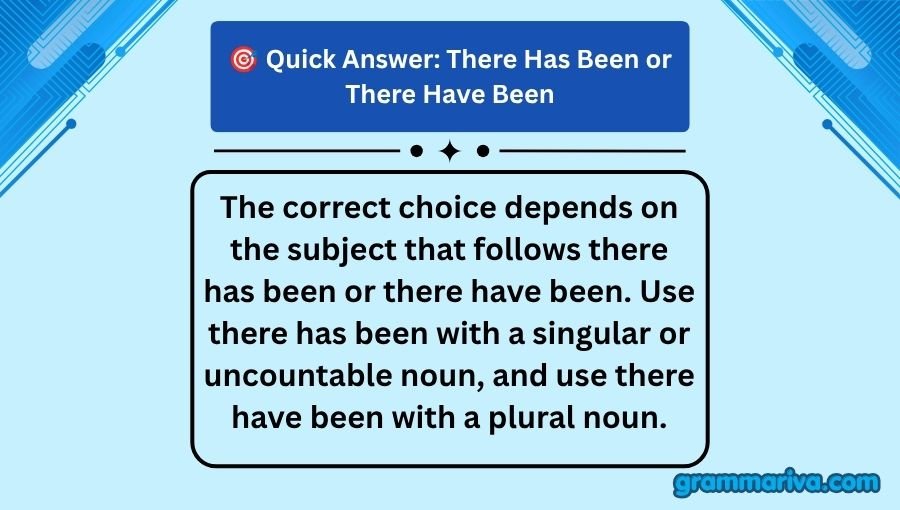
The correct choice depends on the subject that follows there has been or there have been. Use there has been with a singular or uncountable noun, and use there have been with a plural noun.
- ✅ There has been a problem.
- ✅ There have been several problems.
The easiest test is to look at the noun after been. If that noun is singular, choose has. If it is plural, choose have.
📚 Related Forms of There Has Been and There Have Been
These expressions are forms of the verb be used in sentences that begin with there. They often appear with different time expressions and noun forms.
| Form | Type | Example |
|---|---|---|
| there has been | Singular/uncountable present perfect | There has been a delay. |
| there have been | Plural present perfect | There have been delays. |
| there had been | Past perfect | There had been a mistake. |
| there will have been | Future perfect | There will have been several changes. |
| there is | Present singular | There is a problem. |
| there are | Present plural | There are problems. |
The main comparison in this article is there has been versus there have been.
🎯 Understanding the Basics of There Has Been or There Have Been
The main difference is number. There has been goes with a singular or uncountable noun. There have been goes with a plural noun.
For example:
- There has been a change.
- There have been many changes.
The word there does not decide whether you need has or have. The following noun does.
The Singular Rule
Use there has been when the noun is singular.
- ✅ There has been a mistake.
- ❌ There have been a mistake.
The noun mistake is singular. That is why has is correct.
The Plural Rule
Use there have been when the noun is plural.
- ✅ There have been several mistakes.
- ❌ There has been several mistakes.
The noun mistakes is plural. Therefore, have is required.
The Uncountable Noun Rule
Uncountable nouns usually take a singular verb.
- ✅ There has been some progress.
- ❌ There have been some progress.
The word progress is normally uncountable in this meaning. So has is the correct choice.
| Form | Type | Meaning | Example | Correct/Incorrect |
|---|---|---|---|---|
| there has been | Singular | One event or thing exists/occurred | There has been a delay. | ✅ Correct |
| there have been | Plural | More than one event or thing exists/occurred | There have been delays. | ✅ Correct |
| there have been | Singular | Used before one singular noun | There have been a delay. | ❌ Incorrect |
| there has been | Plural | Used before a plural noun | There has been many delays. | ❌ Incorrect |
🤔 Is There Has Been the Same as There Have Been?
No. There has been and there have been are not interchangeable. The first is used with singular or uncountable subjects, while the second is used with plural subjects.
Compare these sentences:
- ✅ There has been an accident.
- ✅ There have been several accidents.
The first sentence talks about one accident. The second talks about more than one.
I often tell students to ignore there for a moment. Find the noun that comes after the verb. That noun usually gives you the answer.
Why This Works
Consider this sentence:
There has been a serious problem with the printer.
The real noun is problem. It is singular. Therefore, has is correct.
Now change the noun:
There have been serious problems with the printer.
Now problems is plural. The verb changes to have.
| Noun After Been | Number | Correct Form | Example |
|---|---|---|---|
| a problem | Singular | there has been | There has been a problem. |
| an issue | Singular | there has been | There has been an issue. |
| some traffic | Uncountable | there has been | There has been some traffic. |
| problems | Plural | there have been | There have been problems. |
| several issues | Plural | there have been | There have been several issues. |
🧠 Why Do People Confuse There Has Been and There Have Been?
People often confuse these forms because there appears at the beginning of the sentence. The eye sees there, but the grammar depends on the noun that follows.
I once worked with a student who wrote, “There has been many reasons.” He knew the basic rule for has and have, but he was looking at there instead of reasons. Once he underlined the noun first, he fixed the sentence immediately.
Another reason is that words can come between been and the noun.
For example:
There have recently been several changes.
The word recently sits between been and several changes. It can make the sentence feel harder to read, but the rule stays the same.
The noun changes is plural, so have is correct.
A Simple Three-Step Method
- Find has been or have been.
- Find the noun that follows it.
- Check whether that noun is singular, uncountable, or plural.
| What You Find | What to Use | Example |
|---|---|---|
| Singular noun | has been | There has been a delay. |
| Uncountable noun | has been | There has been confusion. |
| Plural noun | have been | There have been delays. |
| Plural noun hidden after extra words | have been | There have been several delays. |
💡 How Can You Test There Has Been or There Have Been?
Use the noun test. Remove the opening there in your mind and focus on the noun that controls the verb.
For example:
There have been three complaints.
Ask yourself:
“What is there?”
Answer: three complaints.
Because complaints is plural, use have.
Now try:
There has been one complaint.
The answer is one complaint, which is singular. So use has.
Test Tip
If you can replace the noun with it, use has been.
- There has been a problem.
- It has been a problem.
If you are talking about multiple things and could use they, have been is usually the right choice.
- There have been problems.
- They have been problems.
This is not a perfect replacement test for every sentence, but it is a useful quick check.
📝 Correct Uses of There Has Been
There has been is used when the noun is singular or uncountable. It commonly describes an event, change, problem, condition, or situation that started or happened in the past and has a connection to the present.
One Event or Thing
- ✅ There has been a change in the schedule.
- ❌ There have been a change in the schedule.
Change is singular.
One Problem
- ✅ There has been a problem with the payment.
- ❌ There have been a problem with the payment.
Problem is singular.
An Uncountable Idea
- ✅ There has been progress this month.
- ❌ There have been progress this month.
Progress is uncountable here, so it takes has.
One General Situation
- ✅ There has been confusion about the new rule.
- ❌ There have been confusion about the new rule.
Confusion is normally treated as an uncountable noun in this use.
| Meaning | Word Type | Example Sentence |
|---|---|---|
| One event | Singular | There has been an accident. |
| One problem | Singular | There has been a problem. |
| One change | Singular | There has been a change. |
| General amount | Uncountable | There has been progress. |
| General condition | Uncountable | There has been confusion. |
📝 Correct Uses of There Have Been
There have been is used with plural nouns. It tells readers that two or more things, events, people, problems, or changes have occurred or existed.
Several Events
- ✅ There have been several meetings this week.
- ❌ There has been several meetings this week.
Meetings is plural.
Multiple Problems
- ✅ There have been a few problems with the system.
- ❌ There has been a few problems with the system.
The phrase a few problems is plural.
Many Changes
- ✅ There have been many changes this year.
- ❌ There has been many changes this year.
The noun changes is plural.
Several People
- ✅ There have been many people at the event.
- ❌ There has been many people at the event.
The noun people is plural.
📊 There Has Been or There Have Been in Different Sentence Patterns
The same rule works even when the sentence becomes longer.
| Sentence Pattern | Correct Form | Example |
|---|---|---|
| Singular noun | has been | There has been a delay. |
| Plural noun | have been | There have been delays. |
| Uncountable noun | has been | There has been progress. |
| Singular noun + extra phrase | has been | There has been a delay in shipping. |
| Plural noun + extra phrase | have been | There have been delays in shipping. |
| Plural noun after an adverb | have been | There have recently been delays. |
The extra words do not change the basic rule.
📝 Case Study: A Workplace Email
Imagine a manager needs to tell a team about problems with a new computer system.
Here is the incorrect version:
❌ There has been several issues with the new system.
The problem is several issues. The noun issues is plural.
The corrected version is:
✅ There have been several issues with the new system.
Now imagine the manager is talking about one general issue:
✅ There has been a problem with the new system.
The difference is clear. A problem is singular. Several issues is plural.
I once caught myself typing a similar sentence in an email after a long editing session. I had written “There has been several updates.” I stopped, found the noun updates, and changed has to have. Small checks like that prevent easy mistakes from reaching clients or coworkers.
⚙️ Grammar Rules Explanation
The grammar behind these forms comes from subject-verb agreement. In sentences beginning with there, the verb still needs to agree with the noun that follows.
There has been contains has, which is the singular form of have in the present perfect construction.
There have been contains have, which is used with plural subjects.
The word there introduces the existence or occurrence of something. It does not make the following noun singular.
For example:
There has been a mistake.
The noun is mistake, so the singular verb form has is correct.
There have been mistakes.
The noun is mistakes, so the plural verb form have is correct.
Standard grammar references and major dictionaries support this basic agreement pattern.
Correct vs Incorrect at a Glance
| Sentence | Correct/Incorrect | Why |
|---|---|---|
| There has been a problem. | ✅ Correct | Problem is singular. |
| There have been problems. | ✅ Correct | Problems is plural. |
| There has been several problems. | ❌ Incorrect | Several problems is plural. |
| There have been an accident. | ❌ Incorrect | An accident is singular. |
| There has been some progress. | ✅ Correct | Progress is uncountable. |
⚠️ Common Mistakes With There Has Been and There Have Been
Most mistakes happen because writers focus on there instead of the noun.
Here are some common reasons:
- Fast typing: You may choose the first verb that sounds natural.
- Autocorrect: Spell-check tools do not always catch grammar errors.
- Lack of knowledge: Writers may not know which noun controls the verb.
- Long sentences: Extra words can hide the real subject.
- Speaking habits: Casual speech can make incorrect forms feel normal.
Similar Grammar Confusions
| Confusion | Correct Choice | Example |
|---|---|---|
| it’s / its | Depends on meaning | It’s cold. / Its color is bright. |
| your / you’re | Depends on meaning | Your phone / You’re ready. |
| their / they’re | Depends on meaning | Their car / They’re here. |
| affect / effect | Depends on function | It may affect us. / The effect was clear. |
| has / have | Depends on subject | She has time. / They have time. |
Specific Mistakes With This Term
| Wrong Form | What’s Wrong | Correct Form |
|---|---|---|
| There have been a problem. | Singular noun needs has. | There has been a problem. |
| There has been many problems. | Plural noun needs have. | There have been many problems. |
| There has been several changes. | Several changes is plural. | There have been several changes. |
| There have been an issue. | An issue is singular. | There has been an issue. |
| There has been two accidents. | Two accidents is plural. | There have been two accidents. |
| There have been some confusion. | Confusion is uncountable here. | There has been some confusion. |
🔍 How Extra Words Can Hide the Correct Choice
Long sentences can make this grammar point harder.
Consider:
There have recently been several unexpected changes to the policy.
The word recently appears between have and been. The phrase unexpected appears before changes. These extra words may distract you.
Still, the key noun is changes.
Now compare:
There has recently been a major change to the policy.
The key noun is change. It is singular.
| Sentence | Key Noun | Number | Correct Verb |
|---|---|---|---|
| There has recently been a change. | change | Singular | has |
| There have recently been changes. | changes | Plural | have |
| There has always been confusion. | confusion | Uncountable | has |
| There have always been questions. | questions | Plural | have |
🌎 Usage in Different Contexts
The choice between the two forms does not change just because the writing style changes. The same agreement rule applies in conversation, professional writing, creative work, and digital communication.
| Context | Which Term to Use | Example |
|---|---|---|
| Everyday conversation | Match the noun | There has been a delay. |
| Professional writing | Match the noun | There have been several updates. |
| Creative writing | Match the noun | There has been a strange silence. |
| Social media/texting | Match the noun | There have been so many changes! |
Everyday Conversation
You might say:
There has been a lot of traffic today.
Or:
There have been three accidents nearby.
Both are correct because traffic is uncountable while accidents is plural.
Professional Writing
Professional writing often needs extra care.
- ✅ There has been a delay in processing your request.
- ✅ There have been several delays in processing requests.
Correct agreement makes business writing sound polished and trustworthy.
Creative Writing
Creative writers can use these structures to describe events and atmosphere.
- There has been a strange silence in the house.
- There have been strange noises all night.
Social Media and Texting
Informal writing is more relaxed, but correct grammar still helps.
- There have been so many plot twists!
- There has been one huge surprise.
💬 Common Phrases With There Has Been and There Have Been
These structures appear in many useful everyday phrases. They are not special idioms. They are common sentence patterns.
| Phrase | Meaning |
|---|---|
| There has been a change | One change occurred |
| There has been a problem | One problem occurred |
| There has been some progress | Progress has occurred |
| There have been several changes | Multiple changes occurred |
| There have been many problems | Multiple problems occurred |
| There have been a few delays | Several delays occurred |
You can use these patterns as templates when writing.
For example:
There has been a change in the plan.
Then make it plural:
There have been changes in the plan.
🔄 Synonyms and Alternatives
Sometimes you can rewrite the sentence and avoid the choice between has and have. This can help if you want a shorter or more direct sentence.
| Alternative | Works When | Does Not Work When |
|---|---|---|
| occurred | You are describing events | You mean something simply exists |
| happened | You mean an event took place | You are describing an ongoing state |
| exists | You mean something currently exists | You are focusing on a past event |
| appeared | Something became visible or present | You mean a general condition |
| was/were reported | You are describing reports | You do not have a reporting context |
For example:
There have been several complaints.
Could become:
Several complaints have been reported.
The second sentence is more direct and may work better in formal writing.
🎯 Why Getting There Has Been or There Have Been Right Matters
Grammar choices can affect how clearly readers understand your message. A single wrong verb may not destroy the meaning, but repeated errors can make writing look careless.
Clarity
Correct agreement helps readers understand which noun controls the sentence.
Professionalism
A clean sentence looks better in an email, report, resume, or business document.
Digital Communication
Online writing moves quickly. Short posts and messages are often read by people who do not know the writer personally. Small grammar errors can affect how the message feels.
Clear writing makes your meaning easier to trust.
| Situation | Why Getting It Right Matters |
|---|---|
| Resume | Shows attention to detail |
| Client email | Creates a professional impression |
| Published content | Improves reader confidence |
| Social post | Makes the message easier to read |
🧩 How to Remember the Difference
The easiest memory trick is:
One = has. More than one = have.
Think:
- There has been one thing.
- There have been many things.
Try these pairs:
- There has been a question.
- There have been questions.
- There has been an update.
- There have been updates.
- There has been a delay.
- There have been delays.
This simple contrast works in most everyday cases.
Another Memory Trick
Look past there.
Do not ask:
“Does there take has or have?”
Ask:
“What noun am I talking about?”
That question usually gives you the answer.
📝 More Examples to Build Confidence
Here are several examples you can study.
Singular Examples
- ✅ There has been a mistake in the report.
- ✅ There has been an increase in demand.
- ✅ There has been a change of plans.
- ✅ There has been some confusion.
- ✅ There has been enough time to finish.
Plural Examples
- ✅ There have been several mistakes in the report.
- ✅ There have been increases in demand.
- ✅ There have been changes to the plan.
- ✅ There have been questions about the decision.
- ✅ There have been enough opportunities for everyone.
Mixed Practice Table
| Sentence | Answer | Reason |
|---|---|---|
| There ___ been a delay. | has | Delay is singular. |
| There ___ been delays. | have | Delays is plural. |
| There ___ been some progress. | has | Progress is uncountable. |
| There ___ been three meetings. | have | Meetings is plural. |
| There ___ been an error. | has | Error is singular. |
| There ___ been many errors. | have | Errors is plural. |
🧠 When Should You Use There Has Been or There Have Been?
Use there has been for one singular thing or an uncountable noun. Use there have been for two or more things.
Here is the rule in its shortest form:
Singular or uncountable → has been
Plural → have been
Examples:
- There has been a problem.
- There has been confusion.
- There have been problems.
- There have been questions.
The tense is the same in all four examples. The only key difference is the number of the noun.
⚠️ A Common Trap: Words Like Several, Many, and A Few
Words such as several, many, and a few normally point to plural nouns.
So use have been:
- ✅ There have been several complaints.
- ✅ There have been many changes.
- ✅ There have been a few mistakes.
Do not use has been with these plural noun phrases.
- ❌ There has been several complaints.
- ❌ There has been many changes.
- ❌ There has been a few mistakes.
By contrast, phrases such as a lot of can be followed by either singular or plural nouns. The noun decides.
- ✅ There has been a lot of traffic.
- ✅ There have been a lot of delays.
📋 Quick Recap Checklist
Use this checklist before you submit an important sentence.
| Question | If Yes → Use |
|---|---|
| Is the noun singular? | there has been |
| Is the noun uncountable? | there has been |
| Is the noun plural? | there have been |
| Does the noun follow extra words? | Look past the extra words |
| Are you unsure? | Identify the main noun first |
Practice Examples
- There ___ been a major problem.
Answer: has - There ___ been several major problems.
Answer: have - There ___ been some confusion.
Answer: has
A quick noun check can solve all three.
❓ FAQs About There Has Been vs There Have Been
What is the difference between there has been and there have been?
There has been is used with a singular or uncountable noun. There have been is used with a plural noun. For example, “There has been a problem” is correct, while “There have been several problems” is correct.
Is “there has been” grammatically correct?
Yes. There has been is grammatically correct when it is followed by a singular or uncountable noun. Examples include “There has been a change” and “There has been some confusion.”
Is “there have been” grammatically correct?
Yes. There have been is correct when it is followed by a plural noun. For example, “There have been several changes” uses have because changes is plural.
Should I say “there has been many” or “there have been many”?
Use there have been many when many is followed by a plural noun. For example, “There have been many questions.” The noun questions is plural.
Should I say “there has been a few” or “there have been a few”?
Use there have been a few when a few refers to a plural noun. For example, “There have been a few mistakes.” The noun mistakes is plural.
Is “there has been some” always correct?
No. It depends on the noun after some. Use has with an uncountable noun, such as “There has been some progress.” Use have with a plural noun, such as “There have been some changes.”
Which is correct: “there has been problems” or “there have been problems”?
There have been problems is correct because problems is plural. There has been problems is incorrect in standard English because has does not agree with the plural noun problems.
Can “there has been” be used with an uncountable noun?
Yes. Uncountable nouns normally take the singular form has in this structure. For example, “There has been progress,” “There has been confusion,” and “There has been traffic.”
How can I quickly remember there has been versus there have been?
Look at the noun after been. One singular thing or an uncountable noun takes has. More than one thing takes have. Think: one has, many have.
Does the word “there” control has or have?
No. The noun that follows the verb controls the choice in standard subject-verb agreement. There has been a problem uses has because problem is singular. There have been problems uses have because problems is plural.
✅ Final Rule: There Has Been or There Have Been
The choice between there has been or there have been becomes easy when you focus on the noun, not the word there. If the noun is singular or uncountable, use there has been. If the noun is plural, use there have been.
Think about these two sentences:
There has been a problem.
There have been several problems.
The first uses has because a problem is singular. The second uses have because several problems is plural.
When I edit grammar, I use one simple habit: I find the noun first. That habit prevents many subject-verb agreement errors, even in long sentences with extra words.
So, before you write your next sentence, pause for one second. Find the noun. Ask whether it is singular, uncountable, or plural. Then choose has been or have been.
Once you learn that small trick, this common grammar problem becomes much easier. Keep the rule in mind: one has been, many have been. ✨

Hi, I’m Nathan Reed. I’m a grammar and writing specialist at Grammariva. I work on practical grammar content that helps readers understand sentence structure, punctuation, vocabulary, and better writing habits.



[…] confidence in conversations, emails, texts, and other writing. Let’s make the choice easy. ✨ There Has Been or There Have Been | Marquee vs Marquis | Day Off vs Off […]