Have you ever paused while writing because you were unsure whether to use awhile vs a while? You are not alone. These two forms look almost identical, sound the same, and often appear in sentences with similar meanings. However, they do not work in exactly the same way.
The good news is that the difference is simple once you understand how each form works. One word, awhile, is an adverb that means for a short time. The two-word phrase a while is a noun phrase that refers to a period of time.
As an editor and grammar writer, I often see this small spelling choice cause confusion in emails, school assignments, blog posts, and everyday messages. A simple grammar test can help you choose the right form every time.
In this guide, I will explain the rules, share easy examples, and show you how to avoid common mistakes. By the end, you will feel more confident using both forms. ✍️ Altogether vs All Together | Lend vs Borrow | Bring vs Take
🎯 Quick Answer: Awhile vs A While
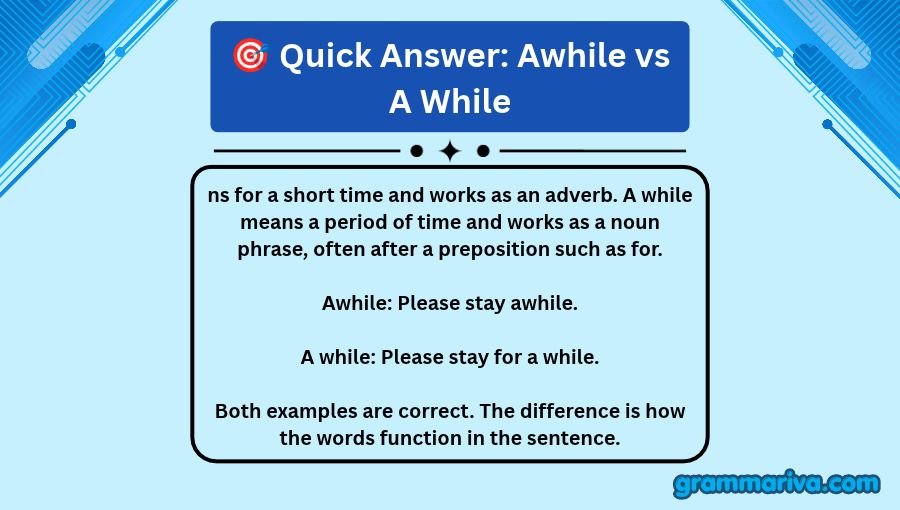
Awhile means for a short time and works as an adverb. A while means a period of time and works as a noun phrase, often after a preposition such as for.
- Awhile: Please stay awhile.
- A while: Please stay for a while.
Both examples are correct. The difference is how the words function in the sentence.
Awhile and A While: Understanding the Basics
The main difference between these forms is their grammatical role. Although they can express nearly the same idea, they follow different sentence patterns.
Awhile is one word. It describes how long an action continues. A while is two words. It names a period of time.
Comparison Table
| Form | Type | Meaning | Example | Correct/Incorrect |
|---|---|---|---|---|
| Awhile | Adverb | For a short time | Sit awhile. | Correct |
| A while | Noun phrase | A period of time | Wait for a while. | Correct |
| For awhile | Incorrect standard construction | Incorrect use after for | Wait for awhile. | Incorrect |
| For a while | Prepositional phrase | For a period of time | Wait for a while. | Correct |
What Does Awhile Mean?
Awhile is an adverb that means for a short time or for some time.
It describes the length of an action. It can answer the question, “How long?”
Examples:
- Please sit awhile.
- We talked awhile after dinner.
- Stay here awhile.
- I rested awhile before going back to work.
In each sentence, awhile describes how long someone performs an action.
What Does A While Mean?
A while is a noun phrase that refers to a period of time.
The word a is an article, while while is a noun. Together, they describe an amount of time.
Examples:
- I have not seen her for a while.
- It took a while to finish the project.
- We waited for a while.
- After a while, everyone went home.
In these sentences, a while refers to a period of time.
💡 How Can You Remember Awhile vs A While?
You can remember the difference by checking whether the sentence needs an adverb or a noun phrase.
Try this simple trick:
- If you can replace the word with “for some time,” use awhile when the sentence does not already contain a separate for.
- If the sentence uses the preposition “for,” you usually need a while after it.
For example:
Correct: I rested awhile.
Correct: I rested for a while.
Incorrect: I rested for awhile.
The first sentence uses an adverb. The second uses a noun phrase after the preposition.
The Simple Replacement Test
Replace the expression with another time phrase.
| Original Sentence | Replacement | Correct Form |
|---|---|---|
| Stay awhile. | Stay for some time. | Awhile |
| Wait for a while. | Wait for some time. | A while |
| It took a while. | It took some time. | A while |
| Rest awhile. | Rest for some time. | Awhile |
Test Tip: When you see for directly before the expression, choose a while. This is one of the easiest ways to avoid the most common mistake.
Why Do People Confuse Awhile and A While?
People confuse these expressions because they sound exactly alike in normal speech. Their meanings are also closely related.
Both forms describe time. The difference is not in pronunciation but in grammar.
Here are some common reasons for the confusion:
- Both forms contain the word while.
- Both can describe a short period.
- They sound identical when spoken.
- People often focus on meaning instead of sentence structure.
- Autocorrect may not identify the intended grammatical form.
I once reviewed a student’s essay in which the phrase “wait for awhile” appeared several times. The student understood the meaning perfectly but did not know that the preposition for needed the noun phrase a while. After learning the replacement test, the student corrected every example.
This shows why understanding the grammar rule is more useful than simply memorizing spellings.
Awhile: Meaning and Correct Use
Awhile is an adverb. It tells readers that an action continues for some time.
It usually appears after a verb or at the end of a sentence.
Use Awhile After an Action Verb
When an action continues for a period of time, awhile can describe its duration.
Examples:
- Let’s talk awhile.
- I stayed awhile.
- She rested awhile.
- They played awhile before going home.
Sentence breakdown:
She rested awhile.
- She: Subject
- Rested: Verb
- Awhile: Adverb describing how long she rested
The word awhile gives extra information about the action.
Use Awhile in Everyday Instructions
You can also use awhile when asking someone to remain somewhere or continue an activity.
Examples:
- Please wait awhile.
- Sit here awhile.
- Stay with us awhile.
- Think about it awhile.
These sentences are short, natural, and grammatically correct.
Use Awhile in Creative Writing
Awhile can make storytelling sound smooth and natural.
Examples:
- The old man watched the rain awhile.
- She stood by the window awhile.
- They walked quietly awhile before speaking.
Writers often choose this form when they want a simple way to describe an action that continues for a period of time.
A While: Meaning and Correct Use
A while is a noun phrase that refers to a period of time. It can appear in several common sentence patterns.
Use A While After For
This is one of the most common uses of the two-word form.
Examples:
- I waited for a while.
- She stayed there for a while.
- We talked for a while.
- He worked for a while before taking a break.
Sentence breakdown:
I waited for a while.
- I: Subject
- Waited: Verb
- For: Preposition
- A while: Noun phrase and object of the preposition
The phrase identifies the period during which the waiting happened.
Use A While After It Takes
The phrase a while commonly appears with the expression “it takes.”
Examples:
- It takes a while to learn a new language.
- It took a while to understand the lesson.
- It may take a while to complete the task.
- It takes a while to build good habits.
Here, a while acts as a noun phrase that describes the amount of time needed.
Use A While After Other Prepositions
You can use a while after several prepositions.
Examples:
- After a while, she smiled.
- We talked about it after a while.
- He returned within a while.
- They left after a little while.
The exact expression may change depending on the sentence, but the noun phrase remains two words.
Summary of the Main Meanings
| Meaning | Word Type | Example Sentence |
|---|---|---|
| For some time | Adverb | Stay awhile. |
| A period of time | Noun phrase | Wait for a while. |
| Time needed for something | Noun phrase | It takes a while. |
| Time after an event | Noun phrase | After a while, we left. |
📝 A Real-Life Case Study: Awhile vs A While in an Email
Imagine that an office manager sends this message to a team member:
“Please wait for awhile. I will review your report shortly.”
The message is understandable, but the grammar is incorrect.
The correct version is:
“Please wait for a while. I will review your report shortly.”
Why is this version correct?
The word for is a preposition. It needs a noun phrase as its object. In this sentence, a while is the correct noun phrase.
Now consider another message:
“Please stay awhile after the meeting. I would like to discuss your ideas.”
This sentence is also correct. Here, awhile works as an adverb and describes how long the person should stay.
Workplace Examples
| Situation | Incorrect Sentence | Correct Sentence |
|---|---|---|
| Waiting | Wait for awhile. | Wait for a while. |
| Meeting | Stay for awhile. | Stay for a while. |
| Resting | Rest awhile. | Rest awhile. |
| Working | Work for awhile. | Work for a while. |
Small grammar changes can make workplace messages more polished and professional.
Grammar Rules Explanation
The difference between awhile and a while comes from their parts of speech. Awhile is an adverb, while a while is a noun phrase.
This distinction explains why they cannot always replace each other.
Rule: Awhile Works as an Adverb
An adverb describes an action, an adjective, or another adverb. In this case, awhile describes how long an action continues.
Correct examples:
- We chatted awhile.
- He slept awhile.
- Please stay awhile.
Incorrect examples:
- We chatted for awhile.
- He slept for awhile.
- Please stay for awhile.
The incorrect examples use awhile after the preposition for. Standard written English calls for the noun phrase a while in this position.
Rule: A While Works as a Noun Phrase
A while refers to a period of time. It can work as the object of a preposition or in other noun positions.
Correct examples:
- I waited for a while.
- It took a while.
- After a while, the noise stopped.
The phrase can also be modified by words such as short and long.
Examples:
- We stayed for a short while.
- She waited for a long while.
- It took quite a while.
Correct vs Incorrect at a Glance
| Sentence | Correct/Incorrect | Why |
|---|---|---|
| Please stay awhile. | Correct | Awhile is an adverb. |
| Please stay for a while. | Correct | A while is the object of for. |
| Please stay for awhile. | Incorrect | Use a while after for. |
| It took awhile to finish. | Incorrect in standard edited writing | It took a while is the standard construction. |
| We talked awhile yesterday. | Correct | Awhile describes the action. |
⚠️ Common Mistakes With Awhile and A While
The most common mistake is writing for awhile instead of for a while. Other mistakes happen when writers forget that one form is an adverb and the other is a noun phrase.
Why Do These Mistakes Happen?
Fast typing
People often write quickly and do not stop to check small grammar details.
Autocorrect
Some writing tools may correct spelling without understanding the full sentence.
Lack of knowledge
Writers who have never learned the difference may assume both forms are interchangeable.
Similar pronunciation
Because both expressions sound the same, speaking does not help writers identify the correct spelling.
I once caught myself typing “for awhile” in a quick work message. I noticed the preposition and corrected it before sending. Even experienced writers benefit from a quick grammar check.
Similar Grammar Confusions
| Confusing Forms | Correct Difference | Example |
|---|---|---|
| It’s / Its | It’s means it is; its shows possession. | It’s raining. |
| Your / You’re | Your shows possession; you’re means you are. | You’re welcome. |
| Their / There | Their shows possession; there refers to a place. | Their house is there. |
| Then / Than | Then relates to time; than makes comparisons. | Better than before. |
| Awhile / A while | Adverb versus noun phrase. | Wait for a while. |
Common Wrong Spellings and Uses
| Wrong Form | What’s Wrong | Correct Form |
|---|---|---|
| For awhile | Incorrect after for | For a while |
| In awhile | Usually incorrect for the intended meaning | In a while |
| After awhile | Incorrect in standard edited writing | After a while |
| Awhile ago | Incorrect standard construction | A while ago |
| It took awhile | Incorrect in standard edited writing | It took a while |
| Stay for awhile | Incorrect construction | Stay for a while |
How Is Awhile vs A While Used in Different Contexts?
Both forms can appear in everyday, professional, creative, and digital writing. The correct choice depends on the sentence structure, not the writing style.
Everyday Conversation
People commonly use both forms when talking about waiting, resting, or spending time.
Examples:
- Come sit awhile.
- I will be back in a while.
- Let’s talk awhile.
- Wait here for a while.
Professional Writing
In professional writing, grammar accuracy helps make communication clear.
Examples:
- Please wait for a while while I check the records.
- The review may take a while.
- You may stay awhile after the presentation.
Creative Writing
Writers can use either form to describe time in stories, poems, and other creative work.
Examples:
- She watched the sunset awhile.
- After a while, the stars appeared.
- The travelers rested awhile near the river.
Social Media and Texting
Both expressions work in casual messages and online posts.
Examples:
- Just relaxing awhile.
- I’ll call you in a while.
- Let’s hang out awhile.
- Be back in a while!
Usage Comparison Table
| Context | Which Term to Use | Example |
|---|---|---|
| Everyday conversation | Both | Stay awhile. |
| Professional writing | Both | It will take a while. |
| Creative writing | Both | After a while, she smiled. |
| Social media/texting | Both | I’ll be back in a while. |
Common Phrases With Awhile and A While
Some expressions are especially common in everyday English. Learning them can help you recognize the correct form more quickly.
Common Expressions With Awhile
| Phrase | Meaning |
|---|---|
| Stay awhile | Remain for some time |
| Rest awhile | Take a short break |
| Sit awhile | Sit for some time |
| Wait awhile | Continue waiting for some time |
| Talk awhile | Talk for some time |
Common Expressions With A While
| Phrase | Meaning |
|---|---|
| For a while | For a period of time |
| After a while | After some time |
| In a while | A little later |
| Once in a while | Occasionally |
| A while ago | Some time before now |
| A little while | A short period of time |
Notice that expressions such as once in a while and a while ago use the two-word form because while is part of a noun phrase.
Synonyms and Alternatives to Awhile and A While
You can sometimes replace these expressions with other time-related words. However, the best alternative depends on the sentence.
| Alternative | Works When | Does Not Work When |
|---|---|---|
| For some time | Describing an action’s duration | A shorter, more casual expression is needed |
| Briefly | Describing a short action | A longer or unclear period is intended |
| Temporarily | Describing something that lasts for a limited period | You mean a specific future time |
| For a moment | Describing a very short period | The period is longer than a moment |
| For a short time | Explaining a limited duration | The sentence needs a different time meaning |
Example Sentences With Alternatives
- Please wait briefly.
- I stayed there for some time.
- She rested for a moment.
- The service was temporarily unavailable.
- We talked for a short time.
These alternatives can make your writing more varied. However, they do not always fit every sentence.
🎯 Why Does Correct Usage Matter?
Using awhile and a while correctly makes your writing easier to read. It also shows that you understand basic English grammar.
A small spelling difference may not change the general meaning, but it can affect how polished a sentence looks.
As a grammar editor, I believe that clear writing comes from making small details right. Readers should focus on your message instead of stopping to question your word choices.
Clarity in Communication
Correct grammar helps readers understand your meaning without confusion.
For example:
- Correct: I will be back in a while.
- Incorrect: I will be back in awhile.
Professionalism
Correct word choices make business emails, reports, and workplace messages look more polished.
Digital Communication
Social media posts, website content, and online messages also benefit from accurate grammar. Good writing helps build trust with readers.
Why Getting It Right Matters
| Situation | Why Getting It Right Matters |
|---|---|
| Resume | Shows attention to detail |
| Client email | Creates a professional impression |
| Published content | Improves readability and accuracy |
| Social post | Makes the message clear and polished |
A useful writing reminder is:
“Clear words make clear messages.”
How To Remember the Difference Between Awhile and A While
The easiest way to remember the difference is to focus on the job each form performs.
Use awhile when it describes an action without a separate preposition such as for.
Use a while when you need a noun phrase to describe a period of time.
Easy Memory Tricks
- Awhile = One word, one adverb.
- A while = Two words, a noun phrase.
- For a while = The standard expression.
- Stay awhile = A correct adverb construction.
Practice Examples
Try choosing the correct form in each sentence.
Example One: Please wait ______.
Answer: awhile.
Correct sentence: Please wait awhile.
Example Two: I have not visited that place for ______.
Answer: a while.
Correct sentence: I have not visited that place for a while.
Example Three: It took ______ to complete the work.
Answer: a while.
Correct sentence: It took a while to complete the work.
✅ Quick Recap Checklist
Use these questions to check whether you understand the difference.
| Question | If Yes → Use |
|---|---|
| Does the word describe how long an action continues? | Awhile |
| Does the sentence contain the preposition for before the time expression? | A while |
| Does the sentence begin with after before the time expression? | A while |
| Does the sentence use the expression “it takes”? | A while |
| Does the sentence use a phrase such as “stay awhile”? | Awhile |
Test Your Knowledge
Choose the correct form for each sentence.
- She waited for (awhile / a while).
- Let’s sit (awhile / a while).
- I will return in (awhile / a while).
Answers:
- She waited for a while.
- Let’s sit awhile.
- I will return in a while.
If you answered all three correctly, you understand the main rule.
FAQs About Awhile vs A While
Is Awhile One Word or Two Words?
Awhile is one word. It is an adverb that means for a period of time. A while is two words and works as a noun phrase.
What Is the Main Difference Between Awhile and A While?
Awhile describes how long an action continues. A while refers to a period of time. For example, “Stay awhile” and “Stay for a while” are both correct.
Is It For Awhile or For A While?
The correct standard form is for a while. The word for is a preposition, so it is followed by the noun phrase a while.
Is It Correct to Say Stay Awhile?
Yes. “Stay awhile” is grammatically correct because awhile is an adverb describing how long someone should stay.
Is It A While Ago or Awhile Ago?
The correct standard expression is a while ago. The two-word form refers to a period of time before the present.
Is It After Awhile or After A While?
The standard form is after a while. The word after is a preposition, and a while is its noun phrase.
Can Awhile and A While Be Used Interchangeably?
No. They have related meanings, but they serve different grammatical roles. Awhile is an adverb, while a while is a noun phrase.
Is It Correct to Write I Haven’t Seen You in Awhile?
In standard edited American English, the preferred form is I haven’t seen you in a while. The phrase in a while is the correct choice for this construction.
Is Awhile Formal or Informal?
Awhile is acceptable in both casual and formal writing when used correctly. However, a while is more common in several everyday expressions, such as “for a while” and “in a while.”
How Can I Quickly Remember When to Use Awhile?
Remember that awhile is one word and works as an adverb. A while is two words and names a period of time. When you see for before the expression, use a while.
Conclusion: Master Awhile vs A While With Confidence
Understanding awhile vs a while becomes easy when you remember one simple grammar rule. Awhile is an adverb that means for some time. A while is a noun phrase that refers to a period of time.
Use “stay awhile” when you want to describe how long someone should stay. Use “stay for a while” when the sentence includes the preposition for. Both expressions are correct, but their grammatical structures are different.
I recommend using the replacement test whenever you feel unsure. If you can replace the expression with “for some time,” check whether the sentence needs an adverb or a noun phrase. Also, remember common expressions such as “after a while,” “in a while,” and “once in a while.”
You do not need to memorize dozens of complicated grammar rules to get this right. Just understand the role of each form and practice using it in real sentences.
Keep practicing, pay attention to small details, and let clear grammar make your writing stronger. Remember: One small space can make a big difference in good writing! 😊

Hi, I’m Nathan Reed. I’m a grammar and writing specialist at Grammariva. I work on practical grammar content that helps readers understand sentence structure, punctuation, vocabulary, and better writing habits.