Have you ever stopped while writing because you were unsure whether to use altogether vs all together? You are not alone. These two expressions look almost the same, but they have different meanings. Choosing the wrong one can change the message you want to share.
The good news is that the difference is simple once you understand how each expression works. Altogether is one word that usually means completely, entirely, or in total. All together is two words that means everyone or everything is in one group or place.
As an English writer and editor, I have seen these expressions cause confusion in school assignments, emails, and everyday messages. The spelling difference may seem small, but it matters when you want your writing to be clear. 😊
In this guide, I will explain both expressions with simple rules, practical examples, comparison tables, and easy memory tips. By the end, you will know exactly when to use each one. Let’s make this grammar rule easy to remember! Lend vs Borrow | Bring vs Take | Learn vs Teach
🎯 Quick Answer: Altogether vs All Together
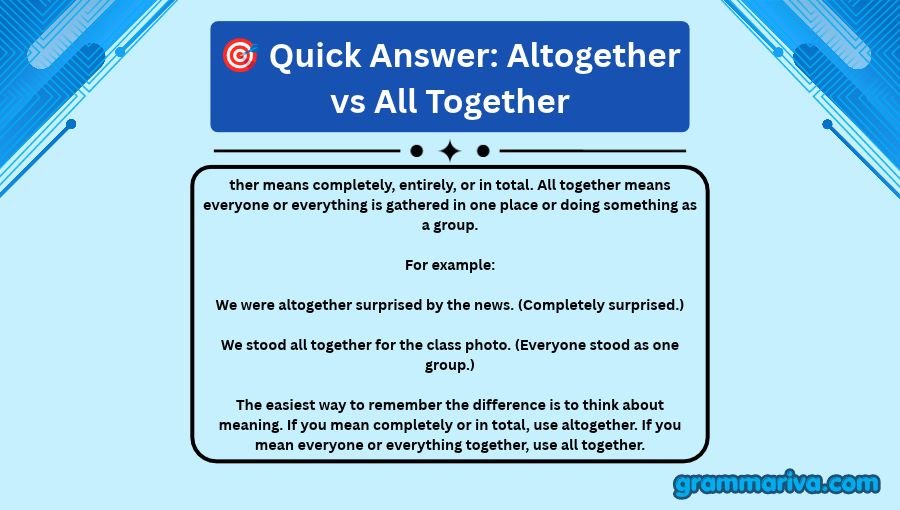
Altogether means completely, entirely, or in total. All together means everyone or everything is gathered in one place or doing something as a group.
For example:
- We were altogether surprised by the news. (Completely surprised.)
- We stood all together for the class photo. (Everyone stood as one group.)
The easiest way to remember the difference is to think about meaning. If you mean completely or in total, use altogether. If you mean everyone or everything together, use all together.
Understanding the Basics of Altogether vs All Together
The main difference between these expressions is how they describe an action, amount, or group. One word expresses completeness or a total amount. Two words describe people or things gathered in one place or acting as a group.
Although they sound similar, they cannot always replace each other.
Altogether: Meaning and Correct Use
Altogether is an adverb. It has two common meanings:
- Completely or entirely.
- In total or when everything is counted.
It can describe how something happens or show the final amount of several things.
Examples:
- The movie was altogether enjoyable.
- I spent $75 altogether.
- His explanation was altogether different from mine.
- The plan seems altogether reasonable.
In the first sentence, altogether means completely. In the second, it means in total.
All Together: Meaning and Correct Use
All together is a two-word phrase. It refers to people or things being in the same place or acting at the same time as a group.
Examples:
- The children sat all together.
- We sang all together at the party.
- Put all the books together on the shelf.
- The family gathered all together for dinner.
Here, all together describes a group sharing a place or activity.
Comparison Table
| Form | Type | Meaning | Example | Correct/Incorrect |
|---|---|---|---|---|
| Altogether | Adverb | Completely | The idea is altogether different. | Correct |
| Altogether | Adverb | In total | We paid $100 altogether. | Correct |
| All together | Phrase | In one group | We arrived all together. | Correct |
| All together | Phrase | At the same time | They shouted all together. | Correct |
| Alltogether | Incorrect spelling | Not standard | We were alltogether happy. | Incorrect |
What Is the Main Difference Between Altogether and All Together?
The main difference is that altogether describes completeness or a total, while all together describes a group gathered in one place or acting at the same time.
Think about what you want to say before choosing the spelling.
Consider these examples:
- The room was altogether too small. (Completely or excessively small.)
- The guests were all together in the living room. (Everyone was in one place.)
Both sentences are grammatically correct. However, they communicate different ideas.
Two Different Jobs
Altogether answers questions such as:
- How completely?
- How entirely?
- What is the total?
All together answers questions such as:
- Where is everyone?
- Are the people in one group?
- Are they doing something at the same time?
Quick Comparison
| Expression | Main Purpose | Example |
|---|---|---|
| Altogether | Shows completeness | The result was altogether unexpected. |
| Altogether | Shows a total | We invited 20 people altogether. |
| All together | Shows a group | The players stood all together. |
| All together | Shows shared action | We counted all together. |
Why Do People Confuse Altogether and All Together?
People confuse these expressions because they sound almost identical when spoken. Both contain the words “all” and “together” in a similar sound pattern.
However, their meanings are not the same.
Here are some common reasons for the confusion:
- Similar sounds: Both expressions can sound alike in everyday speech.
- Similar spelling: The only visible difference is the space.
- Fast writing: People often type without checking the meaning.
- Limited grammar knowledge: Some writers have never learned the difference.
- Autocorrect: A keyboard may not recognize the meaning intended by the writer.
I once reviewed a student’s short essay about a school trip. The student wrote, “We were altogether near the bus.” The intended meaning was that everyone stood in one group. I suggested changing it to “We were all together near the bus.” That small change made the sentence much clearer.
The best solution is to focus on the meaning rather than the sound.
Correct Meanings and Uses of Altogether
Altogether has two main uses in standard English. Understanding both will help you use it correctly in daily conversations and formal writing.
Altogether Meaning Completely or Entirely
Use altogether when you want to show that something is complete or total in nature.
Examples:
- I am altogether happy with the result.
- Her opinion is altogether different from mine.
- The situation became altogether unpleasant.
- This is an altogether new experience.
Sentence breakdown:
In “Her opinion is altogether different from mine,” the word altogether strengthens the adjective “different.” It tells the reader that the opinions are completely different.
Altogether Meaning In Total
Use altogether when you want to describe the final amount after counting or adding separate things.
Examples:
- We bought 12 notebooks altogether.
- There were 30 students altogether.
- The repair cost $250 altogether.
- I spent three hours altogether on the project.
Sentence breakdown:
In “There were 30 students altogether,” the word means that the total number of students was 30.
Summary of Altogether’s Meanings
| Meaning | Word Type | Example Sentence |
|---|---|---|
| Completely | Adverb | The idea is altogether wrong. |
| Entirely | Adverb | I am altogether satisfied. |
| In total | Adverb | We collected $500 altogether. |
| All in all | Adverbial use | Altogether, it was a great day. |
💡 Test Tip
Try replacing altogether with “completely” or “in total.”
- If “completely” works, altogether is likely correct.
- If “in total” works, altogether is also likely correct.
For example:
“She was altogether pleased.”
Replace altogether with completely:
“She was completely pleased.”
The sentence still makes sense. Therefore, altogether is correct.
Correct Meanings and Uses of All Together
All together describes people or things being gathered in one place or participating in the same activity.
It has two common uses.
All Together Meaning Everyone in One Place
Use all together when several people or objects are gathered in the same location.
Examples:
- The students were all together in the library.
- We sat all together at one table.
- The family stayed all together during the holiday.
- All the boxes were placed together in the garage.
The phrase shows that the people or things share one place or group.
All Together Meaning At the Same Time
All together can also describe people performing an action at the same time.
Examples:
- Everyone clapped all together.
- The children shouted all together.
- We started singing all together.
- The team raised their hands all together.
In these sentences, the phrase describes a shared action.
Summary of All Together’s Meanings
| Meaning | Word Type | Example Sentence |
|---|---|---|
| In one group | Phrase | We stayed all together. |
| In one place | Phrase | The bags were all together. |
| At the same time | Phrase | They spoke all together. |
| As a group | Phrase | We worked all together. |
💡 Test Tip
Try replacing all together with “as a group” or “in one place.”
For example:
“The players stood all together.”
Replace the phrase with “as a group”:
“The players stood as a group.”
The meaning stays almost the same. This is a useful sign that all together is the right choice.
📝 Case Study: Altogether vs All Together in Real Life
Imagine a manager organizing a team meeting at an office.
The manager sends an email:
“Please arrive all together at 9 a.m. We have 12 team members altogether.”
Both expressions are correct, but they have different jobs.
- All together: The manager wants everyone to arrive as one group or at the same time.
- Altogether: The manager is giving the total number of team members.
Now imagine the manager writes:
“The meeting was altogether successful.”
Here, altogether means completely or entirely.
I once caught a similar mistake while editing a work email. The writer wanted to say that the total cost included all the supplies. They used “all together” instead of “altogether.” I changed the phrase because the sentence was about the final amount, not where the supplies were placed.
This shows why context matters. A simple space can change the meaning of a sentence.
Grammar Rules Explanation: When to Use Each Expression
The grammar rule is based on the role each expression plays in a sentence.
Altogether is an adverb. It modifies an adjective, another adverb, or sometimes a whole statement. It can also express a total amount.
All together is a phrase made up of separate words. It uses “all” to refer to people or things and “together” to describe their shared location or action.
Rule for Altogether
Use one word when the intended meaning is:
- Completely.
- Entirely.
- In total.
- All in all.
Examples:
- The answer is altogether incorrect.
- We spent $80 altogether.
- The experience was altogether wonderful.
Rule for All Together
Use two words when the intended meaning is:
- Everyone in one place.
- Everything in one group.
- People acting at the same time.
Examples:
- We walked all together.
- The children played all together.
- The guests gathered all together.
Correct vs Incorrect at a Glance
| Sentence | Correct/Incorrect | Why |
|---|---|---|
| We spent $60 altogether. | Correct | It means in total. |
| We spent $60 all together. | Incorrect for the intended total meaning | Use altogether for a total amount. |
| The students sat all together. | Correct | They sat as one group. |
| The students sat altogether. | Incorrect for the intended group meaning | The phrase all together is needed. |
| The result was altogether unexpected. | Correct | It means completely unexpected. |
Remember that a sentence should always be judged by its intended meaning. The same expression may be correct in one sentence but wrong in another.
⚠️ Common Mistakes With Altogether and All Together
These mistakes happen because the expressions look and sound alike. Writers may choose one without thinking about the sentence’s meaning.
Why These Mistakes Happen
Fast typing: People often type quickly and forget to check whether a space changes the meaning.
Autocorrect: Some keyboards may suggest a spelling without understanding the full sentence.
Lack of knowledge: A writer may know both expressions but not understand when each one is needed.
Speech habits: Since both expressions sound similar, people may not notice the difference until they write them down.
Similar Grammar Confusions
| Confusing Words | Correct Difference | Example |
|---|---|---|
| It’s / Its | It’s means it is; its shows ownership. | It’s cold outside. |
| Your / You’re | Your shows ownership; you’re means you are. | You’re welcome. |
| There / Their | There refers to a place; their shows ownership. | Their house is large. |
| To / Too | To shows direction; too means also or excessively. | I want to go too. |
| Then / Than | Then relates to time; than makes comparisons. | She is taller than me. |
Common Wrong Forms of Altogether and All Together
| Wrong Form | What’s Wrong | Correct Form |
|---|---|---|
| Alltogether | Incorrectly combines both words. | All together or altogether |
| All together (for total amount) | Wrong when the meaning is in total. | Altogether |
| Altogether (for one group) | Wrong when describing people gathered in one place. | All together |
| All-together | Unnecessary hyphen in standard usage. | All together |
| Alltogther | Misspelled form. | All together |
| Altogther | Missing a letter. | Altogether |
How to Avoid These Errors
Before publishing or sending a sentence, ask yourself:
- Am I talking about a total amount?
- Do I mean completely or entirely?
- Am I talking about people gathered in one place?
- Is everyone doing something at the same time?
These questions can help you choose the correct expression.
How to Remember the Difference Between Altogether and All Together
The easiest way to remember the difference is to connect each expression with a simple meaning.
Think of altogether as one complete idea. Think of all together as several people or things sharing a place or action.
Easy Memory Tricks
- Altogether = Total: Use it when counting or describing completeness.
- All together = Group: Use it when people or things are gathered.
- One word = Entirely: Remember the one-word meaning.
- Two words = Everyone together: Remember the group meaning.
Simple Memory Table
| Expression | Memory Trick | Example |
|---|---|---|
| Altogether | Think of a total | We paid $40 altogether. |
| Altogether | Think of completely | I am altogether happy. |
| All together | Think of a group | We stood all together. |
| All together | Think of shared action | They sang all together. |
A Simple Sentence Test
Ask yourself whether you can replace the expression with one of these phrases:
- Completely.
- Entirely.
- In total.
- In one group.
- At the same time.
If “completely” or “in total” fits, use altogether.
If “in one group” or “at the same time” fits, use all together.
Usage of Altogether and All Together in Different Contexts
Both expressions appear in everyday speech, workplace communication, creative writing, and digital messages. Their meanings remain the same, even when the writing style changes.
Everyday Conversation
Use altogether when talking about a complete feeling, opinion, or total amount.
Use all together when talking about friends, family, or people sharing an activity.
Examples:
- I am altogether happy with our plan.
- Let’s sit all together.
- We spent $25 altogether.
Professional Writing
In professional writing, altogether can describe a complete result or total cost.
All together can describe a team working or meeting as a group.
Examples:
- The final cost was $1,200 altogether.
- The department met all together on Monday.
- The changes made the report altogether clearer.
Creative Writing
Writers can use both expressions to create clear scenes and descriptions.
Examples:
- The village was altogether silent.
- The travelers gathered all together around the fire.
- It was an altogether unexpected ending.
Social Media and Texting
Both expressions are useful in short online messages.
Examples:
- We had 10 orders altogether!
- We should take a photo all together.
- I am altogether ready for the weekend.
Context Comparison Table
| Context | Which Term to Use | Example |
|---|---|---|
| Everyday conversation | Both | We spent $20 altogether. |
| Professional writing | Both | The team met all together. |
| Creative writing | Both | The scene was altogether beautiful. |
| Social media/texting | Both | Let’s take a picture all together. |
The important thing is not the type of writing. It is the meaning you want to express.
Common Phrases With Altogether and All Together
Some common phrases use altogether to express completeness or a total amount. Others use all together to describe a group.
Common Phrases With Altogether
| Phrase | Meaning |
|---|---|
| Altogether different | Completely different |
| Altogether too much | Excessive or more than needed |
| Altogether reasonable | Completely reasonable |
| Altogether unexpected | Completely unexpected |
| Altogether in total | The final combined amount |
Common Phrases With All Together
| Phrase | Meaning |
|---|---|
| All together now | Everyone doing something at the same time |
| Gather all together | Bring everyone into one group |
| Stand all together | Stand as one group |
| Sit all together | Sit in the same place |
| Work all together | Work as a group |
These phrases are useful in daily speech. However, always check the full sentence before choosing one.
Synonyms and Alternatives for Altogether and All Together
You can sometimes replace these expressions with other words. The best alternative depends on the meaning of your sentence.
Alternatives for Altogether
| Alternative | Works When | Does Not Work When |
|---|---|---|
| Completely | You mean entirely. | You mean people are gathered. |
| Entirely | You describe full agreement or completeness. | You describe a physical group. |
| In total | You describe a final amount. | You describe a shared activity. |
| Fully | You describe a complete state. | You mean everyone is in one place. |
Alternatives for All Together
| Alternative | Works When | Does Not Work When |
|---|---|---|
| As a group | People act as one unit. | You describe a total amount. |
| In one place | People or things share a location. | You mean completely. |
| At the same time | People perform an action together. | You describe an amount. |
| Collectively | People act as a group. | You describe complete satisfaction. |
Be careful when replacing these expressions. A synonym may not fit every sentence.
🎯 Why Getting Altogether and All Together Right Matters
Using the correct expression helps readers understand your message without stopping to guess what you mean.
Good grammar also makes your writing look more polished. This is useful in schoolwork, professional emails, published articles, and social media posts.
Clarity in Communication
A sentence becomes clearer when you choose the expression that matches your meaning.
For example:
- We collected $100 altogether.
- We collected all the donations together.
The first sentence gives a total amount. The second describes the donations as a group.
Professionalism
Correct grammar helps your emails and reports look more professional. Small errors can distract readers from your main message.
Accuracy in Digital Communication
Online writing moves quickly. A short message can still create confusion if the wrong expression is used.
A useful writing principle is:
“Clear words make clear messages.”
Why Correct Usage Matters
| Situation | Why Getting It Right Matters |
|---|---|
| Resume | Shows attention to detail. |
| Client email | Makes the message easier to understand. |
| Published content | Improves writing quality. |
| Social post | Helps followers understand the intended meaning. |
A little attention to word choice can make a big difference in how people understand your writing.
Quick Recap Checklist: Altogether vs All Together
Use this checklist whenever you are unsure which expression belongs in your sentence.
| Question | If Yes → Use |
|---|---|
| Do I mean completely? | Altogether |
| Do I mean entirely? | Altogether |
| Am I describing a total amount? | Altogether |
| Are people gathered in one place? | All together |
| Are people doing something at the same time? | All together |
| Am I describing a group? | All together |
Practice Examples
Choose the correct expression in each sentence.
Example A: We spent $150 ______ on the trip.
Correct answer: altogether
Why: The sentence describes the total amount of money spent.
Example B: The children stood ______ for their school photo.
Correct answer: all together
Why: The children were standing as one group.
Example C: The plan was ______ different from what I expected.
Correct answer: altogether
Why: It means completely different.
Quick Self-Test
Try these three sentences without looking at the answers.
- Everyone sang ______ at the concert.
- The result was ______ unexpected.
- We invited 25 guests ______.
Answers:
- All together.
- Altogether.
- Altogether.
If you answered all three correctly, you understand the basic rule!
FAQs About Altogether vs All Together
What is the difference between altogether and all together?
Altogether is one word that means completely, entirely, or in total. All together is two words that describe people or things gathered in one place or acting as a group.
Is altogether one word or two words?
Altogether is always written as one word when you mean completely, entirely, or in total.
Example: We spent $90 altogether.
Is all together two words?
Yes. All together is written as two separate words when you mean everyone or everything is in one group or place.
Example: The students sat all together.
Can altogether and all together be used interchangeably?
No. They have different meanings and cannot always replace each other. Use altogether for completeness or a total amount. Use all together for a group or shared action.
Does altogether mean in total?
Yes. Altogether can mean in total when you combine separate amounts or numbers.
Example: We bought 15 books altogether.
Does all together mean at the same time?
Yes. All together can describe people performing an action at the same time.
Example: The audience clapped all together.
Is it altogether different or all together different?
The correct expression is “altogether different” when you mean completely different.
Example: Her new style is altogether different from her old one.
Should I write we are all together or we are altogether?
Both can be grammatically correct, but they mean different things.
- We are all together means we are gathered as a group.
- We are altogether means we are completely or entirely something, although this construction usually needs more context to sound natural.
Is altogether formal or informal?
Altogether is suitable for both formal and informal writing. You can use it in professional emails, school assignments, articles, and everyday conversations.
How can I quickly remember altogether vs all together?
Remember that altogether means completely or in total. All together means everyone or everything in one group. Try replacing the words with “in total” or “as a group” to check your choice.
Conclusion
Understanding altogether vs all together is easier when you focus on what each expression means. Altogether is one word that means completely, entirely, or in total. All together is two words that describe people or things gathered in one place or doing something at the same time.
Remember the simple rule: use altogether when you talk about a complete idea or a final amount. Use all together when you describe a group sharing a place or activity.
I recommend using the replacement test whenever you feel unsure. If “completely” or “in total” fits your sentence, choose altogether. If “as a group” or “in one place” makes sense, choose all together.
These expressions may look almost identical, but their meanings are easy to separate once you practice. You do not need complicated grammar rules to get them right. Just think about the message you want to share before choosing the spelling. 😊
The best writing is not about using difficult words. It is about choosing the right words to make your meaning clear.

Hi, I’m Ethan Brooks. I’m an English grammar writer at Grammariva, where I work on clear explanations, practical examples, and useful writing tips. I enjoy making difficult grammar topics easier to understand.

[…] you how to avoid common mistakes. By the end, you will feel more confident using both forms. ✍️ Altogether vs All Together | Lend vs Borrow | Bring vs […]