Have you ever typed a sentence and stopped because accent vs ascent vs assent suddenly looked confusing? 😅 These three words sound similar, but they have very different meanings and jobs in a sentence. One relates to speech or emphasis. Another describes moving upward. The third means agreement. That small spelling difference can change your entire sentence.
I have taught and edited plenty of sentences where one of these words was used by mistake. The good news is that you do not need a complicated grammar rule to remember them. Each word has a clear meaning, and each spelling gives you a useful clue.
In this guide, I will explain accent vs ascent vs assent in simple US English. You will learn what each word means, how to use it, why people confuse them, and how to remember the difference. By the end, you should be able to choose the right word quickly. ✨ Forgo or Forego | City vs Town vs Village | Ingrained or Engrained
🎯 Quick Answer: Accent vs Ascent vs Assent
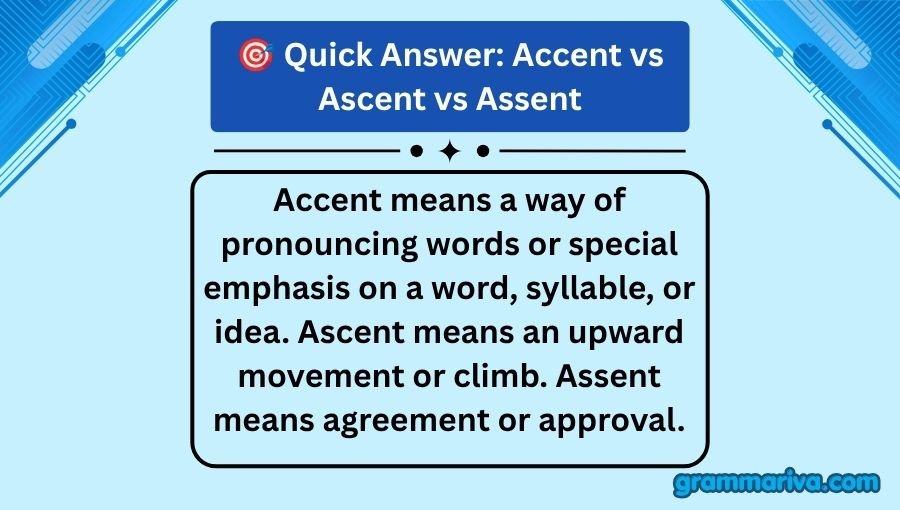
Accent means a way of pronouncing words or special emphasis on a word, syllable, or idea. Ascent means an upward movement or climb. Assent means agreement or approval.
| Word | Main Meaning | Simple Example |
|---|---|---|
| Accent | Speech pattern or emphasis | She has a British accent. |
| Ascent | Movement upward | The hikers began their ascent. |
| Assent | Agreement or approval | The board gave its assent. |
A quick memory trick is this:
- Accent → speech or emphasis 🗣️
- Ascent → going up ⛰️
- Assent → saying yes 👍
📚 Accent, Ascent, and Assent: The Basic Difference
The main difference is meaning. Accent relates to speech or emphasis, ascent relates to upward movement, and assent relates to agreement.
These words can sound alike in some forms of speech. Their spelling, however, points to three different ideas.
| Form | Type | Meaning | Example | Correct/Incorrect |
|---|---|---|---|---|
| accent | Noun/verb | Speech pattern or emphasis | He has a strong accent. | ✅ Correct |
| ascent | Noun | Movement upward | The ascent was difficult. | ✅ Correct |
| assent | Noun/verb | Agreement or approval | She gave her assent. | ✅ Correct |
| ascent | Noun | Agreement | She gave her ascent. | ❌ Incorrect |
| assent | Noun | A speech pattern | He has an assent. | ❌ Incorrect |
The easiest way to separate them is to focus on the idea behind each word.
Accent is about how something sounds or what receives emphasis.
Ascent is about going upward.
Assent is about agreeing.
🗣️ What Does Accent Mean?
Accent is mainly a noun that describes the way someone pronounces words. It can also mean special emphasis placed on a word, part of a sentence, or an idea.
For example:
Maria speaks English with a Spanish accent.
Here, accent describes Maria’s pronunciation.
The word can also describe emphasis:
The teacher placed an accent on the final point.
In that sentence, accent means emphasis.
Accent as a speech pattern
An accent can reflect the way English sounds in a particular region or community. People from different parts of the United States, the United Kingdom, Australia, and other places may pronounce the same words differently.
For example:
He has a noticeable Southern accent. ✅
The sentence tells us something about his pronunciation.
He has a noticeable Southern assent. ❌
The second sentence changes the meaning completely because assent means agreement.
Accent as emphasis
Accent can also mean stress or importance.
The speaker put an accent on the need for honesty. ✅
The speaker put an ascent on the need for honesty. ❌
The first sentence uses accent because the speaker is giving special emphasis to an idea.
| Meaning | Word Type | Example Sentence |
|---|---|---|
| Speech pattern | Noun | Her accent is easy to recognize. |
| Emphasis | Noun | The writer placed an accent on safety. |
| Give emphasis | Verb | The speaker accented the final point. |
💡 Test Tip
Ask yourself: Is this sentence about speech, pronunciation, stress, or emphasis?
If yes, accent is usually the word you need.
⛰️ What Does Ascent Mean?
Ascent means movement upward. It often describes climbing a mountain, rising into the air, or moving from a lower place to a higher one.
For example:
The climbers began their ascent at sunrise. ✅
The climbers are moving upward.
Compare that with:
The climbers began their assent at sunrise. ❌
That spelling is wrong because the sentence is not about agreement.
Ascent in physical movement
The most common use describes going upward.
You might see it in sentences about:
- mountains
- stairs
- aircraft
- elevators
- steep roads
- hills
- climbing
For example:
The plane began its ascent after takeoff. ✅
The aircraft is moving higher into the sky.
Ascent in a figurative sense
The word can also describe progress toward a higher position or level.
Her ascent to the top of the company was impressive. ✅
Here, ascent does not mean that she physically climbed upward. It describes her rise in status or position.
| Meaning | Word Type | Example Sentence |
|---|---|---|
| Physical movement upward | Noun | The ascent was steep. |
| Rise in status | Noun | His ascent to leadership was quick. |
| Rise to a higher level | Noun | The team’s ascent was unexpected. |
The key idea remains the same: upward movement or rise.
👍 What Does Assent Mean?
Assent means agreement or approval. It can be a noun or a verb.
As a noun, it refers to agreement:
The manager gave her assent to the plan. ✅
As a verb, it means to agree:
The manager assented to the plan. ✅
This word often appears in formal writing, but it can also appear in everyday language.
Assent as a noun
When assent is a noun, it often follows words such as:
- give
- receive
- obtain
- seek
- win
Examples:
The proposal was approved with the committee’s assent. ✅
The team sought the director’s assent. ✅
Assent as a verb
As a verb, assent means to agree with something.
The members assented to the new rules. ✅
Notice that the sentence does not mean they physically moved upward. It means they agreed.
| Use | Word Type | Example |
|---|---|---|
| Agreement | Noun | We received his assent. |
| Approval | Noun | The plan needs parental assent. |
| Agree | Verb | She assented to the request. |
💡 Test Tip
Replace the word with agreement or agree.
If the sentence still makes sense, assent may be correct.
🔍 Is Accent the Same as Ascent or Assent?
No. Accent, ascent, and assent are not interchangeable. Their meanings are different even though their spellings and sounds are similar.
Think of them as three separate boxes:
Accent = sound or emphasis
Ascent = upward movement
Assent = agreement
| Word | Think Of | Example |
|---|---|---|
| Accent | Speech | She has a French accent. |
| Ascent | Up | The ascent was exhausting. |
| Assent | Yes | He gave his assent. |
I often teach this distinction by asking students to attach one simple word to each term. For accent, think “voice.” For ascent, think “up.” For assent, think “yes.”
That small trick makes the difference much easier to recall.
❓ Why Do People Confuse Accent, Ascent, and Assent?
People confuse these words because their spellings are close and their sounds can be similar. Fast typing and autocorrect can make the problem worse.
The words all begin with a, and their endings look almost identical. When someone writes quickly, the brain may choose the wrong spelling before the writer stops to check the meaning.
A student once wrote, “The airplane began its assent.” I knew immediately what she meant. She was describing the plane moving upward. We changed assent to ascent, and the sentence was fixed.
This is a good example of why meaning matters more than appearance.
Common reasons for confusion
- The words look almost the same.
- They can sound similar.
- People type quickly.
- Autocorrect may suggest a different word.
- Writers may not know the meanings.
- Spell-checkers may not catch a real-word mistake.
| Confusion | Correct Word | Reason |
|---|---|---|
| it’s / its | Depends on meaning | Contraction vs possession |
| your / you’re | Depends on meaning | Possession vs “you are” |
| there / their / they’re | Depends on meaning | Place, possession, or “they are” |
| accent / ascent / assent | Depends on meaning | Speech, upward movement, or agreement |
The important point is that all three words are real English words. A spell-checker may not tell you that you chose the wrong one.
✍️ Accent vs Ascent vs Assent in Real Sentences
Seeing the words in complete sentences makes the difference easier to understand.
Accent examples
She speaks English with a clear Irish accent. ✅
She speaks English with a clear Irish ascent. ❌
The sentence is about pronunciation, so accent is correct.
Ascent examples
The mountain’s ascent became harder after noon. ✅
The mountain’s assent became harder after noon. ❌
The sentence describes upward movement, so ascent is correct.
Assent examples
The director gave his assent to the proposal. ✅
The director gave his ascent to the proposal. ❌
The director agreed to the proposal, so assent is correct.
| Sentence | Correct/Incorrect | Why |
|---|---|---|
| She has a strong accent. | ✅ Correct | It describes pronunciation. |
| The hikers started their ascent. | ✅ Correct | They are moving upward. |
| The committee gave its assent. | ✅ Correct | It agreed or approved. |
| The pilot began his assent. | ❌ Incorrect | The correct word is ascent. |
| She gave her ascent to the plan. | ❌ Incorrect | The correct word is assent. |
🧠 Grammar Rules Explanation: How Each Word Works
The grammar becomes simple once you identify what the sentence is trying to say.
Accent works as a noun and verb. As a noun, it can name a speech pattern or emphasis. As a verb, it can mean to emphasize something.
Ascent is mainly a noun. It describes movement upward or a rise to a higher position.
Assent can work as both a noun and a verb. As a noun, it means agreement or approval. As a verb, it means to agree.
Most standard English reference sources agree on these basic distinctions. The safest approach is always to check the intended meaning before choosing the spelling.
Correct vs Incorrect at a Glance
| Sentence | Correct/Incorrect | Why |
|---|---|---|
| I noticed her accent immediately. | ✅ Correct | It refers to pronunciation. |
| The plane’s ascent was smooth. | ✅ Correct | The plane moved upward. |
| The board gave its assent. | ✅ Correct | The board agreed. |
| The plane’s assent was smooth. | ❌ Incorrect | A plane has an ascent, not an assent. |
| The board gave its ascent. | ❌ Incorrect | A board gives assent when it agrees. |
The rule is based on meaning, not simply spelling.
📝 Case Study: Choosing the Right Word at Work
Imagine you are writing an email after a company meeting.
You want to say that the team approved a new project.
You write:
“We received the team’s ascent to the new project.”
That sentence is incorrect.
The correct version is:
“We received the team’s assent to the new project.” ✅
Why? The team agreed to the project.
Now imagine you are writing about an employee from another country:
“Her accent was easy to understand during the meeting.” ✅
That sentence is also correct, but it describes speech.
Finally, imagine you are writing about a plane trip:
“The aircraft’s ascent was smooth.” ✅
I once edited a short workplace report where the writer used ascent when discussing approval. The sentence looked polished at first glance, but the meaning was wrong. That is why I always recommend reading the sentence for meaning instead of trusting the spelling alone.
⚠️ Common Mistakes With Accent, Ascent, and Assent
The biggest mistake is choosing the word because it looks right instead of choosing it because it means the right thing.
Mistake 1: Using assent for upward movement
❌ The hikers began their assent up the mountain.
Correct:
✅ The hikers began their ascent up the mountain.
Mistake 2: Using ascent for agreement
❌ The manager gave his ascent to the proposal.
Correct:
✅ The manager gave his assent to the proposal.
Mistake 3: Using assent for speech
❌ She has a beautiful French assent.
Correct:
✅ She has a beautiful French accent.
| Wrong Form | What’s Wrong | Correct Form |
|---|---|---|
| French assent | Agreement does not describe pronunciation | French accent |
| Mountain assent | Agreement does not describe climbing | Mountain ascent |
| Give your ascent | “Ascent” does not mean agreement | Give your assent |
| Plane’s assent | The plane is moving upward | Plane’s ascent |
| Regional ascent | A speech pattern is meant | Regional accent |
| Assent in pronunciation | The meaning is wrong | Accent |
Why these mistakes happen
Fast typing: Your fingers may select a familiar-looking word.
Autocorrect: A device can change a word without you noticing.
Lack of knowledge: If you do not know the meanings, the spellings are easy to mix up.
Similar sounds: Words that sound alike can compete in your mind.
A simple pause can prevent the mistake. Ask, “What does this word need to mean?”
🕰️ A Brief Look at the History of These Words
These words have different histories and meanings, but their modern spellings happen to look similar. Their similarity today does not mean they are interchangeable.
You do not need to memorize their full history to use them correctly. Modern meaning is far more useful for everyday writing.
| Period | Form | Note |
|---|---|---|
| Earlier English | Related forms developed separately | The words had different uses. |
| Middle English period | Different spellings appeared | English spelling was not fully standardized. |
| Early Modern English | Spellings became more stable | Printed English helped standardize forms. |
| Modern English | accent / ascent / assent | The three forms have distinct meanings today. |
The key lesson is simple: similar spelling does not mean identical meaning.
🌎 How Are These Words Used in Different Contexts?
The best word depends on what you are talking about. Everyday speech often uses accent and ascent, while assent can sound more formal.
Everyday conversation
Use accent when discussing how someone speaks.
“I love her accent.”
Use ascent when discussing climbing or rising.
“The ascent took two hours.”
Use assent when talking about agreement, though agreement is often more common in casual speech.
Professional writing
All three can appear in professional writing.
“The candidate has a noticeable accent.”
“The aircraft began its ascent.”
“The committee gave its assent.”
Creative writing
Writers may use all three words to create clear images or ideas.
“The slow ascent toward the summit tested every member of the group.”
Social media and texting
Accent and ascent may appear often in captions or posts. Assent is less common because casual writers usually choose “agree” or “approval.”
| Context | Which Term to Use | Example |
|---|---|---|
| Everyday conversation | Accent | I like your accent. |
| Everyday conversation | Ascent | The ascent was tough. |
| Professional writing | Assent | We received their assent. |
| Creative writing | Ascent | Their ascent continued into the night. |
| Social media/texting | Accent | Her accent is adorable. |
💬 Common Phrases With Accent, Ascent, and Assent
Each word appears in certain natural phrases. Learning these phrases can make the differences easier to remember.
| Phrase | Meaning |
|---|---|
| foreign accent | A speech pattern linked to another language or region |
| strong accent | A noticeable way of pronouncing words |
| rapid ascent | A fast rise or climb |
| steep ascent | A difficult or sharply upward climb |
| give assent | Give agreement or approval |
| with someone’s assent | With that person’s agreement |
Notice how the phrases themselves reveal the meaning.
You can have a strong accent, but you cannot have a “strong assent” when talking about pronunciation.
You can make a rapid ascent, but you cannot make a “rapid assent” up a mountain.
You can give assent, but you cannot “give ascent” to an idea when you mean approval.
🔄 Synonyms and Alternatives for Each Word
Sometimes you can replace these words with simpler alternatives. This can help you avoid confusion.
For accent, try speech pattern, pronunciation, or emphasis, depending on the meaning.
For ascent, try climb, rise, or upward movement.
For assent, try agreement, approval, or agree, depending on the grammar.
| Alternative | Works When | Does Not Work When |
|---|---|---|
| Pronunciation | Talking about speech | Talking about climbing |
| Climb | Talking about upward movement | Talking about agreement |
| Rise | Talking about upward movement or status | Talking about speech |
| Agreement | Talking about approval | Talking about a mountain |
| Approval | Talking about permission or agreement | Talking about pronunciation |
Be careful with replacements. A synonym may change the grammar of the sentence.
For example:
“She assented to the plan.”
can become:
“She agreed to the plan.”
But you cannot replace accent with agree.
🎯 How to Remember the Difference
The fastest way to remember these words is to connect each one with a short mental picture.
Accent = voice 🗣️
Think of someone speaking. You hear the person’s accent.
Ascent = up ⬆️
Think of a mountain. You climb during an ascent.
Assent = yes 👍
Think of someone nodding. They give their assent.
Here is another useful trick:
ACCENT → sounds and stress
ASCENT → climbing
ASSENT → agreement
The middle letters can help you build a mental shortcut. Remembering accent vs ascent vs assent is easy when you connect each word with one simple idea: voice, up, and yes.
| Word | Memory Clue | Meaning |
|---|---|---|
| Accent | Voice | Speech/emphasis |
| Ascent | Up | Climb/rise |
| Assent | Yes | Agreement |
If you remember only three words, remember:
Accent = voice.
Ascent = up.
Assent = yes.
❓ Is Ascent a Verb or a Noun?
Ascent is a noun. It describes the act or process of moving upward or rising.
For example:
The ascent was slow. ✅
You would not normally use ascent as the main verb in a sentence.
Instead, use a verb such as ascend, climb, or rise.
The hikers ascended the mountain. ✅
The hikers began their ascent. ✅
This distinction is useful because ascent and ascend are closely related in spelling but serve different grammatical roles.
| Word | Type | Example |
|---|---|---|
| Ascent | Noun | The ascent was difficult. |
| Ascend | Verb | They ascended the mountain. |
| Climb | Verb/Noun | They climbed the hill. |
| Rise | Verb/Noun | The balloon began to rise. |
❓ Is Assent a Verb or a Noun?
Assent can be both a noun and a verb. As a noun, it means agreement or approval. As a verb, it means to agree.
Compare:
She gave her assent. ✅
Here, assent is a noun.
She assented to the proposal. ✅
Here, assented is a verb.
A useful test is to replace the word with agreement or agree.
If agreement works, you probably need the noun assent.
If agree works, you may need the verb assent.
❓ Is Accent a Verb or a Noun?
Accent can be both a noun and a verb. As a noun, it can describe pronunciation or emphasis. As a verb, it means to emphasize something.
For example:
He has a strong accent. ✅
Here, it is a noun.
The design accents the room’s natural light. ✅
Here, it is a verb.
The noun is much more common in everyday discussions about speech.
❓ What Is the Difference Between Ascent and Assent?
Ascent means upward movement, while assent means agreement.
This is one of the easiest pairs to separate once you remember the meanings.
The climbers began their ascent. ✅
They moved upward.
The climbers gave their assent. ✅
They agreed to something.
The words differ by only one letter, but that letter changes the meaning completely.
❓ What Is the Difference Between Accent and Assent?
Accent refers to speech or emphasis, while assent refers to agreement or approval.
For example:
I noticed his accent. ✅
This is about pronunciation.
I received his assent. ✅
This is about agreement.
If you can replace the word with voice or pronunciation, choose accent.
If you can replace it with agreement, choose assent.
❓ What Is the Difference Between Accent and Ascent?
Accent relates to speech or emphasis, while ascent means movement upward.
Compare these sentences:
Her accent is easy to understand. ✅
Her ascent was easy to understand. ❌
The second sentence does not make sense if you are talking about speech.
Now consider:
The team’s ascent to the final was unexpected. ✅
The team is rising to a higher level.
❓ How Can I Remember Accent, Ascent, and Assent?
Use this three-word memory trick:
Accent = voice.
Ascent = up.
Assent = yes.
You can also picture three scenes:
- 🗣️ Someone speaking → accent
- ⛰️ Someone climbing → ascent
- 👍 Someone agreeing → assent
This method is faster than trying to memorize a long grammar rule.
❓ Which Word Means Agreement: Accent, Ascent, or Assent?
Assent means agreement or approval.
For example:
The parents gave their assent to the plan. ✅
You could rewrite this as:
The parents gave their agreement to the plan. ✅
Or:
The parents agreed to the plan. ✅
Neither accent nor ascent has this meaning.
❓ Which Word Describes a Speech Pattern?
Accent describes a person’s way of pronouncing words.
For example:
She speaks English with a noticeable accent. ✅
An accent can be linked to a region, language background, or community. It can also refer to emphasis in speech or writing.
The words ascent and assent do not mean speech pattern.
❓ Which Word Means a Climb or Rise?
Ascent means a climb or upward movement.
For example:
The hikers completed the steep ascent before sunset. ✅
It can describe physical movement or a rise in position or status.
If the sentence is about going upward, ascent is the word to choose.
🧾 Quick Recap Checklist
Use this checklist whenever you are unsure.
| Question | If Yes → Use |
|---|---|
| Is the sentence about pronunciation? | Accent |
| Is it about emphasis? | Accent |
| Is something moving upward? | Ascent |
| Is someone climbing? | Ascent |
| Does someone agree or approve? | Assent |
| Can you replace the word with “agreement”? | Assent |
Practice Examples
- The pilot began the plane’s ascent.
- She speaks with a gentle accent.
- The committee gave its assent to the plan.
Try covering the bold words and choosing them yourself. If you get all three right, you have the core rule down.
📊 Accent vs Ascent vs Assent: Final Comparison
| Feature | Accent | Ascent | Assent |
|---|---|---|---|
| Main idea | Speech/emphasis | Upward movement | Agreement |
| Common type | Noun/verb | Noun | Noun/verb |
| Related word | Accentuation/emphasis | Ascend | Agree |
| Simple clue | Voice | Up | Yes |
| Example | Her accent is strong. | The ascent was steep. | He gave his assent. |
| Common mistake | Using it for agreement | Using it for approval | Using it for climbing |
This table captures the whole lesson in one place.
❤️ Why Getting These Words Right Matters
Using the right word makes your writing clear. It also shows that you understand the meaning behind your sentence.
In a resume, report, school assignment, email, or published article, a small word choice can affect how professional your writing feels.
Imagine writing:
“The team gave its ascent to the proposal.”
Your reader may understand what you meant, but the sentence is still wrong. Assent is the correct word.
Clear writing saves readers from having to guess.
Good word choice makes your meaning easier to trust.
| Situation | Why Getting It Right Matters |
|---|---|
| Resume | Shows careful writing |
| Client email | Prevents confusion |
| Published content | Builds credibility |
| Social post | Makes the message clear |
I personally find that these three words become easy once writers stop thinking about their spelling and start thinking about their meaning.
🚨 Accent vs Ascent vs Assent: The Mistake-Proof Rule
If you need one final rule, use this:
Choose accent when the sentence is about speech or emphasis.
Choose ascent when something moves upward.
Choose assent when someone agrees.
| Meaning | Correct Word | Example |
|---|---|---|
| Speech | Accent | His accent is distinctive. |
| Emphasis | Accent | The report accents the main risk. |
| Climbing | Ascent | The ascent took four hours. |
| Rising | Ascent | Her ascent in the company was rapid. |
| Agreement | Assent | The group gave its assent. |
| Agreeing | Assent | They assented to the terms. |
That is the rule you can carry into almost any writing situation.
❓ FAQs About Accent vs Ascent
What is the simple difference between accent, ascent, and assent?
Accent means a speech pattern or emphasis. Ascent means movement upward or a rise. Assent means agreement or approval.
Is “ascent” the same as “ascend”?
No. Ascent is a noun, while ascend is a verb. You can say, “The ascent was steep,” or “They ascended the mountain.”
Is “assent” the same as “agree”?
They are closely related, but they are not always used in the same grammatical way. Assent can be a noun meaning agreement and a verb meaning agree. For example, “She gave her assent” and “She assented to the plan.”
Does “accent” only refer to pronunciation?
No. Accent commonly refers to pronunciation, but it can also mean emphasis. For example, a writer or speaker may place an accent on a particular idea.
Which word should I use for climbing a mountain?
Use ascent when you mean the upward climb or movement.
The ascent was difficult. ✅
The verb form is ascend.
They ascended the mountain. ✅
Which word means approval?
Assent means agreement or approval.
The committee gave its assent to the proposal. ✅
You can often replace it with “agreement” without changing the basic meaning.
Which word describes how someone speaks?
Use accent.
He has a noticeable American accent. ✅
It describes a person’s way of pronouncing words.
Can “assent” be a verb?
Yes. Assent can be a verb meaning to agree.
The members assented to the proposal. ✅
It can also be a noun:
The members gave their assent. ✅
Can “accent” be a verb?
Yes. Accent can be a verb meaning to emphasize something.
The design accents the room’s best features. ✅
It is also commonly used as a noun for speech patterns.
How can I quickly remember all three words?
Remember voice, up, yes:
- Accent = voice
- Ascent = up
- Assent = yes
This three-word trick is usually enough to prevent the most common errors.
🏁 Conclusion: Accent vs Ascent vs Assent Made Simple
Accent vs ascent vs assent becomes much easier when you focus on meaning instead of spelling. Accent is connected to speech and emphasis. Ascent describes movement upward or a rise. Assent means agreement or approval.
When you see one of these words in your writing, stop for one second and ask what the sentence means. Is it about someone’s voice? Choose accent. Is something moving upward? Choose ascent. Is someone agreeing? Choose assent.
That tiny pause can prevent a very common word-choice mistake. ✨
I recommend remembering the three words as voice, up, and yes. It is short, practical, and easy to recall when you are writing quickly.
Once you learn that simple pattern, these similar-looking words stop being confusing. Keep the meanings separate, and your writing will stay clear, accurate, and professional. Keep it simple: accent is voice, ascent is up, and assent is yes. 💡

Hi, I’m Madison Hayes. I’m an English learning writer at Grammariva, where I work on simple lessons and examples for people who want to improve their grammar and writing. I love turning confusing rules into easy-to-follow explanations.


[…] English treats it, and which choice is safest for school, work, blogs, and everyday writing. ✍️ Accent vs Ascent vs Assent | Forgo or Forego | City vs Town vs […]