Have you ever looked at a place on a map and wondered whether you should call it a city, town, or village? You are not alone. The words can sound simple, but their use can change from one country to another. That makes city vs town vs village a common source of confusion for English learners, writers, travelers, and even native speakers. 😊
The basic idea is easy once you know what each word usually means. A city is generally a large, important, and highly developed place. A town is usually smaller than a city but larger than a village. A village is generally a small community with fewer people and fewer large services.
However, population is not the only factor. Legal status, local government, history, and regional customs can also affect the label.
In this guide, I will explain the difference in plain US English. I will also show you real examples, common mistakes, useful memory tricks, and practical sentences. By the end, you should feel much more confident choosing the right word. 🌎 Ingrained or Engrained | Hastle or Hassle | Indolence vs Insolence
🎯 Quick Answer: City vs Town vs Village
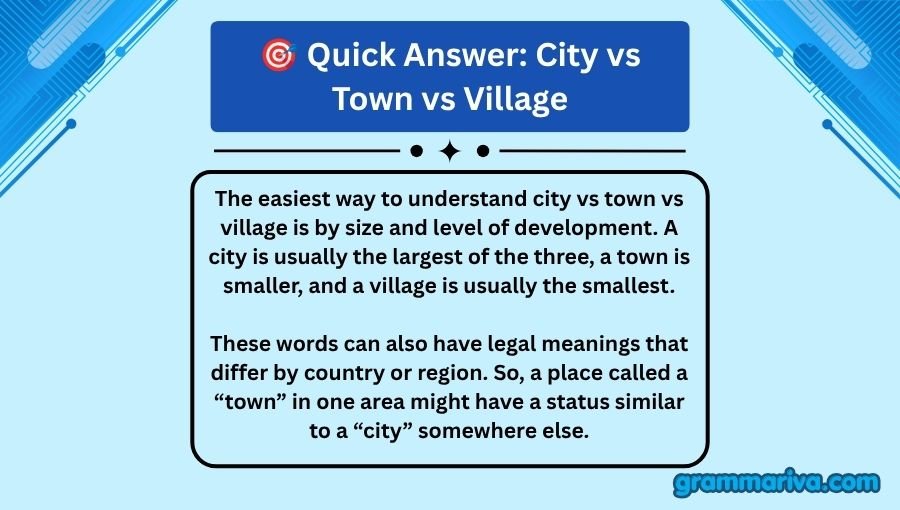
The easiest way to understand city vs town vs village is by size and level of development. A city is usually the largest of the three, a town is smaller, and a village is usually the smallest.
These words can also have legal meanings that differ by country or region. So, a place called a “town” in one area might have a status similar to a “city” somewhere else.
| Term | General Meaning | Typical Size | Common Features |
|---|---|---|---|
| City | A large urban settlement | Large | Many services, businesses, roads, offices |
| Town | A medium-sized settlement | Medium | Shops, schools, local services |
| Village | A small community | Small | Fewer services, homes, local businesses |
The key point is this: size gives you a useful general guide, but official local rules can change the label.
🏙️ City vs Town vs Village: Understanding the Basics
The main difference between a city, town, and village is the general size and character of the settlement. A city usually has a larger population and more developed infrastructure. A town is often smaller and less dense. A village is generally smaller still.
Think of them as three broad levels:
Village → Town → City
This is not a universal legal ranking. It is simply a useful way to understand everyday English.
For example:
- The village has a small grocery store.
- The town has several schools and restaurants.
- The city has a large airport and several business districts.
All three sentences can be correct.
City
A city is usually a large urban area with many people, buildings, businesses, services, and transportation options.
A city may have:
- Hospitals
- Universities
- Shopping centers
- Public transportation
- Office buildings
- Large sports venues
- Major roads
- Government offices
- Cultural attractions
For example:
Chicago is a major city in the United States.
The word “city” tells the reader that Chicago is a large and developed urban area.
Town
A town usually falls between a city and a village in everyday descriptions.
A town can have:
- Schools
- Restaurants
- Stores
- Banks
- Medical offices
- Local government
- Residential neighborhoods
A town may feel busy, but it often has a smaller population and less dense development than a major city.
We stopped in a small town during our road trip.
The sentence gives us a clear picture of a smaller community without suggesting that it is as large as a major city.
Village
A village is generally a small settlement. It often has fewer people and fewer large services.
A village may have:
- Homes
- A small store
- A local school
- A place of worship
- Small farms
- Local roads
- Community spaces
For example:
My grandparents live in a quiet village near the mountains.
The word “village” creates an image of a small community.
Comparison at a Glance
| Feature | City | Town | Village |
|---|---|---|---|
| General size | Large | Medium | Small |
| Population | Usually high | Usually moderate | Usually low |
| Buildings | Dense and varied | Mixed | Mostly smaller buildings |
| Services | Many | Moderate | Limited |
| Traffic | Often heavy | Usually lighter | Usually light |
| Public transit | Often available | Sometimes available | Limited or absent |
| Business activity | High | Moderate | Low to moderate |
| Overall feel | Urban | Semi-urban or local | Rural or small-community |
❓ Is a City Bigger Than a Town?
Usually, yes. In everyday American English, a city is generally understood to be larger and more developed than a town.
However, the word “city” does not always tell you the exact population. Legal definitions differ between places.
For example, a small incorporated community may legally be called a city even if it has fewer people than a large town somewhere else.
So, avoid treating the words as strict mathematical categories.
A Simple Example
Imagine three communities:
- Place A has 500 residents.
- Place B has 20,000 residents.
- Place C has 500,000 residents.
You might naturally call Place A a village, Place B a town, and Place C a city.
But real-world names do not always follow this exact pattern.
❓ Is a Town the Same as a Village?
No. A town and a village are not automatically the same thing.
In general English, a town is larger or more developed than a village. A town often has more businesses, services, public buildings, and transportation options.
A village usually has a smaller population and a more local feel.
| Word | General Idea | Example |
|---|---|---|
| Village | Small community | The village has 300 residents. |
| Town | Medium-sized community | The town has several stores. |
| City | Large urban community | The city has millions of residents. |
There can be exceptions. Local governments may define these terms differently.
A Useful Memory Trick 💡
Remember:
Village = very small
Town = in the middle
City = larger and more urban
This simple scale works well when you are writing normal English.
❓ Why Do People Confuse City, Town, and Village?
People confuse these words because there is no single worldwide rule that determines exactly when a settlement becomes a city, town, or village. Understanding city vs town becomes easier when you separate everyday meaning from official local classifications.
Different countries use different systems. Some places use population. Others consider legal status, government structure, history, or local tradition.
I once reviewed a travel article where the writer used “village” for every small place they mentioned. The problem was that one location was officially a town. The writer was thinking only about size. The local government classification told a different story.
That experience is a good reminder: everyday meaning and official status are not always identical.
Another source of confusion is casual speech. People may call a place a “town” simply because it feels small, even when its official name says something else.
The Main Reasons for Confusion
- Population limits differ.
- Legal definitions vary.
- Local traditions affect word choice.
- People use the terms casually.
- Maps may use official labels.
- Historical names can remain even after a place grows.
So, context matters.
📝 How Do City, Town, and Village Work in Sentences?
Each word is a common noun when used as a general description.
A general noun normally needs an article or another determiner when it is singular.
For example:
She lives in a city.
He grew up in a small town.
They visited a village.
When the word is part of an official place name, the grammar can change.
For example:
New York City is famous for its skyline.
Here, “New York City” is a proper name.
The difference between a general description and a proper name is important.
General Description
We moved to a city near the coast.
“City” describes the kind of place.
Proper Name
We moved to New York City.
“New York City” identifies the specific place.
❓ Should You Capitalize City, Town, and Village?
Usually, no. The words city, town, and village are lowercase when they are used as ordinary nouns.
Correct:
I live in a small town.
Incorrect:
I live in a small Town.
However, capitalize a word when it is part of an official name.
For example:
New York City
Here, “City” is part of the proper name.
The same principle applies to other place names.
| Usage | Correct Example |
|---|---|
| General noun | She lives in a city. |
| General noun | We visited a village. |
| General noun | He works in a town. |
| Proper name | New York City is crowded. |
| Official name | The Town of Exampleville held a meeting. |
Always check whether the word is simply describing a place or forming part of its official name.
💡 Test Tip: How Can You Choose the Right Word?
Here is the test I use when teaching this topic.
Ask yourself three questions:
1. Am I describing the place generally?
If yes, think about its size and character.
2. Is it a large urban area?
If yes, city may be the natural choice.
3. Is it a smaller community?
If yes, town or village may fit better.
Then ask one final question:
Does the place have an official classification?
If it does, use that classification when accuracy matters.
Test Tip Table
| Question | Likely Choice |
|---|---|
| Is it a large urban area? | City |
| Is it medium-sized? | Town |
| Is it a very small community? | Village |
| Is there an official legal name? | Follow the official name |
| Am I writing casually? | Use the common everyday term |
📝 Case Study: Choosing the Right Word in Real Life
Imagine you are writing an email about a business meeting.
Your company has an office in a small community.
You write:
Our meeting will take place in the village of Greenfield.
That sounds reasonable if Greenfield is actually a village.
But suppose Greenfield is officially a town. Then this would be more accurate:
Our meeting will take place in the town of Greenfield.
Now imagine that the meeting is in a major urban center:
Our meeting will take place in the city of Boston.
The basic grammar stays the same. What changes is the description of the place.
I once caught myself doing something similar while editing a travel brochure. The place looked tiny on the map, so I nearly called it a village. A quick check showed that it was officially a town. That small correction made the description more accurate.
Practical Comparison
| Situation | Natural Sentence |
|---|---|
| Large urban area | We live in a city. |
| Medium community | She moved to a town. |
| Small community | They live in a village. |
| Official classification | The town has a new council building. |
| Travel writing | We stayed in a quiet village. |
📚 Grammar Rules Explanation
The words city, town, and village are nouns. They name types of settlements.
The choice among them is mainly a matter of meaning and context, not a special verb rule.
A singular common noun usually needs a determiner.
Correct:
She lives in a city.
Incorrect:
She lives in city.
The article “a” is needed because “city” is a singular countable noun used generally.
The same pattern applies to “town” and “village.”
Correct:
He lives in a town.
Incorrect:
He lives in town.
Correct:
They visited a village.
Incorrect:
They visited village.
There are also fixed expressions where an article may be absent. For example, “in town” is a common expression meaning in the local central area or commercial area.
Standard English reference sources support the basic distinction between these words, while local authorities may use their own legal classifications.
Correct vs Incorrect at a Glance
| Sentence | Correct/Incorrect | Why |
|---|---|---|
| She lives in a city. | ✅ Correct | “City” is a singular countable noun. |
| She lives in city. | ❌ Incorrect | The article is missing. |
| We visited a small village. | ✅ Correct | “Village” has the needed article. |
| We visited small village. | ❌ Incorrect | A singular countable noun needs a determiner. |
| He works in a town. | ✅ Correct | The noun is correctly introduced with “a.” |
⚠️ Common Mistakes With City, Town, and Village
Most mistakes happen because writers focus on size alone or type quickly without checking the context.
Other mistakes come from autocorrect, unfamiliar local classifications, or simple lack of knowledge.
I once typed “village” in a sentence about a place I had visited because the area felt very small. I checked the official information before publishing the sentence and changed it to “town.” The lesson was simple: a place can feel like a village without officially being one.
Similar Grammar Confusions
| Confusion | Common Error | Correct Form |
|---|---|---|
| Its / It’s | Its raining | It’s raining |
| Your / You’re | Your very kind | You’re very kind |
| Their / There / They’re | Their going home | They’re going home |
| Then / Than | Better then this | Better than this |
| Affect / Effect | It had a big affect | It had a big effect |
The same basic lesson applies here. Do not choose a word just because it looks or sounds right. Check its meaning.
Specific City, Town, and Village Mistakes
| Wrong Form or Use | What’s Wrong | Better Form |
|---|---|---|
| She lives in city. | Missing article | She lives in a city. |
| He lives in village. | Missing article | He lives in a village. |
| A New York city | Incorrect treatment of proper name | New York City |
| A village of 500,000 people | May create a misleading picture | Check the official classification |
| The City is small. | Unnecessary capitalization in ordinary use | The city is small. |
| We visited town. | Missing article in ordinary use | We visited a town. |
❓ Does Population Decide Whether a Place Is a City?
No. Population can help you understand the usual meaning, but it does not always decide the official classification.
There is no single population number that works for every city, town, and village around the world.
A community’s legal status may depend on local laws.
That means this statement is too strict:
“Any place with more than 50,000 people is automatically a city.”
That rule does not work worldwide.
A better approach is:
Population gives you a general idea, while local law determines official status.
This distinction is especially useful for writers working with international locations.
🌍 City vs Town vs Village in Different Contexts
The best word can depend on what you are writing.
In everyday conversation, people often use these terms loosely. In professional writing, accuracy matters more. In creative writing, the emotional feeling of a word can also matter.
| Context | Which Term to Use | Example |
|---|---|---|
| Everyday conversation | Based on common usage | I grew up in a small town. |
| Professional writing | Official or accurate term | The town approved the project. |
| Creative writing | Choose for the intended image | The village slept beneath the hills. |
| Social media | Natural everyday wording | Weekend in the city! |
Everyday Conversation
You can say:
I grew up in a small town.
This sounds natural and relaxed.
Professional Writing
When writing reports, business documents, or official material, check the place’s official status.
The town council approved the proposal.
Creative Writing
Writers can choose words that create a specific mood.
“Village” may suggest a close-knit, quiet, rural community.
“City” may suggest movement, crowds, buildings, and energy.
Social Media and Texting
Social media usually favors short, natural language.
City lights and late nights. 🌃
Or:
A quiet village weekend. 🌿
🏡 What Are Common Phrases With These Words?
City, town, and village appear in many common expressions.
Some phrases have a special meaning that cannot be understood simply by looking at each word separately.
| Phrase | Meaning |
|---|---|
| In the city | In an urban area |
| In town | In the local town or central area |
| Small town | A relatively small community |
| City center | The central part of a city |
| City life | Life in an urban environment |
| Village life | Life in a small community |
“In Town”
“In town” is especially useful.
For example:
I’m in town right now.
This does not always mean that the speaker is simply located inside an officially designated town. It can mean the local commercial or central area.
That is why English cannot always be understood by applying one simple size rule.
❓ Can You Call a Small City a Town?
In casual conversation, people sometimes describe a small city as a town because it feels small.
However, if you need formal accuracy, use the place’s official classification.
For example, if a place is legally a city, writing “city” is safer in formal documents even if the place has a small-town feel.
This is especially important in:
- Government documents
- Business reports
- Travel guides
- Academic writing
- Maps
- Published articles
For casual conversation, context gives you more freedom.
🔤 What Alternatives Can Replace City, Town, or Village?
Several words can sometimes replace these terms, but they are not perfect synonyms.
Words such as community, settlement, urban area, and neighborhood have broader or different meanings.
| Alternative | Works When | Does Not Work When |
|---|---|---|
| Community | You mean the people and place together | You need an exact legal classification |
| Settlement | You mean an established place where people live | You want a casual everyday term |
| Urban area | You mean a developed built-up area | You mean a rural village |
| Neighborhood | You mean part of a larger place | You mean an entire independent settlement |
| Municipality | You mean a local government area | You simply mean a small village |
For example:
The community has grown quickly.
This does not necessarily tell us whether the place is a city, town, or village.
That can be useful when the exact classification is not important.
🧠 How to Remember the Difference
The easiest memory trick is to imagine three circles. When you remember the basic city vs town difference, it becomes easier to understand where a village fits.
Village: small circle
Town: medium circle
City: large circle
Now add services.
A village usually has fewer services. A town has more. A city generally has many.
Think:
Village → local life
Town → more services
City → urban life
This is not a legal formula. It is a writing shortcut.
Memory Table
| Term | Think Of |
|---|---|
| Village | Small community |
| Town | Middle-sized community |
| City | Large urban area |
If you remember this basic scale, you will make far fewer mistakes.
🎯 Why City vs Town vs Village Matters
Using the right word helps your reader picture the place correctly.
If you call a tiny rural community a city, your reader may imagine tall buildings, traffic, offices, and busy streets.
If you call a huge urban center a village, the mental picture changes completely.
Clear word choice improves communication.
Why Accuracy Matters
| Situation | Why Getting It Right Matters |
|---|---|
| Resume | Gives accurate location information |
| Client email | Avoids confusion |
| Published content | Builds credibility |
| Social post | Creates a clearer picture |
There is a simple writing rule I often share with students:
Choose the word that gives your reader the clearest picture.
That rule works well here.
❓ Is “City” Always More Formal Than “Town”?
No. “City” is not simply a more formal version of “town.”
The two words describe different kinds of settlements.
You should not replace “town” with “city” just to make your writing sound more professional.
For example:
I live in a small town.
This can be perfectly professional.
Changing it to:
I live in a small city.
does not automatically make the sentence better. It may actually make it inaccurate.
Professional writing comes from accurate word choice, not bigger-sounding words.
❓ Is a Village Always Rural?
No. A village is often associated with rural areas, but that association is not an absolute rule.
The exact meaning depends on local usage and official classification.
In general writing, however, “village” often creates a picture of a small, less urban community.
That is why writers commonly use it when describing:
- Countryside communities
- Small settlements
- Farming areas
- Quiet residential communities
- Traditional local communities
Context remains important.
✍️ How to Use These Words in Professional Writing
Professional writing should favor accuracy over assumptions.
If you are preparing a report about a location, check the official name and classification when possible.
Instead of writing:
The city has only a few hundred residents.
pause and check whether the place is actually classified as a city.
A more neutral sentence might be:
The community has only a few hundred residents.
This works if the exact classification is not important.
Professional Writing Examples
| Purpose | Example |
|---|---|
| Business report | The town opened a new office. |
| Travel article | The village attracts visitors each summer. |
| Research paper | The city experienced rapid growth. |
| Our office is located in the town center. | |
| News writing | The city council approved the plan. |
❓ Which Word Should You Use in a Travel Article?
Use the word that is both accurate and useful to the reader.
If the place is a small rural settlement, “village” may create the right picture.
If it is a medium-sized community, “town” may be better.
If it is a major urban center, “city” is usually the natural choice.
Travel writing also benefits from descriptive language.
Compare:
We visited a village near the coast.
with:
We visited a city near the coast.
The second sentence creates a very different image.
Neither word is automatically better. The context decides.
📱 City, Town, and Village in Social Media
Social media language is usually short and relaxed.
You can use these words in captions without giving a full explanation.
Examples:
City days, cozy nights. ✨
Small-town weekend. ☕
Village views hit different. 🌄
The goal is usually mood and clarity, not legal precision.
Still, avoid using a completely wrong term if the post is giving factual travel or location information.
⚠️ Common Usage Traps to Avoid
Here are some quick traps that can catch even strong writers.
Trap 1: Treating Population as a Universal Rule
There is no single worldwide population cutoff.
Trap 2: Assuming “Village” Means Poor
A village can be wealthy, modern, historic, or highly developed. The word mainly describes the type and scale of settlement.
Trap 3: Capitalizing Every Place Word
Do not capitalize “city,” “town,” or “village” when they are ordinary nouns.
Trap 4: Forgetting Articles
Use:
a city
a town
a village
when using these singular nouns in ordinary descriptions.
Trap 5: Confusing Legal and Everyday Usage
A place can feel like a town while officially having city status.
📊 A Full City, Town, and Village Comparison
| Category | City | Town | Village |
|---|---|---|---|
| Typical scale | Large | Medium | Small |
| Urban development | High | Moderate | Low to moderate |
| Population | Usually larger | Usually smaller | Usually smallest |
| Services | Extensive | Moderate | Limited |
| Traffic | Often high | Moderate | Usually low |
| Business activity | Extensive | Moderate | Limited |
| Housing | Dense and varied | Mixed | Often less dense |
| Public facilities | Many | Several | Fewer |
| General image | Urban | Local and developed | Small and community-based |
| Legal meaning | Varies | Varies | Varies |
Remember that this table describes general usage, not a worldwide legal standard.
🧩 Practice: Choose the Correct Word
Try these before looking at the answers.
Example 1
New York is a large ______.
Answer: city
Example 2
My grandparents live in a quiet ______ surrounded by farmland.
Answer: village
Example 3
We stopped at a small ______ to buy food during our road trip.
Answer: town
Example 4
The ______ has several major hospitals and universities.
Answer: city
Example 5
The ______ has only a few hundred residents and one small store.
Answer: village
Correct vs Incorrect Practice
1.
✅ She lives in a small town.
❌ She lives in small town.
2.
✅ They visited a quiet village.
❌ They visited quiet village.
3.
✅ He works in a city.
❌ He works in city.
4.
✅ We spent the weekend in a village.
❌ We spent the weekend in village.
🧾 Quick Recap Checklist
Use this checklist whenever you are unsure which word to choose.
| Question | If Yes → Use |
|---|---|
| Is it generally a large urban area? | City |
| Is it a medium-sized community? | Town |
| Is it a very small community? | Village |
| Does it have an official classification? | Follow the official classification |
| Are you writing casually? | Use the common everyday term |
| Are you writing formally? | Verify the location if accuracy matters |
Three Final Practice Examples
A. A large urban center with many businesses → city
B. A medium-sized community with local stores and schools → town
C. A small community with fewer services → village
❓ What Is the Main Difference Between a City and a Town?
A city is generally larger and more urban than a town. A town is usually smaller and has fewer people and services.
However, the official distinction depends on local laws and customs.
❓ What Is the Main Difference Between a Town and a Village?
A town is generally larger and more developed than a village. A village is usually a smaller community with fewer services.
The exact legal meaning can vary by location.
❓ Is a Village Smaller Than a Town?
Usually, yes. In everyday English, a village normally refers to a smaller settlement than a town.
But there is no universal population rule that applies everywhere.
❓ Is a City Bigger Than a Village?
Generally, yes. A city is normally much larger and more urban than a village.
A city often has more people, businesses, public services, transportation, and infrastructure.
❓ Can a Village Become a Town?
Yes. A community can grow over time and may receive a different official classification under local law.
The change depends on the rules used by the relevant government.
❓ Can a Town Become a City?
Yes, in places where local law allows a settlement to receive city status.
The process and requirements vary by country, state, province, or other local authority.
❓ Should City, Town, and Village Be Capitalized?
Usually, no. They are lowercase when used as common nouns.
For example:
She lives in a small town.
But capitalize them when they form part of an official proper name, such as New York City.
❓ Is There a Fixed Population for a City, Town, or Village?
No. There is no single population number that defines these terms worldwide.
Different governments use different rules. Population may be one factor, but legal status and local history can also matter.
❓ Which Word Is Best for a Small Place?
Usually, village suggests a very small community, while town suggests a somewhat larger place.
If the official classification matters, check the local designation rather than relying only on size.
❓ Can I Use “Community” Instead of City, Town, or Village?
Sometimes. Community is a broader word that can describe the people and place together.
It is useful when you do not know or do not need to state the exact settlement type.
For example:
The community has grown quickly in recent years.
This avoids making an unnecessary classification.
❓ Is “In Town” Grammatically Correct?
Yes. “In town” is a common English expression.
For example:
I’m in town today.
It can mean that someone is in the local central or commercial area. It does not always function as a simple description of an officially classified town.
🌟 Conclusion: City vs Town vs Village Made Simple
City vs town vs village becomes much easier once you focus on the basic picture. A city is generally a large, developed urban settlement. A town is usually smaller and falls between a city and a village. A village is generally a small community with fewer people and services. 😊
Still, do not treat this as a strict worldwide ranking. Local laws can define these terms differently. A place may officially be a city even when it feels small, or a town may be larger than another place that has city status.
For everyday writing, think about size, development, and the picture you want your reader to see. For formal writing, check the official classification when accuracy matters.
My best memory trick is simple: village is small, town is in the middle, and city is larger and more urban.
Get that basic idea right, and you will avoid most common mistakes.
Choose the word that gives your reader the clearest picture. 🗺️

Hi, I’m Ethan Brooks. I’m an English grammar writer at Grammariva, where I work on clear explanations, practical examples, and useful writing tips. I enjoy making difficult grammar topics easier to understand.


[…] confident choosing the right word in emails, essays, work documents, and everyday writing. ✍️ City vs Town vs Village | Ingrained or Engrained | Hastle or […]