Have you ever asked someone to lend you a pen but accidentally said, “Can you borrow me a pen?” You are not alone! The words lend vs borrow often confuse English learners because both describe the same action involving money, books, tools, or other things. However, they describe that action from two different points of view.
The good news is that the difference is simple once you understand who gives something and who receives it. One word describes giving something temporarily. The other describes receiving something temporarily. Getting these words right can make your everyday conversations, emails, school assignments, and professional writing much clearer.
As an English grammar guide, I recommend learning these words through simple examples rather than memorizing long rules. You will discover their meanings, sentence patterns, common mistakes, and practical uses in this guide. Let’s make this confusing pair easy to remember! 😊 Bring vs Take | Learn vs Teach | Flaunt vs Flout
🎯 Quick Answer: Lend vs Borrow
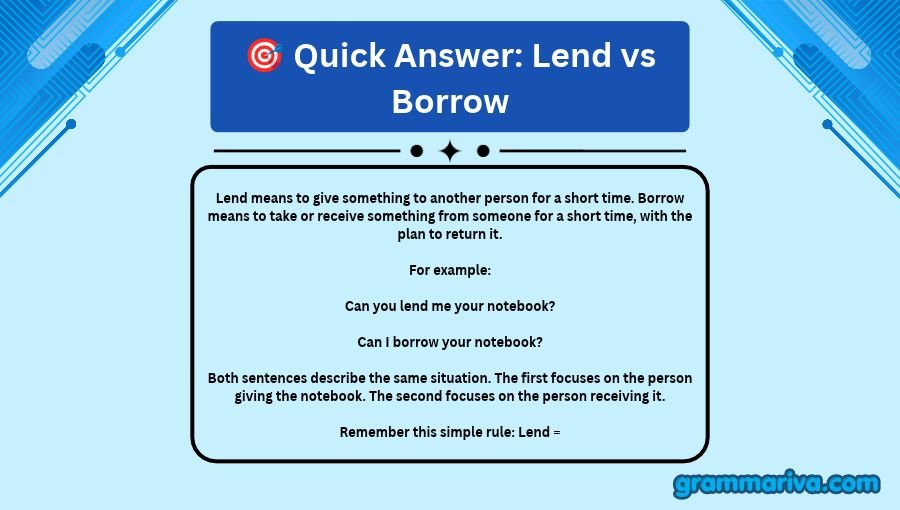
Lend means to give something to another person for a short time. Borrow means to take or receive something from someone for a short time, with the plan to return it.
For example:
- Can you lend me your notebook?
- Can I borrow your notebook?
Both sentences describe the same situation. The first focuses on the person giving the notebook. The second focuses on the person receiving it.
Remember this simple rule: Lend = Give. Borrow = Receive.
📚 Understanding the Basics of Lend vs Borrow
The main difference is the direction in which something moves between two people. When you lend an item, it moves away from you to another person. When you borrow an item, it comes from another person to you.
Think about a library. The library lends books to readers. Readers borrow books from the library. The book is the same, but the words change depending on who performs the action.
Lend: Meaning and Correct Use
Lend is a verb that means to give something to another person temporarily. The person receiving the item is expected to return it.
You can lend many things, including:
- Money
- Books
- Pens
- Clothes
- Tools
- Electronic devices
- Other personal belongings
Examples:
- My brother will lend me his laptop.
- Can you lend Sarah some money?
- The teacher lent us extra books.
- I often lend my friends my notes.
In these sentences, the person using the verb is giving something to another person.
Sentence breakdown:
“My friend lent me his bicycle.”
- My friend = The person giving the item.
- Lent = The past form of lend.
- Me = The person receiving the item.
- His bicycle = The item being given temporarily.
Borrow: Meaning and Correct Use
Borrow is a verb that means to receive or take something from another person temporarily. The person borrowing the item should return it.
You can borrow the same types of things that someone can lend.
Examples:
- I need to borrow a pen.
- Can we borrow your car?
- She borrowed money from her sister.
- They borrowed some books from the library.
In these examples, the subject receives something from another person.
Sentence breakdown:
“I borrowed a book from my teacher.”
- I = The person receiving the item.
- Borrowed = The past form of borrow.
- A book = The item received.
- From my teacher = The person who gave it.
Lend vs Borrow Comparison Table
| Form | Type | Meaning | Example |
|---|---|---|---|
| Lend | Verb | Give something temporarily | I lend him my pen. |
| Lends | Verb | Gives something temporarily | She lends books. |
| Lent | Past tense | Gave something temporarily | He lent me money. |
| Lending | Present participle | Giving something temporarily | She is lending her bike. |
| Borrow | Verb | Receive something temporarily | I borrow books. |
| Borrows | Verb | Receives something temporarily | He borrows my notes. |
| Borrowed | Past tense | Received something temporarily | I borrowed her phone. |
| Borrowing | Present participle | Receiving something temporarily | They are borrowing tools. |
🔍 What Is the Main Difference Between Lend and Borrow?
The main difference is the person’s role in the exchange. Lend describes the action of giving, while borrow describes the action of receiving.
Consider this example:
- Alex lends a camera to Jake.
- Jake borrows a camera from Alex.
Both sentences describe the same event. Alex gives the camera, and Jake receives it.
Direction of the Action
The direction of the action is the easiest way to understand these verbs.
| Situation | Correct Word | Reason |
|---|---|---|
| You give someone your book | Lend | You are the giver. |
| You receive someone’s book | Borrow | You are the receiver. |
| Your friend gives you money | Lend | Your friend gives it. |
| You take money from your friend | Borrow | You receive it. |
Who Gives and Who Receives?
Ask yourself one question before choosing either word: Am I giving something or receiving something?
- If you give an item, use lend.
- If you receive an item, use borrow.
Correct vs Incorrect Examples
- ✅ Can you lend me your charger?
- ❌ Can you borrow me your charger?
- ✅ May I borrow your jacket?
- ❌ May I lend your jacket?
- ✅ She lent me her notes.
- ❌ She borrowed me her notes.
- ✅ I borrowed his bicycle.
- ❌ I lent his bicycle.
The incorrect sentences use the wrong verb for the intended meaning.
💡 How Do You Remember the Difference Between Lend and Borrow?
You can remember the difference by connecting each word with a simple action.
Think of lend as giving and borrow as receiving. This short memory trick works in almost every everyday situation.
Easy Memory Trick
Use these two questions:
- Lend: Am I giving something to someone?
- Borrow: Am I getting something from someone?
For example, imagine that your friend needs $20.
If you give your friend $20, you lend the money.
If your friend receives $20 from you, your friend borrows the money.
Test Tip
Try replacing the confusing word with “give” or “receive.”
If the sentence makes sense with “give,” use lend.
If it makes sense with “receive,” use borrow.
Examples:
- Can you give me your pen? → Can you lend me your pen?
- Can I receive your pen temporarily? → Can I borrow your pen?
This simple test can help you choose the correct word without memorizing complicated grammar rules.
📝 Real-Life Case Study: Lend and Borrow at Work
Imagine that Emma works in an office. One morning, she forgets her notebook at home. She asks her coworker, Daniel, for help.
Emma says:
“Could I borrow your notebook for today’s meeting?”
Daniel replies:
“Sure! I can lend it to you.”
After the meeting, Emma returns the notebook.
This short conversation shows how both words work naturally.
| Person | Action | Correct Word |
|---|---|---|
| Emma | Receives the notebook | Borrow |
| Daniel | Gives the notebook | Lend |
| Emma | Returns the notebook | Return |
| Daniel | Gets his notebook back | Receive |
Now consider another workplace example.
A manager says, “I can lend you my laptop until Friday.”
An employee replies, “Thank you! I will borrow it and return it on Thursday.”
Both people use the words correctly because they understand their roles.
The key lesson is that one event can be described using either word. The correct choice depends on the person speaking and the action being described.
📖 Grammar Rules for Lend and Borrow
Lend and borrow are both regular parts of everyday English grammar, but they follow different sentence patterns.
Rule 1: Use Lend When Someone Gives Something
The common structure is:
Subject + lend + person + object
Examples:
- I lend my brother my car.
- She lends her friend a book.
- They lent us some money.
You can also use this structure:
Subject + lend + object + to + person
Examples:
- I lent my car to my brother.
- She lent a book to her friend.
- They lent some money to us.
Both structures are grammatically correct.
Rule 2: Use Borrow When Someone Receives Something
The common structure is:
Subject + borrow + object + from + person
Examples:
- I borrowed a car from my brother.
- She borrowed a book from her friend.
- They borrowed money from us.
The word “from” helps identify the person who gives the item.
Rule 3: Learn the Past Forms
Lend and borrow have different past forms.
| Base Form | Past Tense | Past Participle | Example |
|---|---|---|---|
| Lend | Lent | Lent | I have lent him my book. |
| Borrow | Borrowed | Borrowed | I have borrowed her book. |
Notice that “lent” is not “lended.” The correct past form of lend is lent.
Rule 4: Use the Correct Prepositions
Lend commonly uses “to” when the recipient comes after the object.
Borrow commonly uses “from” when the source comes after the object.
Examples:
- I lent my phone to Sarah.
- I borrowed a phone from Sarah.
These prepositions make the direction of the action clear.
Correct vs Incorrect at a Glance
| Sentence | Correct/Incorrect | Why |
|---|---|---|
| Can you lend me your book? | Correct | The speaker asks for something to be given. |
| Can I borrow your book? | Correct | The speaker wants to receive something. |
| She borrowed me her car. | Incorrect | Use lent when describing giving. |
| He lent money from his brother. | Incorrect | Use borrowed money from his brother. |
| I lent my laptop to Jake. | Correct | The speaker gives the laptop. |
⚠️ Why Do People Confuse Lend and Borrow?
People confuse these verbs because both describe the same exchange between two people. They also appear in similar situations, such as asking for money, sharing books, or using someone else’s belongings.
Here are some common reasons.
Similar Situations
Both words are used when something moves between people temporarily. This makes them easy to mix up.
For example:
- I lent him my phone.
- He borrowed my phone.
The situation is identical, but the subject changes.
Fast Typing
People sometimes type the first word that comes to mind without checking its meaning. This can lead to mistakes in messages and emails.
Autocorrect
Autocorrect may change a sentence without understanding the intended meaning. A writer may also fail to notice the change.
Lack of Knowledge
Some English learners understand the general idea of both words but do not know which person gives and which person receives.
A useful classroom-style example is a student writing, “Can you borrow me a pencil?” The student understands the request but chooses the wrong verb. Changing “borrow” to “lend” fixes the sentence.
Similar Grammar Confusions
| Confusing Words | Main Difference | Example |
|---|---|---|
| It’s / Its | It’s means it is; its shows ownership. | It’s raining. |
| Your / You’re | Your shows ownership; you’re means you are. | You’re holding your bag. |
| Affect / Effect | Affect is usually a verb; effect is usually a noun. | Sleep affects mood. |
| Lend / Borrow | Give versus receive. | I lent him a pen. |
| Then / Than | Then relates to time; than compares. | Better than before. |
| There / Their | There shows place; their shows ownership. | Their house is there. |
Common Wrong Forms and Uses
| Wrong Form | What’s Wrong | Correct Form |
|---|---|---|
| Borrow me a pen. | Uses borrow for giving. | Lend me a pen. |
| Lend a book from her. | Uses lend for receiving. | Borrow a book from her. |
| Lended him money. | Incorrect past tense. | Lent him money. |
| Borrowed me her phone. | Uses borrow for giving. | Lent me her phone. |
| Lent money from him. | Incorrect direction. | Borrowed money from him. |
| I will lend from you. | Uses the wrong verb for receiving. | I will borrow from you. |
🗣️ Can You Use Lend and Borrow in Everyday Conversation?
Yes! Both verbs are common in everyday English. You can use them when talking about money, personal belongings, school supplies, or other things that people share temporarily.
Everyday Conversation
Use lend when you offer something to another person. Use borrow when you ask to receive something.
Examples:
- Can you lend me your umbrella?
- May I borrow your headphones?
- I can lend you my jacket.
- I need to borrow a little money.
Professional Writing
In professional communication, these words help explain temporary transfers clearly.
Examples:
- The company lent the employee a laptop.
- I would like to borrow a projector for the presentation.
- Our department can lend you the required equipment.
Creative Writing
Writers can use these words to describe relationships, generosity, and everyday events.
Examples:
- She lent him her favorite book.
- He borrowed a coat before leaving the house.
- The old man lent his neighbor a helping hand.
Social Media and Texting
Both words work well in casual messages.
Examples:
- Can I borrow your charger? 🔋
- I’ll lend you my hoodie tomorrow.
- Who can lend me a camera?
- I borrowed my sister’s shoes today.
Usage Comparison Table
| Context | Which Term to Use | Example |
|---|---|---|
| Everyday conversation | Both | Can I borrow your pen? |
| Professional writing | Both | We can lend you a laptop. |
| Creative writing | Both | He borrowed her favorite book. |
| Social media/texting | Both | Can you lend me $10? |
✍️ Common Phrases and Expressions With Lend and Borrow
Both verbs appear in common English expressions. Some phrases have meanings beyond simply giving or receiving an object.
Common Phrases With Lend
- Lend a hand: Help someone with a task.
- Lend an ear: Listen carefully to someone.
- Lend support: Offer help or encouragement.
- Lend money: Give money temporarily.
- Lend your name: Allow your name to be used in support of something.
Common Phrases With Borrow
- Borrow money: Receive money temporarily.
- Borrow a book: Take a book temporarily.
- Borrow trouble: Worry about problems that may never happen.
- Borrow time: Gain extra time before something difficult happens.
- Borrow an idea: Use an idea that came from another person or source.
Phrase Comparison Table
| Phrase | Meaning |
|---|---|
| Lend a hand | Help someone. |
| Lend an ear | Listen to someone. |
| Lend support | Give assistance. |
| Borrow money | Receive money temporarily. |
| Borrow trouble | Worry unnecessarily. |
| Borrow time | Gain extra time. |
🔄 Synonyms and Alternatives for Lend and Borrow
Some words can replace lend or borrow in certain sentences. However, they do not always have exactly the same meaning.
Alternatives for Lend
- Give: Use when you transfer something to another person. It does not always mean the item must be returned.
- Loan: Use when giving money or an item temporarily.
- Provide: Use when supplying something someone needs.
- Offer: Use when making something available to another person.
Alternatives for Borrow
- Take: Use when receiving or picking up something, but it does not always suggest permission or a plan to return it.
- Get: Use in casual conversation when receiving something.
- Use: Use when focusing on the activity rather than the act of receiving.
- Loan from: This is less natural in everyday US English than “borrow from.”
Synonyms Comparison Table
| Alternative | Works When | Does Not Work When |
|---|---|---|
| Give | Describing a transfer. | You need to stress temporary lending. |
| Loan | Describing temporary giving. | You need a simple everyday verb in some contexts. |
| Provide | Describing supplying something. | You need to show that an item must be returned. |
| Take | Describing receiving or picking up. | You need to show that permission was given. |
| Get | Describing receiving something casually. | You need a precise borrowing meaning. |
🎯 Why Does Using Lend and Borrow Correctly Matter?
Using these verbs correctly helps people understand who is giving something and who is receiving it. This is especially useful when discussing money, work equipment, personal belongings, or important items.
Clarity in Communication
The correct word makes your message clear. It helps the listener understand your role in the exchange.
Professionalism
Correct grammar makes emails, reports, and workplace messages easier to understand. Small word choices can affect how professional your writing sounds.
Better Digital Communication
Messages often contain short sentences with little context. Choosing the correct verb helps prevent misunderstandings.
A useful reminder is:
“Clear words make clear conversations.”
Why Accuracy Matters in Different Situations
| Situation | Why Getting It Right Matters |
|---|---|
| Resume | Shows good command of English. |
| Client email | Makes requests clear and polite. |
| Published content | Improves grammar and readability. |
| Social post | Prevents confusing messages. |
🧠 Quick Recap Checklist: Lend vs Borrow
Use this checklist whenever you are unsure which word belongs in your sentence.
| Question | If Yes → Use |
|---|---|
| Am I giving something to another person? | Lend |
| Am I receiving something from someone? | Borrow |
| Am I describing a past action of giving? | Lent |
| Am I describing a past action of receiving? | Borrowed |
| Am I giving something to a person? | Lend something to someone |
| Am I receiving something from a person? | Borrow something from someone |
Practice Examples
Try these sentences before checking the answers.
Example A: Can you _____ me your calculator?
Answer: Lend.
Example B: May I _____ your calculator?
Answer: Borrow.
Example C: She _____ some money from her brother yesterday.
Answer: Borrowed.
Example D: My brother _____ me his car last weekend.
Answer: Lent.
Quick Self-Test
- If you give something, choose lend.
- If you receive something, choose borrow.
- If you gave something in the past, choose lent.
- If you received something in the past, choose borrowed.
❓ FAQs About Lend vs Borrow
What is the main difference between lend and borrow?
Lend means to give something to another person temporarily. Borrow means to receive something from another person temporarily. The main difference is who gives and who receives.
Is it correct to say “Can you borrow me a pen”?
No. This sentence is incorrect in standard US English when you mean that someone should give you a pen. The correct sentence is “Can you lend me a pen?”
Should I say “Can I lend your book” or “Can I borrow your book”?
Say “Can I borrow your book?” when you want to receive the book temporarily. Lend is used when you are giving the book to someone else.
What is the past tense of lend?
The past tense of lend is lent. For example, “My friend lent me his jacket yesterday.” The word “lended” is not the standard past form.
What is the past tense of borrow?
The past tense of borrow is borrowed. For example, “I borrowed a laptop from my cousin last week.”
Can lend and borrow be used in the same sentence?
Yes. You can use both words in one sentence when describing the same exchange from two different points of view.
Example: “I lent Sarah my book, and she borrowed it for a week.”
Do you borrow from someone or borrow to someone?
You borrow something from someone. The word “from” identifies the person who gives you the item.
Correct: “I borrowed money from my friend.”
Do you lend to someone or lend from someone?
You lend something to someone. The word “to” identifies the person receiving the item.
Correct: “I lent my camera to my neighbor.”
Is loan the same as lend?
Loan can be used as a verb with a meaning similar to lend, especially in American English. For example, “She loaned me her car” and “She lent me her car” both describe temporary giving.
How can I remember when to use lend or borrow?
Remember two simple words: give and receive. Use lend when you give something to another person. Use borrow when you receive something from another person.
Conclusion
Understanding lend vs borrow becomes easy when you remember one simple rule: lend means give, while borrow means receive. Both words describe the same temporary exchange, but they focus on different people involved in the action.
When you give someone a book, a pen, or money, you lend it. When you receive that item from someone, you borrow it. You should also remember their past forms. Lent is the past tense of lend, while borrowed is the past tense of borrow.
I recommend using the give-and-receive test whenever you feel unsure. It works in everyday conversations, school assignments, professional emails, and social media messages.
Good grammar does not have to be difficult. Sometimes, learning one small difference can make your English much stronger. Keep practicing these examples, pay attention to how people use both words, and soon you will choose the right one without thinking twice! 🌟
Remember: You lend what you give, and you borrow what you receive.

Hi, I’m Olivia Carter. I’m an English language editor at Grammariva, and I work on making grammar lessons clear, accurate, and easy to follow. I especially enjoy writing about common grammar mistakes and everyday English.


[…] you will know exactly when to use each one. Let’s make this grammar rule easy to remember! Lend vs Borrow | Bring vs Take | Learn vs […]