Have you ever typed loose when you meant lose? You are not alone. These two words look almost the same, but they have very different meanings. One describes something that is not tight, while the other means to misplace something or fail to win. Understanding loose vs lose can help you avoid spelling mistakes in emails, schoolwork, social media posts, and everyday writing.
As an English grammar writer, I often see these words mixed up because they contain nearly the same letters. The good news is that the rule is simple once you understand how each word works. You do not need to memorize long grammar rules or study difficult terms. You just need to connect each spelling with its meaning. 😊
In this guide, I will explain the difference between these words with simple definitions, practical examples, comparison tables, and easy memory tricks. You will also find common mistakes, practice questions, and answers to frequently asked questions. By the end, you will know exactly which word to choose. 🎯 Than vs Then | Whose vs Whos | Their vs There vs They’re
🎯 Quick Answer: Loose vs Lose
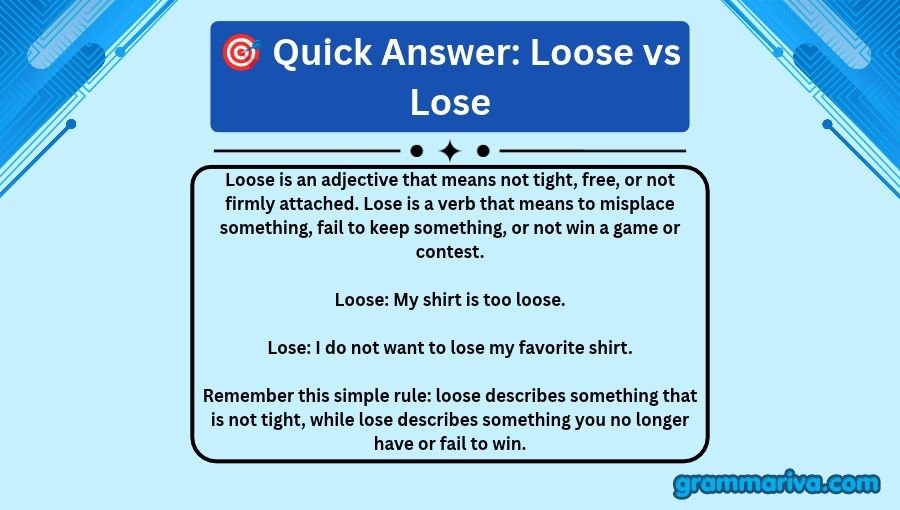
Loose is an adjective that means not tight, free, or not firmly attached. Lose is a verb that means to misplace something, fail to keep something, or not win a game or contest.
- Loose: My shirt is too loose.
- Lose: I do not want to lose my favorite shirt.
Remember this simple rule: loose describes something that is not tight, while lose describes something you no longer have or fail to win.
Understanding the Basics of Loose vs Lose
The main difference between these words is their meaning and grammatical role. Although they look similar, they do different jobs in a sentence.
Loose describes a person, object, or situation. It tells readers that something is not tight, fixed, or controlled.
Lose describes an action or result. It tells readers that someone misplaces something, fails to keep it, or does not win.
Here is a simple comparison:
| Form | Type | Meaning | Example | Correct/Incorrect |
|---|---|---|---|---|
| Loose | Adjective | Not tight | These shoes are loose. | ✅ Correct |
| Lose | Verb | Misplace something | I always lose my keys. | ✅ Correct |
| Loose | Adjective | Not firmly attached | The door handle is loose. | ✅ Correct |
| Lose | Verb | Fail to win | We might lose the match. | ✅ Correct |
| Loose | Adjective | Not strict or controlled | The rules are loose. | ✅ Correct |
Why Do Loose and Lose Have Different Meanings?
The easiest way to understand them is to look at what each word describes.
Use loose when you describe the condition of something. For example, a loose button is not attached firmly. Loose clothes have extra space and do not fit tightly.
Use lose when you describe an action. For example, you can lose your phone, lose a race, or lose your way.
Consider these sentences:
- ✅ My belt is too loose.
- ❌ My belt is too lose.
- ✅ I do not want to lose my belt.
- ❌ I do not want to loose my belt.
The first pair describes how the belt fits. The second pair explains what someone might misplace.
Related Word Forms of Loose and Lose
Both words have related forms that are useful to understand. Their forms change depending on the sentence, but their basic meanings remain connected to the original words.
| Form | Type | Example |
|---|---|---|
| Loose | Adjective | My jacket is loose. |
| Loosely | Adverb | The rope was loosely tied. |
| Loosen | Verb | Please loosen your tie. |
| Looseness | Noun | The looseness of the handle worried me. |
| Lose | Verb | Do not lose your wallet. |
| Loses | Verb | She loses her keys often. |
| Losing | Verb form | He is losing confidence. |
| Lost | Past tense / past participle | I lost my notebook. |
| Loss | Noun | The team suffered a loss. |
| Loser | Noun | Nobody likes being called a loser. |
Important: The word loss is a noun, while lose is a verb. They are related in meaning, but they cannot always replace each other.
Examples:
- ✅ I do not want to lose the game.
- ✅ Losing the game was disappointing.
- ✅ The team accepted its loss.
- ❌ The team accepted its lose.
Loose: Meaning and Correct Use
Loose means not tight, not firmly attached, free, or not closely controlled. It is mainly used as an adjective, although it also appears in the phrase “let loose.”
Let’s look at its most common meanings.
Loose Means Not Tight
This is one of the most common uses of the word. It describes clothes, shoes, belts, knots, or other things that do not fit or hold tightly.
Examples:
- My jeans are too loose around the waist.
- She prefers loose clothing during summer.
- The screw is loose on my desk.
- His shoelaces are loose.
- I bought a loose-fitting shirt.
Sentence breakdown:
My jeans are too loose.
- My: Shows ownership.
- Jeans: The subject.
- Are: A linking verb.
- Too loose: Describes the condition of the jeans.
Here, loose explains how the jeans fit. It does not describe an action.
Loose Means Free or Not Attached
Loose can also describe something that has become detached or is moving freely.
Examples:
- A loose dog was running through the park.
- One page came loose from my notebook.
- The wire is loose behind the television.
- A loose stone fell from the wall.
- The horse broke free and ran loose.
Sentence breakdown:
One page came loose from my notebook.
The word loose explains that the page was no longer firmly attached to the notebook.
Loose Means Relaxed or Not Strict
Sometimes loose describes rules, controls, or standards that are not strict.
Examples:
- The teacher has a loose classroom policy.
- The company follows loose safety rules.
- They have a loose plan for the weekend.
- The manager keeps loose control over the project.
- Our schedule is loose this afternoon.
In these examples, loose means flexible, relaxed, or not tightly controlled.
Loose in Common Expressions
Loose also appears in several everyday expressions.
| Expression | Meaning | Example |
|---|---|---|
| Let loose | Relax and enjoy yourself | We let loose at the party. |
| Break loose | Escape from control | The dog broke loose. |
| On the loose | Free and not contained | The cat is on the loose. |
| Loose ends | Unfinished details | I need to tie up a few loose ends. |
| Play fast and loose | Act carelessly or dishonestly | He played fast and loose with the rules. |
Test Tip for Using Loose
Ask yourself whether you are describing something that is not tight, fixed, or strict.
If the answer is yes, loose is probably the correct word.
For example:
- Is your shirt not tight? Use loose.
- Is a screw not firmly attached? Use loose.
- Are the rules flexible? Use loose.
You can also remember that loose has an extra letter o. Think of the extra space in loose clothing.
Lose: Meaning and Correct Use
Lose is a verb that means to misplace something, fail to keep something, experience a loss, or fail to win. It describes an action or result.
Here are its main uses.
Lose Means to Misplace Something
Use lose when you cannot find something because you have misplaced it.
Examples:
- I always lose my house keys.
- Do not lose your school ID.
- She might lose her phone on the trip.
- He does not want to lose his wallet.
- We often lose small items around the house.
Sentence breakdown:
I always lose my keys.
- I: The subject.
- Always: An adverb of frequency.
- Lose: The action.
- My keys: The object.
Lose explains what happens to the keys.
Lose Means to Fail to Win
Lose is also used when someone does not win a game, competition, race, or contest.
Examples:
- Our team may lose the final match.
- I do not want to lose this race.
- They lost the football game yesterday.
- She hates to lose at chess.
- We played well but still lost.
Sentence breakdown:
Our team might lose the match.
The verb lose describes the possible result of the match. The team may not win.
Lose Means to Stop Having Something
Lose can describe situations where someone no longer has something they once had.
Examples:
- He does not want to lose his job.
- She is afraid of losing her best friend.
- We should not lose hope.
- I do not want to lose your trust.
- They could lose their chance to compete.
This meaning is common in both personal and professional writing.
Lose Means to Reduce Weight or an Amount
Lose can also mean reducing the amount of something.
Examples:
- I want to lose weight.
- The company may lose money this year.
- We could lose valuable time.
- She hopes to lose a few pounds.
- The business does not want to lose customers.
In these sentences, lose describes a reduction or decrease.
Test Tip for Using Lose
Ask yourself whether someone is misplacing something, failing to win, or no longer keeping something.
If the sentence describes an action or result, lose is usually the right choice.
Try these examples:
- Can you misplace your phone? Use lose.
- Can your team fail to win? Use lose.
- Can you stop having a job? Use lose.
- Can you reduce weight? Use lose.
Remember that lose has only one o between the letters l and s.
⚠️ Why Do People Confuse Loose and Lose?
People confuse these words because their spelling is very similar. Both begin with the letter L and contain the letters S and E. However, their pronunciation and meanings are different.
There are three common reasons for this confusion:
- Similar spelling: The words look almost identical when written.
- Fast typing: People sometimes type the wrong word without checking the sentence.
- Autocorrect: A spelling tool may not catch the mistake because both words are real English words.
- Lack of knowledge: Some writers have never learned the difference between the adjective and the verb.
I once reviewed a student’s homework where the sentence read, “I don’t want to loose my place in the competition.” The student knew what the sentence meant but had chosen the wrong spelling. I explained that losing a place is an action, so the correct sentence was, “I don’t want to lose my place in the competition.”
Similar Grammar Confusions
Loose and lose are not the only English words that writers mix up. Several other word pairs have similar spelling or pronunciation.
| Word Pair | Difference | Example |
|---|---|---|
| Its / It’s | Possession / It is or it has | The dog wagged its tail. / It’s raining. |
| Your / You’re | Possession / You are | Your book is here. / You’re welcome. |
| Their / There | Possession / Place | Their house is there. |
| Then / Than | Time or order / Comparison | Eat first, then leave. / She is taller than me. |
| Affect / Effect | Usually a verb / Usually a noun | It can affect you. / It had an effect. |
| To / Too | Direction or infinitive / Also or excessively | Go to school. / I want one too. |
Common Wrong Spellings and Uses of Loose vs Lose
The following table shows mistakes that can change the meaning of a sentence.
| Wrong Form | What’s Wrong | Correct Form |
|---|---|---|
| I don’t want to loose my phone. | Loose does not mean misplace. | I don’t want to lose my phone. |
| My shoes are too lose. | Lose is not an adjective for fit. | My shoes are too loose. |
| Don’t loose hope. | The sentence needs a verb meaning keep. | Don’t lose hope. |
| The screw is lose. | The sentence describes something not tight. | The screw is loose. |
| We might loose the game. | The sentence describes failing to win. | We might lose the game. |
| Her dress feels lose. | The sentence describes the fit of clothing. | Her dress feels loose. |
📝 Loose vs Lose: A Real-Life Case Study
Imagine that you work in an office and need to send an email to your manager about a damaged chair.
You write:
“One of the chair’s screws is lose, and I don’t want to loose any parts while moving it.”
There are two spelling mistakes in this message.
The correct version is:
“One of the chair’s screws is loose, and I don’t want to lose any parts while moving it.”
Why?
- Loose: Describes the screw because it is not firmly attached.
- Lose: Describes the possibility of misplacing the parts.
This example shows why the difference matters in professional communication.
I once noticed a similar mix-up while editing a short workplace notice. The writer had used “lose screws” when describing a chair that needed repair. Changing one letter made the message much clearer.
Another Everyday Conversation
Imagine a friend asks you about your new shoes.
Friend: Are your new shoes comfortable?
You: They look nice, but they are a little loose.
Friend: Be careful. You don’t want to lose one while running!
Both words are correct because they describe different things.
- Loose explains how the shoes fit.
- Lose explains what could happen to one of them.
📚 Grammar Rules Explanation: When to Use Each Word
The basic grammar rule is simple: loose is generally an adjective, while lose is a verb. Their roles in a sentence help you decide which spelling to use.
Rule for Loose
Use loose when describing a noun.
A noun can be a person, place, thing, or idea. Loose gives more information about that noun.
Examples:
- ✅ The loose button fell off my coat.
- ❌ The lose button fell off my coat.
- ✅ My dog has a loose collar.
- ❌ My dog has a lose collar.
In these examples, loose describes the button and collar.
Rule for Lose
Use lose when describing an action or state of no longer having something.
Examples:
- ✅ I might lose my jacket.
- ❌ I might loose my jacket.
- ✅ They do not want to lose the match.
- ❌ They do not want to loose the match.
In these examples, lose explains what someone might do or experience.
Correct vs Incorrect at a Glance
| Sentence | Correct/Incorrect | Why |
|---|---|---|
| My shirt is loose. | ✅ Correct | Loose describes the shirt’s fit. |
| I don’t want to lose my shirt. | ✅ Correct | Lose means misplace or no longer have. |
| My shirt is lose. | ❌ Incorrect | Lose is not the correct adjective here. |
| She might loose her keys. | ❌ Incorrect | The verb should be lose. |
| The rope became loose. | ✅ Correct | Loose describes the rope’s condition. |
Most standard English dictionaries and grammar references recognize these as separate words with different meanings and grammatical roles. The safest approach is to check the meaning of the whole sentence rather than choosing a spelling based only on how it looks.
How to Remember the Difference Between Loose and Lose
Remembering the difference becomes easier when you connect each word with a simple image or idea.
Here are five helpful tricks.
Think About the Extra O
Loose has two O’s, while lose has one.
Think of loose clothing. It has extra room and space.
- Loose = extra space.
- Lose = misplace something or fail to win.
Connect Loose With Tight
Loose is the opposite of tight.
Examples:
- A tight shirt.
- A loose shirt.
- A tight knot.
- A loose knot.
This simple connection works in many everyday situations.
Connect Lose With Win
Lose is the opposite of win when discussing games and competitions.
Examples:
- Win a race.
- Lose a race.
- Win a match.
- Lose a match.
This trick is especially helpful for sports-related sentences.
Make a Simple Sentence Pair
Repeat these two sentences:
- My pants are loose.
- I do not want to lose my pants.
The first describes clothing. The second describes something that might happen.
Use a Quick Grammar Question
Before writing either word, ask yourself:
- Am I describing something? Choose loose.
- Am I describing an action? Choose lose.
This small check can prevent many spelling mistakes.
How Are Loose and Lose Used in Different Contexts?
Both words appear in casual conversations, workplace communication, creative writing, and online messages. Their spelling does not change across these situations. Only the context changes.
| Context | Which Term to Use | Example |
|---|---|---|
| Everyday conversation | Both | My shoes are loose, and I might lose them. |
| Professional writing | Both | The connection is loose, and the company may lose data. |
| Creative writing | Both | Her loose hair moved in the wind, but she did not want to lose her hat. |
| Social media/texting | Both | These jeans are so loose! I don’t want to lose my keys again. |
Loose and Lose in Everyday Conversation
People use both words when talking about clothing, personal belongings, games, and daily activities.
Examples:
- Your jacket looks loose.
- Don’t lose your ticket.
- The dog is running loose.
- I always lose my sunglasses.
Loose and Lose in Professional Writing
Professional writing needs correct spelling because a small mistake can affect how readers understand a message.
Examples:
- The loose cable needs to be repaired.
- We cannot afford to lose another client.
- The company has a loose deadline for this task.
- Please do not lose the original document.
Loose and Lose in Creative Writing
Writers can use loose to describe movement, clothing, objects, and relaxed conditions. Lose can describe emotional changes, forgotten things, or missed opportunities.
Examples:
- Her loose hair danced in the evening breeze.
- He feared he would lose the person he loved.
- The loose pages scattered across the floor.
- She refused to lose hope.
Loose and Lose on Social Media
Social media posts often use short and casual language. However, correct spelling still matters.
Examples:
- “These loose jeans are my new favorite!”
- “Never lose your confidence.”
- “I always lose my phone at home.”
- “Let loose and enjoy the weekend!”
Common Phrases With Loose and Lose
Both words appear in common English expressions. Learning these phrases can help you recognize the correct spelling without thinking too much about grammar rules.
| Phrase | Meaning |
|---|---|
| Let loose | Relax and behave freely |
| On the loose | Free and not under control |
| Loose ends | Unfinished details |
| Break loose | Escape from something |
| Lose hope | Stop believing something will improve |
| Lose track | Stop knowing where something is or what is happening |
Examples in Sentences
- Let loose: We decided to let loose after finishing our exams.
- On the loose: A small dog was on the loose near the park.
- Loose ends: I need to finish a few loose ends before leaving.
- Break loose: The horse managed to break loose.
- Lose hope: Never lose hope during a difficult time.
- Lose track: I lost track of time while reading.
Notice that loose appears in expressions about freedom, control, or unfinished details. Lose appears in expressions about no longer having or keeping something.
Synonyms and Alternatives for Loose and Lose
You can sometimes replace these words with other English words. However, the best alternative depends on the sentence.
| Alternative | Works When | Does Not Work When |
|---|---|---|
| Baggy | Describing oversized clothing | Describing a missing object |
| Unfastened | Describing something not secured | Describing a failed competition |
| Relaxed | Describing rules or a flexible approach | Describing a misplaced item |
| Misplace | Describing something you cannot find | Describing clothing that is not tight |
| Forfeit | Describing giving up a right, chance, or prize | Describing a loose screw |
Examples:
- My pants are baggy. (Similar to loose.)
- The gate is unfastened. (Similar to loose.)
- I misplaced my wallet. (Similar to lose.)
- The team forfeited the match. (Can replace lose in certain situations.)
These alternatives are not perfect replacements in every sentence. Always check the meaning before changing a word.
💡 Why Does Using the Correct Word Matter?
Using loose and lose correctly makes your writing easier to understand. Even though the difference is only one letter, the meaning of a sentence can change completely.
Here are three reasons to pay attention to these words.
Clarity in Communication
Correct spelling helps readers understand your message without guessing.
Compare:
- ✅ My shoes are loose.
- ✅ I don’t want to lose my shoes.
Both sentences communicate different ideas clearly.
Professionalism in Writing
Correct grammar creates a better impression in professional emails, reports, applications, and business documents.
For example, writing “We cannot afford to lose customers” is clear and professional. Using loose instead would make the sentence incorrect.
Accuracy in Digital Communication
Spelling mistakes can make social media posts, website content, and text messages look careless. Correct word choice helps readers trust your writing.
A useful reminder is:
Clear writing begins with choosing the right words.
| Situation | Why Getting It Right Matters |
|---|---|
| Resume | Shows attention to spelling and detail. |
| Client email | Makes your message professional and clear. |
| Published content | Improves readability and writing quality. |
| Social media post | Helps followers understand your message. |
🎯 Quick Recap Checklist: Loose or Lose?
Use this checklist whenever you are unsure which word belongs in your sentence.
| Question | If Yes → Use |
|---|---|
| Does the sentence describe something that is not tight? | Loose |
| Does it describe something that is not firmly attached? | Loose |
| Does it describe relaxed rules or control? | Loose |
| Does it mean misplacing something? | Lose |
| Does it mean failing to win? | Lose |
| Does it mean no longer having something? | Lose |
| Does it describe reducing weight or money? | Lose |
Practice Examples
Test your knowledge with these three sentences. Choose the correct word for each blank.
Example A: My new shoes are too _____.
- A. Loose
- B. Lose
Correct answer: A. Loose
Explanation: The sentence describes how the shoes fit. Loose means not tight.
Example B: I do not want to _____ my favorite book.
- A. Loose
- B. Lose
Correct answer: B. Lose
Explanation: The sentence describes the possibility of misplacing something.
Example C: Our team might _____ the final game.
- A. Loose
- B. Lose
Correct answer: B. Lose
Explanation: Lose means failing to win a game or competition.
FAQs About Loose vs Lose
What Is the Main Difference Between Loose and Lose?
Loose means not tight, free, or not firmly attached. Lose means to misplace something, fail to win, or stop having something. Loose is generally an adjective, while lose is a verb.
Is Loose or Lose Correct When Talking About Clothing?
Loose is correct when describing clothing that does not fit tightly.
Example: My new shirt is too loose.
Lose is not correct in this situation because it does not describe how clothing fits.
Is It Lose Weight or Loose Weight?
Lose weight is correct. Lose means to reduce the amount of weight you have.
Example: She wants to lose weight through healthy habits.
Loose weight is incorrect in this context.
Is It Lose Hope or Loose Hope?
Lose hope is correct. It means to stop believing that something good will happen.
Example: Never lose hope when life becomes difficult.
Why Is Loose Spelled With Two O’s?
Loose has two O’s as part of its standard spelling. A helpful memory trick is to connect the extra O with extra room in loose clothing.
Is It Too Loose or Too Lose?
Too loose is correct when describing something that is not tight enough.
Example: These trousers are too loose for me.
Too lose is incorrect because lose is a verb, not an adjective describing fit.
What Is the Past Tense of Lose?
The past tense of lose is lost.
Examples:
- Present: I lose my keys.
- Past: I lost my keys.
- Present perfect: I have lost my keys.
What Is the Opposite of Loose?
The opposite of loose is usually tight, fastened, or secure, depending on the context.
For example:
- Loose clothing → Tight clothing.
- Loose screw → Tight screw.
- Loose connection → Secure connection.
Can Loose and Lose Be Used in the Same Sentence?
Yes! Both words can appear in one sentence because they have different meanings.
Example: My shoes are loose, and I do not want to lose them.
Loose describes how the shoes fit, while lose describes the possibility of misplacing them.
How Can I Remember Loose vs Lose Easily?
Remember these two simple connections:
- Loose = Not tight. Think about loose clothes with extra room.
- Lose = Misplace or fail to win. Think about losing your keys or a game.
Practice these examples regularly, and choosing the correct word will become much easier.
Conclusion: Master Loose vs Lose With Simple Rules
Understanding loose vs lose is easier than it first seems. Both words look similar, but they have different meanings and grammatical roles. Loose describes something that is not tight, firmly attached, or strictly controlled. Lose is a verb that means to misplace something, fail to win, or stop having something.
The easiest way to remember the difference is to connect loose with extra space and lose with misplacing something. When describing clothes, shoes, screws, or relaxed rules, choose loose. When talking about losing a game, forgetting an item, or reducing weight, choose lose.
As a writer, I recommend checking the meaning of your sentence before choosing either spelling. This small habit can improve your emails, school assignments, website content, and everyday messages.
Keep practicing with simple examples until the difference feels natural. You do not need complicated grammar rules to write correctly.
Remember: Loose means not tight, and lose means you no longer have something or fail to win. Get this one-letter difference right, and your writing will become clearer every day! ✅

Hi, I’m Ethan Brooks. I’m an English grammar writer at Grammariva, where I work on clear explanations, practical examples, and useful writing tips. I enjoy making difficult grammar topics easier to understand.


[…] tricks. You’ll also find practice questions to help you use both words with confidence. 😊 Loose vs Lose | Than vs Then | Whose vs […]
[…] language. By the end, you will know exactly which spelling to choose. 😊 Advice vs Advise | Loose vs Lose | Than vs […]