Have you ever wondered about the difference between their vs there vs they’re while writing a sentence? These three words sound exactly alike, but they have very different meanings and uses. Choosing the wrong one can change your sentence and make your writing confusing. The good news is that learning their vs there vs they’re is easier than you might think. Each word has a simple job. Once you understand those jobs
Choosing the wrong one can change your sentence and make your writing confusing. The good news is that learning their vs there vs they’re is easier than you might think. Each word has a simple job. Once you understand those jobs, you can pick the right word without guessing.
As an English writer and editor, I often see these mistakes in emails, school assignments, blog posts, and social media captions. Even strong writers sometimes mix them up when typing quickly. 😊 In this guide, I will explain each word with simple rules, clear examples, comparison tables, and easy memory tricks.
You will also find common mistakes, practice questions, and answers to frequently asked questions. By the end, you will know exactly when to use each word and feel more confident about your writing. ✍️ Your vs You’re | Its vs It’s
🎯 Quick Answer: Their vs There vs They’re
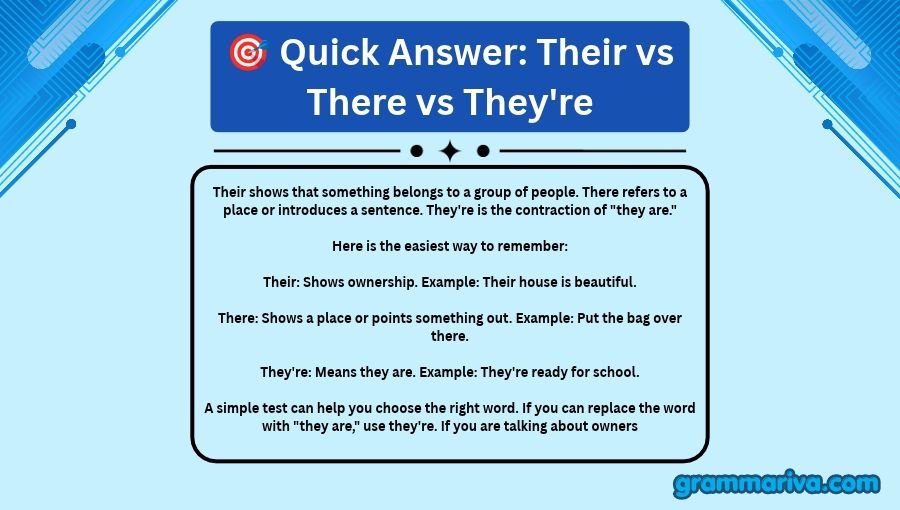
Their shows that something belongs to a group of people. There refers to a place or introduces a sentence. They’re is the contraction of “they are.”
Here is the easiest way to remember:
- Their: Shows ownership. Example: Their house is beautiful.
- There: Shows a place or points something out. Example: Put the bag over there.
- They’re: Means they are. Example: They’re ready for school.
A simple test can help you choose the right word. If you can replace the word with “they are,” use they’re. If you are talking about ownership, use their. If you mean a place or introduce something, use there.
Understanding the Basics of Their vs There vs They’re
The main difference between these three words is their job in a sentence. They sound alike, but they do not share the same meaning or grammar role.
| Form | Type | Meaning | Example | Correct/Incorrect |
|---|---|---|---|---|
| Their | Possessive determiner | Shows ownership | Their dog is friendly. | ✅ Correct |
| There | Adverb or introductory word | Refers to a place or introduces a statement | The keys are over there. | ✅ Correct |
| They’re | Contraction | Means they are | They’re playing outside. | ✅ Correct |
| Their | Possessive determiner | Does not mean they are | Their going home. | ❌ Incorrect if meaning “they are going home” |
| There | Place word | Does not show ownership | There car is new. | ❌ Incorrect |
| They’re | Contraction | Does not show ownership | They’re house is large. | ❌ Incorrect |
Let’s look at each word in more detail.
What Does Their Mean?
Their is a possessive determiner. It shows that something belongs to two or more people, animals, or things.
It answers the question: Whose?
Examples:
- The students brought their books.
- My friends love their new home.
- The children cleaned their room.
- The players wore their team shirts.
- The neighbors parked their cars outside.
In each sentence, the word shows ownership or a connection to someone or something.
Sentence breakdown:
“The students brought their books.”
- The students = The people who own or use the books.
- Their = Shows possession.
- Books = The things connected to the students.
Remember that their does not always mean legal ownership. It can also show a relationship or association.
For example:
“Everyone should bring their own lunch.”
Here, their refers to the lunch each person should bring.
What Does There Mean?
There has several common uses. It can point to a place, show where something is, or help introduce a sentence.
Examples:
- Your shoes are over there.
- We went there last summer.
- There is a cat outside.
- There are five apples in the basket.
- I have never been there before.
The word often answers the question: Where?
However, it also appears in sentences that introduce the existence or presence of something.
Sentence breakdown:
“There are three books on the table.”
- There = Introduces the statement.
- Are = Links the statement to the subject.
- Three books = The things being described.
- On the table = Explains their location.
Notice that there does not show ownership.
What Does They’re Mean?
They’re is a contraction made from two words: “they” and “are.”
The apostrophe replaces the missing letter in the shortened form.
Examples:
- They’re very happy today.
- They’re coming to dinner.
- They’re working on a new project.
- They’re my favorite teachers.
- They’re waiting for the bus.
Sentence breakdown:
“They’re watching a movie.”
- They = Refers to two or more people or things.
- ‘re = Short form of “are.”
- Watching a movie = Describes what they are doing.
The easiest way to check this word is to replace it with “they are.” If the sentence still makes sense, they’re is probably correct.
Their, There, and They’re at a Glance
| Word | Main Job | Easy Question | Example |
|---|---|---|---|
| Their | Shows possession | Whose? | Their garden is lovely. |
| There | Shows location or existence | Where? / What exists? | There is a garden. |
| They’re | Short form of they are | Can I say “they are”? | They’re gardening. |
💡 How to Remember the Difference
You do not need to memorize complicated grammar rules to use these words correctly. A few simple memory tricks can help you make the right choice.
Remember Their Through Ownership
Think of the word “heir.” An heir is someone who may receive something from another person. This connection can remind you that their relates to possession.
Example:
“Their new car is outside.”
Ask yourself: Whose car is it?
If the car belongs to them, their is correct.
Remember There Through Here
The words there and here both contain the word “here.”
This can help you remember that there often refers to a place.
Examples:
- Come here.
- Go there.
- The restaurant is over there.
When your sentence talks about a location, there may be the correct choice.
Remember They’re Through They Are
This is the easiest memory trick of all.
Simply expand they’re into “they are.”
Examples:
- They’re tired. = They are tired.
- They’re studying. = They are studying.
- They’re excited. = They are excited.
If the expanded sentence sounds wrong, you should not use they’re.
The Three-Question Test
Before publishing or sending a sentence, ask yourself:
- Does the word show ownership? Use their.
- Does the word point to a place or introduce something? Use there.
- Does the word mean they are? Use they’re.
This quick test works in most everyday writing situations.
Why Do People Confuse Their, There, and They’re?
People confuse these words because they sound the same when spoken. They are examples of homophones. Homophones are words that share the same pronunciation but have different meanings or spellings.
When people speak, listeners usually understand the meaning from the rest of the sentence. Writing is different. Readers see the spelling, so the wrong choice can make a sentence look incorrect.
I once reviewed a student’s short story in which the sentence read, “Their going to the park after school.” The student knew the intended meaning but had forgotten that they’re means they are. Replacing their with they’re fixed the sentence immediately.
Other common reasons include:
- Fast typing: People often choose the first spelling that comes to mind.
- Autocorrect: A phone or computer may not recognize a grammar mistake.
- Lack of knowledge: Some writers have never learned the difference.
- Similar pronunciation: All three words sound alike in common speech.
- Limited proofreading: Writers may focus on spelling other words and miss these small errors.
The solution is to focus on meaning instead of sound.
Correct Meanings and Uses of Each Word
Understanding the different uses of these words will help you handle more complex sentences.
Different Uses of Their
Their mainly shows possession or a connection to a group.
Examples:
- The workers finished their tasks.
- The birds returned to their nests.
- The company changed their policy.
It can also refer to one person when the person’s gender is unknown, irrelevant, or when they use they/them pronouns.
Example:
“Someone left their phone on the desk.”
Here, their refers to one unknown person.
Different Uses of There
There can work in different ways depending on the sentence.
There as a place adverb
It tells readers where something is.
Example: “The library is over there.”
There as an introductory word
It introduces the existence of something.
Example: “There is a problem with the computer.”
There in expressions
It appears in common expressions such as:
- There you go.
- There it is.
- There you are.
- There is no doubt.
These expressions have different meanings, but they all use the same spelling.
Different Uses of They’re
They’re always means they are.
It can describe an action, condition, identity, or quality.
Examples:
- They’re laughing loudly. (Action)
- They’re happy. (Feeling)
- They’re good friends. (Relationship)
- They’re ready. (Condition)
- They’re teachers. (Identity)
Remember that the apostrophe is not optional. Writing “theyre” without it is incorrect in standard writing.
Summary of Their, There, and They’re
| Meaning | Word Type | Example Sentence |
|---|---|---|
| Possession | Possessive determiner | Their garden looks beautiful. |
| Location | Adverb | The garden is over there. |
| Existence | Introductory word | There is a garden outside. |
| Action | Contraction | They’re planting flowers. |
| Feeling | Contraction | They’re happy today. |
| Identity | Contraction | They’re my neighbors. |
📝 Real-Life Case Study: Their, There, and They’re in an Email
Imagine that an office worker wants to send an email to a manager about a team meeting.
Here is an incorrect version:
“Hi, the team finished they’re project. Their meeting is over their, and they’re waiting for you.”
This email contains two mistakes.
Here is the corrected version:
“Hi, the team finished their project. Their meeting is over there, and they’re waiting for you.”
Let’s understand the corrections:
- “Their project” is correct because the project belongs to the team.
- “Over there” is correct because it refers to the meeting location.
- “They’re waiting” is correct because it means “they are waiting.”
I once edited a workplace notice that used “there” instead of “their” in a sentence about employees’ responsibilities. The intended message was clear from the context, but the spelling made the notice look rushed. A quick review made it much more professional.
The lesson is simple: Check the meaning of each word before sending an important message.
Grammar Rules Explanation: When to Use Each Word
The correct choice depends on the role the word plays in a sentence. Their shows possession, there points to a place or introduces an idea, and they’re replaces the words “they are.”
Rule for Using Their
Use their when you want to show that something belongs to or is connected to a group of people.
Correct examples:
- The girls packed their bags. ✅
- The students completed their homework. ✅
- The dogs wagged their tails. ✅
Incorrect examples:
- The girls packed they’re bags. ❌
- The students completed there homework. ❌
- The dogs wagged they’re tails. ❌
Why are the incorrect sentences wrong? The sentences describe possession. Therefore, their is the correct word.
Rule for Using There
Use there when you refer to a location or introduce the existence of something.
Correct examples:
- Your jacket is over there. ✅
- There are two chairs in the room. ✅
- We visited there last year. ✅
Incorrect examples:
- Your jacket is over their. ❌
- Their are two chairs in the room. ❌
- We visited they’re last year. ❌
The incorrect sentences use words that do not match the intended meaning.
Rule for Using They’re
Use they’re when you mean “they are.”
Correct examples:
- They’re playing football. ✅
- They’re very kind people. ✅
- They’re going to visit us. ✅
Incorrect examples:
- Their playing football. ❌
- There very kind people. ❌
- Their going to visit us. ❌
A simple replacement test will help you avoid these errors. Write “they are” in place of they’re. If the sentence still makes sense, you have probably chosen correctly.
Correct vs Incorrect at a Glance
| Sentence | Correct/Incorrect | Why |
|---|---|---|
| Their house is near the park. | ✅ Correct | Shows ownership. |
| They’re going to the store. | ✅ Correct | Means they are going. |
| The books are over there. | ✅ Correct | Shows location. |
| There dog is sleeping. | ❌ Incorrect | Should be their dog. |
| Their coming tomorrow. | ❌ Incorrect | Should be they’re coming. |
Can More Than One of These Words Appear in One Sentence?
Yes! You can use all three words in a single sentence if each one has the correct job.
Example:
“They’re taking their bags over there.”
Let’s break it down:
- They’re = They are.
- Their = Shows who owns the bags.
- There = Refers to the destination.
This sentence is a great example of how three similar-sounding words can work together without causing confusion.
⚠️ Common Mistakes With Their, There, and They’re
Most mistakes happen when writers focus on how a word sounds instead of what it means. The best way to avoid them is to understand the sentence before choosing a spelling.
Common Grammar Confusions
Their, there, and they’re are not the only words that create confusion. English has several word pairs that sound similar or have closely related spellings.
| Confusing Words | Main Difference | Example |
|---|---|---|
| Your / You’re | Possession vs. you are | Your bag is here. / You’re late. |
| Its / It’s | Possession vs. it is | The dog wagged its tail. / It’s raining. |
| To / Too | Direction vs. also or excessively | Go to school. / I want to go too. |
| Then / Than | Time or order vs. comparison | Eat first, then leave. / She is taller than me. |
| Two / Too | Number vs. also or excessively | I have two pens. / I want one too. |
| Who’s / Whose | Who is vs. possession | Who’s there? / Whose book is this? |
Learning these differences can improve your writing and help you avoid simple errors.
Common Wrong Forms of Their, There, and They’re
Here are some mistakes to watch for when writing these three words.
| Wrong Form | What’s Wrong | Correct Form |
|---|---|---|
| Their going home. | Uses possession instead of they are. | They’re going home. |
| There house is big. | Uses a place word instead of possession. | Their house is big. |
| Theyre ready. | Missing apostrophe. | They’re ready. |
| The car is over their. | Uses possession instead of location. | The car is over there. |
| Their are many options. | Uses possession instead of an introductory word. | There are many options. |
| There coming soon. | Uses the wrong form of they are. | They’re coming soon. |
Why Do These Mistakes Happen?
There are three major reasons:
Fast typing: People often write quickly and do not stop to check each word. This is common when sending text messages or short emails.
Autocorrect: Some devices correct spelling without checking the meaning. For example, a phone may leave “their” unchanged even when the sentence needs “they’re.”
Lack of knowledge: Some writers learn these words by hearing them but never study their grammar roles.
I once caught myself typing “their ready” in a quick message to a colleague. The sentence looked normal at first because the words sound the same. I used the replacement test and corrected it before sending.
How to Avoid These Errors
Follow these simple habits:
- Read the full sentence before choosing a word.
- Replace they’re with “they are” to test it.
- Ask “whose?” when checking for their.
- Ask “where?” when checking for there.
- Read important emails again before sending them.
- Do not depend completely on autocorrect.
- Use a grammar checker as a second step, not your only solution.
How Are Their, There, and They’re Used in Different Contexts?
The same grammar rules apply whether you are speaking with friends, writing a business email, creating a story, or posting online. However, the level of care you need may change with the situation.
Everyday Conversation
In everyday conversation, people usually understand these words from context. However, you should still use the correct spelling when writing messages.
Examples:
- They’re coming to dinner tonight.
- Their children are very polite.
- Your shoes are over there.
Professional Writing
Professional writing requires clear and correct grammar. A wrong word can make an email, report, or business message look careless.
Examples:
- The employees submitted their reports.
- They’re reviewing the new plan.
- The meeting room is over there.
Creative Writing
Writers use these words in stories, poems, dialogue, and descriptions. Correct spelling helps readers follow the story without distractions.
Examples:
- They’re walking through the forest.
- Their little cottage stood near the lake.
- There was a strange sound outside.
Social Media and Texting
Social media often uses informal language. Still, correct spelling makes posts easier to read and understand.
Examples:
- They’re finally here!
- Their photos look amazing.
- The best memories are over there.
Usage Comparison Table
| Context | Which Term to Use | Example |
|---|---|---|
| Everyday conversation | All three, depending on meaning | They’re bringing their food over there. |
| Professional writing | All three, depending on meaning | They’re sending their reports over there. |
| Creative writing | All three, depending on meaning | Their home stood over there. |
| Social media/texting | All three, depending on meaning | They’re sharing their pictures over there. |
Common Phrases With Their, There, and They’re
These words appear in many everyday expressions. Learning common phrases can help you recognize the correct spelling more quickly.
Common Expressions With Their
| Phrase | Meaning |
|---|---|
| Their own way | A way chosen by a particular group |
| Their best effort | The greatest effort they can make |
| Their point of view | Their personal opinion |
| Their own business | Something that belongs to them |
| Their responsibility | A duty assigned to them |
Common Expressions With There
| Phrase | Meaning |
|---|---|
| Over there | In another place |
| Here and there | In different places |
| There you go | Used when giving or showing something |
| There it is | Used when something is found |
| There is no doubt | Something is certain |
Common Expressions With They’re
| Phrase | Meaning |
|---|---|
| They’re on their way | They are coming |
| They’re all set | They are ready |
| They’re in charge | They are responsible |
| They’re doing well | They are performing or feeling well |
| They’re looking forward to it | They are excited about something coming |
Notice that they’re can appear in expressions that also contain their or there. Each word still keeps its own meaning.
Synonyms and Alternatives for Their, There, and They’re
Sometimes you can replace one of these words with another phrase. However, you cannot always do this without changing the sentence.
Alternatives for Their
Their can sometimes be replaced with a phrase that clearly identifies the owner.
Alternatives for There
There can sometimes be replaced with a more exact location or an introductory expression.
Alternatives for They’re
They’re can be replaced directly with “they are.”
| Alternative | Works When | Does Not Work When |
|---|---|---|
| Belonging to them | Explaining ownership | The sentence needs a short possessive determiner |
| Owned by them | Showing clear ownership | The meaning is association rather than ownership |
| In that place | Explaining a location | There introduces the existence of something |
| At that location | Referring to a specific place | There is used in an expression |
| They are | Expanding they’re | The sentence requires possession or location |
Example:
- Their house is beautiful.
- The house belonging to them is beautiful.
Both sentences communicate ownership, although the second sounds less natural in everyday conversation.
Another example:
- They’re ready.
- They are ready.
Both sentences are correct and have the same meaning.
Why Correct Usage Matters
Correct grammar helps readers understand your message without stopping to work out what you mean. It also shows that you care about clear communication.
Clarity in Communication
The wrong word can change the meaning of a sentence.
Compare:
- They’re bringing their bags over there. ✅
- Their bringing there bags over their. ❌
The first sentence is clear. The second is confusing because all three words are used incorrectly.
Professionalism
Correct grammar makes your emails, reports, applications, and other documents look more polished. Small spelling mistakes can distract readers from your actual message.
Accuracy in Digital Communication
People write thousands of short messages, comments, and posts. Using the right word helps your message look clear and trustworthy.
“Clear writing begins with choosing the right words.”
Situations Where Correct Grammar Matters
| Situation | Why Getting It Right Matters |
|---|---|
| Resume | Shows attention to detail and writing skills. |
| Client email | Creates a professional impression. |
| Published content | Improves readability and trust. |
| Social media post | Helps followers understand your message. |
🎯 Quick Recap Checklist
Before choosing their, there, or they’re, use this checklist.
| Question | If Yes → Use |
|---|---|
| Does the word show ownership? | Their |
| Does it refer to a place? | There |
| Does it introduce the existence of something? | There |
| Can you replace it with “they are”? | They’re |
| Does the sentence describe something belonging to a group? | Their |
Easy Practice Examples
Try these sentences before looking at the answers.
Practice 1: ______ going to the beach tomorrow.
Practice 2: The children left ______ shoes outside.
Practice 3: Your phone is over ______.
Correct Answers
- Practice 1: They’re going to the beach tomorrow.
- Practice 2: The children left their shoes outside.
- Practice 3: Your phone is over there.
More Practice: Test Your Knowledge
Grammar Practice Quiz
0 / 5 answered
1. ______ planning a surprise party.TheirThereThey’re
2. The students forgot ______ homework.theirtherethey’re
3. Please put the boxes over ______.theirtherethey’re
4. ______ are several books on the desk.TheirThereThey’re
5. ______ going to enjoy ______ new home.Their / they’reThey’re / theirThere / their
Check My Answers
FAQs About Their vs There vs They’re
Here are answers to common questions about these three confusing English words. Each answer explains the rule with a simple example.
What Is the Difference Between Their, There, and They’re?
Their shows possession, there refers to a place or introduces something, and they’re means they are. Although all three words sound alike, they have different meanings and uses.
Examples:
- Their house is large.
- The house is over there.
- They’re living in a large house.
When Should I Use Their Instead of There?
Use their when you want to show that something belongs to or is connected to a group of people.
Examples:
- Their parents are teachers.
- The players changed their uniforms.
- My friends love their new school.
Use there when you are talking about a place or introducing something that exists.
Is They’re Short for They Are?
Yes. They’re is the contraction of “they are.” The apostrophe replaces the missing letter.
Examples:
- They’re happy. = They are happy.
- They’re working. = They are working.
- They’re coming. = They are coming.
How Can I Remember the Difference Between Their and They’re?
Remember that their shows possession, while they’re means they are. You can test they’re by replacing it with the full phrase “they are.”
For example:
“Their coming home” is incorrect if you mean that they are coming home. The correct sentence is “They’re coming home.”
Is There Used to Show Ownership?
No. There does not show ownership. It usually refers to a location or introduces the existence of something.
Example:
- Correct: Their house is beautiful.
- Incorrect: There house is beautiful.
When you are showing who owns something, use their.
Can I Use Their for One Person?
Yes. Their can refer to one person when the person’s gender is unknown, not relevant, or when that person uses they/them pronouns.
Example:
“Someone forgot their umbrella.”
Here, their refers to one unknown person rather than a group.
Why Do Their and There Sound the Same?
Their and there are homophones. This means they have the same pronunciation but different spellings and meanings.
They’re also sounds the same in common speech. However, its apostrophe and spelling show that it is a contraction of “they are.”
Which Is Correct: Their Going or They’re Going?
They’re going is correct when you mean that a group of people is going somewhere.
Example:
“They’re going to the movies tonight.”
Their going can also be grammatically correct in a different sentence structure, such as “Their going to the movies surprised me.” In that sentence, their describes the action as a noun-like phrase.
Is It Correct to Write There Are or Their Are?
“There are” is correct when introducing the existence of something.
Example:
“There are ten students in the classroom.”
“Their are ten students” is incorrect because their shows possession and cannot introduce the existence of students.
Can I Use All Three Words in One Sentence?
Yes. All three words can appear naturally in the same sentence.
Example:
“They’re taking their children over there.”
In this sentence:
- They’re means they are.
- Their shows possession or relationship.
- There identifies a place.
Conclusion
Understanding their vs there vs they’re does not have to be difficult. The main rule is simple: use their to show ownership, there to describe a place or introduce something, and they’re when you mean they are. Once you learn these three basic differences, you can avoid many common grammar mistakes.
I recommend using the replacement test whenever you feel unsure. Replace they’re with “they are” and see whether the sentence still makes sense. Ask “whose?” when checking their, and think about location or existence when checking there.
Remember, good writing is not about using complicated words. It is about choosing simple, correct words that make your message easy to understand. 😊 Keep practicing with everyday sentences, emails, and social media posts. Soon, choosing the correct word will become a natural habit.
The secret to better grammar is simple: understand the meaning, choose the right word, and write with confidence! ✍️

Hi, I’m Madison Hayes. I’m an English learning writer at Grammariva, where I work on simple lessons and examples for people who want to improve their grammar and writing. I love turning confusing rules into easy-to-follow explanations.



[…] practical examples, comparison tables, common mistakes, and short practice questions. 😊 Their vs There vs They’re | Your vs You’re | Its vs […]
[…] You will also find helpful tables and practice questions to test your knowledge. Whose vs Whos | Their vs There vs They’re | Your vs […]