Have you ever stopped while writing because you were unsure about than vs then? You are not alone. These two words look and sound similar, but they have very different meanings. Choosing the wrong one can change the meaning of your sentence or make your writing confusing.
The difference between than vs then is simple once you understand how each word works. Than is mainly used to compare two people, things, places, or ideas. Then is used to talk about time, order, or what happens next. Both words appear in everyday conversations, school assignments, emails, and professional writing.
As an English grammar guide, I recommend learning one simple rule: use than when making a comparison and then when talking about what happens next. This small trick can help you avoid common spelling mistakes. 😊
In this guide, I will explain their meanings, grammar rules, common mistakes, and real-life examples. You will also find helpful tables and practice questions to test your knowledge. Whose vs Whos | Their vs There vs They’re | Your vs You’re
🎯 Quick Answer: Than vs Then
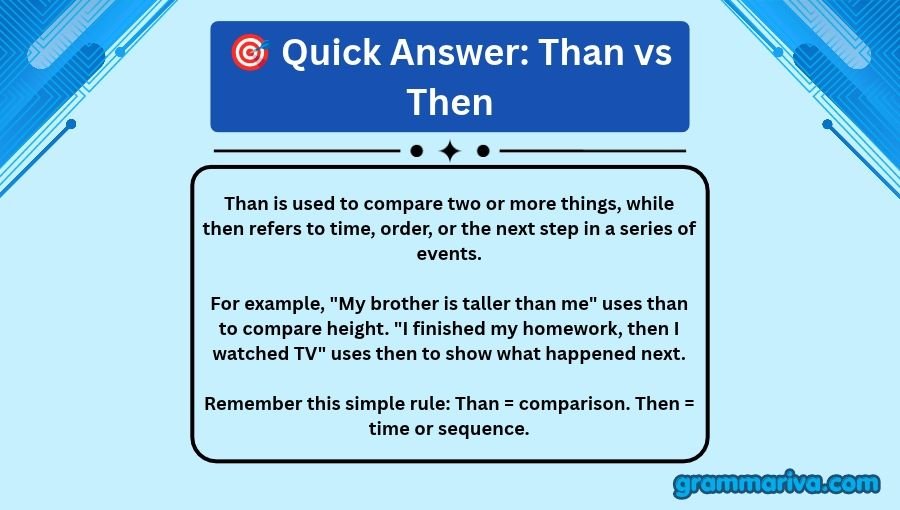
Than is used to compare two or more things, while then refers to time, order, or the next step in a series of events.
For example, “My brother is taller than me” uses than to compare height. “I finished my homework, then I watched TV” uses then to show what happened next.
Remember this simple rule: Than = comparison. Then = time or sequence.
Understanding the Basics of Than vs Then
The main difference between these words is their job in a sentence. Although they may look alike, they do not have the same meaning and cannot usually replace each other.
Than: Meaning and Correct Use
Than is a word used to compare people, objects, places, actions, or ideas. It often appears after comparative adjectives and adverbs.
Comparative words show that one thing has more or less of a quality than another.
Examples include:
- Sarah is younger than her sister.
- This book is better than the last one.
- My new phone is cheaper than yours.
- Walking is healthier than sitting all day.
- He runs faster than his friend.
In each sentence, than connects two things being compared.
Sentence breakdown:
“My car is faster than yours.”
- My car: The first thing being compared.
- Is faster: The quality being compared.
- Than yours: The second thing in the comparison.
The word than makes the comparison clear.
Then: Meaning and Correct Use
Then is commonly used to describe time, order, or the next event. It helps readers understand when something happens or what happens after another action.
Examples include:
- I ate breakfast, then I went to school.
- We can finish the work and then relax.
- She was younger then.
- First, wash your hands. Then, prepare the food.
- I lived in Texas back then.
In these examples, then connects actions or describes a particular time.
Sentence breakdown:
“I finished my work, then I went outside.”
- I finished my work: The first action.
- Then: Shows what happened next.
- I went outside: The second action.
The word then helps show the order of events.
Than vs Then Comparison Table
| Form | Type | Meaning | Example | Correct/Incorrect |
|---|---|---|---|---|
| Than | Conjunction/preposition | Shows comparison | She is taller than me. | ✅ Correct |
| Then | Adverb | Shows time or order | We ate, then we left. | ✅ Correct |
| Than | Comparison word | Compares two choices | Tea is better than coffee. | ✅ Correct |
| Then | Time word | Refers to a past time | I was younger then. | ✅ Correct |
| Then | Incorrect comparison | Used instead of than | She is taller then me. | ❌ Incorrect |
| Than | Incorrect sequence | Used instead of then | We ate, than we left. | ❌ Incorrect |
💡 Why Do People Confuse Than and Then?
People confuse than and then because they look almost identical. They also sound similar in everyday speech, especially when people speak quickly.
However, their meanings are different. One is mainly about comparison, while the other is about time and order.
Here are some common reasons for this confusion:
- Similar spelling: Both words have four letters and share three of them.
- Similar sounds: Their pronunciation can sound close in casual speech.
- Fast typing: People sometimes choose the wrong word without checking the sentence.
- Limited grammar knowledge: Some writers do not know which word shows comparison and which shows time.
- Autocorrect: A typing tool may not recognize that the selected word is wrong in its context.
Imagine a student writing, “My new school is bigger then my old school.” The student knows the sentence is a comparison but chooses the wrong word because both forms look familiar.
The correct sentence is:
“My new school is bigger than my old school.”
This example shows why understanding meaning is more useful than simply memorizing spelling.
Is Than Used for Comparisons?
Yes. Than is the correct word when you compare two or more people, objects, actions, or ideas. It often follows words such as taller, shorter, smarter, faster, better, and more.
Comparisons With Adjectives
Comparative adjectives describe differences between two things.
Examples:
- My house is bigger than yours.
- This dress is prettier than that one.
- Summer is hotter than spring.
- Her bag is heavier than mine.
- This question is easier than the last one.
Sentence breakdown:
“This movie is more interesting than the book.”
The word interesting describes the movie and the book. The phrase more interesting creates a comparison. The word than introduces the second item.
Comparisons With Adverbs
Than can also follow comparative adverbs. These words explain how someone performs an action.
Examples:
- She speaks more clearly than I do.
- He drives faster than his brother.
- I arrived earlier than expected.
- They worked harder than before.
- My dog runs more quickly than yours.
These sentences compare the way different people or animals perform actions.
Comparisons With Nouns and Pronouns
You can also use than when comparing people, objects, or amounts.
Examples:
- I have more books than you.
- She earns more money than her brother.
- We invited fewer guests than last year.
- There are more students here than yesterday.
- He has less free time than I do.
The word introduces the second part of the comparison.
Comparisons With Numbers and Amounts
Than is useful when comparing quantities, measurements, prices, and numbers.
Examples:
- The box weighs more than ten pounds.
- This laptop costs less than $800.
- More than fifty people attended the event.
- The trip took longer than three hours.
- She has worked here for more than five years.
| Meaning | Word Type | Example Sentence |
|---|---|---|
| Comparing size | Conjunction/preposition | My room is larger than yours. |
| Comparing quality | Conjunction/preposition | This meal is better than that one. |
| Comparing speed | Conjunction/preposition | He runs faster than I do. |
| Comparing amounts | Conjunction/preposition | I have more than ten dollars. |
| Comparing age | Conjunction/preposition | She is older than her cousin. |
Test Tip: Whenever you see a comparison, ask yourself whether the sentence compares two things. If it does, than is usually the correct choice.
Is Then Used for Time and Sequence?
Yes. Then is used to describe when something happens, what happens next, or what was true at a particular time.
It helps readers follow events in the correct order.
Then for the Next Action
Use then when one action happens after another.
Examples:
- First, read the instructions. Then, answer the questions.
- I took a shower, then I went to bed.
- She opened the door, then walked inside.
- We finished dinner and then played a game.
- He packed his bags, then called a taxi.
Sentence breakdown:
“First, I cleaned my room. Then, I watched a movie.”
The first sentence explains the first action. The word then introduces the next action.
Then for a Past Time
You can use then to talk about a particular time in the past.
Examples:
- I was living in New York back then.
- She was only ten years old then.
- Life was different then.
- We did not have smartphones then.
- My parents were still students then.
In these sentences, then refers to a past period or situation.
Then for Future Plans
Then can also describe a future action that will happen after another event.
Examples:
- I will finish my homework, then I will call you.
- We will visit the museum and then go shopping.
- She will save money and then buy a car.
- First, we will book the tickets. Then, we will plan the trip.
- He will complete his training and then apply for the job.
Then in If-Then Statements
The word then is often used in conditional sentences. It introduces a result that follows a condition.
Examples:
- If it rains, then we will stay home.
- If you study hard, then you may get better grades.
- If the store is open, then we can buy some food.
- If she calls, then tell her I am busy.
| Meaning | Word Type | Example Sentence |
|---|---|---|
| Next action | Adverb | I ate lunch, then I rested. |
| Past time | Adverb | I was happier then. |
| Future order | Adverb | We will talk, then decide. |
| Conditional result | Adverb | If you agree, then we can begin. |
| At that time | Adverb | Things were easier back then. |
How To Remember the Difference Between Than and Then
The easiest way to remember these words is to connect each one with its main purpose.
- Than = comparison.
- Then = time or order.
I recommend using the following memory tricks when writing.
The Comparison Trick
Think of the word comparison whenever you see than.
For example:
- My dog is bigger than yours.
- This test is harder than the last one.
- She is more patient than her brother.
If you are comparing two things, choose than.
The Next-Step Trick
Think of the phrase “and next” whenever you see then.
For example:
- I finished my work and then went home.
- First, make a list. Then, buy the items.
- She called her friend and then sent a message.
If replacing the word with “next” makes sense, then is likely correct.
The Letter E Memory Trick
The letter E in then can remind you of an event happening next.
For example:
“First, I studied. Then, I slept.”
This is only a memory trick, not a formal grammar rule, but it can make the difference easier to remember.
Case Study: Than vs Then in Everyday Writing
Consider a workplace email in which an employee explains that a new project is more difficult than the previous one. The employee also explains what the team will do next.
Here is an example:
Incorrect email:
“Hello Team,
The new project is more difficult then the last project. We should review the instructions than start working on the first task.
Thank you.”
The email contains two word-choice mistakes.
Correct email:
“Hello Team,
The new project is more difficult than the last project. We should review the instructions and then start working on the first task.
Thank you.”
The first word introduces a comparison between two projects. The second word shows the order of two actions.
In an editing scenario like this, I would check the meaning of each sentence before changing the spelling. That helps preserve the writer’s original message.
| Sentence | Word Needed | Reason |
|---|---|---|
| This project is harder ___ the last one. | Than | Compares two projects |
| Review the notes, ___ begin writing. | Then | Shows the next action |
| She is older ___ her cousin. | Than | Compares ages |
| We will eat dinner and ___ leave. | Then | Shows event order |
Grammar Rules Explanation
The grammar rule for these words depends on their role in a sentence. Than introduces a comparison, while then works mainly as an adverb of time, sequence, or result.
Rule 1: Use Than After Comparative Words
Comparative adjectives and adverbs often need than to introduce the second part of a comparison.
Correct examples:
- This road is longer than that one.
- She sings better than I do.
- My phone is newer than yours.
Incorrect examples:
- This road is longer then that one. ❌
- She sings better then I do. ❌
- My phone is newer then yours. ❌
Rule 2: Use Then to Show Order
When describing events in sequence, use then.
Correct examples:
- I brushed my teeth, then went to bed.
- First, open the app. Then, sign in.
- He finished his lunch and then returned to work.
Incorrect examples:
- I brushed my teeth, than went to bed. ❌
- First, open the app. Than, sign in. ❌
- He finished his lunch and than returned to work. ❌
Rule 3: Use Then for a Specific Time
When referring to a past or future time, use then.
Correct examples:
- I was very young then.
- We lived in Chicago back then.
- Things may be different by then.
Incorrect examples:
- I was very young than. ❌
- We lived in Chicago back than. ❌
- Things may be different by than. ❌
Rule 4: Use Than in More-Than and Less-Than Phrases
These expressions are common in everyday English.
Examples:
- More than twenty people joined the meeting.
- Less than an hour remains.
- The bag weighs more than five pounds.
- She is less interested in sports than her brother.
Correct vs Incorrect at a Glance
| Sentence | Correct/Incorrect | Why |
|---|---|---|
| My sister is taller than me. | ✅ Correct | Shows comparison |
| My sister is taller then me. | ❌ Incorrect | Then does not introduce this comparison |
| I ate breakfast, then left. | ✅ Correct | Shows event order |
| I ate breakfast, than left. | ❌ Incorrect | Than is not a sequence word |
| I was younger then. | ✅ Correct | Refers to a past time |
⚠️ Common Mistakes With Than and Then
Most mistakes happen because people focus on how a word looks instead of what it means. Fast typing, autocorrect, and a lack of grammar knowledge can all cause these errors.
Here are some other commonly confused word pairs that create similar problems.
Other Commonly Confused Grammar Words
| Word Pair | Correct Difference | Example |
|---|---|---|
| Its / It’s | Possession / It is or it has | The dog wagged its tail. |
| Your / You’re | Possession / You are | You’re doing great. |
| There / Their | Place / Possession | Their house is over there. |
| To / Too | Direction or purpose / Also or excessively | I want to go too. |
| Affect / Effect | Usually a verb / Usually a noun | Rain can affect traffic. |
| Than / Then | Comparison / Time or order | She is taller than me, then we left. |
Specific Wrong Forms of Than and Then
| Wrong Form | What’s Wrong | Correct Form |
|---|---|---|
| Better then | Uses a time word for comparison | Better than |
| More then five | Uses the wrong word for quantity | More than five |
| First, than eat | Uses a comparison word for sequence | First, then eat |
| Back than | Uses a comparison word for past time | Back then |
| Faster then me | Uses a time word for comparison | Faster than me |
| And than leave | Uses the wrong word for the next action | And then leave |
Why These Mistakes Happen
Fast typing: People often type quickly and do not review their sentences. Since the two words look similar, they may select the wrong one without noticing.
Autocorrect: Some writing tools correct spelling but cannot always understand the intended meaning. Both than and then are correctly spelled words, so an incorrect choice may remain unchanged.
Lack of knowledge: Some writers have learned the spelling of both words but have not learned the grammar rule behind them.
A typical editing example is a social media post that says, “Nothing is better then spending time with family.” The sentence needs than because it compares one experience with another.
The correct version is:
“Nothing is better than spending time with family.”
Usage of Than and Then in Different Contexts
Both words appear in daily life, but their use depends on the message you want to share. Knowing how to choose the right one can improve your writing in school, work, and online conversations.
Everyday Conversation
Use than when comparing things during a normal conversation.
Examples:
- Pizza is better than burgers.
- My house is closer than yours.
- You are faster than me.
Use then when describing what happens next.
Examples:
- Let’s eat and then go home.
- Call me, then we can talk.
- I will see you then.
Professional Writing
Professional emails, reports, and business documents need clear grammar.
Examples with than:
- The new plan is more effective than the previous one.
- Our sales were higher than expected.
Examples with then:
- Please review the report and then send your feedback.
- We will discuss the results and then make a decision.
Creative Writing
Writers use both words to make stories clear and natural.
Examples with than:
- The forest looked darker than before.
- Her voice was softer than a whisper.
Examples with then:
- He opened the old door, then stepped inside.
- She smiled, then disappeared into the crowd.
Social Media and Texting
People often use these words in short posts, captions, and messages.
Examples with than:
- Coffee is better than bad moods.
- Nothing feels better than a peaceful morning.
Examples with then:
- Work hard, then enjoy your weekend.
- First, take pictures. Then, make memories.
Context Comparison Table
| Context | Which Term to Use | Example |
|---|---|---|
| Everyday conversation | Than for comparisons | This food tastes better than that one. |
| Everyday conversation | Then for sequence | Eat first, then relax. |
| Professional writing | Than for comparisons | Our results are better than expected. |
| Professional writing | Then for sequence | Review the file, then approve it. |
| Creative writing | Than for comparisons | The night was colder than usual. |
| Creative writing | Then for sequence | She turned around, then smiled. |
| Social media/texting | Than for comparisons | Friends are better than followers. |
| Social media/texting | Then for sequence | Take a breath, then try again. |
Common Phrases and Expressions With Than and Then
Both words appear in several everyday expressions. Learning these phrases can help you recognize the correct form more quickly.
Common Phrases With Than
| Phrase | Meaning |
|---|---|
| More than | A greater amount or number |
| Less than | A smaller amount or number |
| Rather than | Instead of choosing something else |
| Other than | Except for or apart from |
| Better than | Of higher quality or value |
| More often than not | Usually or in most cases |
Example sentences:
- I have more than enough time.
- She would rather walk than drive.
- Other than Monday, I am free all week.
- This feels better than expected.
Common Phrases With Then
| Phrase | Meaning |
|---|---|
| Back then | At a time in the past |
| Right then | At that exact moment |
| Every now and then | Occasionally |
| Since then | From that time until now |
| Until then | Up to a particular time |
| Just then | At that very moment |
Example sentences:
- We were best friends back then.
- I have learned a lot since then.
- Every now and then, I visit my old school.
- We will wait until then.
Synonyms and Alternatives for Than and Then
Some words and phrases can replace than or then in certain sentences. However, they do not always work in the same way.
Alternatives for Than
| Alternative | Works When | Does Not Work When |
|---|---|---|
| Compared with | Making a comparison | Showing the next action |
| In comparison with | Discussing differences | Referring to time |
| Versus | Comparing two options | Showing event order |
| As opposed to | Highlighting a difference | Describing a past moment |
Examples:
- This car is faster than mine.
- This car is faster compared with mine.
Both can express a comparison, although the sentence structure may need adjustment.
Alternatives for Then
| Alternative | Works When | Does Not Work When |
|---|---|---|
| Next | Showing the following action | Making a comparison |
| Afterward | Describing a later event | Comparing two things |
| Subsequently | Showing what happened later | Describing a quality difference |
| At that time | Referring to a particular time | Introducing a comparison |
Examples:
- We ate dinner, then watched a movie.
- We ate dinner, afterward watched a movie.
The second sentence needs a small change to sound natural: “We ate dinner and watched a movie afterward.”
Always check the complete sentence before replacing either word.
Why Getting Than and Then Right Matters
Correct word choice makes your writing easier to understand. It also helps you sound more confident in school assignments, workplace emails, published articles, and social media posts.
Clarity in Communication
Using the right word helps readers understand your message without stopping to guess what you mean.
For example:
- Correct: This option is better than the other one.
- Incorrect: This option is better then the other one.
The incorrect sentence may still be understood, but it contains a grammar mistake.
Professionalism
Grammar mistakes can make business communication look rushed. Using the correct words shows that you care about the quality of your work.
Digital Communication
Social media posts, online articles, and text messages are often written quickly. A small spelling mistake can make otherwise good writing look less polished.
A useful reminder is:
“Clear words make clear messages.”
Where Correct Usage Makes a Difference
| Situation | Why Getting It Right Matters |
|---|---|
| Resume | Shows attention to detail |
| Client email | Creates a professional impression |
| Published content | Improves readability and trust |
| Social media post | Makes the message easier to understand |
How to Check Your Sentence Before Publishing
A quick review can help you catch mistakes before sharing your writing. You do not need a complicated grammar tool to check these two words.
Try these steps:
- Find the word than or then in your sentence.
- Ask whether you are comparing two things.
- If you are comparing, use than.
- If you are showing time or order, use then.
- Read the sentence again to make sure the meaning is clear.
For example:
“She is smarter ___ her brother.”
The sentence compares two people, so the answer is than.
“I finished my homework, ___ I played outside.”
The sentence describes two actions in order, so the answer is then.
This simple check works for most everyday writing situations.
How to Practice Than and Then
Practice is one of the best ways to remember the difference. Read each sentence carefully and decide whether it needs than or then.
Fill in the Blanks
- My new shoes are more comfortable ___ my old shoes.
- We went shopping and ___ had lunch.
- She is younger ___ her cousin.
- I was living in California back ___.
- First, complete your homework. ___, play your favorite game.
Answer Key
- My new shoes are more comfortable than my old shoes.
- We went shopping and then had lunch.
- She is younger than her cousin.
- I was living in California back then.
- First, complete your homework. Then, play your favorite game.
Extra Practice Examples
Example A: This book is more interesting then the movie.
<text color=”success” weight=”medium”>Correct answer:</text> This book is more interesting than the movie.
Example B: I will call you than I finish work.
<text color=”success” weight=”medium”>Correct answer:</text> I will call you when I finish work.
This example is worth noticing because neither than nor then is correct. The sentence needs when to express the intended meaning.
Example C: She finished her lunch, than returned to her desk.
<text color=”success” weight=”medium”>Correct answer:</text> She finished her lunch, then returned to her desk.
✅ Quick Recap Checklist
Use this checklist whenever you are unsure which word belongs in your sentence.
| Question | If Yes → Use |
|---|---|
| Am I comparing two things? | Than |
| Am I comparing people or places? | Than |
| Am I describing what happens next? | Then |
| Am I talking about a past time? | Then |
| Am I explaining the order of actions? | Then |
| Am I using a phrase like “more than”? | Than |
| Am I using a phrase like “back then”? | Then |
Test Your Knowledge
Choose the correct word for each sentence.
Practice 1: My sister is taller ___ me.
- A. Than
- B. Then
Practice 2: We watched a movie and ___ went to sleep.
- A. Than
- B. Then
Practice 3: I have more ___ twenty books.
- A. Than
- B. Then
Answers:
- Practice 1: A. Than
- Practice 2: B. Then
- Practice 3: A. Than
If you answered all three correctly, you understand the basic difference.
FAQs About Than vs Then
What Is the Main Difference Between Than and Then?
Than is used to compare two or more things. Then is used to describe time, order, or what happens next. For example, “She is taller than me” shows comparison, while “She ate and then left” shows sequence.
When Should I Use Than Instead of Then?
Use than when comparing people, objects, amounts, actions, or ideas. It often follows comparative words such as better, faster, older, smaller, and more.
Example: “My new laptop is faster than my old one.”
When Should I Use Then Instead of Than?
Use then when describing what happens next or referring to a particular time. It can also introduce a result in an if-then sentence.
Example: “First, read the question. Then, write your answer.”
Is Then Ever Correct in a Comparison?
No. In standard English, then does not replace than when making a direct comparison.
Incorrect: My brother is stronger then me.
Correct: My brother is stronger than me.
Can Than Be Used at the Beginning of a Sentence?
Yes. Than can appear at the beginning of a sentence in certain comparison structures, especially when the sentence continues a previous thought.
Example: “Than expected, the results were better” is not natural standard wording. A more natural sentence is “The results were better than expected.”
In some comparative structures, a sentence may begin with a phrase such as “Than I expected, the trip was easier” in special literary or unusual constructions, but most everyday writers should place than after the comparative word.
Is It More Than or More Then?
The correct phrase is more than when talking about a greater amount, number, or degree.
Correct: “She has more than ten books.”
Incorrect: “She has more then ten books.”
Use then when describing what happens next, not when comparing quantities.
Is It Better Than or Better Then?
The correct expression is better than because it compares the quality of two things.
Example: “This restaurant is better than the one we visited last week.”
The word then would be incorrect in this comparison.
What Does Back Then Mean?
“Back then” refers to a particular time in the past. It is used when talking about an earlier period, memory, or situation.
Example: “We did not have smartphones back then.”
Here, then refers to the time being discussed.
How Can I Easily Remember Than vs Then?
Remember this simple rule: than is for comparisons, and then is for time or order.
You can also replace then with “next” in many sentences. If the sentence still makes sense, then is probably the correct choice.
Example: “I ate dinner, then went to bed.”
Is It First Then or First Than?
The correct phrase is first, then when describing the order of actions.
Example: “First, wash the vegetables. Then, cut them into small pieces.”
The word then introduces the next step. Than is used for comparisons, not instructions or sequences.
Conclusion
Understanding than vs then becomes much easier when you remember the purpose of each word. Use than when comparing people, places, objects, amounts, or ideas. Use then when talking about time, describing the next action, or showing the order of events.
For example, “My new phone is better than my old phone” uses than because it compares two phones. “I bought a new phone, then called my friend” uses then because it explains what happened next.
As a simple writing habit, always check the meaning of your sentence before choosing between these words. Do not depend only on how they look or sound. A quick review can prevent small grammar mistakes and make your writing clearer.
Whether you are writing a school assignment, a professional email, a blog post, or a social media caption, this rule will help you choose correctly. Keep practicing, use the comparison and sequence tricks, and soon the choice will feel natural. ✨
Remember: Compare with THAN. Move forward with THEN.

Hi, I’m Olivia Carter. I’m an English language editor at Grammariva, and I work on making grammar lessons clear, accurate, and easy to follow. I especially enjoy writing about common grammar mistakes and everyday English.


[…] answers to frequently asked questions. By the end, you will know exactly which word to choose. 🎯 Than vs Then | Whose vs Whos | Their vs There vs […]